
Fast citizenship programs let you obtain a second passport quickly through government-approved investments. These programs, often called Citizenship by Investment (CBI), bypass lengthy residency or naturalization requirements. Options include donating to national funds, purchasing real estate, or investing in bonds or businesses. Processing times vary, with some programs like Vanuatu granting citizenship in as little as 30–60 days, while others, such as Caribbean programs, take 3–6 months.
Key benefits include:
- Visa-free travel (e.g., St. Kitts & Nevis offers access to 155 destinations).
- Tax advantages (e.g., no global income or inheritance taxes in many CBI countries).
- Family inclusion options.
- Access to unique visas like the U.S. E-2 Investor Visa (via Grenada or Turkey).
Investment costs range from $90,000 (non-refundable donation) to over $1,000,000 (government bonds or business investments). Due diligence and legal compliance are critical, as poor oversight can reduce passport value, as seen with Vanuatu losing EU access. Choose from the simplest citizenship programs based on your goals – speed, travel privileges, or long-term benefits like EU citizenship via residency-to-citizenship routes.
Quick Comparison:
| Program Type | Timeline | Residency Required | Example Countries |
|---|---|---|---|
| Direct CBI Programs | 1–12 months | None or minimal | St. Kitts, Vanuatu, Turkey |
| Residency-to-Citizenship | 3–7 years | Varies (e.g., 7 days/year) | Portugal, Paraguay |
Fast-track citizenship can be a smart choice for global mobility, financial planning, and security, but it requires careful planning and expert guidance to align with your personal and financial goals.
Key Concepts and Eligibility Requirements
Understanding Citizenship by Investment (CBI)
Citizenship by Investment (CBI) programs offer individuals full citizenship in exchange for a qualifying financial contribution. These programs are distinct from Residency by Investment (RBI) programs. While CBI grants citizenship with minimal or no residency requirements, RBI programs initially provide residence permits, with citizenship only attainable after years of physical presence and meeting additional conditions. Caribbean CBI programs are particularly appealing, as they often deliver full citizenship within 3 to 6 months. In contrast, European Golden Visas typically grant residency first, with citizenship requiring a longer commitment and additional hurdles.
Core Eligibility Requirements
To qualify for a CBI program, applicants must meet specific criteria. Most programs require the following:
- Age: Applicants must be at least 18 years old.
- Clean Criminal Record: A spotless background is essential, with checks performed against international databases to ensure compliance with anti-money laundering and counter-terrorism standards.
- Legitimate Source of Funds: Proof of income or assets, such as business earnings, property sales, or inheritance, is mandatory, often managed through an asset protection private family office to ensure compliance.
- Medical Clearance: A certificate confirming the applicant is free from contagious diseases is often required.
Comprehensive due diligence is a cornerstone of these programs, ensuring all applicants undergo rigorous background checks. Some Caribbean nations, including Antigua & Barbuda, Dominica, Grenada, St. Kitts & Nevis, and St. Lucia, now require in-person interviews for primary applicants and adult dependents.
Family inclusivity is another feature of many programs. Typically, a spouse and dependent children are covered, and some programs extend eligibility to parents or grandparents over a certain age (commonly 55 or 65) for an additional fee. Including these family members in the initial application is generally more cost-efficient than adding them later.
"Due diligence is the backbone of the entire system… what separates legitimate programs from questionable ones, and genuine investors from those who might have something to hide." – CitizenX
Investment Categories and Costs
The investment options available under CBI programs are just as important as eligibility requirements. Most fast-track citizenship programs offer four main investment routes, each with its own cost and potential for financial recovery:
| Investment Type | Typical Cost Range (USD) | Refundable? |
|---|---|---|
| Government Donation | $90,000 – $250,000+ | No |
| Real Estate Purchase | $200,000 – $700,000+ | Yes, after a 3–7 year hold |
| Government Bonds | $300,000 – $1,000,000+ | Yes, after a fixed term |
| Business Investment | $350,000 – $1,500,000+ | Partial/varies |
Government donations are often the most affordable and fastest route, though the funds are non-recoverable. Real estate investments, on the other hand, require a larger initial outlay but provide opportunities for recovery and potential appreciation after the mandatory holding period. Government bonds are a safer option, offering a refund after a fixed term, though they typically yield little to no interest. For example, St. Lucia currently includes this option in its CBI offerings.
Applicants should also account for additional expenses, such as government processing fees, due diligence costs, and authorized agent charges. These extra costs can range from $20,000 to $35,000 on top of the minimum investment amount.
sbb-itb-39d39a6
Types of Fast Citizenship Programs
Fast citizenship programs come in different forms: some offer a direct path to a passport in just weeks, while others require starting with residency and waiting years before becoming eligible for citizenship. Knowing the difference can help you decide which option aligns best with your goals and timeline.
Direct Citizenship by Investment Programs
Direct Citizenship by Investment (CBI) programs let you gain full citizenship through a qualifying investment and passing due diligence, without needing to establish residency.
Vanuatu’s Development Support Program (DSP) is the quickest option worldwide, with government approvals typically completed in 30 to 60 days and total processing taking 6 to 10 weeks after a $130,000 donation. Another well-known choice, St. Kitts and Nevis, which launched the first CBI program in 1984, offers an Accelerated Application Process (AAP). This ensures government review within 45 to 60 days, with the overall process taking 3 to 4 months. Turkey, on the other hand, requires a $400,000 real estate investment and offers a unique advantage: Turkish citizenship provides access to the US E-2 Treaty Investor Visa, a benefit shared only with Grenada among major CBI programs.
"Golden visas provide residency rights with a potential path to citizenship; CBI programs provide direct citizenship." – Jean-François Harvey, Founder, Harvey Law Group
It’s important to note that while speed is an advantage, there can be trade-offs. For instance, Vanuatu recently lost its Schengen visa-free access after the EU terminated its visa exemption agreement in December 2024, effective February 2025, due to concerns over due diligence. If European travel is a priority, this might impact your decision.
Fast-Track Residency-to-Citizenship Routes
Residency-to-citizenship programs involve securing a residence permit first, followed by a waiting period before qualifying for citizenship. These programs take longer – usually 3 to 7 years – but the passports they offer often come with broader travel and work privileges.
For example, Portugal’s Golden Visa requires a €500,000 investment in a qualifying fund and a 5-year residency period. The physical presence requirement is minimal – just 7 days per year. The reward? EU citizenship, granting the right to live, work, and travel freely across all 27 EU member states. For a more affordable option, Paraguay offers citizenship eligibility after 3 years of legal residence through its SUACE program, which requires only a $70,000 bank deposit or business investment. This makes it one of the least expensive ways to obtain a passport with Schengen access.
| Feature | Direct CBI Programs | Residency-to-Citizenship Routes |
|---|---|---|
| Time to Passport | 30 days to 18 months | 3 to 7 years |
| Initial Status | Full citizen | Resident permit holder |
| Physical Presence | Usually none | Varies (e.g., Portugal: 7 days/year) |
| Example Countries | St. Kitts, Vanuatu, Turkey | Portugal, Paraguay, Greece |
This table highlights the key differences between the two paths, helping you decide which option best matches your priorities. If speed is your main concern, direct CBI programs are the way to go. But if you’re willing to wait for a passport that offers more extensive benefits – like EU citizenship – a residency-first approach might be the better choice.
Major Countries Offering Fast Citizenship
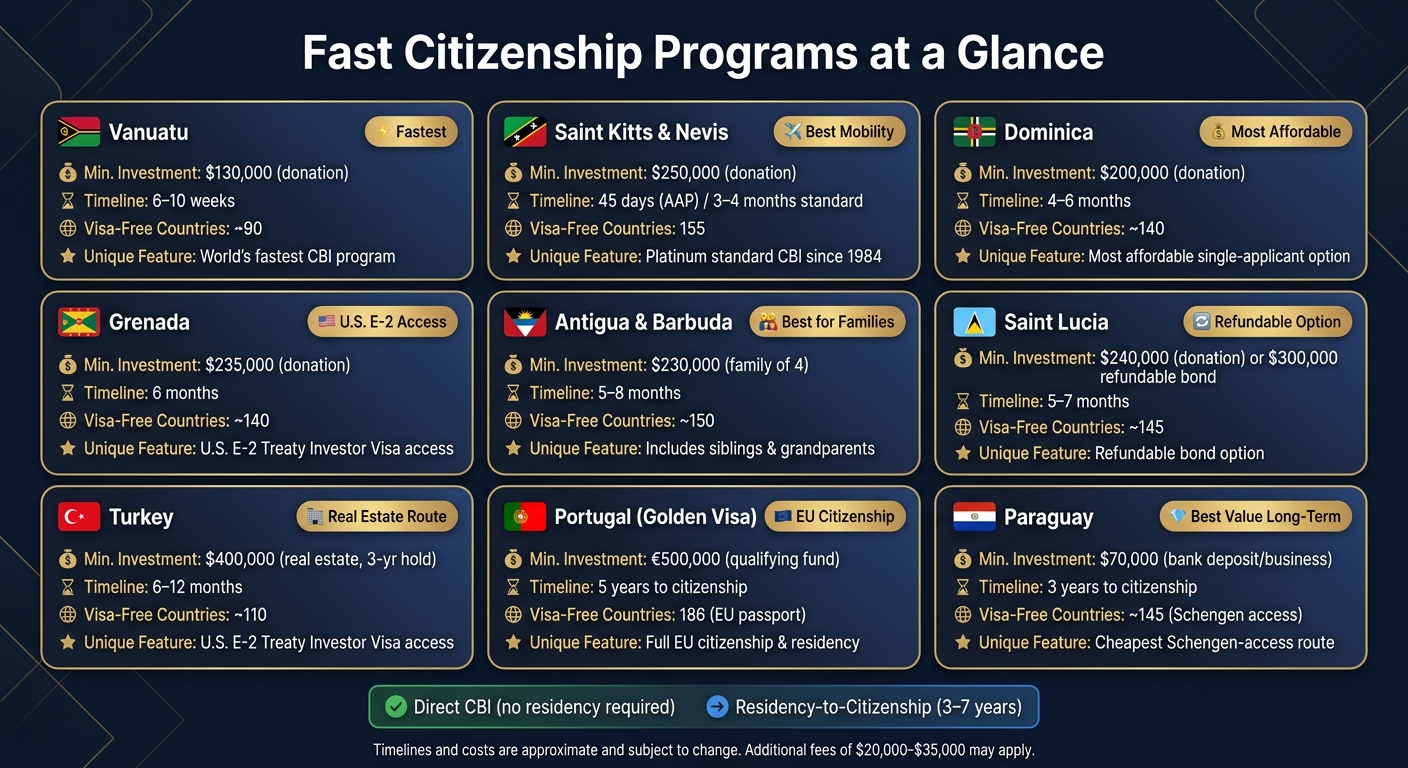
Let’s dive into some of the most sought-after citizenship programs that prioritize efficiency and transparency.
Caribbean Citizenship by Investment Programs
Five Caribbean nations – Antigua and Barbuda, Dominica, Grenada, Saint Kitts and Nevis, and Saint Lucia – offer citizenship through investment, typically via donations. Processing times range from 3 to 6 months, with overall timelines extending to 5 to 9 months.
"St. Kitts and Nevis introduced the first CBI program… often called the ‘platinum standard’ of CBI." – CitizenX
Each country’s program has its own standout features:
- Saint Kitts and Nevis is celebrated for its speed and the strength of its passport, granting visa-free or visa-on-arrival access to 155 countries. For those in a rush, the Accelerated Application Process (AAP) guarantees approval in just 45 days for an additional $25,000 fee.
- Grenada is unique in offering eligibility for the U.S. E-2 Treaty Investor Visa, making it a great choice for those aiming to do business in the U.S..
- Antigua and Barbuda is ideal for families – its $230,000 donation covers a family of four and even allows the inclusion of siblings and grandparents.
- Dominica offers the most affordable single-applicant option at $200,000, making it a popular entry point.
- Saint Lucia provides an interesting twist with a $300,000 refundable government bond option. The principal is returned after five years, offering a safer investment route.
These programs not only provide a second nationality but also offer enhanced international mobility and asset protection, all with minimal residency requirements.
A significant update in 2024 saw CARICOM introduce standardized minimum investments and mandatory interviews with biometric checks for all applicants. While this has slightly extended timelines, it adds credibility to the programs, especially in the eyes of the EU and UK.
| Program | Min. Donation | Fastest Timeline | Unique Feature |
|---|---|---|---|
| Saint Kitts & Nevis | $250,000 | 45 days (AAP) | Access to 155 countries visa-free |
| Antigua & Barbuda | $230,000 (family of 4) | 5–8 months | Includes siblings; university scholarship |
| Grenada | $235,000 | 6 months | U.S. E-2 visa treaty access |
| Saint Lucia | $240,000 | 5–7 months | Refundable $300k bond option |
| Dominica | $200,000 | 4–6 months | Most affordable single-applicant option |
Non-Caribbean Citizenship Programs
Outside the Caribbean, other countries also offer fast-track citizenship options that cater to different investment preferences.
Turkey provides a route to citizenship through a $400,000 real estate investment, which must be held for three years. The process takes 6 to 12 months and includes obtaining a Foreign Exchange Purchase Certificate from the Central Bank of Turkey before completing the transaction. Like Grenada, Turkey offers access to the U.S. E-2 Treaty Investor Visa, making it a strategic choice for entrepreneurs targeting the U.S. market.
"Fulfilling the investment requirements to the letter does not provide the individual with an ‘absolute right’ to acquire citizenship. The administration holds broad discretionary power." – Nazlı Özkul, Partner, NPartners
El Salvador’s Freedom Passport is a niche option for high-net-worth individuals, requiring a $1,000,000 investment exclusively in Bitcoin or USDT. With a processing time of just 6 weeks, it’s one of the fastest programs available. The program is capped at 1,000 applicants per year, with the only in-person requirement being a biometrics appointment. For those seeking a crypto-friendly jurisdiction, this program offers a unique opportunity to secure citizenship quickly.
Practical Considerations for Fast Citizenship
Legal and Tax Implications
Getting a new passport doesn’t mean you can sidestep your tax obligations. Tax residency is usually tied to where you physically spend most of your time – often based on the 183-day rule – not the passport you hold. Thanks to the Common Reporting Standard (CRS), which operates in over 120 jurisdictions, banks report account details based on your actual residence, not your nationality. Trying to use a second passport to misrepresent your tax residency can lead to serious compliance issues.
For U.S. citizens, the situation is even stricter. They are taxed on their worldwide income no matter where they live. To escape this, they must formally renounce their citizenship, which often comes with exit taxes. Similarly, leaving high-tax nations like the UK, Germany, or France might trigger exit taxes or deemed disposal rules before you can fully shift your tax base. Simply acquiring a second passport won’t lower your tax burden – you need to physically relocate and sever ties with your current tax jurisdiction.
These factors highlight the importance of carefully managing risks when selecting a citizenship program.
Due Diligence and Risk Management
Not all fast-track citizenship programs are created equal. A legitimate program should have a strong legal framework, like the Grenada Citizenship-by-Investment Act, which is formally established under sovereign legislation.
"Economic citizenship today is therefore a regulated, compliance-driven process designed to protect the integrity of the issuing nation." – Jean-François Harvey, Founder, Harvey Law Group
Transparency is key. Governments require thorough documentation to verify the origin of your investment funds. This might include audited financial statements, tax returns, sale agreements, or inheritance records. Incomplete or unverifiable documentation is one of the main reasons citizenship applications face delays or outright rejection.
Programs with robust due diligence processes stand out as more reliable. Weak due diligence has led some programs to lose visa-free travel privileges, as was the case with Vanuatu. If a passport loses access to major travel zones, its value drops significantly. It’s essential to evaluate a program’s international reputation and whether it faces scrutiny from organizations like the EU or OECD.
When seeking guidance, it’s better to work with a licensed law firm rather than a marketing agent. Lawyers can provide legal analysis and attorney-client privilege, while agents often handle only administrative tasks and may have conflicts of interest tied to specific programs.
"The most expensive mistake applicants make is… choosing a CBI lawyer or advisor whose business model is subject to a conflict of interest." – Jean-François Harvey, Founder, Harvey Law Group
Fitting Citizenship into an Asset Protection Plan
Securing citizenship is just one piece of the puzzle – it should fit into a larger asset protection strategy. Addressing tax considerations and due diligence challenges helps strengthen your overall financial plan. Think of citizenship as part of a layered approach that includes tax planning, asset protection, and global mobility.
Take Nevis, for example. Its well-established trust and corporate laws, combined with a zero-income-tax policy, make it an appealing jurisdiction for asset protection. Grenada offers another advantage: its E-2 treaty with the United States provides business opportunities beyond just travel convenience.
"Families that approach mobility as a deliberate long-term strategy, rather than a contingency plan, will be best positioned to absorb shocks, capture opportunity, and preserve optionality." – Dominic Volek, Group Head of Private Clients, Henley & Partners
Specialists can help you craft a comprehensive strategy. For instance, Global Wealth Protection supports entrepreneurs and investors in creating integrated plans that combine offshore company formation, trusts, and tax optimization. These strategies work in tandem with second citizenship to form a long-term, structured internationalization plan.
Citizenship is more than just a document – it’s a gateway. Its real value lies in how it complements your broader asset protection and financial strategy.
Conclusion
Fast-track citizenship programs provide advantages like increased global mobility, access to tax-friendly jurisdictions, financial diversification, and a safety net in uncertain times. Countries such as Dominica, St. Kitts and Nevis, and Grenada offer the opportunity to obtain a second passport in just 3–6 months, a stark contrast to the 5–10 years typically required through conventional naturalization processes.
That said, the decision to pursue these programs shouldn’t be based solely on speed. With growing scrutiny, shifting investment criteria, and ongoing tax responsibilities, careful planning is critical. Success hinges on meticulous documentation, a solid understanding of tax and residency implications, and the support of experienced legal professionals – key themes discussed throughout this guide.
As Henley & Partners aptly put it:
"Acquiring an alternative citizenship is a wise decision and an investment for the future." – Henley & Partners
FAQs
Will a second passport reduce my taxes?
A second passport won’t automatically reduce your taxes, but it can play a role in tax planning. It might allow you to establish tax residency in countries with lower tax rates, which could help you reduce your overall tax obligations. That said, U.S. citizens are taxed on their worldwide income unless they choose to renounce their citizenship. It’s crucial to consult with a professional to stay compliant and make the most of a second passport as part of your financial strategy.
What documents prove my source of funds?
When proving the origin of your funds, you’ll need to provide documents such as bank statements, transaction histories, tax filings that reflect asset holdings, invoices, contracts, and client payment confirmations. Additionally, a written explanation detailing how you acquired your wealth can be essential. These documents should clearly establish both the source and legitimacy of your funds.
How do I choose between CBI and a Golden Visa?
Choosing between Citizenship by Investment (CBI) and a Golden Visa comes down to your priorities. With CBI, you can gain full citizenship and a passport in as little as 1–6 months, all without needing to meet residency requirements. It’s a great option if you’re looking for a quick path to a second nationality. On the other hand, a Golden Visa provides residency, with the possibility of citizenship after 5–10 years. This route works well if you’re aiming for long-term residence and access to EU benefits. Some investors even choose to pursue both to maximize global mobility and secure future residency opportunities.
