
Fast-track citizenship programs allow you to obtain a second passport in as little as 30 to 90 days by making financial contributions to participating countries. These programs are fully legal and designed to boost local economies while offering applicants benefits like visa-free travel, tax advantages, and asset protection. Countries like Vanuatu, St. Kitts and Nevis, and Dominica are popular choices due to their quick processing times and straightforward requirements. Here’s what you need to know:
- How It Works: Make a government-approved investment (e.g., donation or real estate purchase) and undergo due diligence checks.
- Benefits: Visa-free travel to 90–150+ destinations, no residency requirements, tax perks, and family inclusion.
- Top Programs:
- Vanuatu: Fastest processing (30-60 days) with a $130,000 investment.
- St. Kitts and Nevis: 60-day expedited option, $250,000 minimum donation.
- Dominica: Affordable at $200,000, with access to 140+ destinations.
Key Steps: Work with licensed agents, submit required documents, and complete due diligence. These programs are ideal for those seeking global mobility, financial security, or a backup plan in uncertain times.
Countries with 90-Day Citizenship Programs
Some nations offer citizenship-by-investment programs that are not only quick but also highly appealing for those looking to expand their global mobility. These programs provide full citizenship rights without requiring long-term residency. They stand out for their speed, visa-free travel perks, and simplest citizenship programs, making them an attractive choice for many.
St. Kitts and Nevis: 60-Day Processing Option
St. Kitts and Nevis offers an Accelerated Application Process (AAP), which guarantees a decision within 60 days for those who opt for expedited handling. The minimum investment required is $250,000 through the Sustainable Island State Contribution (SISC). This passport ranks among the top 20 globally for travel freedom, granting visa-free access to numerous destinations and eligibility for a 10-year U.S. visitor visa.
There are no residency requirements, and applicants can include spouses, children, and dependent parents or grandparents aged 55 or older. Additionally, biometric e-passports valid for 10 years are issued to adults, combining security with travel convenience.
Dominica: Economic Diversification Fund Program
Dominica’s program is managed through its Economic Diversification Fund, offering one of the most affordable pathways to citizenship. A minimum donation of $200,000 is required. This program is known for its efficiency and is a popular choice for those seeking expedited processing.
The Dominican passport provides visa-free access to over 140 destinations, including the Schengen Area, the United Kingdom, and Hong Kong. Like other Caribbean programs, there are no residency obligations, and applicants can include family members in their application.
Vanuatu: Development Support Program
Vanuatu boasts one of the quickest citizenship-by-investment programs, with processing times as short as 30 to 60 days. According to Zlata Erlach, Head of the Austrian office at Immigrant Invest:
"If you need a second passport quickly, consider Vanuatu – it consistently ranks among the fastest programs available."
The program requires a minimum investment of $130,000 for a family of up to four, making it a cost-effective option. While the Vanuatu passport provides visa-free access to 96 countries, it falls short of some Caribbean programs as it excludes the Schengen Area and the United Kingdom. However, it does allow visa-free travel to places like India, the Maldives, and Hong Kong, and citizens can secure a 5-year U.S. visitor visa.
These programs highlight how fast-track citizenship options can enhance global mobility while offering added benefits like asset protection, which will be explored further in this guide.
sbb-itb-39d39a6
Eligibility and Application Requirements
Standard Eligibility Requirements
Fast-track citizenship programs generally have a set of shared requirements across different regions. Applicants must be at least 18 years old, have a clean criminal record, and provide evidence that their investment funds are legitimate. Additionally, most programs mandate a thorough medical examination, which often includes HIV testing.
As of 2023, virtual interviews have become mandatory for all applicants aged 16 and older. Countries in the Caribbean, such as Dominica and St. Kitts and Nevis, now include these interviews as part of stricter vetting measures. An applicant’s visa history also plays a role – previous visa denials from nations offering visa-free travel to the target citizenship country could impact eligibility.
Many programs employ a "traffic light system" for due diligence. For instance, Dominica uses a Red/Yellow/Green system: a "Red" result means automatic rejection, "Yellow" requires additional documentation, and "Green" leads to approval. In 2023, Dominica revoked citizenship for 260 individuals who had submitted false information, highlighting the critical need for accuracy and honesty in applications.
These eligibility rules ensure only qualified individuals move forward to the streamlined application process outlined below.
Application Process Steps
Applications must be submitted through licensed agents rather than directly by applicants. The process typically involves seven key stages:
- Choosing a program and engaging a licensed representative.
- Compiling personal and financial documents (a process that usually takes 2–4 weeks).
- Submitting the application to the Citizenship by Investment Unit (CIU).
- Undergoing background checks performed by government and independent agencies.
- Receiving Approval in Principle.
- Completing the required investment, whether through a donation or real estate purchase.
- Obtaining citizenship certificates and passports.
Accuracy in document preparation is crucial. All documents must be notarized, apostilled, and translated into English. It’s important to secure Approval in Principle before transferring funds. Donations to government funds are generally processed faster than real estate investments, which involve additional parties. Following each step precisely is essential to keep the process on track.
Working with Professional Advisors
Once documents are prepared, working with authorized advisors is essential to navigate the application process smoothly. Only government-approved agents listed on official CIU websites should be used to maintain direct communication with authorities. These professionals perform preliminary due diligence checks to identify potential issues that could result in rejection by the government.
"The single biggest delay in any CBI application is incomplete or improperly prepared documentation. Working with an authorized agent is essential",
- Amir Ismail, Global Immigration Adviser.
Due diligence fees vary depending on the program. For example, Dominica charges $7,500 for the main applicant and $4,000 for dependents aged 16 and older. St. Kitts and Nevis, on the other hand, charges $10,000 for the main applicant and $7,500 for dependents in the same age group.
Program Costs and Comparison
Investment and Fee Breakdown
Recent adjustments have placed the minimum donation requirements for most Caribbean programs between $200,000 and $250,000. These amounts include the core investment as well as administrative fees, which differ depending on the program.
For example, St. Kitts and Nevis requires a $250,000 donation along with about $25,000 in fees. They also offer an Accelerated Application Process (AAP) for an extra fee, guaranteeing a decision within 60 days. Dominica offers a more accessible option, with donations starting at $200,000 for its Economic Diversification Fund (EDF) and government fees of around $25,000 for real estate investments. Meanwhile, Vanuatu provides the lowest cost among the listed programs, with a $130,000 donation covering a family of up to four.
In 2024/2025, Nauru entered the scene with its Economic and Climate Resilience Citizenship Program (NECRCP), requiring a $105,000 contribution for single applicants. Across all these programs, donation-based routes are typically faster to process compared to real estate investments.
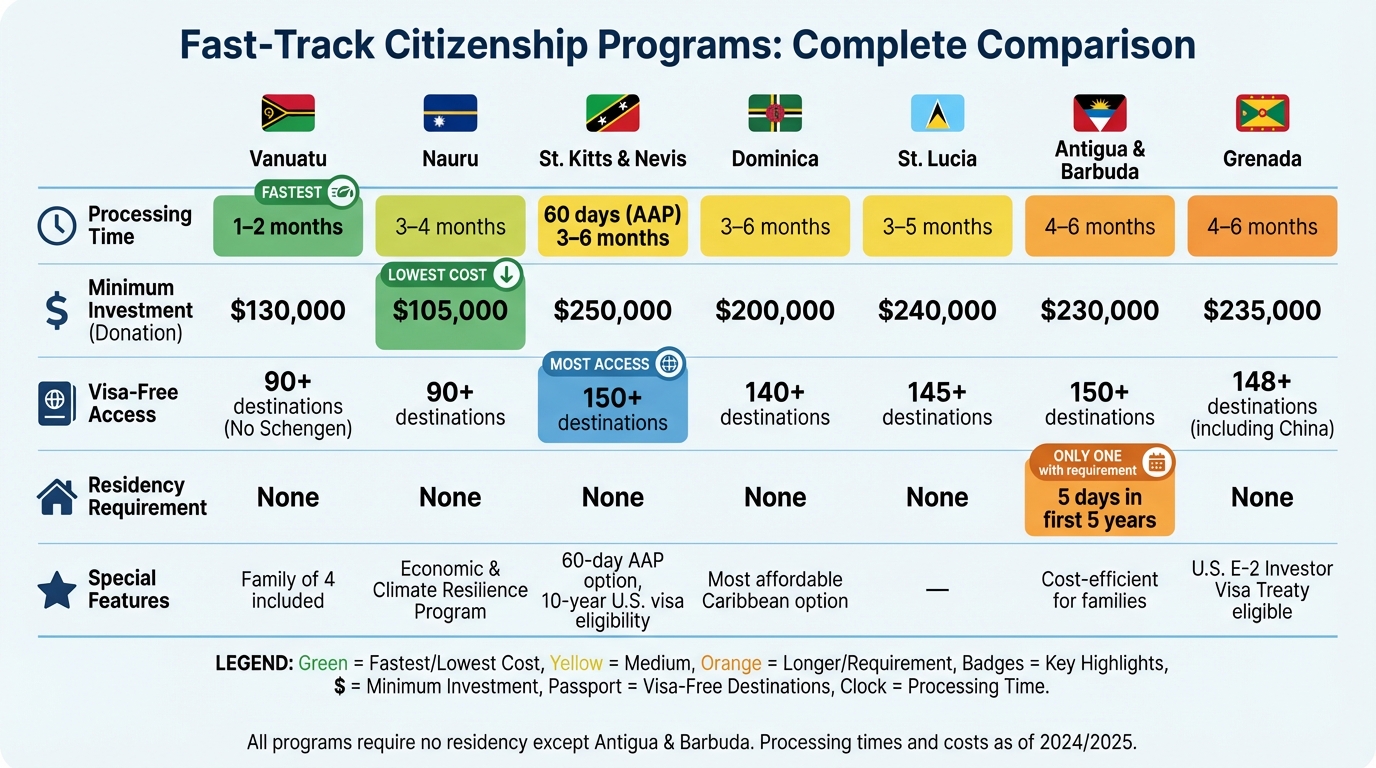
Program Comparison Table
Here’s a quick comparison of key details across these programs:
| Country | Processing Time | Min. Investment (Donation) | Visa-Free Access | Residency Requirement |
|---|---|---|---|---|
| Vanuatu | 1–2 months | $130,000 | 90+ (No Schengen) | None |
| Nauru | 3–4 months | $105,000 | 90+ | None |
| St. Kitts & Nevis | 60 days (AAP) / 3–6 months | $250,000 | 150+ | None |
| Dominica | 3–6 months | $200,000 | 140+ | None |
| St. Lucia | 3–5 months | $240,000 | 145+ | None |
| Antigua & Barbuda | 4–6 months | $230,000 | 150+ | Minimum 5 days residence in first 5 years |
| Grenada | 4–6 months | $235,000 | 148+ (including China) | None |
Among these options, Vanuatu stands out for its quick 1–2 month processing time, though it no longer offers visa-free access to the Schengen Area. On the other hand, St. Kitts and Nevis boasts the widest visa-free access, allowing travel to over 150 destinations. Most programs do not require applicants to reside in the country, with Antigua and Barbuda being the exception, requiring a minimum of five days of residence within the first five years.
All these programs maintain rigorous security standards, conducting thorough background checks via Interpol and third-party verification. While some offer "fast track" options, this refers strictly to administrative efficiency and does not compromise the integrity of the screening process.
These updated figures highlight the trade-offs between processing speed, investment requirements, and the benefits offered, making them valuable tools for those seeking international asset protection.
Combining Citizenship with Asset Protection
Pairing Second Passports with Offshore Trusts
Combining a second passport with an offshore trust creates a strong shield against creditors and legal claims. For example, pairing a second passport with a trust in the same jurisdiction – like the Nevis International Exempt Trust in St. Kitts and Nevis – establishes protection under laws that don’t recognize foreign court judgments or freeze orders. In Nevis, creditors face significant hurdles, such as posting a US$100,000 bond and hiring local legal counsel before proceeding. Additionally, asset transfers into the trust can only be contested within two years, and the system ensures strict privacy with no public registry. This kind of jurisdictional diversification helps ensure that no single government or court can fully control an individual’s wealth or restrict their mobility. Beyond just protecting assets, this approach aligns with strategic tax planning.
Tax Planning with Second Citizenship
A second passport also plays a key role in tax planning, complementing asset protection strategies. Many Caribbean citizenship programs offer tax-friendly environments with territorial or zero-tax regimes – meaning no taxes on personal income, capital gains, or inheritance. However, it’s important to note that a second passport doesn’t automatically relieve tax obligations. U.S. citizens, for instance, are taxed on their worldwide income and must carefully navigate renunciation processes, including exit taxes and expatriation rules. Meanwhile, non-U.S. citizens need to formally establish residency in a low-tax jurisdiction to benefit from these favorable regimes.
Interestingly, the United States has not signed onto the OECD’s Common Reporting Standard (CRS), which opens the door for individuals with a second passport to bank in the U.S. while maintaining greater financial privacy. Grenada stands out as the only Caribbean citizenship-by-investment country with a U.S. E-2 Investor Visa Treaty. This treaty allows Grenadian citizens who reside there for three years to apply for a U.S. non-immigrant investor visa. Notably, interest in citizenship-by-investment programs has skyrocketed, with inquiries increasing by 392%.
Selecting the Right Program for Your Needs
Factors to Consider
Start by identifying your top priority. If speed is what you need, Vanuatu stands out with a processing time of just 1–3 months, making it the fastest option worldwide. For those prioritizing global mobility, St. Kitts and Nevis offers visa-free travel to over 150 destinations and a guaranteed 60-day decision through its Accelerated Application Process. On the other hand, if your goal is strategic business access to the United States, Grenada is the only Caribbean program that provides eligibility for the U.S. E-2 Investor Visa.
If you’re looking for faster processing with predictable costs, donation-based programs are often the best choice. Vanuatu’s 1–3 month timeline is unmatched for speed, while Antigua and Barbuda offers a cost-efficient option for families, requiring a US$230,000 donation for a family of four. Additionally, countries like St. Kitts, Dominica, and Antigua provide attractive tax benefits, including no taxes on inheritance, gifts, wealth, or capital gains.
Before proceeding, check whether your home country allows dual citizenship to avoid losing your original nationality. Also, review the eligibility criteria for dependents under your chosen program – spouse, children, parents, or grandparents – and calculate any additional costs involved. Ensuring these factors align with your asset protection and tax planning goals will help you make the right decision.
Once you’ve considered these aspects, you’ll be ready to move forward with your application.
Getting Started
To begin, work with a government-authorized agent to submit your application to the Citizenship by Investment Unit. You can confirm licensed agents on official government websites to steer clear of unapproved promoters.
"Don’t wait for a crisis to begin the process. The fastest programs still take a few months, so proactive planning is the key to leveraging a second citizenship effectively." – Amir Ismail, Global Immigration Adviser
Organize all required documents early to avoid setbacks. This includes providing notarized paperwork and clear "source of funds" documentation to meet due diligence requirements. Consulting with experienced professionals can help you navigate the process, ensuring your application aligns with your family’s needs, business objectives, and long-term financial plans.
FAQs
Can I be denied after I pay?
Applications for expedited citizenship programs aren’t automatically approved just because you’ve made a payment. If you don’t meet the eligibility requirements or submit false or incomplete information, your application can still be denied. To minimize the risk of rejection, double-check that all your documents are complete, accurate, and align with the program’s guidelines.
Will a second passport reduce my U.S. taxes?
Obtaining a second passport through citizenship by investment won’t directly reduce your U.S. tax obligations. However, it can open doors for strategic tax planning. Additionally, it offers perks such as asset protection and greater global mobility, which can be valuable for individuals managing international assets or seeking broader travel freedom.
Which program is fastest for families?
The quickest route for families seeking citizenship through investment is the Vanuatu citizenship by investment program, which can be finalized in just one to two months. Another viable choice is the St. Kitts and Nevis program, which processes applications in a minimum of six months and offers options tailored for families.
