
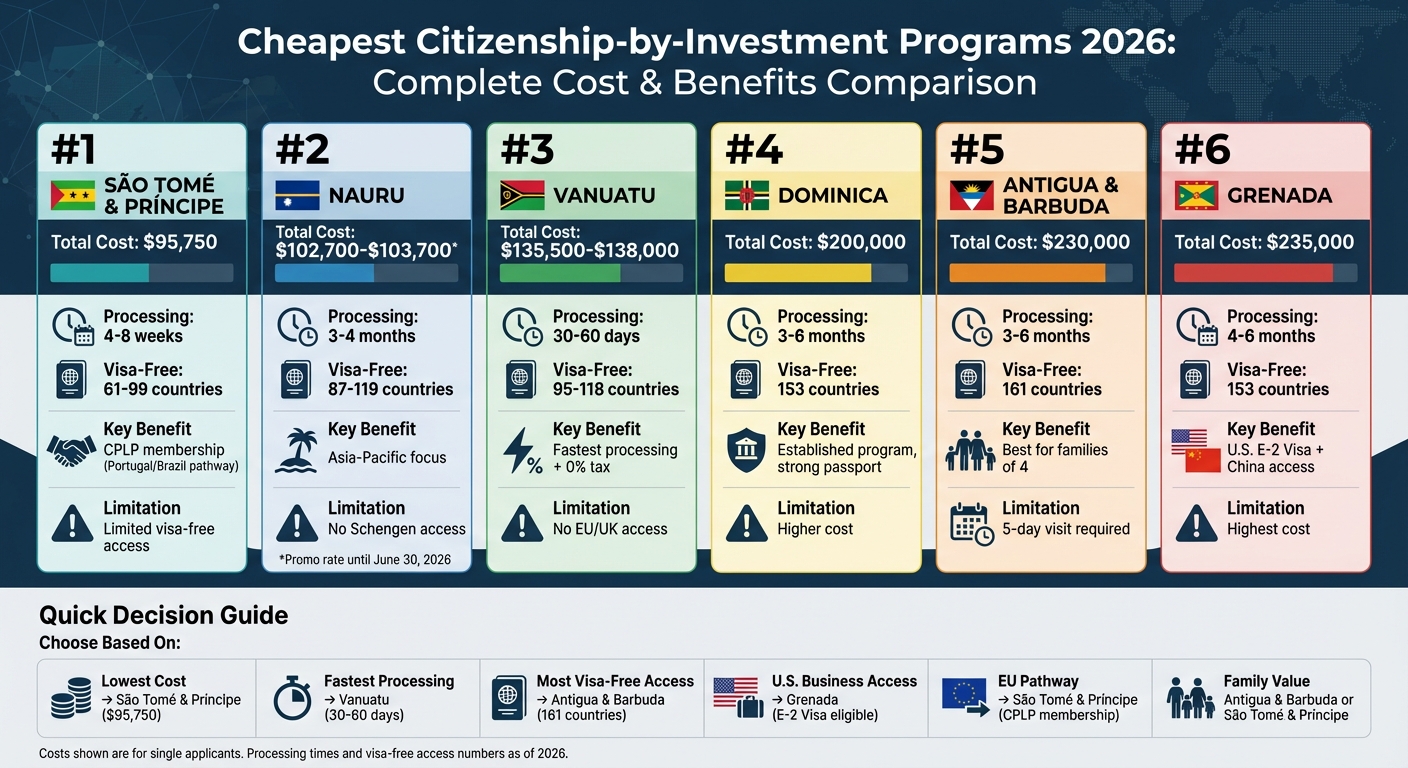
Citizenship-by-investment (CBI) programs let you acquire a second passport through financial contributions, offering benefits like global mobility, access to new markets, and a safeguard against instability. In 2026, São Tomé and Príncipe leads as the lowest-cost option at $95,750, followed by Nauru ($102,700–$103,700) during its promotional period, and Vanuatu ($135,500–$138,000). Caribbean programs, like Dominica, start at $200,000, providing broader visa-free travel but higher costs.
Key Programs:
- São Tomé and Príncipe: $95,750, fastest approval (~4–8 weeks), CPLP benefits (Portugal/Brazil pathways).
- Nauru: $102,700–$103,700 (promo rate until June 30, 2026), Asia-Pacific focus.
- Vanuatu: $135,500–$138,000, fastest processing (30–60 days), no EU/UK access.
- Dominica: $200,000, 153 visa-free destinations, no residency required.
- Antigua & Barbuda: $230,000, family-friendly, 5-day stay required.
- Grenada: $235,000, U.S. E-2 Visa eligibility, China access.
Quick Comparison:
| Program | Total Cost (Single) | Processing Time | Visa-Free Access | Key Benefit | Limitation |
|---|---|---|---|---|---|
| São Tomé & Príncipe | ~$95,750 | 4–8 weeks | 61–99 countries | Cheapest; Portugal/Brazil path | Limited visa-free access |
| Nauru | ~$102,700–$103,700 | 3–4 months | 87–119 countries | Affordable; Asia-Pacific focus | No Schengen access |
| Vanuatu | ~$135,500–$138,000 | 30–60 days | 95–118 countries | Fast processing; tax advantages | No EU/UK access |
| Dominica | $200,000 | 3–6 months | 153 countries | Established; strong passport | Higher cost |
| Antigua & Barbuda | $230,000 | 3–6 months | 161 countries | Best for families | 5-day visit requirement |
| Grenada | $235,000 | 4–6 months | 153 countries | U.S. E-2 Visa; China access | Higher cost than Dominica |
São Tomé and Príncipe offers the lowest entry cost, while Caribbean programs like Dominica and Grenada provide better global mobility. Choose based on your priorities: affordability, travel access, or the simplest citizenship programs for residency pathways.
1. São Tomé and Príncipe CBI Program
In August 2025, São Tomé and Príncipe introduced its Citizenship by Investment (CBI) program through Decree-Law 07/2025. At just $90,000, it’s the most budget-friendly option worldwide – $40,000 less than Vanuatu’s program and $110,000 cheaper than Caribbean alternatives. The program is funded by a non-refundable donation to the National Transformation Fund, which supports projects in infrastructure, renewable energy, and social development.
For a single applicant, the total cost comes to $95,750. This includes the $90,000 donation, a $5,000 application fee, and $750 in document fees (passport: $350; national ID: $150; certificate: $250). For a family of four, the cost rises to $103,000, with the donation increasing to $95,000. Additional dependents can be added for $5,000 each.
The application process is efficient, averaging 2.5 months, with some approvals granted in as little as one month. Managed by the Citizenship Investment Unit based in Dubai, the entire process can be completed remotely. Between September 2025 and January 2026, the program attracted 98 applications and raised over $2.5 million for the National Transformation Fund.
Holders of São Tomé and Príncipe’s passport enjoy visa-free or visa-on-arrival access to 61–99 destinations, including South Africa, Singapore, Hong Kong, and Malaysia. Additionally, membership in the Community of Portuguese Language Countries (CPLP) grants preferential immigration opportunities to Portugal and Brazil. While cryptocurrency can be used to demonstrate proof of funds, all payments must ultimately be made in U.S. dollars.
The program is open to all nationalities except North Korea and allows applicants to include family members such as spouses, unmarried dependent children under 30, and parents or grandparents aged 55 and above. Adult passports are valid for seven years, while passports for minors under 16 are valid for three years. With its affordability and benefits, São Tomé and Príncipe’s CBI program has quickly become a competitive option in the global market.
sbb-itb-39d39a6
2. Vanuatu CBI Program
Vanuatu offers two distinct citizenship pathways: the Development Support Program (DSP), which requires a non-refundable donation, and the Capital Investment Immigration Plan (CIIP), which involves a $50,000 investment that can be reclaimed after five years. With competitive costs and quick processing times, Vanuatu has become a strong contender among affordable citizenship-by-investment (CBI) programs.
For individuals applying through the DSP, the total cost typically ranges from $135,500 to $138,000. This includes a $130,000 donation, a due diligence fee of approximately $5,500, and biometric fees between $1,000 and $3,000. Families of four can expect to pay around $185,500 to $188,000, with the donation amount increasing to $180,000.
The CIIP offers a slightly different structure. Families (up to four members) pay about $170,500 upfront, which includes the recoverable $50,000 investment. This lowers the long-term net cost to approximately $120,500. Additional dependents incur fees ranging from $15,000 to $25,000 each.
"Vanuatu stands out as a low-cost option at $130,000, often combined with one of the fastest processing timelines globally." – IMI Daily
One of the program’s standout features is its streamlined processing time, with applications typically processed within 30 to 60 days. Most approvals are granted within about 45 days. Successful applicants receive a passport that grants visa-free or visa-on-arrival access to 95–118 destinations. However, recent changes mean visas are now required for travel to the EU/Schengen Area, the United Kingdom, Ireland, the United States, and Canada.
Applicants are required to submit biometric data through designated centers or authorized embassies. The program also accommodates family members, including spouses, children under 25 (if they are full-time students and financially dependent), and parents over 50. However, restrictions apply to citizens of Iran, Iraq, North Korea, Yemen, and Venezuela, unless they have lived outside their home country for at least 10 years.
3. Nauru CBI Program
The Nauru Citizenship by Investment (CBI) Program, officially known as the Economic and Climate Resilience Citizenship Program (NECRCP), offers an appealing option for investors, particularly families. Launched in early 2026, this program aligns its pricing to fund climate adaptation projects. For a limited window – February 3, 2026, to June 30, 2026 – Nauru is offering a reduced contribution rate, lowering the required amount from $115,000 to $90,000. This temporary discount underscores Nauru’s efforts to provide a more accessible investment pathway.
For a single applicant, the total cost ranges from $102,700 to $103,700. This includes the $90,000 contribution, a $5,000 application fee, a $6,000 due diligence fee, a $500 passport fee, and transaction fees of $1,200 to $2,200. After June 30, 2026, the contribution reverts to $115,000, increasing the overall expense accordingly.
One of the program’s standout features is its inclusive approach to family members. Applicants can add dependents such as spouses, adult children, parents, and grandparents for approximately $7,500 each. Fees for younger children are around $2,500, while siblings incur a higher fee of $15,000 per person.
"While the world debates climate action, we must take proactive steps to secure our nation’s future." – David Adeang, President of Nauru
The program boasts a processing time of 3–4 months and does not require physical residency or travel. A Nauru passport grants visa-free or visa-on-arrival access to 85–101 destinations, including key locations like the United Kingdom, Singapore, Hong Kong, the UAE, Ireland, and Malaysia. However, applicants from high-risk countries identified by the United Nations, such as Russia and North Korea, are excluded from eligibility.
4. Dominica CBI Program
The Caribbean has long been a hub for Citizenship by Investment (CBI) programs, and Dominica stands out as one of the most established options. Launched in 1993, Dominica’s program has gained recognition for its affordability and straightforward process. In July 2024, the minimum investment requirement was adjusted to $200,000, aligning with regional standards. By 2026, this places Dominica as the Caribbean’s most affordable CBI option.
"Dominica sets the lowest published minimum investment threshold at US$200,000 through the government’s Economic Diversification Fund (EDF) route… and it’s therefore the most affordable citizenship by investment program starting 2026." – Apex Capital Partners
For a single applicant, the EDF route costs approximately $210,000. This includes the $200,000 government contribution and additional fees: $7,500 for due diligence, $1,000 for processing, $1,000 for the interview, and $500 for the certificate. Families of up to four pay $250,000, with extra costs of $25,000 for dependents under 18 and $40,000 for those 18 or older.
The application process is efficient, typically taking 60 to 90 days for initial approval, with most cases completed within three to six months. The entire process can be handled remotely through a government-approved Licensed Authorized Agent, and there’s no requirement to visit or live in Dominica. Successful applicants gain access to visa-free or visa-on-arrival travel to around 160 destinations, including the EU Schengen Area, China, Russia, Singapore, Hong Kong, and Brazil. However, the program does not provide visa-free entry to the United Kingdom or Ireland.
For those interested in real estate, the program offers an investment option starting at $200,000 in government-approved projects. These investments must be held for at least three years, or five years if resold to another CBI applicant. Additional government fees apply: $75,000 for a single applicant or $100,000 for a family of up to four.
With its combination of affordability, global mobility, and asset protection, Dominica’s CBI program continues to attract investors seeking strategic second citizenship options.
5. Antigua and Barbuda CBI Program
Launched in 2013, Antigua and Barbuda’s citizenship program has become a popular choice in the Caribbean. Starting in August 2024, the minimum investment for the National Development Fund (NDF) increased from $100,000 to $230,000, following a regional pricing agreement. This adjustment positions the program as a mid-range option in terms of cost, balancing investment requirements with additional fees to remain competitive.
For a single applicant, the NDF route totals approximately $250,300. This includes the $230,000 government contribution plus $20,300 in additional fees, which cover processing, due diligence, interviews, and passports. Families of four can expect to pay around $270,200, with the same $230,000 investment and added costs: $20,000 for processing, $17,500 for due diligence, $1,500 for interviews, and $1,200 for passports.
The program also offers flexibility with four investment options:
- National Development Fund (NDF): $230,000 minimum investment
- University of the West Indies Fund (UWI Fund): $260,000, ideal for families of six or more as it includes processing fees for up to six members and a one-year scholarship for one family member
- Real Estate Option: Starting at $300,000
- Business Investment: Either $1.5 million for sole investors or $400,000 per person in a joint venture
The application process typically takes three to six months. Applicants aged 16 or older, including dependents, must complete a virtual interview with the Citizenship by Investment Unit. Once approved, new citizens must spend at least five days in Antigua and Barbuda within the first five years of citizenship.
The program’s benefits extend beyond investment flexibility. The passport grants visa-free or visa-on-arrival access to over 150 countries, including the United Kingdom (up to 180 days annually), the Schengen Area, Hong Kong, and Singapore. It also qualifies citizens for a 10-year B-1/B-2 visitor visa to the United States.
Since its inception, the program has processed 5,203 applications and issued 9,018 passports. The NDF option remains the most popular, with 611 out of 739 applicants in the first half of 2024 choosing this route. Additionally, the program accommodates a wide range of dependents, including spouses, children under 30, parents and grandparents over 55, and unmarried siblings.
6. Grenada CBI Program
Grenada’s citizenship-by-investment (CBI) program stands out by offering access to the U.S. E-2 Investor Visa. However, this option requires applicants to maintain three years of continuous residence.
Starting in July 2024, applicants can gain citizenship by making a donation of at least $235,000 to the National Transformation Fund (NTF). This amount covers families of up to four members. For individuals, the total cost is approximately $244,350, which includes the base contribution and all associated fees. For a family of four, the cost rises to about $258,400, with additional fees applying to family members aged 17 and older.
For those interested in recovering their capital, Grenada offers a real estate investment option. This path requires a higher initial investment: $270,000 for shared ownership or $350,000 for sole ownership, along with a $50,000 administrative fee and around $11,000 for legal and registration expenses. In 2023, 66% of applicants chose this route, attracted by the possibility of recovering their investment and earning rental yields of 3–5% after a five-year holding period.
Grenadian citizenship comes with impressive travel perks, offering visa-free or visa-on-arrival access to 147 destinations. Notably, this includes China (up to 30 days). The passport also allows entry to the UK (up to 180 days annually with a £10 eTA valid for two years), the Schengen Area (90 days per 180-day period), Russia (90 days), Hong Kong (90 days), and Singapore (30 days). Globally ranked 27th, Grenada is one of only five passports that grants visa-free access to China, Russia, the Schengen Area, and the UK simultaneously.
The program also stands out for its straightforward application process and eligibility criteria. Applications are processed in four to eight months and must be submitted through a government-authorized licensed agent. The program accommodates a broad range of family members, including spouses, children under 30 (no education requirement), parents and grandparents over 55 (no longer needing to be "fully supported"), and unmarried siblings without children. However, applications from Russian and Belarusian nationals are currently not accepted.
Grenada’s territorial tax system adds another layer of appeal. Non-residents are not taxed on worldwide income, wealth, inheritance, gifts, or capital gains. These features make Grenada a compelling choice for those seeking an affordable and strategically advantageous CBI program.
Advantages and Disadvantages
Every citizenship-by-investment program comes with its own set of pros and cons, which can heavily influence your decision. Below is a comparison of six of the most affordable options, evaluated across three key factors: cost for a single applicant, processing time, and visa-free travel opportunities.
| Program | Min. Total Cost (Single) | Processing Time | Visa-Free Access | Main Advantage | Main Disadvantage |
|---|---|---|---|---|---|
| São Tomé & Príncipe | ~$95,750 | 4–8 weeks | 61 countries | Cheapest; CPLP/Portugal pathway | Lowest visa-free count |
| Vanuatu | ~$138,000 | 30–60 days | 95–118 countries | Fastest; Zero income tax | EU access currently on hold |
| Nauru | ~$125,500* | 3–4 months | 87–119 countries | Affordable; Asia-Pacific reach | No Schengen access |
| Dominica | $200,000 | 3–6 months | 153 countries | Established; Strong passport | No EU residency rights |
| Antigua & Barbuda | $230,000 | 3–6 months | 161 countries | Best for families of 4 | 5-day visit requirement |
| Grenada | $235,000 | 4–6 months | 153 countries | U.S. E-2 Visa; China access | Higher cost than Dominica |
*Promotional rate valid until June 30, 2026.
The table highlights the main factors, but let’s take a closer look at the trade-offs involved. One common dilemma is choosing between fast processing and greater global mobility. For instance, Vanuatu boasts one of the quickest approval processes – just 30 days – but its visa-free access to the EU Schengen Area and the UK is currently suspended. On the other hand, Caribbean programs like Dominica and Antigua offer broader travel access, though applicants should expect processing times of three to six months.
Cost considerations for families often play a significant role. São Tomé and Príncipe stands out with a family package costing approximately $103,000 – only $7,250 more than the single applicant fee of $95,750. Similarly, Antigua and Barbuda provides citizenship for a family of four under a single $230,000 donation, though it does require a five-day visit within the first five years.
Tax benefits vary widely across programs. Vanuatu offers a 0% tax rate on income, capital gains, inheritance, wealth, or property. These tax and residency solutions are particularly attractive for location-independent professionals. Grenada, meanwhile, operates under a territorial tax system, meaning non-residents are not taxed on worldwide income or assets. Notably, in March 2024, Caribbean nations collectively raised their minimum investment threshold to $200,000 to strengthen due diligence and regional stability.
In addition to tax perks, strategic residency pathways enhance the appeal of certain programs. São Tomé and Príncipe citizenship provides access to the Community of Portuguese Language Countries (CPLP), which includes a streamlined residency option in Portugal (with naturalization possible after seven years) and Brazil (after three years). Grenada holds a unique advantage as the only Caribbean program that makes applicants eligible for the U.S. E-2 Treaty Investor Visa.
Conclusion
These programs cater to different priorities, offering a mix of cost efficiency, processing speed, and travel flexibility. The rankings are based on detailed cost evaluations, including investment thresholds, government fees, and mobility perks – factors crucial for safeguarding assets and enhancing global access.
If your focus is on affordability, São Tomé and Príncipe is a standout choice at approximately $95,750. It also offers significant family benefits and, through its CPLP membership, provides a simplified route to Portuguese or Brazilian residency – an economical gateway to the European Union.
For those who value speed and tax advantages, Vanuatu is hard to beat. It delivers a passport in as little as 30 days and offers a 0% tax rate on income, capital gains, and inheritance. Though it costs about $42,000 more than São Tomé, it provides nearly double the visa-free access. Additionally, Nauru’s promotional $90,000 rate is an appealing option for enhancing travel within the Asia-Pacific region.
In the Caribbean, programs like Dominica ($200,000) and Antigua and Barbuda ($230,000) have long-standing reputations, granting access to 153 and 161 visa-free destinations, respectively. For entrepreneurs eyeing opportunities in the U.S., Grenada stands out by offering eligibility for the U.S. E-2 Treaty Investor Visa, a significant advantage for business-focused applicants.
Ultimately, the right program depends on your goals. Families may gravitate toward São Tomé or Antigua, speed-conscious investors might prefer Vanuatu, entrepreneurs targeting the U.S. can benefit from Grenada, and those seeking EU access can capitalize on São Tomé’s CPLP membership.
FAQs
What other costs can raise the “total cost” beyond the stated minimums?
Additional expenses can push the total investment beyond the minimum amounts listed. These may include government fees, due diligence charges, administrative costs, and fees for including family members or dependents. The exact amounts often depend on the specific program and the applicant’s individual circumstances.
Which program gives the best travel access for the lowest price?
If you’re looking for a citizenship-by-investment program that combines affordability with solid travel benefits, Nauru stands out. For a minimum investment of $105,000, you gain visa-free access to 89 countries, including destinations like the UK, Russia, and Singapore.
Other budget-friendly options include:
- Vanuatu: Requires an investment of $130,000 and grants visa-free access to 130+ countries.
- Dominica: With an investment of $200,000, you can travel visa-free to 145+ countries.
Among these, Nauru offers the most cost-effective balance between investment and travel access, making it an attractive choice for those seeking value.
Can a CBI passport help me get residency in the EU or the U.S.?
A CBI passport (Citizenship by Investment passport) can play a role in securing EU residency through investment residence programs, often referred to as "golden visas." However, when it comes to direct citizenship by investment within the EU, Malta is the only country that offers such an option.
In the United States, holding a CBI passport doesn’t automatically provide residency. That said, it can simplify certain visa applications. For example, Grenada’s citizenship-by-investment program grants access to the E-2 visa, which allows investors to live and work in the U.S. This makes Grenada’s program particularly appealing for those eyeing opportunities in the U.S.
