
- US EB-5: Invest $800,000+ for a Green Card; citizenship after 5 years.
- Portugal Golden Visa: Invest €250,000+; citizenship in 5 years with minimal stay.
- New Zealand Active Investor Plus: NZ$5M+ investment; residency in 3–5 years.
- Singapore GIP: S$10M+ investment; immediate residency, citizenship optional.
- UK Innovator Founder Visa: £50K+ business-focused pathway; citizenship in 5 years.
- Antigua and Barbuda: $230K+ donation; citizenship in 3–9 months.
- St. Kitts and Nevis: $250K+ donation; citizenship in 3–9 months.
- Hong Kong CIES: HK$30M+ investment; permanent residency in 7 years.
- Jersey High-Value Residency: £10M+ wealth and tax requirements; British citizenship in 6 years.
- Japan Business Manager Visa: ¥30M+ business investment; citizenship in 5 years.
Each program serves different goals – fast citizenship, tax advantages, or access to key global markets. Choose based on your priorities: mobility, wealth preservation, or family opportunities.
Quick Comparison
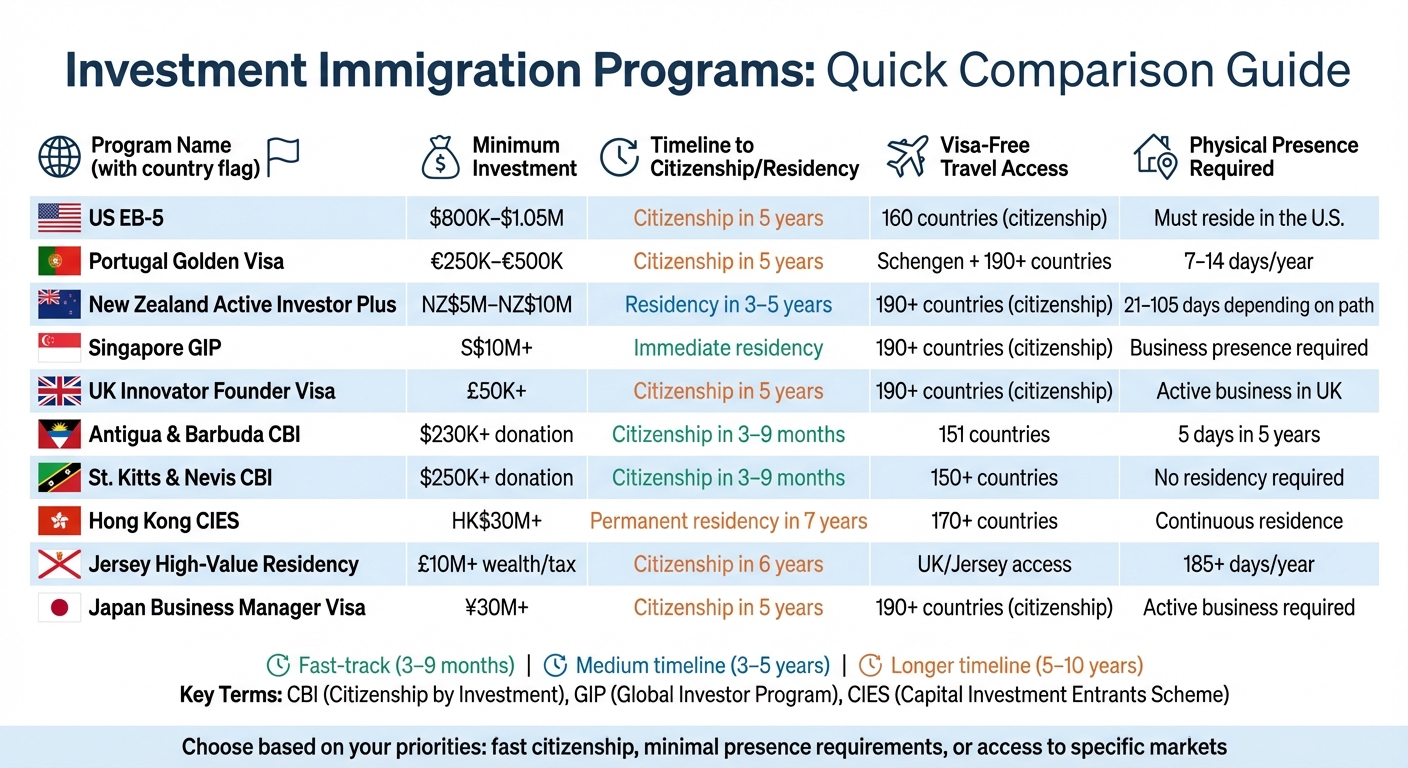
| Program | Minimum Investment | Residency/Citizenship Timeline | Travel Access | Physical Presence |
|---|---|---|---|---|
| US EB-5 | $800K–$1.05M | Citizenship in 5 years | 160 countries (citizenship) | Must reside in the U.S. |
| Portugal Golden Visa | €250K–€500K | Citizenship in 5 years | Schengen + 190+ countries | Minimal (7–14 days/year) |
| New Zealand AIP | NZ$5M–NZ$10M | Residency in 3–5 years | 190+ countries (citizenship) | 21–105 days depending on path |
| Singapore GIP | S$10M+ | Immediate residency | 190+ countries (citizenship) | Business presence in Singapore |
| UK Innovator Visa | £50K+ | Citizenship in 5 years | 190+ countries (citizenship) | Active business in the UK |
| Antigua & Barbuda CBI | $230K+ donation | Citizenship in 3–9 months | 151 countries | 5 days in 5 years |
| St. Kitts & Nevis CBI | $250K+ donation | Citizenship in 3–9 months | 150+ countries | No residency required |
| Hong Kong CIES | HK$30M+ | Permanent residency in 7 years | 170+ countries | Continuous residence |
| Jersey Residency | £10M+ wealth/tax | Citizenship in 6 years | UK/Jersey access | 185+ days/year in Jersey |
| Japan Manager Visa | ¥30M+ | Citizenship in 5 years | 190+ countries (citizenship) | Active business required |
These programs cater to diverse goals, from tax efficiency to global access. Pick the one that aligns with your personal and financial objectives.
1. US EB-5 Immigrant Investor Program
The EB-5 program provides conditional Green Cards to investors who contribute a significant amount of capital to U.S. businesses and create 10 permanent full-time jobs. This program is especially appealing to ultra-high-net-worth individuals (UHNWIs) who value direct access to the U.S. economy, top-tier education opportunities, and a reliable legal environment for protecting their wealth.
Minimum Investment Threshold
The standard investment requirement for the EB-5 program is $1,050,000. However, this amount drops to $800,000 for investments in Targeted Employment Areas (TEAs) or qualifying infrastructure projects. TEAs include rural areas or locations where unemployment is at least 150% of the national average. These thresholds are adjusted every five years based on the Consumer Price Index, with the next update scheduled for January 1, 2027.
To qualify, investors must create 10 permanent full-time jobs for U.S. workers within two years. Investments made through regional centers offer added flexibility, as up to 90% of the job creation requirement can be met through indirect or induced employment rather than direct hiring.
Once the investment is made, the residency process begins.
Residency or Citizenship Timeline
The EB-5 program follows a structured residency timeline. After meeting the investment requirements, investors receive a two-year conditional Green Card. Between 21 and 24 months, they must file Form I-829 to remove the conditions on their residency. The entire process typically takes 2 to 5 years, depending on USCIS processing times and the investor’s country of origin. After holding lawful permanent residency for five years, investors can apply for U.S. citizenship, provided they meet the physical presence requirement of at least 30 months during that time.
Physical Presence Requirements
Unlike some other residency programs, the EB-5 program offers flexibility for investors who frequently travel. To qualify for naturalization, investors must maintain continuous residence in the U.S. over a five-year period, spending at least 30 out of 60 months physically in the country. Investors with valid nonimmigrant visas can also file for Adjustment of Status, allowing them to quickly obtain employment authorization and travel permissions. However, leaving the U.S. without securing an Advance Parole document (Form I-131) could risk their application.
Alexander Jovy, Senior Immigration Expert at Global Immigration Partners, comments: "2026 is shaping up to be a defining year for the EB-5 program. With stable investment thresholds, important filing deadlines, and reserved visa categories that may offer expedited opportunities, informed planning is essential".
The program allocates 20% of annual visas to rural projects, 10% to high-unemployment areas, and 2% to infrastructure investments. These categories often provide faster processing times for investors. Additionally, petitions submitted before September 30, 2026, are protected under current rules, ensuring eligibility even if future legislative changes occur.
sbb-itb-39d39a6
2. Portugal Golden Visa
Portugal offers a compelling European alternative for investment-based immigration, especially for those interested in residency options. The Portugal Golden Visa program has been a magnet for investors since its launch in October 2012, attracting over 12,000 participants and generating more than $8.1 billion in investments. By 2025, Americans had become the leading nationality investing in the program.
Minimum Investment Threshold
There are several investment paths available under the Golden Visa program. One of the most affordable is the cultural donation route, starting at €250,000 (around $267,500) or €200,000 (approximately $214,000) for low-density areas. However, the most popular choice as of 2025 is the fund investment route, requiring €500,000 (about $535,000) in eligible private equity or venture capital funds.
Since October 2023, real estate investments have been removed from the program, leading to nearly all applications in 2025 and 2026 opting for the fund pathway.
"The Portugal Golden Visa investment minimum stands at the center of the fund-based pathway that, in 2025, has become the primary route for sophisticated international investors", according to Portugal Panorama.
The fund option offers the possibility of returns on the investment, while cultural donations are non-refundable. Other options include €500,000 (or €400,000 in low-density areas) for scientific research or a €500,000 business investment that creates at least five jobs.
Residency or Citizenship Timeline
Processing times for the Golden Visa typically range from 12 to 18 months. Once approved, investors receive an initial two-year residence card, which can be renewed for three years. After five years from the application date, investors may apply for permanent residency or citizenship, provided they pass a basic Portuguese language test at the A2 level.
Physical Presence Requirements
The program has minimal physical presence requirements, with applicants needing to spend an average of seven days per year (or 14 days within a two-year permit) in Portugal to meet residency criteria for citizenship. Before making an investment, applicants must secure a Portuguese Tax Identification Number and open a local bank account.
A Portuguese passport, granted through this program, allows visa-free travel to 184 countries, including all 29 Schengen zone nations.
3. New Zealand Active Investor Plus Visa
The New Zealand Active Investor Plus Visa, updated in April 2025, is designed for ultra-high-net-worth individuals (UHNWIs) seeking residency in a stable, English-speaking country. This program has drawn significant interest, with American investors making up 41.8% of applications – 573 submissions in total – representing a potential investment of NZD $2.1 billion. Like similar high-level investor programs, it provides benefits such as asset protection and enhanced global mobility. Below are the key financial requirements and investment options for the program.
Minimum Investment Threshold
This visa offers two investment pathways:
- Growth Category: Requires a minimum investment of NZD $5 million in productive assets. This includes direct investments in qualified New Zealand companies or approved managed funds.
- Balanced Category: Requires NZD $10 million, allowing investments in bonds, listed equities, charitable donations, or new property developments (excluding existing residential properties).
Application fees start at NZD $27,470.
"The NZ Active Investor Plus (AIP) visa is designed for high-net-worth individuals to gain New Zealand residency… Its focus is attracting productive capital into New Zealand’s growing innovation economy", says Jason Wang of Icehouse Ventures.
A notable investment option under this program is Icehouse Ventures’ Growth Fund III, approved in June 2025. The fund aims to raise NZD $150 million and invests in 20 late-stage technology companies. The fund uses a tranched capital call structure, meaning the full committed amount counts toward visa requirements, even though only 25% of the funds are drawn annually over three years.
Residency or Citizenship Timeline
Immigration New Zealand processes 80% of applications to "Approval in Principle" within four months, with an average processing time of just 26 working days as of late 2025. Once approved, investors have six months to transfer and invest their funds, with an optional six-month extension if needed.
- Growth Category: Investments must be maintained for three years.
- Balanced Category: Investments must be held for five years.
After meeting all investment and presence requirements, investors can apply for permanent residency. Citizenship eligibility follows after five years of residence, requiring a total physical presence of 1,350 days.
Physical Presence Requirements
The program’s physical presence rules vary depending on the investment pathway:
- Growth Category: Requires visa holders to spend only 21 days in New Zealand over the three-year investment period.
- Balanced Category: Requires 105 days of physical presence over five years. However, this requirement can be reduced by 14 days for every additional NZD $1 million invested, with a minimum stay of 63 days.
Family members included in the application are not subject to physical presence requirements but must arrive in New Zealand within 12 months of visa approval. For example, in early 2026, Harvey Law Group facilitated a case where a U.S.-based philanthropist’s 19-year-old son obtained residency while continuing his studies in New York.
Additionally, visa holders may purchase or build a residential property valued at NZD $5 million or more for personal use, an option exempt from typical overseas buyer restrictions.
4. Singapore Global Investor Program
The Singapore Global Investor Program (GIP) underwent major changes in March 2023, making it more appealing to ultra-high-net-worth individuals (UHNWIs). The revamped program introduces three distinct investment pathways aimed at driving significant capital inflow and creating local jobs. Singapore’s passport, known for its strength, offers visa-free or visa-on-arrival access to 194 countries, providing UHNWIs with enhanced global mobility and added asset protection. Below are the key details about the program’s investment requirements, processing timelines, and residency conditions.
Minimum Investment Threshold
The updated GIP provides three investment options:
- Option A: Business Investment – Requires a minimum investment of SGD 10 million in starting a new business or expanding an existing one, with the obligation to create at least 30 local jobs.
- Option B: GIP-Select Fund – Demands an investment of at least SGD 25 million in a fund that supports Singapore-based companies.
- Option C: Family Office – Involves setting up a Single-Family Office in Singapore with assets under management of at least SGD 200 million, including a commitment to invest at least SGD 50 million in approved assets.
Applicants must have at least three years of entrepreneurial experience and demonstrate a recent annual turnover of SGD 50 million, with an average turnover of the same amount over the past three years.
"The aim of this move is to generate more employment opportunities for locals, benefit from an influx of wealth, and attract high-quality investors to Singapore", notes the UNCTAD Investment Policy Monitor.
Residency or Citizenship Timeline
The GIP application process generally takes 6–12 months. Once applicants receive Approval in Principle (usually within 6–9 months), they have six months to fulfill the investment requirements. Upon doing so, permanent residency is granted. Permanent residents are issued a five-year Re-entry Permit (REP), allowing them to maintain their residency status even when traveling abroad. After two years of permanent residency, investors can apply for Singapore citizenship. However, as Singapore does not allow dual citizenship, applicants must renounce their original nationality.
Physical Presence Requirements
There is no requirement for physical presence to obtain initial permanent residency under the GIP. However, conditions apply for renewing the Re-entry Permit:
- To renew for three years, the investor (or a dependent) must have lived in Singapore for at least 2.5 years over the past five years or meet specific business milestones, such as hiring five locals and incurring an additional SGD 1 million in annual business expenses.
- For a five-year renewal, both residency and business performance criteria must be met.
It’s worth noting that male children who gain permanent residency through their parents are subject to National Service obligations.
5. UK Innovator Founder Visa
The UK Innovator Founder Visa offers a unique path for entrepreneurs by focusing on a strong, scalable business plan rather than requiring a set investment amount. Applicants must secure an endorsement from a Home Office–approved body, which evaluates whether the business idea is innovative, feasible, and capable of growth. Essentially, the investment should align with the needs outlined in the endorsed business plan.
"The UK Innovator Founder Visa remains one of the most attractive routes for entrepreneurs seeking to build long-term ventures in the UK." – Jeremy Ling, Author, WestBridge Business Immigration
Residency or Citizenship Timeline
Applicants initially receive a 3-year visa. After this period, they may apply for Indefinite Leave to Remain (ILR) if their business meets certain performance milestones. British citizenship becomes an option after five years of residency, provided the applicant has held ILR for at least 12 months. To qualify for ILR within three years, the business must achieve at least two major targets, such as:
- Generating £1 million in annual revenue.
- Creating 10 full-time jobs for settled workers.
- Meeting the £50,000 investment requirement.
Physical Presence Requirements
Visa holders must ensure they do not spend more than 180 days outside the UK in any rolling 12-month period to maintain eligibility for settlement. Additionally, they are required to attend two checkpoint meetings over the three years to evaluate business progress. While secondary employment is allowed in roles at RQF Level 3 or above, the endorsed business must always remain their primary focus.
Visa-Free Access or Global Mobility
Although the visa does not provide immediate access to the Schengen area, achieving British citizenship can significantly enhance global mobility. Dependents of visa holders benefit from almost unrestricted rights to work and study in the UK and can apply for settlement alongside the main applicant.
6. Antigua and Barbuda Citizenship by Investment
Designed for ultra-high-net-worth individuals (UHNWIs) seeking easy global mobility and asset protection, Antigua and Barbuda’s program offers a streamlined pathway to citizenship with competitive investment options.
Launched in 2013 and overseen by the Citizenship by Investment Unit (CIU), this program provides a direct route to obtaining a Caribbean passport. It stands out for its simplicity – there are no language tests, history exams, or relocation requirements. Applications are handled remotely, with a mandatory virtual interview for the main applicant and dependents aged 16 or older.
"The threshold to participate in the citizenship by investment program is $230,000, and the investor does not have to move to Antigua and Barbuda or renounce the existing citizenship." – Lyle Julien, Investment Programmes Expert
Here’s a closer look at the investment options, processing timeline, and travel perks that make this program appealing.
Investment Options
Applicants can choose from several pathways to meet the program’s requirements:
- National Development Fund (NDF): Contribute at least $230,000. This non-refundable option covers a family of up to four.
- University of the West Indies (UWI) Fund: Requires $260,000 for families of six or more, with the added benefit of one year of free tuition for a family member.
- Real Estate: Invest a minimum of $300,000 in approved real estate projects. Properties can be resold after five years.
- Business Investment: Either invest $1.5 million individually or $400,000 per person in a joint venture totaling $5 million.
Processing Timeline
From start to finish, the process typically takes four to six months. Applicants must work through licensed agents, as direct government submissions are not allowed. Dual citizenship is fully recognized, adding extra appeal to this program.
Travel Benefits
Antigua and Barbuda passport holders enjoy visa-free or visa-on-arrival access to 151 countries. This includes privileges like 90 days within the Schengen Area over 180 days and up to 180 days annually in the United Kingdom. While the passport doesn’t grant visa-free entry to the United States, holders can apply for a 10-year B-1/B-2 visitor visa through a simplified process that takes just two weeks. It also eases travel to key business destinations such as Hong Kong, Singapore, and Russia.
Physical Presence Requirements
To maintain citizenship and renew their passport, individuals need to spend only five days in Antigua and Barbuda within the first five years. This minimal requirement is especially attractive for UHNWIs who prioritize flexibility and prefer not to commit to long-term relocation.
7. St. Kitts and Nevis Citizenship by Investment
Launched in 1984, St. Kitts and Nevis introduced the world’s first citizenship by investment program. Over the past four decades, it has built a reputation for reliability and stability. Managed by the Citizenship by Investment Unit (CIU), the program requires all applications to be processed through licensed agents to ensure its high standards remain intact.
"St. Kitts & Nevis is recognized as the platinum brand for citizenship with a strict due diligence process for applicants."
This quote from JH Marlin Global underscores the program’s commitment to rigorous applicant screening. Recent updates now require mandatory interviews for all main applicants and dependents aged 16 and older, conducted either in person or virtually. Starting April 1, 2026, biometric data collection, including fingerprints and facial recognition, will also become a requirement. Notably, citizenship acquired through this program is hereditary, allowing it to be passed down to future generations.
The program’s robust due diligence measures are complemented by multiple investment pathways designed for ultra-high-net-worth individuals (UHNWIs).
Minimum Investment Threshold (USD)
Applicants can choose from four investment options, each tailored to different needs and offering distinct benefits:
| Investment Option | Minimum Investment | Holding Period | Key Feature |
|---|---|---|---|
| SISC (Contribution) | $250,000 | N/A (Non-refundable) | Simplest and fastest route |
| Public Benefit Option | $250,000 | N/A (Non-refundable) | Supports infrastructure projects |
| Approved Real Estate | $325,000 | 7 Years | Potential rental income (2–5% annually) |
| Private Home Sale | $600,000 | 7 Years | Full property ownership |
Both the Sustainable Island State Contribution (SISC) and the Public Benefit Option (PBO) require a minimum of $250,000 for single applicants or families of up to four. For real estate, the minimum investment was reduced from $400,000 to $325,000 in October 2024, making this pathway more competitive. Real estate investments must be held for seven years, during which investors can earn rental income. Additional due diligence fees apply to all options.
Residency or Citizenship Timeline
The processing period typically ranges from 3 to 6 months once all documents are submitted. The Public Benefit Option often processes faster, averaging 3 to 4 months, due to lower application volumes. The program boasts a 99% approval rate, as reported by licensed agents. However, citizens from Afghanistan, Belarus, Iran, Iraq, North Korea, and Russia are currently ineligible to apply.
Visa-Free Access or Global Mobility
A St. Kitts and Nevis passport provides visa-free or visa-on-arrival access to over 150 countries, including the United Kingdom, the European Schengen Area, Singapore, and Hong Kong. The passport ranks among the top 20 globally in terms of travel power. While it doesn’t grant visa-free entry to the United States, passport holders can apply for a 10-year B-1/B-2 visitor visa, which is the longest validity available for this visa type. Applicants who obtain their US visa at the consulate in Barbados may also qualify for remote renewal without needing an interview.
Physical Presence Requirements
There are no residency requirements to obtain or retain citizenship. However, naturalization certificates must be collected in person, either on the islands or at an approved embassy or consulate. Additionally, the country imposes no personal income, wealth, inheritance, or capital gains taxes on its citizens. This tax-friendly environment aligns with the goals of UHNWIs, offering both asset protection and enhanced global mobility. The absence of residency requirements further supports portfolio diversification strategies for investors.
8. Hong Kong Capital Investment Entrants Scheme
The Hong Kong Capital Investment Entrants Scheme (CIES) sets a minimum investment threshold of HKD 30 million (approximately $3.85 million USD). This program is open to foreign nationals, Macao residents, Chinese nationals with permanent residency in another country, and Chinese residents of Taiwan. Applicants must have maintained net assets of at least HKD 30 million for six consecutive months within the past two years and must retain this amount throughout the seven-year period leading to permanent residency eligibility.
The investment is divided into two parts:
- HKD 27 million: This portion can be allocated to approved financial assets or non-residential real estate. Eligible financial assets include listed equities, debt securities, authorized collective investment schemes, and limited partnership interests. Non-residential real estate investments are capped at HKD 10 million, while Certificates of Deposit are limited to 10% of the total investment, or HKD 3 million.
- HKD 3 million: This amount must be invested in a CIES Investment Portfolio managed by the Hong Kong Investment Corporation Limited. These funds are aimed at supporting the long-term growth of the local economy.
This dual investment structure not only facilitates entry into Hong Kong but also serves as a pathway to permanent residency. It is particularly designed for ultra-high-net-worth individuals (UHNWIs) seeking flexible residency options and opportunities for safeguarding their assets. For personalized guidance on these complex requirements, private consultations can help tailor a strategy to your specific financial goals.
Residency or Citizenship Timeline
Once the investment is made, applicants are granted an initial stay of 24 months, followed by extensions of 2, 3, and 3 years. After maintaining the required investment and residing in Hong Kong for seven continuous years, applicants and their dependents can apply for permanent residency. The financial aspects of the application are evaluated by Invest Hong Kong, while the Hong Kong Immigration Department oversees visa and stay extension processes.
Physical Presence Requirements
The scheme does not impose strict physical presence requirements for maintaining the visa or stay. However, to qualify for permanent residency after seven years, applicants must demonstrate "continuous ordinary residence" in Hong Kong. For those who meet the investment criteria but do not satisfy the continuous residence condition, it is possible to apply for an unconditional stay, which allows unrestricted entry and residence in Hong Kong. Dependents, including a spouse and unmarried children under 18, are also eligible for inclusion in the application.
9. Jersey High-Value Residency
Jersey’s High-Value Residency program, also known as "21e status", takes a different approach compared to standard investment immigration programs. Instead of requiring a direct investment into businesses or funds, this program emphasizes minimum tax contributions, property purchases, and proof of substantial personal wealth. As a British Crown Dependency, Jersey offers ultra-high-net-worth individuals (UHNWIs) a strategic base in Europe and a simplified route to British citizenship. This setup aligns with the broader theme of asset protection and increased mobility for UHNWIs.
Minimum Investment Requirements
To qualify, applicants must meet specific financial benchmarks:
- A personal net worth of over £10,000,000 (excluding their primary residence).
- A minimum annual global income of £1,250,000.
- An annual tax payment of at least £250,000.
- Property purchase requirements include spending at least £1,750,000 for an apartment or £3,500,000 for a house.
Additional costs include a £5,000 application fee per person and stamp duty that can go as high as 10.5% on property transactions.
Residency or Citizenship Timeline
The approval process is relatively quick, usually taking between 2 to 4 weeks. Once approved, applicants are granted a temporary residence permit. After 5 years of continuous residence, this permit can be converted to permanent residency (Indefinite Leave to Remain). Following 6 years of total residency – 5 as a temporary resident and 1 as a permanent resident – individuals can apply for British citizenship.
Visa-Free Access and Mobility
Jersey residents benefit from unrestricted travel within the Common Travel Area (CTA), which includes the United Kingdom, Ireland, and the Isle of Man, without the need for immigration checks. After obtaining British citizenship, they gain visa-free access to over 173 countries, including key destinations like the European Union, the United States, Canada, and Australia. Jersey’s proximity to major European cities such as London, Dublin, Berlin, and Paris enhances its appeal as a convenient hub for global travel.
Physical Presence Requirements
To maintain their residency status, individuals must spend at least 185 days per year in Jersey. For those seeking permanent residency, the majority of their time over the five-year qualifying period must be spent on the island. If applying for British citizenship, applicants are limited to a maximum of 450 days of absence during the five years and no more than 90 days in the year immediately preceding their application.
10. Japan Business Manager Visa
Japan’s Business Manager Visa is aimed at serious entrepreneurs and ultra-high-net-worth individuals (UHNWIs), requiring substantial capital and strict management commitments. This visa provides a route to permanent residency and citizenship, offering access to the benefits of Japan’s highly regarded passport. Below are the key updates on investment requirements, residency timelines, and management obligations.
Minimum Investment Threshold
As of October 16, 2025, the minimum investment threshold saw a dramatic increase, rising from ¥5,000,000 to ¥30,000,000 (around $197,000). Businesses must meet these requirements:
- Corporations: Provide ¥30,000,000 in paid-in capital.
- Sole Proprietors: Allocate ¥30,000,000 toward a dedicated office, essential equipment, and one year of personnel expenses.
Applicants must also hire at least one full-time employee who is either a Japanese citizen or a resident with full work rights. Additionally, either the applicant or their staff must demonstrate Japanese language proficiency at JLPT N2/CEFR B2 level. Other criteria include having at least three years of management experience or holding a Master’s degree in a business-related field. Furthermore, the business plan must be certified by a Small and Medium Enterprise Management Consultant, CPA, or licensed tax accountant, which adds an extra cost of ¥100,000 to ¥300,000 (roughly $660 to $1,970) to the setup process.
Residency or Citizenship Timeline
Visa processing generally takes about 120 to 210 days. Under the standard program, the Business Manager Visa paves the way to permanent residency after 10 years. However, applicants qualifying under the Highly Skilled Professional point system can achieve permanent residency in just 3 years. Citizenship, on the other hand, becomes an option after 5 years of continuous residence. For instance, one applicant successfully attained permanent residency after adhering to strict financial and tax compliance standards.
Physical Presence Requirements
Active business operations within Japan are a non-negotiable condition of this visa. Prolonged absences without valid business reasons can jeopardize visa renewal, as extended time away might signal a lack of genuine management activity. Businesses must operate from a dedicated physical office, as virtual offices or shared residential/business spaces are no longer permitted.
"Long-term stays abroad may be viewed as ‘no real business activity in Japan’… especially if you are absent for several months at a time, the risk is high."
These stringent requirements align with the priorities of UHNWIs, emphasizing active business oversight in a stable and well-regulated environment.
Program Comparison Table
Here’s a detailed comparison of ten residency and citizenship programs, focusing on investment requirements, timelines, travel privileges, and physical presence expectations:
| Program | Minimum Investment | Residency/Citizenship Timeline | Visa-Free Travel Access | Physical Presence Requirements |
|---|---|---|---|---|
| US EB-5 | $800,000 (TEA) / $1,050,000 (standard) | Green Card in 24–36 months; citizenship after 5 years | 160 countries (upon citizenship) | Requires maintaining US residence |
| Portugal Golden Visa | €250,000 (cultural/arts) / €500,000 (funds/research) | Citizenship after 5 years | Schengen Area access; 190+ countries (upon citizenship) | 7 days in Year 1; 14 days every 2 years thereafter |
| New Zealand Active Investor Plus | NZ$5 million (Growth) / NZ$10 million (Balanced) | Permanent residency after 3–5 years | 190+ countries (upon citizenship) | 21 days over 3 years (Growth); 105 days over 5 years (Balanced) |
| Singapore GIP | S$10 million (~$7.4 million) | Permanent residency immediately; citizenship discretionary | 190+ countries (upon citizenship) | Requires ongoing business operations in Singapore |
| UK Innovator Founder Visa | £50,000 (~$63,000) with endorsement | Permanent residency after 3 years | 190+ countries (upon citizenship) | Must actively manage UK business |
| Antigua and Barbuda CBI | $230,000 (donation) | Citizenship in 3–9 months | 151 countries | No mandatory residence |
| St. Kitts and Nevis CBI | $250,000 (donation) | Citizenship in 3–9 months | 150+ countries | No mandatory residence |
| Hong Kong CIES | HK$30 million (~$3.85 million) | Permanent residency after 7 years | 170+ countries (upon citizenship) | Must maintain continuous ordinary residence |
| Jersey High-Value Residency | £10 million (~$12.6 million) housing / £145,000 annual tax | Renewable residency permit | UK/Jersey travel rights | Must reside in Jersey |
| Japan Business Manager Visa | ¥30 million (~$197,000) | Permanent residency after 10 years (3 years via HSP); citizenship after 5 years | 190+ countries (upon citizenship) | Active business operations required; prolonged absences risk renewal |
Caribbean programs like Antigua and Barbuda or St. Kitts and Nevis offer quick citizenship with no residency obligations – ideal for those seeking fast-track solutions. European options, such as Portugal’s Golden Visa, provide extended timelines but grant access to the Schengen Area and beyond. Meanwhile, countries like Singapore and Hong Kong attract executives and investors to their financial hubs, offering stability and global connectivity. The US EB-5 program stands out with its highly sought-after passport but comes with residence requirements and a longer path to citizenship. Each program caters to different priorities, allowing high-net-worth individuals to align their choices with personal and professional objectives.
Conclusion
Investment immigration has become a cornerstone strategy for ultra-high-net-worth individuals (UHNWIs) seeking to secure their wealth and enhance global mobility. The ten programs highlighted here provide tailored solutions for different priorities, aligning with what Dr. Juerg Steffen, CEO of Henley & Partners, aptly describes:
"Residence and citizenship rights are increasingly assembled rather than inherited: a diversified portfolio of jurisdictions that builds resilience and enhances mobility across generations".
Whether your focus is immediate access to global travel through Caribbean citizenship, long-term entry to the European Union via Portugal, or operational flexibility in financial hubs like Singapore and Hong Kong, these programs are designed to meet specific strategic goals.
The numbers speak for themselves. With 142,000 high-net-worth individuals projected to relocate by 2026 and a notable spike in U.S. applications, the need for timely action is clear. The rise of centi-millionaires – those holding over $100 million in investable assets – by 54% over the last decade underscores the growing demand for sophisticated, multi-jurisdictional planning.
For families, these programs go beyond mobility. They offer a structured pathway to seamlessly transition from elite education opportunities to integration into local workforces. Industry experts emphasize that holding multiple residencies or citizenships has shifted from being a luxury to a necessity for those prioritizing asset protection and cross-border security.
Programs like the U.S. EB-5 and Singapore Global Investor Program provide access to robust capital markets and financial stability. Meanwhile, options such as the Jersey High-Value Residency deliver tax-efficient environments for preserving and growing family wealth. These pathways not only expand mobility but also enhance asset protection and global diversification – consistent themes throughout this discussion .
FAQs
Which program fits my goal best – fast citizenship, low-stay residency, or market access?
The right program depends on what matters most to you. If fast citizenship is your goal, look into programs with expedited timelines, usually requiring investments between $650,000 and $2 million. For those prioritizing low-stay residency, EU Golden Visas from countries like Portugal or Spain offer a gradual path to citizenship over 5–10 years, with investment requirements ranging from €250,000 to €500,000. On the other hand, if market access and mobility are your focus, Caribbean programs can grant second citizenship in just 3–6 months with investments of $100,000 to $200,000.
What are the biggest approval risks or common reasons investors get denied?
The most frequent risks of denial in investment immigration programs revolve around verifying the source of funds, uncovering a criminal background, or failing to satisfy due diligence requirements. It’s essential to tackle these issues carefully during the application process to improve the chances of approval.
How do taxes and reporting change after getting a second residency or passport?
Obtaining a second residency or passport can make taxes and reporting more complicated. You might have to report your worldwide income and assets to more than one country, which could mean extra tax filings and compliance tasks. Understanding these obligations is essential to stay on the right side of the law.
