
Looking for the best places to protect your financial privacy? Here’s a straightforward guide to 11 offshore jurisdictions known for their strong privacy laws. These locations offer legal tools like trusts, LLCs, and banking secrecy to safeguard assets, reduce risks, and maintain confidentiality.
Key Takeaways:
- Top jurisdictions: Switzerland, Singapore, Cook Islands, Nevis, and more.
- Privacy features: Non-public registries, strict banking secrecy, and protection against foreign court judgments.
- Compliance matters: Offshore privacy doesn’t exempt you from legal reporting obligations (e.g., FBAR for U.S. citizens).
- Popular tools: Asset Protection Trusts, LLCs, and private foundations.
Quick Comparison:
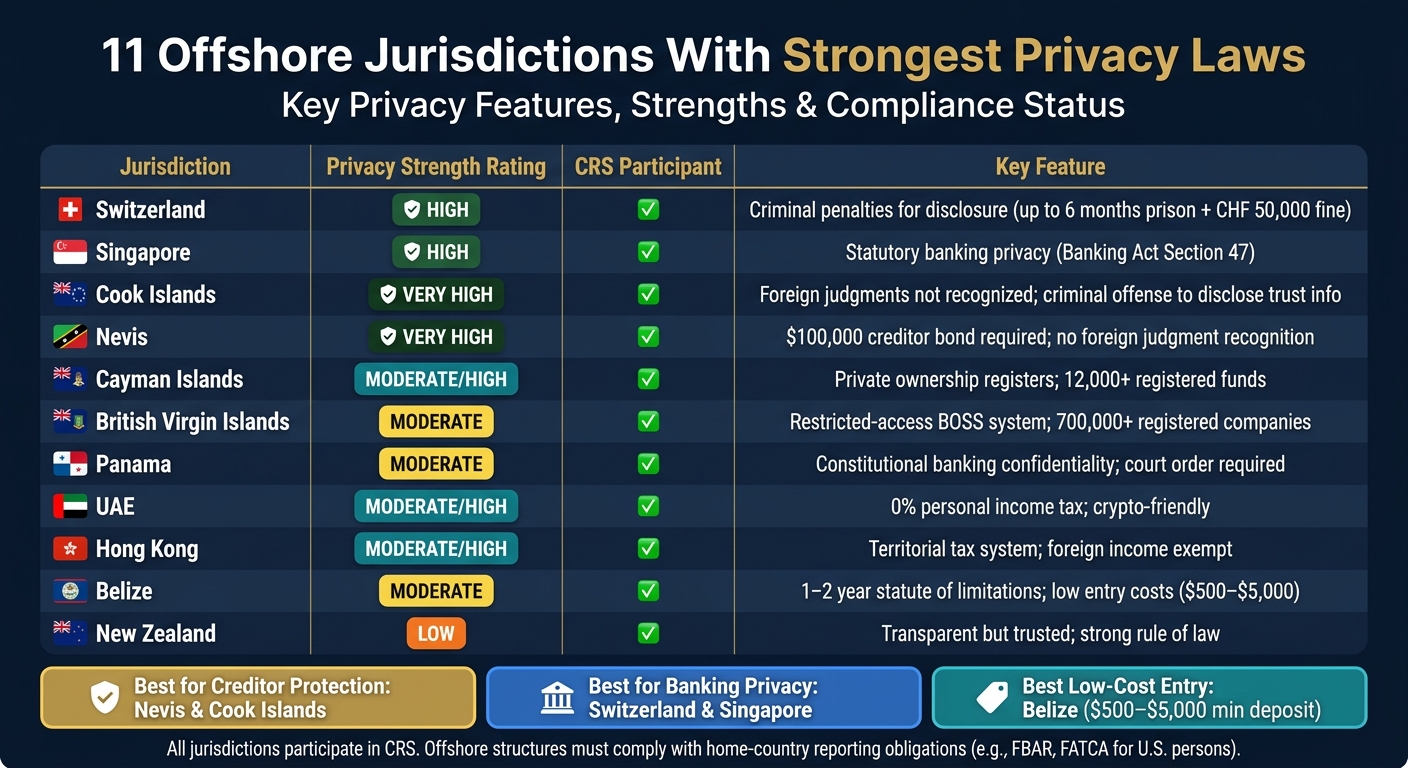
| Jurisdiction | Privacy Strength | CRS Participant | Key Feature |
|---|---|---|---|
| Switzerland | High | Yes | Banking secrecy with criminal penalties |
| Singapore | High | Yes | Strong banking privacy laws |
| Cook Islands | Very High | Yes | Rejects foreign judgments |
| Nevis | Very High | Yes | $100,000 creditor bond requirement |
| Cayman Islands | Moderate/High | Yes | Private ownership registers |
| British Virgin Islands | Moderate | Yes | Restricted-access BOSS system |
| Panama | Moderate | Yes | Constitutional banking confidentiality |
| Belize | Moderate | Yes | Short 1–2 year statute of limitations |
| UAE | Moderate/High | Yes | Zero personal income tax |
| Hong Kong | Moderate/High | Yes | Territorial tax system |
| New Zealand | Low | Yes | Transparent but trusted legal framework |
These jurisdictions cater to different needs – whether you’re prioritizing banking secrecy, creditor protection, or tax neutrality. Combining multiple jurisdictions can create a stronger asset protection strategy. Just remember, timing and compliance are key to success, often requiring private consultations to ensure proper setup.
Key Criteria for Evaluating Offshore Privacy Jurisdictions
Not all jurisdictions offering privacy protections are created equal. The ones that truly safeguard financial data meet stringent legal and structural standards. Here’s how we assessed these jurisdictions and what makes some stand out.
Banking Secrecy and Confidentiality Laws
Banking privacy starts with strong legal protections. Take Panama, for instance – its national constitution ensures banking information stays confidential, only permitting disclosure through a court order rather than an administrative request.
An ideal jurisdiction keeps its registers non-public, allowing access solely to regulatory authorities for anti-money laundering purposes. This approach aligns with a significant ruling by the Court of Justice of the European Union (CJEU) on November 22, 2022. The court declared unrestricted public access to beneficial ownership data invalid, citing it as a breach of fundamental privacy rights.
"The quality of a financial centre is determined by how precisely and consistently it differentiates between justified transparency and the necessary protection of privacy and confidentiality." – Dr. Marco Felder and PD Dr. Thomas Stern, Bergt & Partner AG
Beyond banking secrecy, data protection laws play a critical role in reinforcing privacy.
Data Protection and Privacy Legislation
Top jurisdictions ensure that data collected for tax purposes remains restricted to government use, adhering to the purpose limitation principle. This means information shared under frameworks like the Common Reporting Standard (CRS) doesn’t end up in public records.
It’s also essential to consider whether a jurisdiction appears on international watchlists. For example, as of 2024, Belize was still on the EU’s grey list pending reforms, which could invite extra scrutiny on entities formed there. A jurisdiction’s regulatory standing influences how banks and financial partners perceive its entities, regardless of local privacy laws.
While data protection is vital, the availability of advanced legal tools also sets apart the leading jurisdictions.
Asset Protection Tools and Legal Frameworks
In addition to privacy, robust asset protection mechanisms are crucial for securing financial interests. Some of the most effective legal structures include Asset Protection Trusts (APTs), charging-order-only LLCs, and private-benefit foundations. These tools are designed to limit what creditors and foreign courts can access.
Certain legal features distinguish the best jurisdictions:
- Non-recognition of foreign judgments: Jurisdictions like Nevis and the Cook Islands require creditors to re-litigate under local law, as they don’t enforce foreign court orders.
- Short statutes of limitations: Leading jurisdictions limit the timeframe for challenging asset transfers to 1–2 years, compared to 4–6 years in many onshore regions.
- High burden of proof: Nevis and the Cook Islands demand creditors prove fraudulent conveyance beyond a reasonable doubt.
- Creditor bond requirements: In Nevis, creditors must post a $100,000 cash bond with the Ministry of Finance before initiating action against an international trust.
- Anti-freezing protections: Nevis prevents Mareva injunctions (pre-judgment asset freezes), ensuring assets remain accessible during litigation.
Here’s how three well-known jurisdictions compare across these criteria:
| Feature | Nevis | Cook Islands | Belize |
|---|---|---|---|
| Foreign Judgment Recognition | No | No | No |
| Creditor Bond Required | Yes ($100,000) | No | No |
| Statute of Limitations | 1–2 Years | 1–2 Years | 1–2 Years |
| Burden of Proof | Beyond Reasonable Doubt | Beyond Reasonable Doubt | High Standard |
| Anti-Freezing (Mareva) | Prohibited | Historically Allowed | Varies |
| Tax Status | Tax Neutral | Tax Neutral | Tax Neutral |
Another important consideration is whether a jurisdiction allows self-settled trusts, where the trust creator can also be a beneficiary. This feature provides flexibility for individuals who want to retain some control over their assets while still enjoying legal protections.
sbb-itb-39d39a6
Top 11 Offshore Jurisdictions with Strong Privacy Laws
Here’s a closer look at some of the most notable offshore jurisdictions and what sets them apart when it comes to financial privacy and asset protection. Each one offers distinct advantages tailored to privacy-conscious investors.
Switzerland
Switzerland has long been synonymous with private banking. The Banking Act of 1934 made banking secrecy a legal cornerstone, with severe penalties for unauthorized disclosures – including up to six months in prison and fines of 50,000 Swiss francs.
"Switzerland remains the gold standard for private banking, offering exceptional stability, sophisticated services, and strong asset protection." – CitizenX Insights
Switzerland manages about one-third of all offshore assets globally. Its private banking services, including exclusive numbered accounts requiring minimum deposits of $1,000,000, are backed by political stability and a sophisticated financial ecosystem.
Singapore
Often called the "Switzerland of Asia", Singapore combines a robust legal system with cutting-edge banking infrastructure. For non-residents, tax exemptions apply to assets exceeding $1,000,000, particularly through frameworks like Section 13O/13U, which benefit fund managers and family offices.
Hong Kong
Hong Kong’s territorial tax system and English common law framework offer a secure and private environment for investors. Foreign-sourced income is typically exempt from local tax reporting, making Hong Kong an attractive hub for accessing mainland China’s capital markets.
United Arab Emirates
The UAE, especially Dubai, has emerged as a major player in wealth management. With zero personal income tax and strong confidentiality protections, it appeals to privacy-focused investors. Free zones like the Dubai International Financial Centre (DIFC) and Abu Dhabi Global Market (ADGM) operate under independent legal systems based on English common law, supported by data protection laws. Formation costs range from $2,500 to $6,000, and a 9% corporate tax rate was introduced in 2023.
Cayman Islands
The Cayman Islands is a global leader in alternative investment vehicles, hosting over 12,000 registered funds. Operating under English common law, it imposes no direct taxes on offshore entities. Ownership registers remain private, accessible only to law enforcement and regulators, and there’s no minimum capital requirement for company formation.
British Virgin Islands
The BVI is home to over 700,000 registered companies, with formation times as quick as 24–48 hours. Its International Business Companies Act allows for corporate structures that don’t require public ownership disclosures. The restricted-access Beneficial Ownership Secure Search (BOSS) system further protects ownership details, limiting access to law enforcement only. Formation costs typically range between $1,200 and $2,500.
Panama
Panama safeguards banking privacy through constitutional protections, requiring a court order for information disclosure. It offers offshore trusts and private interest foundations that separate assets from their original owners while benefiting designated parties. With a territorial tax system, foreign-sourced income is exempt from local taxation. Despite modernizing compliance frameworks, Panama retains strict banking confidentiality.
Belize
Belize is known for its strong banking confidentiality laws and flexible asset protection trusts. Its statute of limitations for challenging asset transfers is just 1–2 years. Operating under a territorial tax system, Belize also benefits from low inflation, which stood at approximately 0.8% in late 2020. However, its placement on the EU’s gray list as of 2024 could attract additional scrutiny.
Nevis (Saint Kitts and Nevis)
Nevis is celebrated for its LLC and trust-based asset protection structures. With no personal income tax, its legal framework is designed to make creditor claims highly challenging. Nevis also allows redomiciliation, enabling businesses to move their legal base without dissolving the original entity, thus preserving privacy and legal continuity .
Cook Islands
The Cook Islands is known for its trust laws that resist creditor claims. Legal challenges must be re-litigated locally under strict standards, and foreign court judgments are not recognized. These features make it a stronghold for trust-based asset protection.
New Zealand
New Zealand offers a low-risk environment with transparent domestic regulations and adherence to international information-sharing agreements. Its foreign trusts, under certain conditions, are exempt from paying taxes on foreign-sourced income, making it a practical option for privacy-conscious investors.
Comparing Privacy Strengths Across the 11 Jurisdictions
Privacy Features at a Glance
Offshore jurisdictions differ widely in how they handle privacy. Some enforce strict criminal penalties for unauthorized disclosures, while others rely on restricted registries or judicial oversight. Knowing these distinctions is key to crafting an effective asset protection plan.
| Jurisdiction | Banking Secrecy Level | Beneficial Ownership Registry | CRS Participant | Key Privacy Feature |
|---|---|---|---|---|
| Switzerland | High (Criminal Penalties) | Private (Not Public) | Yes | Federal Banking Act Art. 47 |
| Singapore | High (Statutory Duty) | Private (Internal Only) | Yes | Banking Act Section 47 |
| Hong Kong | Moderate/High | Private | Yes | Territorial tax system; foreign income exempt |
| UAE | Moderate/High | Private (Government Only) | Yes | 0% income tax; crypto-friendly |
| Cayman Islands | Moderate/High | Private (Closed to Public) | Yes | No direct taxes; tax-neutral |
| BVI | Moderate | Private (BOSS Act) | Yes | "Legitimate interest test" for disclosure |
| Panama | Moderate | Private | Yes | Panamanian Private Foundations |
| Belize | Moderate | Private | Yes | High liquidity requirements (24%) |
| Nevis | Very High | Private (No Public Registry) | Yes | Foreign judgments not recognized |
| Cook Islands | Very High | Private (No Public Registry) | Yes | Criminal offense to disclose trust info |
| New Zealand | Low (Transparent) | Public | Yes | High credibility and rule of law |
This table highlights how jurisdictions approach confidentiality and asset protection. Notably, Switzerland, Nevis, and the Cook Islands stand out for imposing criminal penalties that hold institutions accountable for unauthorized disclosures . While all 11 jurisdictions participate in CRS data exchange, beneficial ownership registries in places like the Cayman Islands, BVI, UAE, and Singapore remain entirely closed to public access.
Choosing the Right Jurisdiction for Your Needs
Selecting the best jurisdiction depends on your specific privacy and asset protection goals.
For creditor protection, Nevis and the Cook Islands are top choices. These jurisdictions do not recognize foreign court judgments, requiring creditors to re-litigate locally under strict "beyond a reasonable doubt" standards .
"Cook Islands trusts are not about secrecy. They are about jurisdictional strength." – Blake Harris, Esq.
Switzerland and Singapore are leading options for banking privacy. Switzerland, managing over $2.5 trillion in offshore assets, enforces rigorous confidentiality under its Federal Banking Act. Similarly, Singapore’s Banking Act Section 47 ensures a robust statutory duty of privacy.
For those seeking affordable entry with reliable protections, Belize offers a low-cost threshold for account openings, ranging from $500 to $5,000. This is significantly lower than Nevis, where typical deposits fall between $5,000 and $10,000.
Finally, New Zealand emphasizes transparency but remains a trusted jurisdiction due to its legal integrity and strong rule of law. This makes it an appealing option for investors who prioritize reputation and compliance with international banking standards.
Building a Solid Asset Protection Strategy
Using Multiple Jurisdictions Together
Relying on just one jurisdiction for asset protection isn’t enough. The most effective strategies combine multiple jurisdictions, each playing a distinct role. For example, a Nevis trust might own a BVI company, which then holds a bank account in Switzerland or the UAE. This layered setup not only spreads risk but also creates a more resilient protection system. Each jurisdiction adds its own advantage: the Cook Islands offers well-established trust laws dating back to 1984, the Cayman Islands provides a tax-neutral environment for holding companies, and Singapore and Switzerland deliver secure, privacy-oriented banking. Together, these elements create a structure far more difficult to breach than relying on a single offshore account or entity.
Another benefit often overlooked is estate planning flexibility. Many offshore jurisdictions allow you to bypass "forced heirship" rules – laws in some civil-law countries that dictate how your assets must be distributed to heirs. Places like Nevis and Belize let you allocate assets according to your preferences, regardless of your home country’s regulations.
Timing is critical. Offshore structures should be established well before any legal disputes arise. Transfers made after litigation starts could be reversed as fraudulent conveyance. Acting proactively avoids this risk, with Nevis trusts, for example, offering a much shorter limitation period of 1–2 years compared to the 4–6 years common in U.S. courts.
Why Expert Guidance Matters
Given the complexities involved, expert guidance is crucial. Structuring offshore trusts for asset protection is not something you can handle on your own. Retaining too much control over a trust can lead to courts labeling it a "sham", meaning the assets might be treated as if they were never transferred. Striking the right balance requires professionals who understand both offshore laws and your country’s reporting requirements.
Tax compliance is another area where expert advice is indispensable. U.S. citizens, for instance, must report foreign trusts and accounts to the IRS under FATCA and the Common Reporting Standard (CRS). Non-compliance can lead to severe penalties – far outweighing any potential benefits of the structure. A knowledgeable advisor ensures your setup is both protective and fully compliant.
Cost management is another reason to seek expert help. Setting up a Cook Islands trust typically costs $15,000 to $20,000, with annual fees ranging from $3,000 to $6,000. A Nevis trust is a more affordable option, costing $5,000 to $10,000 upfront and $2,000 to $5,000 annually. These figures don’t include legal fees, compliance filings, or registered agent costs, which can add up quickly. Planning for these expenses upfront avoids unpleasant surprises later.
Global Wealth Protection specializes in helping investors and entrepreneurs build multi-jurisdictional structures. Their services include offshore company formation, trust setup, and personalized consultations. They guide clients through jurisdiction selection, compliance requirements, and long-term asset protection planning, ensuring every detail is carefully managed.
Conclusion
Financial privacy is about maintaining control over who can access your financial information while safeguarding your assets. Different jurisdictions provide unique benefits, such as private banking, strong confidentiality measures, reliable asset protection, and adaptable corporate structures. Navigating this landscape requires strategies tailored to the specific advantages each jurisdiction offers.
No single jurisdiction can provide absolute protection. Instead, combining the strengths of multiple jurisdictions creates a more robust asset protection plan. The offshore privacy landscape has evolved, now relying heavily on jurisdictional separation and legal safeguards. It’s worth noting that around 17% of high-net-worth individuals utilize offshore structures, highlighting the importance of strategic and compliant planning.
Success in this area hinges on timing, structure, and rigorous compliance. Offshore structures must be established proactively – before any legal challenges arise. Every detail, from trust deeds to annual IRS filings, must be managed with care and accuracy. Choosing the right jurisdiction for the right reasons is a critical factor in creating an effective protection strategy.
As this guide has shown, crafting a solid offshore strategy requires expertise and careful planning. Global Wealth Protection works with investors and entrepreneurs to develop compliant, multi-jurisdictional strategies, offering services ranging from offshore company formation to trust setup and private consultations.
FAQs
Are offshore accounts still private under CRS and FATCA?
Offshore accounts can still provide a degree of privacy under the Common Reporting Standard (CRS) because the United States does not participate in the CRS framework. Moreover, the U.S. shares Foreign Account Tax Compliance Act (FATCA) data selectively, which makes U.S. banking relationships an appealing choice for maintaining privacy, especially for individuals who are not U.S. citizens or residents.
Which jurisdiction is best for creditor protection versus banking secrecy?
For creditor protection, the Cook Islands stands out thanks to its strong trust laws, a solid track record in litigation, and strict requirements for creditor challenges. On the other hand, for banking secrecy, Switzerland continues to be a prominent option. Its Banking Secrecy Law provides substantial confidentiality protections, even though these have been somewhat relaxed over the years. Deciding between the two comes down to your main focus – whether it’s safeguarding assets or ensuring financial privacy.
What’s the safest multi-jurisdiction setup for privacy and compliance?
To achieve the best balance of privacy and compliance, consider combining jurisdictions known for strong privacy protections, like the Cayman Islands, BVI, and Seychelles, with those recognized for high compliance standards, such as Singapore and the UAE. This strategy helps safeguard confidentiality while adhering to regulations like economic substance laws and AML requirements. Careful planning and maintaining operational substance are key to aligning with your income, residency, and business objectives without compromising on either privacy or compliance.
