
Private trusts are often misunderstood, but they’re practical tools for managing assets, avoiding probate, and ensuring financial privacy. Despite the myths, they’re not just for the ultra-wealthy, don’t guarantee anonymity, and require active management to work effectively. Here’s what you need to know:
- Types of Trusts: Revocable, irrevocable, and offshore trusts serve different purposes, from flexibility to asset protection.
- Affordability: Trusts aren’t exclusive to the rich. You can set one up for as little as $1,000–$5,000.
- Control: Revocable trusts let you retain control, while irrevocable trusts offer stronger asset protection but limit your authority.
- Privacy vs. Anonymity: Trusts improve privacy but won’t make your assets invisible to governments or creditors.
- Tax Rules: Trusts don’t eliminate taxes but shift who pays and when. Irrevocable trusts face higher tax rates if income isn’t distributed.
- Ongoing Management: Proper funding, updates, and compliance are essential for a trust to function as intended.
Private trusts are highly customizable, but success depends on choosing the right type, structuring it correctly, and maintaining it over time. Missteps – like neglecting compliance or retaining too much control – can undermine their benefits.
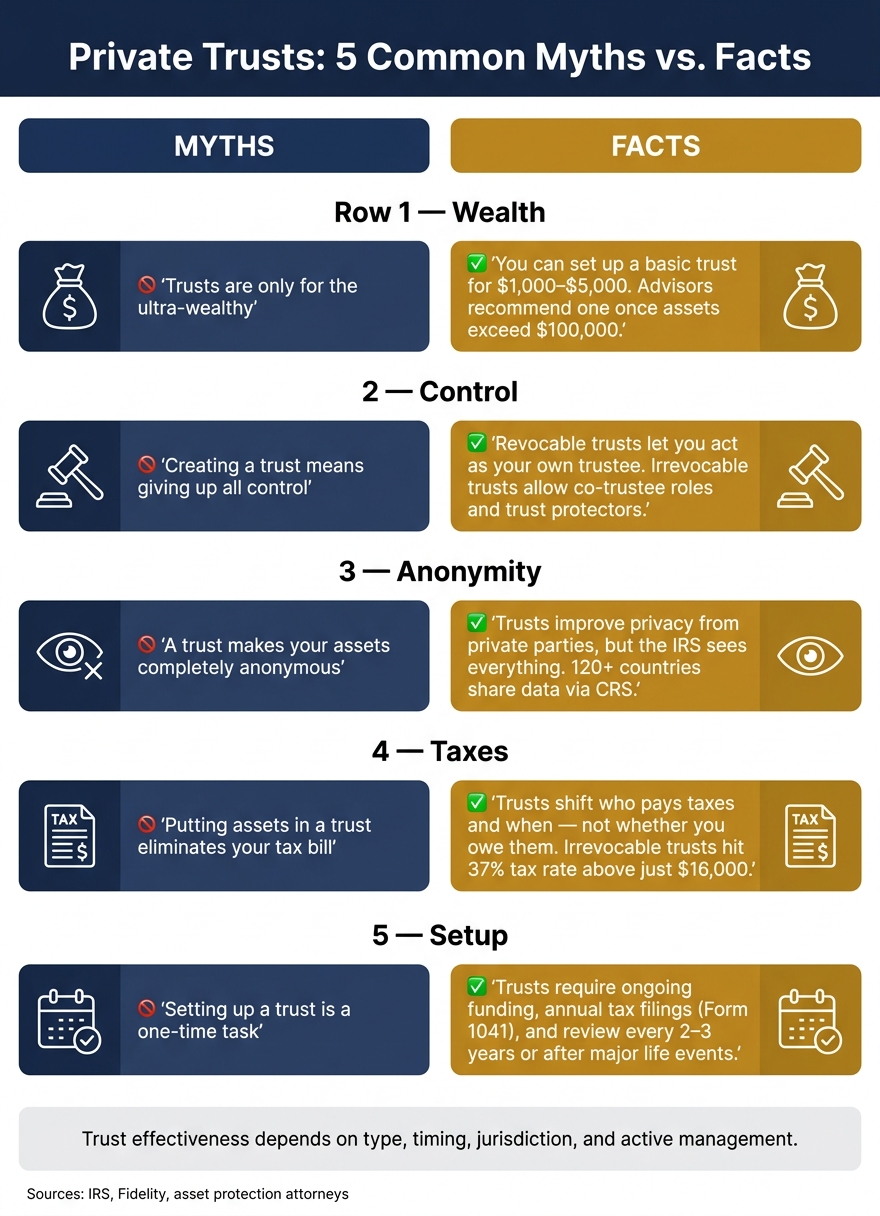
Myth: Private Trusts Are Only for the Ultra-Wealthy
Many people still associate private trusts with images of old money, grand estates, and the ultra-wealthy. This stereotype has persisted for years, but it no longer reflects the current reality. As Danny Lohrfink, Co-founder and Chief Product Officer at Wealth.com, explained:
"The result was that only the wealthy had these vehicles because they were the only people who could afford them."
These days, setting up a basic revocable living trust is far more accessible. With an estate planning attorney, you can establish one for as little as $1,000 to $5,000. While this is a one-time expense, it can save your family significant money in probate fees, which often consume 6% to 8% of a gross estate. The notion that trusts are exclusively for the wealthy is now outdated.
Fact: Trusts Can Work Across Different Wealth Levels
Trusts are no longer reserved for the super-rich. Financial advisors often recommend creating a trust once your assets exceed $100,000. At this point, the benefits – such as avoiding probate, managing incapacity, and maintaining privacy – outweigh the initial setup cost. While the federal estate tax exemption will rise to $15 million per individual in 2026, meaning most Americans won’t owe federal estate tax, trusts remain relevant for their practical planning benefits rather than tax advantages.
For most families, the value of a trust lies in its ability to simplify complex situations. For example, a revocable living trust allows a successor trustee to take over immediately if you become incapacitated. This avoids court delays and keeps your estate out of probate, ensuring privacy. Families with young children often use trusts to distribute inheritance over time, with staggered payouts at ages like 25, 30, and 35, instead of handing over a lump sum.
The type of trust that fits your needs often depends on your financial situation. Here’s how trust structures align with different asset levels:
| Asset Level | Recommended Structure | Primary Goal |
|---|---|---|
| $100,000 – $1 million | Revocable Living Trust | Probate avoidance, incapacity planning |
| $1 million – $3 million | Domestic Asset Protection Trust (DAPT) | Creditor protection, privacy |
| $3 million – $5 million+ | Offshore Trust (Cook Islands, Nevis) | Maximum asset protection |
Trusts are increasingly popular among upper-middle-income professionals, such as physicians, entrepreneurs, and real estate investors. For these individuals, trusts aren’t just about tax savings – they’re about protecting assets from professional liability and business disputes. In these cases, a trust isn’t a luxury; it’s a practical tool for managing risk.
sbb-itb-39d39a6
Myth: Creating a Private Trust Means Giving Up Control
A common hesitation around setting up a private trust stems from the fear of losing control over assets once they are transferred into the trust.
Fact: Control Depends on the Type of Trust
The truth is, the level of control you retain depends entirely on the type of trust you establish.
With a revocable living trust, you maintain full control. In most cases, you act as your own trustee, managing assets just as you did before. You can amend, revoke, or restructure the trust at any time. However, this flexibility comes with a tradeoff – assets in a revocable trust are still considered your personal property. This means creditors can potentially access them.
Irrevocable trusts, on the other hand, involve transferring legal ownership of your assets, but that doesn’t mean you’re left out of the equation. Many irrevocable trusts are designed to allow you to retain influence. For instance, you could act as a co-trustee, where you manage investments while an independent trustee oversees distributions. You could also appoint a trust protector, who has the authority to remove or replace trustees, veto distributions, or initiate other safeguards. In some cases, the trust might own an LLC, with you serving as the LLC manager. This setup lets you control daily operations, such as managing bank accounts and business activities, while the trust retains ownership.
That said, it’s critical to avoid treating trust assets as though they’re still yours. In U.S. v. Tingey, the Tenth Circuit ruled against a couple who continued using property held in an irrevocable trust as their own. The court labeled the arrangement a sham, allowing the IRS to seize the property.
As the legal principle emphasizes:
"If retained powers equate to actual ownership, the courts have shown a willingness to unravel the structure." – Collas Crill
This highlights an important distinction: Ownership and operational control are not the same. Brian T. Bradley, a well-known asset protection attorney, puts it succinctly:
"The tradeoff is not protection versus control. It is flexibility versus permanent complexity."
Here’s a quick breakdown of control and asset protection across different trust types:
| Trust Type | Grantor Control | Asset Protection |
|---|---|---|
| Revocable Living Trust | Maximum – the grantor acts as trustee | None – assets are treated as personal property |
| Irrevocable Domestic Trust | Limited – roles like co-trustee or trust protector provide influence | Strong – assets are legally separate from the grantor |
| Offshore Trust (e.g., Cook Islands) | Indirect – control via LLC management | Maximum – offshore trustees can resist court orders |
This comparison shows that setting up a private trust doesn’t mean giving up all control. Instead, it’s about finding the right balance between flexibility and protection. If you’re unsure which trust structure suits your financial goals, Global Wealth Protection can help guide you toward the best solution.
Myth: Private Trusts Make Your Assets Completely Anonymous
There’s a common belief that private trusts can make your assets completely invisible – hidden from creditors, courts, and anyone looking. But this is far from the truth. Assuming that a private trust guarantees total anonymity can lead to serious legal and financial problems, especially when managing a private family office.
Fact: Trusts Improve Privacy but Don’t Guarantee Anonymity
Private trusts do provide a level of privacy, but it’s important to understand the limits. A trust can remove your assets from public records like real estate deeds, corporate filings, or vehicle titles. This makes it much harder for private parties to track your holdings. For example, a nationwide asset search in the U.S., which costs between $1,500 and $7,500, can piece together a financial profile from public records in under a week. Assets in a well-structured trust, however, might not show up in such a search.
That said, privacy from private parties isn’t the same as anonymity from the government. Attorney Gideon Alper explains:
"Financial privacy and tax evasion are not the same thing. An offshore trust is fully reported to the IRS… The government sees everything. Non-government parties do not."
The U.S. has strict reporting rules for individuals with assets in foreign trusts, and these rules are non-negotiable. Ignoring them can lead to hefty penalties.
| Requirement | Form | Trigger |
|---|---|---|
| Foreign Bank Account Reporting | FinCEN Form 114 (FBAR) | Aggregate foreign accounts > $10,000 |
| Foreign Financial Asset Reporting | IRS Form 8938 (FATCA) | > $50,000 for single U.S.-based filers |
| Foreign Trust Ownership/Transfers | IRS Form 3520 | Creation, transfers, or distributions |
| Foreign Trust Annual Return | IRS Form 3520-A | Annual accounting of trust activities |
| Beneficial Ownership Reporting | FinCEN (CTA) | 25% ownership or substantial control |
Failing to file Form 3520 can lead to penalties starting at $10,000 or 35% of the gross reportable amount, whichever is higher. For willful FBAR violations, fines can reach up to 50% of the highest account balance per year. This clearly shows that trusts enhance privacy but don’t provide absolute anonymity.
Globally, the situation is similar. Over 120 jurisdictions now follow the Common Reporting Standard (CRS), which facilitates the automatic exchange of financial account information between countries. By 2024, this system covered 123 million accounts holding about €12 trillion. In December 2024, a federal judge allowed the IRS to subpoena records from the Trident Trust Group, targeting U.S. taxpayers who may have failed to report offshore assets from 2014 to 2023. The takeaway? Trusts don’t shield you from federal oversight. For personalized guidance on navigating these complexities, consider private consultations to ensure your structure remains compliant.
Where you set up the trust can influence the level of privacy available. For example:
- The Cook Islands makes it illegal for trustees to disclose trust details without a local court order.
- Nevis keeps court proceedings private and requires creditors to post a $100,000 cash bond just to file a lawsuit against a trust.
These measures can deter private parties, but they don’t stop tax authorities. As attorney Howard Rosen succinctly puts it:
"Transparency is the new protection. Courts can’t claim concealment when every account appears on tax returns."
Myth: Putting Assets in a Private Trust Eliminates Your Tax Bill
There’s a common misconception that private trusts can completely erase your tax obligations. This belief often leads to misunderstandings and, in some cases, expensive mistakes. The truth is, trusts don’t make taxes disappear – they just determine who pays and when taxes are due. Let’s break down how different types of trusts impact your tax responsibilities.
Fact: Trusts Follow Specific Tax Rules
The way a trust is taxed depends entirely on its structure. For example, a revocable trust is essentially invisible to the IRS when it comes to taxes. As the IRS clearly states:
"Income that is earned by one person cannot be assigned to another for federal income tax purposes. You would still be liable for income taxes due on income earned, even though it was directly paid to the trust."
In simple terms, a revocable trust doesn’t change your tax situation. You’ll continue to report all income on your personal tax return (Form 1040), using your Social Security number, as if the trust doesn’t exist.
On the other hand, irrevocable non-grantor trusts are treated as separate entities for tax purposes. These trusts require their own Employer Identification Number (EIN) and must file an annual Form 1041 if their gross income is $600 or more. But here’s the catch: trusts face steeper tax rates compared to individuals. For example, in the 2026 tax year, a trust hits the top federal tax rate of 37% once taxable income exceeds $16,000. Meanwhile, an individual won’t reach that same rate until their income surpasses $640,600.
| Tax Rate | Trust Taxable Income (2026) |
|---|---|
| 10% | $0 – $3,300 |
| 24% | $3,300 – $11,700 |
| 35% | $11,700 – $16,000 |
| 37% | Over $16,000 |
Additionally, trusts incur a 3.8% Net Investment Income Tax (NIIT) on undistributed income above $16,000, while individuals face much higher thresholds. This means leaving income in the trust instead of distributing it can lead to a heavier tax burden.
One way to manage this is through income distributions. Trusts can deduct distributed income under the Distributable Net Income (DNI) rules, shifting the tax liability to beneficiaries. Beneficiaries often fall into lower tax brackets, which could reduce the overall tax impact. Trustees can also use the 65-Day Rule under IRC §663(b), which allows them to treat early-year distributions as if they were made in the previous tax year – offering some strategic flexibility. As Fidelity highlights:
"Trusts reach the highest federal marginal income tax rate at much lower thresholds than individual taxpayers, and therefore generally pay higher income taxes."
For foreign trusts, the U.S. tax rules are even stricter. Regardless of where the trust is located, forms like 3520 and 3520-A must be filed, with penalties for non-compliance starting at the greater of $10,000 or 35% of the gross reportable amount.
In short, while trusts can provide many benefits, they won’t erase your tax responsibilities. Understanding the structure and tax rules of a trust is essential to avoid unpleasant surprises.
Myth: Any Private Trust Will Protect Your Assets
The idea that any private trust will automatically safeguard your assets is misleading. Whether a trust provides protection depends heavily on its structure, timing, and jurisdiction. Simply transferring assets into a trust doesn’t guarantee immunity from creditors, lawsuits, or government claims. This is especially critical for business owners seeking asset protection for the entrepreneur. These protections hinge on the type of trust, when assets are transferred, and where the trust is established.
Fact: Protection Depends on Trust Type and Jurisdiction
Not all trusts are created equal. For example, revocable trusts don’t shield assets from creditors because the grantor retains control over the assets. In contrast, an irrevocable trust can create the legal separation needed to protect assets from creditors’ claims.
Even among irrevocable trusts, the level of protection varies. A "fully discretionary" trust – where the trustee has no obligation to distribute funds – offers the strongest safeguard. As asset protection attorney Gideon Alper explains:
"The level of protection depends on the distribution standard. A fully discretionary trust – where the trustee has no obligation to distribute anything – is the hardest for creditors to reach."
On the other hand, if a trust mandates distributions, courts can redirect those payments to satisfy judgments. This means the trust’s structure is critical. Beyond structure, the timing of asset transfers and the governing jurisdiction also play key roles. Transfers made after a threat arises can be reversed under fraudulent transfer laws. For instance, federal bankruptcy law enforces a 10-year lookback period for transfers to self-settled trusts intended to defraud creditors.
Jurisdiction matters just as much. A trust’s home jurisdiction may not always protect its assets. For example, in United States v. Huckaby (March 2026), the U.S. District Court for the Eastern District of California ruled that a Nevada Domestic Asset Protection Trust couldn’t shield property located in California. Since California law voids self-settled spendthrift trusts, the court allowed foreclosure to satisfy an $87,959 IRS lien.
Domestic vs. Offshore Trusts: What’s the Difference?
Offshore trusts, such as those in the Cook Islands or Nevis, provide a higher level of protection because they don’t recognize U.S. court judgments. Creditors must re-litigate in the local jurisdiction, where the legal hurdles are much higher. For example, in Nevis, a creditor must post a $100,000 bond just to initiate a lawsuit against a trust. However, these trusts come with higher costs. A Cook Islands trust typically costs $20,000–$25,000 to set up and $5,000–$8,000 annually to maintain.
Here’s a comparison of domestic and offshore trusts:
| Feature | Domestic Trust (DAPT) | Offshore Trust (Cook Islands/Nevis) |
|---|---|---|
| Foreign Judgment Recognition | Must recognize (Full Faith & Credit) | Explicitly refused |
| Burden of Proof | Preponderance of evidence (51%) | Beyond a reasonable doubt |
| Statute of Limitations | 2–4 years typically | 1–2 years |
| IRS Protection | Minimal (Federal law overrides) | Stronger (foreign trustee ignores U.S. orders) |
| Setup Cost | $3,000–$10,000 | $15,000–$25,000 |
Retaining Control Can Undermine Protection
Another critical aspect to consider is the level of control retained by the trust’s creator. Courts can disregard a trust’s structure if the grantor retains too much personal control. A well-known example is the FTC v. Affordable Media case, where the settlors of a Cook Islands trust were jailed for contempt after naming themselves as Trust Protectors and maintaining excessive influence. As attorney Brian T. Bradley, Esq. explains:
"Ownership and operational control are not the same thing. A court can order you to transfer assets you own. It cannot order you to cause a trustee to exercise discretionary authority in a particular way."
These examples highlight why not all trusts provide the same level of asset protection. The trust’s structure, timing, jurisdiction, and the grantor’s level of control all play critical roles in determining its effectiveness.
Myth: Setting Up a Trust Is a One-Time Task
Many assume that once a trust document is signed, the work is done. In truth, drafting the trust is just the beginning. Without proper funding and regular updates, even a carefully crafted trust can fail to protect assets from the risks it was meant to address.
Fact: Trusts Need Active Management
One of the biggest mistakes people make after setting up a trust is neglecting to fund it. A trust only governs assets that are legally transferred into its name, such as real estate, brokerage accounts, or business holdings. As UltraTrust explains:
"A trust document that sits in a drawer, unfunded, is nothing more than an expensive stack of paper that offers the grantor a false sense of security."
Proper funding is just the start. Tax compliance is another critical aspect. Trusts that generate income must file IRS Form 1041 each year. Poorly planned distributions can even push the trust into the highest tax bracket unnecessarily. Offshore trusts face even stricter requirements, including Forms 3520, 3520-A, FBAR, and Form 8938. Penalties for non-compliance can start at $10,000 per form annually and may escalate to 5% of the trust’s gross assets each year for ongoing violations.
Trusts also need to adapt as your circumstances change. Experts recommend reviewing your trust every two to three years or immediately after major life events like marriage, divorce, or a significant shift in your financial situation. Dustin MacFarlane, a California State Bar Certified Specialist in Estate Planning, emphasizes this point:
"Small drafting mistakes can change outcomes in ways that are dramatic and sometimes irreversible… This is not a document. It is a long-term system."
Managing a trust doesn’t have to break the bank. Annual costs for offshore trusts typically range from $5,000 to $8,000, covering trustee fees ($3,300–$5,000), tax compliance ($1,500–$3,000), and banking fees ($500–$1,500). Domestic trusts usually incur professional trustee fees of 1% to 2% of the trust’s assets per year. However, neglecting a trust can lead to far more expensive legal battles or corrections down the line.
Here’s a quick look at the ongoing responsibilities involved in managing a trust:
| Responsibility | Frequency | Purpose |
|---|---|---|
| Tax Filing (Form 1041) | Annual | Report trust income and deductions |
| KYC Updates | Periodic | Maintain regulatory compliance with trustees |
| Asset Funding | Ongoing | Ensure new assets are legally owned by the trust |
| Formal Review | Every 2–3 years | Align trust with current laws and family status |
| Life Event Updates | As needed | Amend trust for marriage, birth, or divorce |
Regular updates and diligent management ensure your trust continues to protect your assets effectively over time. For personalized guidance on maintaining your structure, consider a private consultation.
Conclusion: Getting the Facts Right on Private Trusts
The myths we’ve explored shine a light on the importance of precise trust structuring. Misconceptions – like the idea that a revocable trust shields assets from creditors, or that an offshore trust erases IRS obligations – can lead to costly mistakes. Similarly, registering a trust in Nevada doesn’t mean Nevada law will apply if you live in a different state, like California.
What really matters is getting the structure and classification right. The roles of Grantor, Trustee, and Beneficiary must be clearly defined, as these elements dictate tax treatment and legal validity. Courts rely on these details to uphold the legitimacy of a trust. Asset protection attorney Brian T. Bradley emphasizes:
"Your CPA and Estate Planning Attorney Can’t Protect Your Assets."
Trust structuring isn’t a one-size-fits-all solution. The best approach depends on your goals, where you live, the assets in question, and the risks you face. For example, a Dynasty Trust works well for multi-generational wealth planning, while a Bridge Trust is tailored to protect assets from ongoing litigation.
Timing is another critical piece of the puzzle. Trusts created during stable financial periods are far more effective than those hastily set up in response to a crisis. Federal bankruptcy law includes a 10-year lookback period for self-settled trusts, meaning transfers made years earlier can still be reversed if deemed fraudulent. This underscores the need for early and strategic planning.
For anyone considering a private trust, Global Wealth Protection provides expert advice on offshore trust structures, asset protection strategies, and international compliance – solutions tailored for entrepreneurs and investors looking for secure, legally sound options.
FAQs
Which trust type fits my goals?
The type of trust you choose should align with your priorities – whether that’s protection, jurisdiction, or simplicity. Offshore trusts, such as those in the Cook Islands or Nevis, are known for offering exceptional asset protection and operating outside the reach of U.S. legal systems. On the other hand, Domestic Asset Protection Trusts, like those in Nevada or South Dakota, deliver robust protections within the framework of U.S. state laws. If you’re looking for more adaptability and discretion beyond standard regulations, a private express trust could be the perfect fit.
What makes a trust legally “funded”?
When a trust is legally funded, it means the grantor has transferred assets from their name into the trust’s name. This process requires updating the ownership titles of assets – like real estate, financial accounts, or business interests – so the trust officially becomes the owner. Just drafting the trust document isn’t sufficient. Without funding the trust properly, it won’t offer the legal protections or probate avoidance it’s designed to provide.
What filings do offshore trusts require?
Offshore trusts come with specific filing requirements that vary based on the jurisdiction and the taxpayer’s status. For U.S. persons, there are mandatory IRS reporting obligations, including:
- Form 3520: Used to report the existence of the trust and any transactions involving it.
- Form 3520-A: Required to disclose the trust’s income details.
In addition to these, other filings might be necessary. For example:
- FinCEN Form 114 (FBAR): Must be filed if the trust holds foreign accounts exceeding $10,000.
- Form 8938: Ensures compliance with the Foreign Account Tax Compliance Act (FATCA).
Failing to meet these requirements can lead to steep financial penalties, making compliance a critical aspect for anyone involved with offshore trusts.
