
Repatriating profits from foreign subsidiaries to a parent company can be tricky and expensive without a clear strategy. Taxes, compliance, and international rules can quickly complicate the process. Here’s a quick breakdown of the best methods to minimize tax costs and avoid penalties:
- Dividends: Straightforward but often subject to withholding taxes (5%-30%). Tax treaties and the U.S.’s §245A exemption can reduce or eliminate U.S. taxes on qualified dividends.
- Intercompany Loans: Flexible option where interest is deductible locally, but strict documentation (loan agreements, interest policies) is required to avoid reclassification as dividends.
- Royalties: Ideal for companies with intellectual property (IP). Royalties reduce local taxable income but require strong transfer pricing compliance and proof of IP ownership.
- Management Fees: Charge subsidiaries for services provided by the parent company. These fees are deductible locally but must be supported by detailed records to avoid reclassification.
Each method has its pros and cons, depending on your business structure and the countries involved. Key considerations include tax treaties, local withholding taxes, and compliance with rules like thin capitalization and transfer pricing. Proper planning, documentation, and timing are critical to avoid costly mistakes.
Quick Tip: Always ensure compliance with IRS forms like 5471 and 5472 to avoid penalties starting at $10,000 per missed form. Plan repatriation strategies months in advance to align with financial and tax deadlines.
Main Methods for Repatriating Profits with Lower Tax Costs
When it comes to bringing profits back to the parent company while keeping tax costs in check, there’s no universal solution. The best approach depends on your company’s structure, the countries involved, and how much tax complexity you’re prepared to handle. Below are some common methods, starting with dividends, the simplest option.
Dividends
Dividends are the most straightforward way to repatriate profits. A foreign subsidiary distributes its after-tax earnings to the parent company. For U.S. corporations, IRC §245A provides a 100% participation exemption on dividends received from foreign subsidiaries, as long as certain ownership and holding period requirements are met. This effectively eliminates U.S. taxes on these distributions.
That said, foreign withholding taxes (WHT) often apply. Most countries impose WHT on outbound dividends, typically ranging from 5% to 30% before the funds leave. However, tax treaties can lower this rate – sometimes to as little as 5% or even 0% – if your structure qualifies. Additionally, the subsidiary must have distributable profits under local corporate law.
If dividends aren’t the best option, intercompany loans may offer another way to move profits.
Intercompany Loans
An intercompany loan allows the parent company to withdraw cash from a subsidiary as a loan instead of a dividend. The subsidiary pays interest on the loan, which is usually tax-deductible in its jurisdiction – a useful advantage in high-tax countries. Meanwhile, the parent receives the principal and interest without triggering a formal dividend.
However, tax authorities closely monitor these arrangements. Without proper documentation, they may reclassify the loan as a dividend. To avoid this, every intercompany loan needs:
- A formal promissory note
- A market-rate interest policy
- A realistic repayment schedule
Additionally, many countries have thin capitalization rules that limit how much debt a subsidiary can carry. Exceeding these limits could result in denied interest deductions or other penalties.
Royalties and Licensing Agreements
If your company owns intellectual property (IP) – like software, patents, or trademarks – royalty payments can be an efficient way to repatriate profits. The foreign subsidiary pays the parent company a licensing fee for using its IP. The subsidiary deducts this fee, reducing its local taxable income, while the parent company receives the payment as ordinary income.
This method is especially popular among technology and software companies, but it comes with strict requirements. Tax authorities will expect clear proof of IP ownership, compliant transfer pricing, and substantive operational activity. Without these, the arrangement could face challenges during audits.
Management and Service Fees
If the parent company provides actual services to its foreign subsidiaries – like legal support, IT, or strategic management – it can charge service fees. These fees are deductible as business expenses for the subsidiary, lowering its local taxable income, while the parent company recognizes the income.
To ensure compliance, you’ll need intercompany agreements, detailed time records, and invoices that justify the fees. If the charges seem excessive or unsupported, tax authorities might reclassify them as dividends, which could trigger withholding taxes.
| Method | Primary Benefit | Primary Risk |
|---|---|---|
| Dividends | 100% U.S. participation exemption (§245A) | Foreign withholding taxes; requires distributable profits |
| Intercompany Loans | Interest deductible locally; flexible timing | Thin capitalization rules; risk of reclassification without proper documentation |
| Royalties | Recurring cash flow tied to IP value | High audit scrutiny; requires robust transfer pricing and operational substance |
| Service Fees | Deductible business expense for the subsidiary | Must prove the value delivered; potential withholding if mischaracterized as dividends |
sbb-itb-39d39a6
Tax Treaties and Local Rules That Affect Repatriation
Once you’ve chosen a repatriation method, the next step is calculating the net amount you’ll retain after factoring in tax treaties and local regulations. A well-thought-out strategy combines the right method with strict adherence to these rules. Ignoring them could lead to unexpected costs or even challenges to your financial structure.
How to Use Tax Treaties to Lower Withholding Taxes
Tax treaties, officially called Double Taxation Conventions, exist to avoid taxing the same income twice by allocating taxing rights between two countries. Without one, the U.S. applies a standard withholding tax rate of 30%. However, treaties can significantly reduce this rate.
As of 2024, the U.S. has tax treaties with 68 countries, including many major economies in the European Union. Here’s a quick comparison of treaty rates versus the default 30%:
| Country | Dividends (General) | Dividends (Direct/Significant) | Interest |
|---|---|---|---|
| United Kingdom | 15% | 5% | 0% |
| Germany | 15% | 5% | 0% |
| Netherlands | 15% | 5% | 0% |
| France | 15% | 5% | 0% |
| Japan | 10% | 5% | 10% |
| China | 10% | 10% | 10% |
Source: IRS Treaty Tables [11]
To claim these benefits, you’ll need to pass the Beneficial Ownership test and file Form W-8BEN-E along with Form 8833. Failing to file these forms could lead to penalties, even if your underlying tax position is correct.
However, U.S. citizens and residents face an additional hurdle: the "Saving Clause" included in most U.S. treaties. This clause allows the U.S. to tax its citizens as if the treaty didn’t exist. For these individuals, Foreign Tax Credits often become the primary way to avoid double taxation.
Finally, to secure reduced withholding rates, you must also meet local substance requirements.
Substance Requirements and Compliance
It’s not enough to simply register an entity in a favorable jurisdiction; tax authorities also expect genuine economic activity. This focus on "substance" has become a cornerstone of modern tax enforcement.
Most treaties now include anti-abuse provisions. For example, the Limitation on Benefits (LOB) clause, commonly found in U.S. treaties, requires entities to qualify as an "active trade or business" rather than acting as a passive holding company. Similarly, the Principal Purpose Test (PPT), prevalent in treaties aligned with OECD standards, denies benefits if the structure’s primary goal is to exploit the treaty.
To comply, your foreign entity needs to demonstrate real operations. This might include having local directors, holding board meetings on-site, and maintaining valid commercial reasons for choosing the jurisdiction. Regulators increasingly use "look-through" approaches to examine holding companies that lack meaningful activity. Without sufficient substance, you risk losing treaty benefits and facing the full 30% withholding rate. Additionally, local rules on pricing and debt ratios must be followed.
Thin Capitalization and Transfer Pricing Rules
Even if your repatriation strategy aligns with treaties and substance requirements, thin capitalization and transfer pricing rules can restrict your deductions. Thin capitalization rules limit interest deductions when a subsidiary’s debt-to-equity ratio exceeds specific thresholds, potentially reclassifying excess debt as non-deductible.
Transfer pricing rules ensure payments between related entities – whether for interest, royalties, or service fees – are set at arm’s length, meaning they reflect rates agreed upon by unrelated parties. Additionally, the Base Erosion and Anti-Abuse Tax (BEAT) imposes a 10% minimum tax on certain deductible payments made to foreign affiliates. Properly pricing these intercompany transactions is critical to maintaining a compliant and defensible repatriation structure.
How to Set Up a Sound Profit Repatriation Plan
Once you’ve decided on the best repatriation methods, the next step is creating a solid legal framework. This isn’t something you can rush – planning months in advance is key. Agreements need to be in place, records must be organized, and transactions should be timed carefully to ensure everything is compliant.
Setting Up Intercompany Agreements
Every repatriation method relies on having formal agreements in place. Without them, transactions can be reclassified, potentially leading to tax issues. For example, if you claim to have an intercompany loan but lack a promissory note, stated interest rate, or repayment schedule, the IRS might not recognize it as a loan. As WTP Advisors aptly stated:
"If your ‘loan’ has no note, no interest policy, and no repayments, it’s not a loan. It’s a story."
Under IRC Section 482, all transactions must follow arm’s length pricing standards. This applies to everything from service fees to intellectual property licensing and loan interest. To meet these requirements, agreements should include:
- A promissory note
- Market-rate interest
- A clear repayment schedule
- Proof of value delivered
For companies focused on software or intellectual property, it’s especially important to establish cost-sharing arrangements and accurate IP valuations. Meanwhile, manufacturers need to pay close attention to supply chain pricing and distribution margins.
In addition, management fee and royalty agreements must be backed by evidence of services provided. Without proper documentation, authorities could reclassify these payments as disguised dividends, which could lead to different withholding tax treatments and penalties.
Record Keeping for Ownership and Transactions
Before moving funds, make sure you have all the necessary documentation lined up. This includes records of beneficial ownership, transfer pricing documentation, and proof of operational substance, such as office leases, payroll records, and board meeting minutes.
The IRS has strict reporting requirements for international structures, and the penalties for missing forms can be steep. For example, failing to file certain international information returns can result in penalties starting at $10,000 per form. Transfer pricing adjustments under IRC Section 6662(e) can lead to accuracy-related penalties ranging from 20% to 40%. Common forms include:
| Form | Purpose | Trigger |
|---|---|---|
| Form 5471 | Information return for U.S. persons with interests in foreign corporations | Ownership of more than 10% of a foreign corporation |
| Form 8865 | Return for U.S. persons with interests in foreign partnerships | Ownership in a foreign partnership |
| Form 8938 | Statement of specified foreign financial assets | Holding foreign assets above specific thresholds |
| FinCEN 114 (FBAR) | Report of foreign bank and financial accounts | Foreign accounts exceeding $10,000 in aggregate |
If you’re claiming reduced withholding tax rates under a treaty, you’ll also need to submit Form W-8BEN-E to the withholding agent. Without this, the default 30% withholding rate will apply.
Once agreements and documentation are in place, timing becomes the next critical factor.
Timing Transactions for Better Tax Outcomes
When it comes to repatriation, timing is just as important as the method. For example, dividend payments often require board approval and finalized statutory accounts before they can be distributed. This means planning for dividend repatriation should start well before the end of the year. Additionally, structural adjustments and tax elections must be made before the close of the Controlled Foreign Corporation (CFC) tax year, making mid-year reviews essential.
The years 2025 and 2026 bring unique opportunities and challenges. Companies with qualifying export sales may want to accelerate income into 2025 to take advantage of the higher 37.5% FDII deduction before it drops to 33.34% under the One Big Beautiful Bill Act for tax years starting after December 31, 2025. On the other hand, firms with significant capital investments or high leverage might benefit from deferring income to 2026 due to changes like the elimination of QBAI and adjustments to interest and R&E expense allocation rules.
As WTP Advisors put it:
"Repatriation is a strategy for moving cash, not a last-minute wire request."
To stay ahead, plan your cash needs 6–12 months in advance. Identify where funds are located and what’s required to choose the best legal route for repatriation.
Repatriation Methods Side by Side: Which One Fits Your Situation?
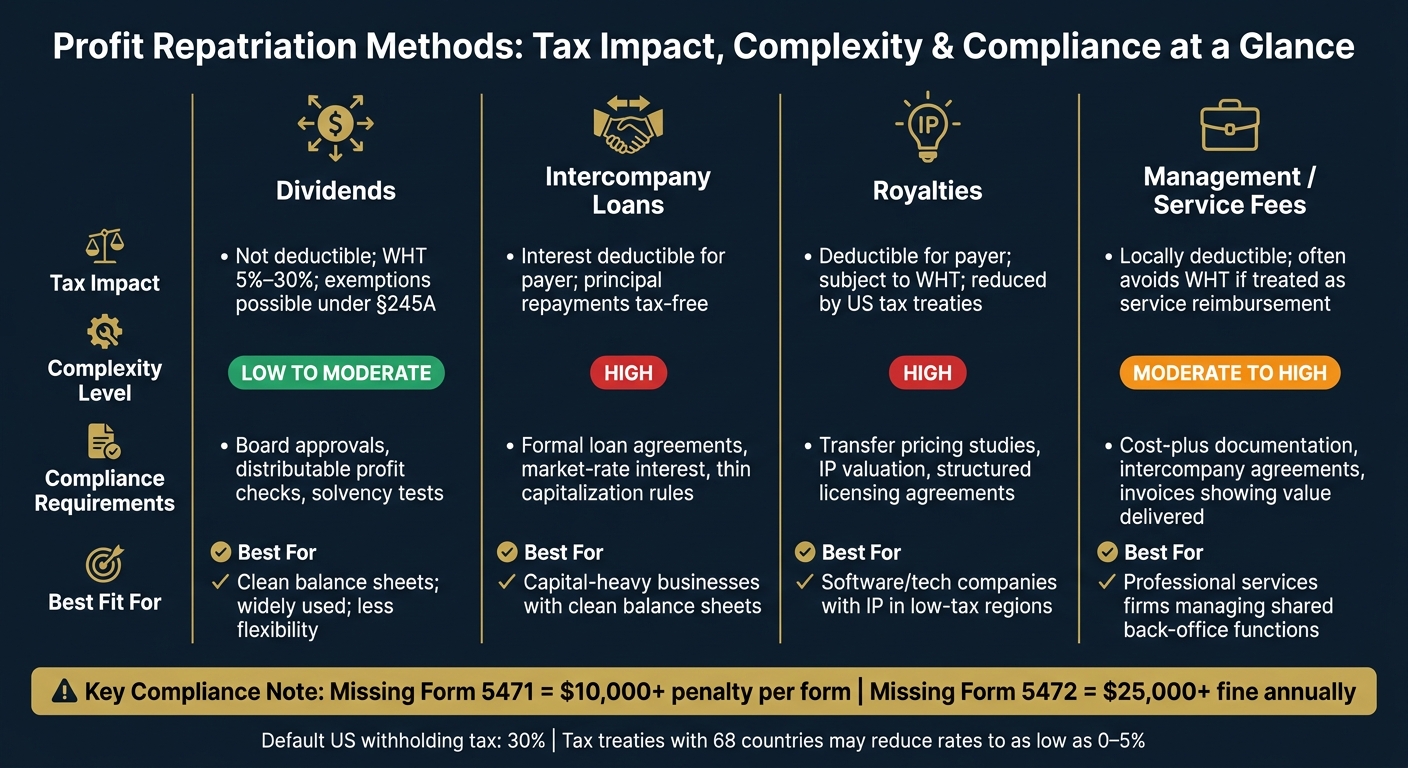
When it comes to repatriating funds, the right choice depends entirely on the unique setup of your business. Factors like your entity type, where your intellectual property (IP) is located, the debt levels of your subsidiary, and your long-term goals all play a role in determining the best method. There’s no one-size-fits-all solution here – it’s all about aligning the strategy with your business’s specific needs.
Repatriation isn’t just about transferring funds; it’s a series of decisions that can have significant tax and operational implications. Each method comes with its own set of benefits depending on your industry and structure. For instance:
- Software companies with IP in low-tax regions often lean toward royalties.
- Professional services firms managing shared back-office functions may prefer management fees.
- Capital-heavy businesses with clean balance sheets might find intercompany loans appealing.
- Dividends, while widely used, tend to offer less flexibility compared to other methods.
Comparison Table of Repatriation Methods
| Method | Tax Impact | Complexity | Compliance Requirements |
|---|---|---|---|
| Dividends | Not deductible; typically subject to withholding tax (5%–30%), though exemptions may apply under specific regimes. | Low to Moderate | Requires board approvals, distributable profit checks, and solvency tests. |
| Intercompany Loans | Interest is deductible for the payer, and principal repayments are tax-free. | High | Needs formal loan agreements, market-rate interest adherence, and compliance with thin capitalization rules. |
| Royalties | Deductible for the payer but generally subject to withholding tax. US tax treaties can reduce rates. | High | Requires transfer pricing studies, defensible IP valuation, and structured licensing agreements. |
| Management / Service Fees | Locally deductible and often structured to avoid withholding tax if treated as service reimbursement. | Moderate to High | Must include cost-plus documentation, intercompany agreements, and invoices showing value delivered. |
This breakdown helps businesses match the method to their operational setup and strategic goals.
Another critical element to consider is foreign exchange costs, especially when moving large sums. The difference in margins between a standard bank (2.5%–4%) and a specialist currency broker (0.3%–0.8%) can significantly impact your net proceeds. This is particularly important for dividends, where fixed payment dates can expose you to exchange rate fluctuations. Using a forward contract to lock in the exchange rate at the time of declaration can safeguard against these risks.
Finally, ensure the method you choose aligns naturally with your business operations. Avoid using royalties or management fees without genuine supporting activities, as these can attract regulatory scrutiny. By pricing transactions at arm’s length and reflecting real business activities, you’ll build a strong compliance foundation.
Conclusion: Steps to Repatriate Profits the Right Way
It’s essential to plan for profit repatriation before funds start piling up. Treat it as a core structural decision from the beginning, not as a rushed wire transfer when cash is urgently needed back home.
Here’s what to focus on: pinpoint where funds are located and understand any restrictions, select the best method for repatriation, estimate potential withholding taxes and U.S. tax implications ahead of time, and ensure all documentation is in order. This includes intercompany agreements, board resolutions, and invoices that clearly outline each transaction. Once your plan is in place, execution needs to be both timely and thoroughly documented.
Proper documentation is non-negotiable. Forms like 5471 and 5472 must be handled with care to avoid severe penalties. Missing Form 5471 filings can lead to penalties starting at $10,000 per form, while failing to file Form 5472 can result in a $25,000 fine annually, with additional $25,000 penalties every 30 days if not corrected after notice. The regulatory landscape is becoming stricter, with initiatives like the Corporate Transparency Act and the Common Reporting Standard increasing visibility into cross-border financial activities.
Combining early planning with strict compliance ensures both efficiency and adherence to regulations. For businesses operating across multiple jurisdictions, managing these complexities alone can be overwhelming. Global Wealth Protection assists location-independent entrepreneurs and investors in designing tax-efficient, legally sound structures. From offshore company formation to intercompany agreements, they help ensure profits are moved cleanly and defensibly. As Global Wealth Protection explains:
"Going offshore isn’t about secrecy. It’s about control. You control where your company is based, where your money lives, and how much you pay in tax."
Taking action early gives you more flexibility and reduces risks. Waiting until profits accumulate can limit your options and increase potential exposure.
FAQs
Which repatriation method is best for my situation?
The most effective way to repatriate profits hinges on your unique situation, objectives, and the legal framework of your jurisdiction. Some commonly used methods are dividends, intercompany loans, royalties, and returns of capital – each carrying its own set of tax and regulatory implications. Critical factors to assess include double taxation treaties, withholding tax obligations, transfer pricing rules, and your residency status. For personalized strategies, Global Wealth Protection provides expert advice to help entrepreneurs and investors manage these complexities effectively.
How can I reduce foreign withholding tax on repatriations?
To lower foreign withholding tax, see if a bilateral income tax treaty exists between the U.S. and the recipient’s country that provides a reduced rate. If you qualify, you can certify your eligibility to the withholding agent by submitting proper documentation, such as Form W-8BEN. If you can’t get immediate relief, you might have to pay the full domestic rate upfront and then file a reclaim request with the appropriate tax authority later.
What documents and IRS forms do I need to avoid penalties?
To steer clear of penalties when handling international business interests or bringing profits back to the U.S., make sure to file the necessary IRS forms. These include:
- Form 5471: Required for those who own shares in a foreign corporation.
- Form 5472: Must be submitted (along with a pro forma Form 1120) for U.S. disregarded entities that are foreign-owned.
- Form 8938: Applies to individuals with foreign financial assets exceeding specific thresholds.
- FinCEN Form 114 (FBAR): Needed if your foreign account balances exceed $10,000.
Failing to file these forms properly can result in penalties ranging from $10,000 to $25,000 per form.
