
The 2025 updates to the OECD Model Tax Convention introduce major changes aimed at addressing tax evasion and modernizing international tax rules for a digital and mobile economy. Key revisions include:
- Remote Work Rules: A 50% threshold for home-office work to determine taxable presence.
- Expanded Information Sharing: Tax authorities can now use exchanged data across multiple investigations.
- Anti-Abuse Measures: Strengthened Principal Purpose Test (PPT) to combat treaty shopping and profit shifting.
- Profit Allocation Clarifications: Updated Article 9 rules to prevent misuse of intercompany loans and excessive debt.
These updates are designed to improve enforcement and transparency but rely heavily on consistent application by tax authorities and businesses worldwide. Challenges include inconsistent adoption, potential conflicts between domestic and treaty rules, and delays in measurable outcomes.
Key OECD Model Updates Targeting Tax Evasion
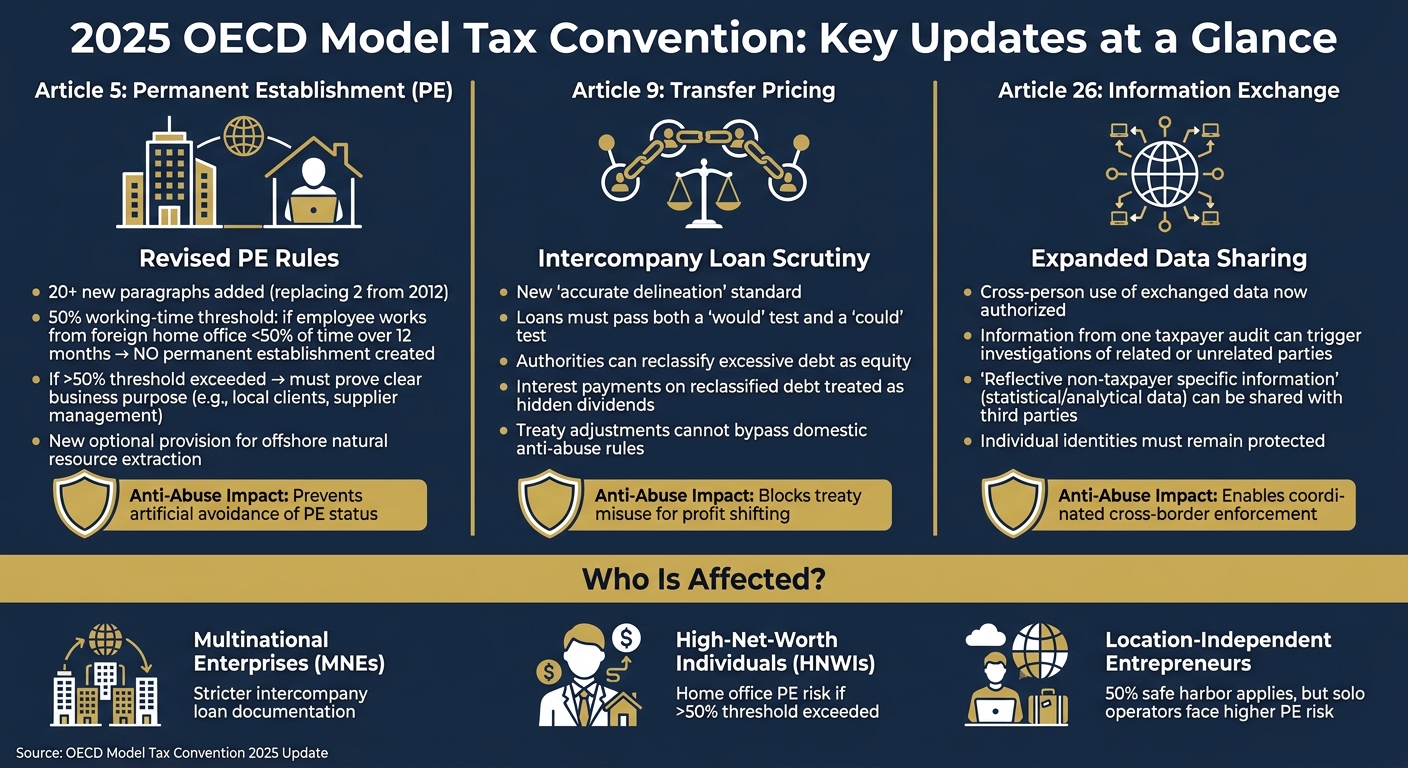
The 2025 update to the OECD Model Tax Convention brings focused changes in three key areas: anti-abuse provisions, information exchange rules, and permanent establishment definitions. These updates aim to address specific challenges in curbing tax evasion.
Anti-Abuse Provisions: Principal Purpose Test and Treaty Shopping
The Principal Purpose Test (PPT), introduced under BEPS Action 6, remains a core measure to prevent tax treaty abuse. It denies treaty benefits if securing those benefits is the primary goal of an arrangement. The 2025 update further strengthens the preamble of the 2017 Model, emphasizing that tax treaties should not facilitate tax evasion or treaty shopping. This reinforces scrutiny across more than 3,000 bilateral tax treaties worldwide.
In addition, Article 9 clarifies the boundaries between international profit allocation and domestic tax rules. Multinational companies can no longer use treaty-based corresponding adjustment claims to bypass domestic rules that limit interest deductions or other anti-abuse measures.
These anti-abuse provisions are paired with enhanced cross-border transparency measures.
Information Exchange and Transparency Updates
Article 26 sees significant expansion in the 2025 update, allowing tax authorities to use exchanged information beyond the original taxpayer or case. This change enables more coordinated cross-border enforcement against tax evasion.
"The Update’s express authorization for cross-person use of exchanged information transforms the tax investigation landscape, as tax authorities can leverage information obtained about one taxpayer to pursue investigations and assessments against related parties, group entities, or even unrelated taxpayers." This increased scrutiny makes asset protection for private family offices more critical as tax authorities gain broader access to group-wide data. – Eversheds Sutherland
Additionally, the update introduces "reflective non-taxpayer specific information." This includes statistical data and analytical insights derived from exchanged information, which can be shared with third parties as long as individual identities remain protected.
Alongside these transparency improvements, the update also addresses how remote work arrangements affect taxable presence.
Revised Permanent Establishment Rules
Article 5, which governs Permanent Establishments (PE), undergoes a substantial overhaul with the addition of over 20 new paragraphs, replacing the two that had been in place since 2012. These revisions tackle strategies used to artificially avoid creating a taxable presence in a jurisdiction.
The key change introduces a two-part test for remote and home office work. If an employee works from a foreign home office for less than 50% of their total work time over a 12-month period, no permanent establishment is created. If this threshold is exceeded, the employee’s location must serve a clear business purpose – such as meeting local clients or managing supplier relationships – for it to qualify as a permanent establishment. Simply working remotely to retain an employee or reduce office costs does not meet the criteria.
Another notable addition is an optional provision targeting natural resource extraction. This provision sets a lower threshold for offshore seabed exploration and exploitation, ensuring that source countries can tax short-term or mobile extraction activities that previously escaped taxation.
| Provision | 2025 Update Focus | Anti-Abuse Impact |
|---|---|---|
| Article 5 (PE) | Remote work & natural resources | Prevents artificial avoidance of PE status through mobile work or short-term extraction |
| Article 9 (Transfer Pricing) | Separation of treaty vs. domestic law | Blocks the use of treaty adjustments to circumvent domestic anti-abuse rules |
| Article 26 (Info Exchange) | Cross-person use of data | Allows information from one audit to trigger investigations against related or unrelated parties |
sbb-itb-39d39a6
How Effective Are the OECD Model Updates in Reducing Tax Evasion?
Research Findings on Tax Evasion Reduction
The 2025 updates to the OECD Model Tax Convention are designed to enhance enforcement, but their success largely depends on how effectively tax authorities implement the changes. These updates represent a shift toward strengthening global tax enforcement mechanisms.
One significant update is the expanded scope of Article 26. This change allows tax authorities to use information obtained from one taxpayer to investigate other related or unrelated parties without requiring new authorization:
"The Update’s express authorization for cross-person use of exchanged information transforms the landscape of tax controversy, as tax authorities can leverage information obtained about one taxpayer to pursue investigations and assessments against related parties, group entities, or even unrelated taxpayers." – Eversheds Sutherland
Another key change involves Article 9, which clarifies how financial transactions are defined. It empowers tax authorities to reclassify excessive debt as equity and deny treaty benefits on interest payments that function as disguised dividends. These adjustments strengthen the ability of authorities to scrutinize questionable financial arrangements.
Experts in the field have praised these updates. For example, KPMG Belgium highlighted that the revisions modernize international tax rules by clarifying provisions on permanent establishments and information exchange.
However, while these updates enhance legal tools for enforcement, their overall impact on reducing tax evasion depends on consistent adoption and practical implementation across jurisdictions.
Challenges in Measuring the Impact
Despite the potential of these updates, assessing their real-world effectiveness in reducing tax evasion is complicated by several factors.
A major hurdle is inconsistent adoption. The 2025 updates are not automatically incorporated into existing bilateral treaties; they serve as a guide for interpretation and future negotiations. Additionally, some countries, like Israel, the Czech Republic, Chile, and Colombia, have formally objected to certain provisions. India’s approach further illustrates this issue. While the OECD introduced a 50% working-time threshold for establishing home-office permanent establishments, India has rejected this threshold and the commercial-reason requirement, opting instead for a broader "at the disposal" interpretation.
Another challenge is the time delay in seeing measurable results. Many of the 2025 updates are designed to clarify existing treaty language rather than introduce entirely new obligations. As Jacques Malherbe from Simont Braun explained:
"The 2025 Update is particularly notable for its focus on practical issues… although many changes are clarificatory rather than revolutionary, together they significantly refine the international tax framework." – Jacques Malherbe
These clarifications may take years to influence audits, court rulings, and revenue collection data.
Finally, the ability to measure the updates’ impact depends on the availability of detailed data. This includes cross-border working-time logs, documentation of commercial rationales for remote work arrangements, and coordinated transfer pricing records. Many organizations are still in the early stages of systematically collecting this type of information. Until these processes mature, it will be difficult to fully assess how much tax evasion has been reduced.
What the Updates Mean for Taxpayers and Authorities
What the Updates Mean for Tax Authorities
The updated Article 26 gives tax authorities broader access to taxpayer data, allowing them to use this information across multiple investigations. This change enables more comprehensive cross-audit capabilities. Additionally, under Article 9, authorities can now examine not just the interest rates on intercompany loans but also the total debt volume. If they find the debt excessive, they can reclassify it as equity, treating the related interest payments as hidden dividends. Bloomberg Tax explains:
"The endorsement of the accurate delineation of transactions bridges this historical gap… the tax authority gains a robust treaty basis to use Article 11 (in conjunction with Article 9 and domestic rules) to deny the withholding tax benefits originally claimed on the recharacterized interest."
Deloitte notes that the OECD revisions aim to prevent the creation of permanent establishments in situations where only minimal profits would be attributed. This reduces the administrative workload for tax authorities.
These updates equip tax authorities with stronger tools for enforcement while simultaneously increasing compliance responsibilities for businesses and individuals.
What the Updates Mean for Multinational Enterprises and High-Net-Worth Individuals
The changes also bring new compliance challenges for multinational enterprises (MNEs) and high-net-worth individuals (HNWIs). For MNEs, stricter documentation is now required, especially for cross-border intercompany loans. These loans must pass both a "would" and a "could" test – confirming that a borrower would have secured a similar loan from an independent third party and could have accessed that level of debt from an external lender. As Christos Theophilou, Tax Partner at STI Taxand, explains:
"Article 9 doesn’t merely govern the arm’s-length pricing of the interest rate; it governs the arm’s-length nature of the capital structure itself."
Another significant change is the 50% temporal threshold, which requires companies to monitor employee locations. If an employee’s presence in a country exceeds 12 months, the company must demonstrate a valid commercial reason, such as managing local suppliers or building a client base.
Self-employed HNWIs also face tighter scrutiny. For example, if a consultant works primarily from a home office in another country over an extended period, that location could be classified as a fixed place of business permanent establishment.
What the Updates Mean for Location-Independent Entrepreneurs
Smaller, location-independent businesses are not exempt from these changes. The expanded Article 5 guidance, which now includes over 20 paragraphs instead of the original two, closely examines mobile business models. The 50% safe harbor rule offers some relief – working from a location for less than half of the total working time over a 12-month period generally avoids creating a permanent establishment. However, solo entrepreneurs face higher risks, as their home offices are more likely to be classified as fixed places of business.
Richard Tonge, Partner and Global Mobility Services Practice Leader at Grant Thornton, highlights the benefits of the updated guidance:
"The commentary is positive in providing employers with greater clarity and flexibility in designing talent strategy that can expand talent attraction across country borders without immediate risk of creating corporate tax exposure."
For entrepreneurs, meticulous tracking of physical presence across borders and documenting the purpose of each stay is critical. Differentiating between personal and business activities is key. Tools and services, such as those offered by Global Wealth Protection, can help entrepreneurs create compliant international structures that meet these new standards.
Open Debates and Future Directions in International Tax Policy
Debates on Digital Taxation and Tax Fairness
One of the most pressing issues in international tax policy today is figuring out how to fairly tax digital economies. The OECD’s Two-Pillar Solution, supported by more than 135 jurisdictions, aims to tackle this by shifting taxing rights to the countries where digital services are consumed, instead of where companies are headquartered. As the OECD puts it:
"The international tax system… is no longer fit for purpose in a globalised and digitalised economy."
Under Pillar One’s Amount B, the 2025 Update introduces a streamlined method for taxing basic marketing and distribution activities. However, not everyone is on board. For instance, India has voiced concerns, rejecting the 50% working-time threshold and advocating for a broader "at the disposal" test. This approach increases the risk of permanent establishment for businesses.
The idea of replacing unilateral Digital Services Taxes (DSTs) with a globally unified standard is another sticking point. Without universal agreement, the risk remains that countries will adopt a fragmented mix of national tax rules. These unresolved challenges highlight the need for further exploration into issues that remain unsettled, paving the way for discussions about future research and reforms.
Research Gaps and What Comes Next
The complexities of digital taxation have revealed several areas where more research is needed, particularly as future reforms take shape. One major question revolves around the impact of revised Article 9, which separates profit allocation rules from domestic taxable income. The 2025 Update clarifies that denying domestic deductibility doesn’t automatically trigger obligations for corresponding adjustments. However, this could lead to economic double taxation for businesses caught between conflicting national tax rules.
Another area of concern is the updated Article 26, which expands tax authorities’ ability to use exchanged information. This change allows data from a single audit to be used to investigate related parties – or even unrelated taxpayers. While this boosts investigative reach, the long-term consequences of this shift remain largely unexplored. These gaps underscore the challenges introduced by modernization efforts and reflect the ongoing evolution of international tax systems.
Looking ahead, the OECD Inclusive Framework is expected to outline its plans for addressing corporate residence, profit attribution for remote workers, and personal tax residence by mid-2026. Additionally, a work plan focusing on global mobility – particularly cross-border remote work – should be released in early 2026. These developments will likely shape the future of international tax policy in significant ways.
Conclusion: Key Takeaways on the OECD Model and Tax Evasion
The 2025 updates to the OECD Model Tax Convention mark one of the most impactful shifts in international tax policy since 2017. As Eversheds Sutherland aptly noted:
"These revisions represent a fundamental recalibration of international tax principles in response to contemporary challenges posed by an increasingly mobile workforce and digitalized global economy."
Some of the standout updates include: a 50% remote work threshold (Article 5) that establishes clearer criteria for defining a permanent establishment; a new "accurate delineation" standard (Article 9) that allows tax authorities to scrutinize and reclassify questionable intercompany debt; an expanded Article 26, which permits cross-border investigations using centralized data; and a separation of treaty profit allocation from domestic deductibility rules. These changes reflect the evolving strategies and complexities of global taxation.
Taken together, these updates highlight a stronger focus on enforcement and transparency in international tax practices. For multinational companies and entrepreneurs operating across borders, this means a greater emphasis on tracking employee activities, justifying intercompany transactions, and ensuring tax compliance aligns with substance over form. These aren’t just recommendations – they’re now essential steps in navigating the new tax landscape.
FAQs
How do I know if remote work creates a permanent establishment?
The OECD Model Tax Convention evaluates the concept of a permanent establishment (PE) using a two-part framework:
- Temporal test: If an employee spends less than 50% of their total working time working remotely within a 12-month period, it generally does not result in the creation of a PE.
- Commercial reason test: A PE is established only when the remote presence is critical to business operations. It cannot be based solely on personal choices, employee retention strategies, or cost-saving measures.
Can tax authorities reuse shared data to audit other people or entities?
Tax authorities operate under the principle of foreseeable relevance, which means any shared data must be directly tied to specific tax enforcement needs. International agreements, such as the OECD Model Tax Convention, enforce strict rules around confidentiality and restrict how the data can be used. If authorities want to use the information for purposes beyond the original investigation, they typically need prior approval from the country that provided it. Violating these rules or misusing taxpayer data can result in sanctions, and authorities are required to adhere to stringent confidentiality standards.
Will the Article 9 changes increase my risk of double taxation?
The 2025 updates to Article 9 might increase the risk of double taxation, especially if cross-border intercompany loans are reclassified as equity. These changes, aligning with OECD transfer pricing guidelines, allow tax authorities to examine the economic substance of debt more closely. If a loan is considered commercially unrealistic, interest payments could be recharacterized as dividends. This reclassification may result in the denial of treaty benefits and spark tax disputes for both lenders and borrowers.
