
Thinking about relocating abroad in 2026? Here’s what you need to know to pick the right country:
- Top Priorities for Expats: Cost of living, safety, healthcare, visa accessibility, and lifestyle matter most. Use tools like the Global Peace Index, WHO health rankings, and visa comparison platforms to evaluate options.
- Best Countries by Category:
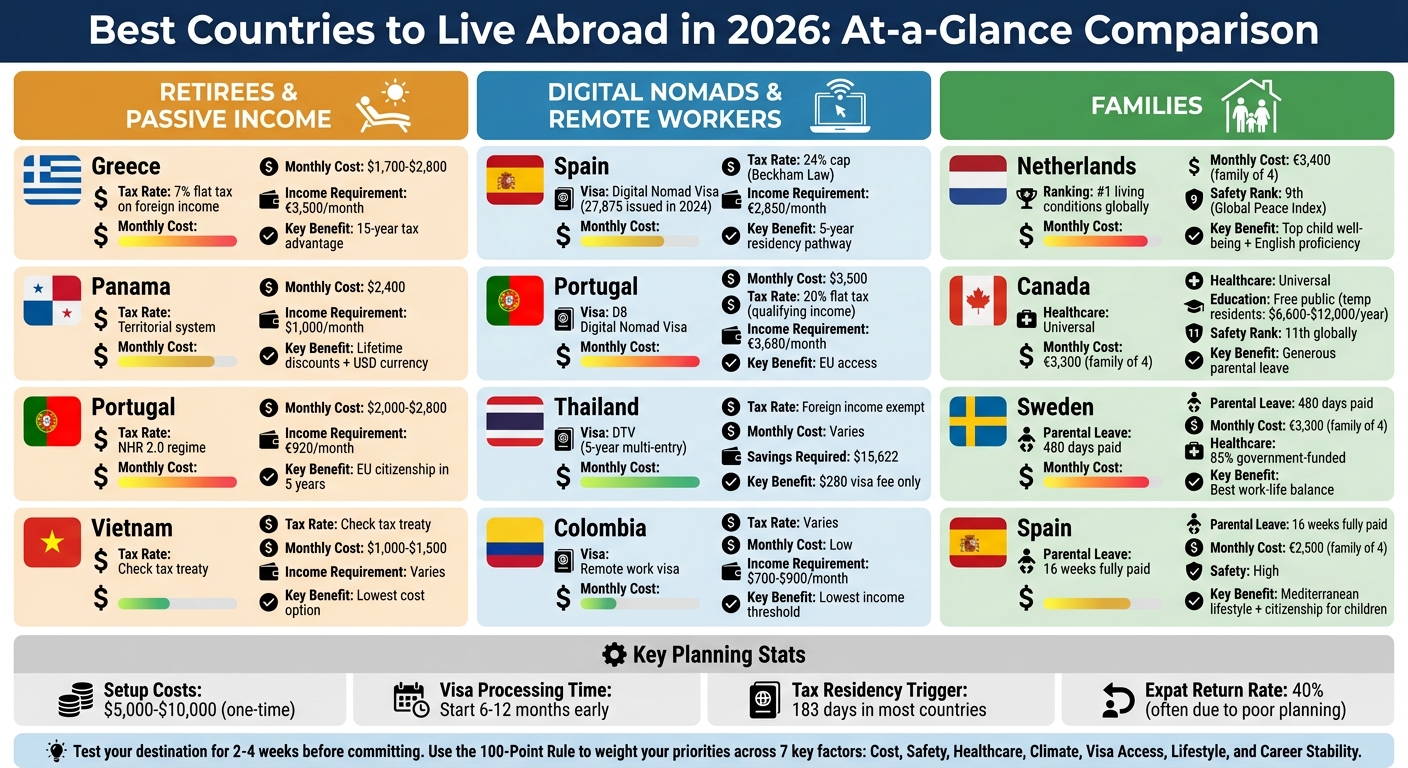
- Retirees: Greece (7% flat tax), Panama (low income requirement), Portugal (affordable living costs).
- Digital Nomads: Spain (Digital Nomad Visa, 24% tax cap), Portugal (D8 Visa), Thailand (low entry cost).
- Families: The Netherlands (child-friendly policies), Canada (free education, universal healthcare), Sweden (generous parental leave).
- Key Visa Tips: Start applications early, check income requirements, and confirm tax residency rules to avoid surprises.
- Cost Insights: Monthly budgets vary – $1,200 in Ecuador, $2,500 in Spain, $3,500 in Greece. Plan for setup costs ($5,000–$10,000).
Pro Tip: Spend time in your chosen destination before committing. Rent locally, test daily routines, and explore healthcare and infrastructure firsthand.
Relocation is about aligning your goals with reliable data. Ready to make your move? Keep reading for a step-by-step guide.
How to Evaluate Countries for Relocation
Key Evaluation Factors
When choosing a country to relocate to, it’s crucial to consider how well it aligns with your personal priorities. To do this, evaluate seven main factors: cost of living, safety, healthcare quality, climate and environment, visa accessibility, lifestyle and culture, and career or economic stability.
Start by assigning weight to each factor based on what’s most relevant to you. For instance, cost of living includes not just daily expenses but also things like health insurance, school fees, and housing costs. Safety can be measured using tools like the Global Peace Index, UN crime statistics, and indicators of political stability. For healthcare, metrics such as the WHO Universal Health Coverage Index or the Euro Health Consumer Index can help you assess a country’s medical infrastructure. If you work remotely, don’t overlook factors like internet speed, transportation networks, and reliable utilities – they can make or break your productivity.
As the team at WhereNext aptly states:
"The romantic version of a place and the daily-life version are almost always different".
What feels exciting during a short vacation might become tedious or challenging in daily life. That’s why practical considerations like English proficiency and openness to different cultures are essential for long-term satisfaction. For example, the Netherlands is a standout for English-speaking expats, consistently ranking as the top country for English proficiency among non-native speakers.
Healthcare is another area to prioritize – unexpected emergencies can quickly drain your savings. Similarly, if your income comes in a foreign currency, keep an eye on inflation and exchange rates, as they can impact your purchasing power. Identify your non-negotiables, such as safety, visa requirements, or climate preferences, to quickly narrow down your options.
Once you’ve identified these key factors, align them with your personal circumstances to refine your choices further.
Matching Criteria to Your Situation
Your life stage and circumstances will greatly influence what matters most in a relocation. For retirees or those with passive income, the focus often shifts to healthcare, safety, and cost of living. Portugal, for example, is a popular choice due to its overall quality of life and accessible residency programs.
For digital nomads and remote workers, visa options for digital nomads, affordability, and lifestyle tend to take center stage. Spain offers a Digital Nomad Visa, providing access to Mediterranean living with strong infrastructure. Families planning a move abroad may prioritize safety, healthcare, and education. Singapore, which scored 75/100 in a composite quality-of-life ranking for 2026, excels in education, career opportunities, and infrastructure.
Of course, there are trade-offs. High-end destinations like Switzerland and Singapore provide world-class infrastructure and job prospects but come with steep living costs. On the other hand, more budget-friendly options like Portugal and Spain offer public healthcare, pleasant climates, and accessible visa pathways – though they may have slower bureaucratic processes and lower local salaries. To simplify decision-making, try a points-based approach: allocate 100 points across the seven dimensions based on your priorities. For example, a retiree might assign 30 points to healthcare, 25 to safety, and 20 to cost of living, while a digital nomad might prioritize visa accessibility, cost, and lifestyle.
Research Tools and Resources
Once you’ve outlined your priorities, use data-driven tools to narrow your options. These tools can provide reliable insights into each evaluation factor. For instance:
- WhereNext Global Relocation Index, AffordWhere, and Numbeo supply verified data on safety, costs, and visa options.
- The WhereNext Global Relocation Index 2026 uses information from sources like the World Bank, WHO, and OECD to rank countries across various dimensions.
- AffordWhere calculates tax burdens based on a €60,000 salary, using data from national authorities like HMRC and Destatis.
- wheretoemigrate.io tracks over 1,900 visa programs across 190+ countries, offering personalized eligibility assessments.
For cost comparisons, platforms like Numbeo provide detailed data on expenses like rent, groceries, and utilities, often using New York City as a baseline (NYC = 100). Additionally, the World Bank’s PPP Conversion Factors and OECD’s Purchasing Power Parities are helpful for comparing purchasing power between countries.
To evaluate safety, the Global Peace Index remains an authoritative source. For language considerations, the EF English Proficiency Index can help determine how easily you can navigate daily life without needing to learn a new language. After narrowing down your options, always verify visa requirements and processing times on official government immigration websites, as these can change frequently.
Finally, follow a structured four-step process to finalize your decision:
- Eliminate options that don’t meet your non-negotiable criteria.
- Score the remaining countries based on your weighted priorities.
- Dive deeper into city-level data, exploring local rental platforms and living conditions.
- Test your top choices by spending at least two weeks in each location to experience daily life firsthand.
During your trial stay, rent a local apartment, shop for groceries in neighborhood markets, and rely on public transit instead of tourist services. This hands-on experience can reveal challenges and nuances that no index or guidebook can fully capture.
sbb-itb-39d39a6
Best Countries by Expat Type
Best for Retirees and Passive Income Earners
Greece tops the 2026 Annual Global Retirement Index, thanks to its Article 5B tax regime. This system offers retirees a 7% flat tax on foreign-sourced income for up to 15 years. Living in Greece is relatively affordable, with monthly expenses ranging from $1,700 to $2,800. However, to qualify for residency, retirees generally need a passive income of around €3,500.
Panama continues to be a favorite among American retirees. Its Pensionado visa requires a modest $1,000 monthly income from sources like Social Security or pensions. On top of that, Panama’s territorial tax system provides discounts on utilities, healthcare, and entertainment for life. The use of the U.S. dollar eliminates currency exchange risks. As of May 2025, the Social Security Administration reported 738,551 beneficiaries receiving payments outside the U.S..
For those leaning toward Europe, Portugal remains a sought-after destination. Its D7 visa requires just €920 per month in passive income, and while the original Non-Habitual Resident (NHR) tax regime has been replaced by NHR 2.0, Portugal still offers a path to EU citizenship after five years. Monthly living costs generally fall between $2,000 and $2,800. Spain, on the other hand, has a higher income requirement for its Non-Lucrative Visa – around €2,400 per month. However, it boasts top-tier healthcare, with private insurance for a 77-year-old costing roughly €217 per month.
If affordability and a slower pace of life are priorities, Vietnam is an excellent choice. Retirees can live comfortably on $1,000 to $1,500 per month, with one-bedroom rentals in Da Nang priced at $400 to $600. However, it’s important to check if your destination has a tax treaty with the U.S. to avoid double taxation. Maintaining multi-currency accounts can also help manage exchange rate fluctuations.
As we shift focus from retirement to work mobility, let’s explore the best destinations for digital nomads and remote workers.
Best for Digital Nomads and Remote Workers
Visa options and tax incentives play a huge role in choosing the right destination for remote work. In 2026, Spain set the benchmark, issuing 27,875 Digital Nomad Visas by the end of 2024 – nearly triple the 2023 number. This visa offers a five-year residency pathway and access to the "Beckham Law", capping income tax at 24% for eligible professionals. The income requirement is about €2,850 per month, with average rents in Barcelona for an 80 m² apartment hovering around €1,920. Demand for housing remains high, with 15% of rental properties being leased within 24 hours in late 2025.
Portugal offers a similar option with its D8 Digital Nomad Visa, requiring a monthly income of €3,680. For qualifying workers, a 20% flat tax rate may apply, depending on income type and residency status. If you’re looking for a more budget-friendly EU option, Croatia offers its Nomad Permit with a €3,295 monthly income requirement and a full tax exemption on foreign-sourced income for up to one year.
Outside of Europe, Thailand has revamped its visa offerings with the Destination Thailand Visa (DTV). For about $280 (THB 10,000), this visa grants five years of multi-entry access. Bangkok, a hotspot for digital nomads, accounts for 2.22% of global visits in this category. Unlike income-based visas, Thailand’s DTV requires proof of $15,622 in savings instead. Similarly, Indonesia (Bali) offers a five-year visa with full tax exemptions on foreign income, requiring a minimum monthly income of $2,500.
For a more accessible entry point, Colombia stands out with income requirements as low as $700 to $900 per month. Meanwhile, Mexico’s financial solvency route now demands about $4,400 per month due to a 13% wage hike in 2025. With over 65 countries offering remote work visas as of early 2026, most require apostilled criminal background checks and proof of income. It’s wise to start applications 3–6 months in advance. Also, staying more than 183 days in many countries can trigger tax residency, so confirm if your visa provides an exemption.
While remote workers prioritize flexibility and tax benefits, families often focus on stability and comprehensive social systems.
Best for Families Starting Over
The Netherlands is a standout destination for families, ranking first globally for living conditions in the Legatum Prosperity Index 2023. It excels in child well-being (per UNICEF), offers a robust education system, and benefits from widespread English proficiency. Monthly costs for a family of four, excluding rent, are about €3,400. The country also ranks 9th on the Global Peace Index.
Canada is another top choice, especially for North American families. It offers universal healthcare, free public education, and generous parental leave policies. Temporary residents may need to pay tuition fees of $6,600 to $12,000 annually until they gain permanent residency. Canada ranks 11th in global safety rankings, and as of February 2025, 42% of Americans were considering leaving the U.S., with 86% of families citing affordability as a key factor.
For those seeking work-life balance, Sweden and Norway are excellent options. Sweden provides 480 days of paid parental leave that can be shared between parents, with monthly costs for a family of four around €3,300. Norway, meanwhile, covers approximately 85% of healthcare costs through government funding. Both countries also have high levels of English proficiency.
Spain and Portugal appeal to families looking for a Mediterranean lifestyle. Spain offers 16 weeks of fully paid maternity and paternity leave, with average monthly costs for a family of four at €2,500. Portugal is slightly more affordable at around €2,300 per month and ranks 7th globally for safety. Both countries allow children born to residents (with at least one year of residency) to gain citizenship.
Families are increasingly using Digital Nomad Visas in Spain and Portugal as stepping stones toward permanent residency. Visa-free entry periods, such as Georgia’s 365-day stay, also provide a chance to "test-drive" a country before committing. Safety concerns drive nearly 35% of families to relocate, while 48% point to political dissatisfaction as a major motivator in 2026.
Tax and Financial Planning for Relocation
Understanding Residency and Taxes
When planning a move abroad in 2026, understanding tax rules and residency requirements is crucial. Tax residency is not the same as physical residency. Many countries consider you a tax resident after spending 183 days there, but others may look at factors like your domicile, main interests, or ties, such as family or property ownership. Once you’re classified as a tax resident, most developed nations tax your worldwide income. However, some countries, like the UAE, Panama, and Singapore, use territorial tax systems, taxing only the income earned within their borders.
To avoid being taxed twice on the same income, Double Taxation Agreements (DTAs) offer solutions like exemptions, tax credits, or reduced withholding rates on dividends and interest. To access these benefits, you’ll often need a Certificate of Residency from your new country and may have to file specific forms, such as the U.S. Form W-8BEN. U.S. citizens should note that the United States taxes worldwide income regardless of where you live. In 2026, over 4.4 million Americans filed tax returns from abroad. Tools like the Foreign Earned Income Exclusion (FEIE) – which allows up to $132,900 of foreign earned income to be excluded – and the Foreign Tax Credit (FTC), which offsets U.S. taxes on other income types, can offer some relief.
Another consideration is exit taxes. Countries like the United States, Canada, Australia, and Germany may tax your unrealized capital gains when you give up residency, provided certain thresholds are met. Selling property before losing tax residency can help you retain capital gains exemptions that might otherwise disappear when you become a non-resident.
Once you’ve clarified your tax residency, the next step is to align your budget with the living costs of your chosen destination.
Monthly Cost Breakdowns by Region
Living expenses can vary widely depending on the region, so budgeting is an essential part of relocation planning. In Southeast Asia, countries like Thailand and Malaysia generally require a monthly budget of around $3,200. These destinations often feature territorial tax systems where foreign-sourced income is usually exempt from taxation.
In Latin America, costs can range significantly. For example:
- Ecuador: ~$1,200/month
- Mexico: ~$1,800/month
- Panama: ~$2,400/month
- Costa Rica: ~$2,800/month (also a territorial tax system).
European countries tend to have higher living expenses, but they often come with extensive public services. For instance:
- Greece: ~$3,500/month, with a 7% flat tax on foreign income for retirees.
- Portugal: ~$3,500/month, with progressive tax rates up to 48% for new residents.
- Spain: ~$2,500/month.
In addition to monthly expenses, you’ll need to account for one-time setup costs. These typically range from $5,000 to $10,000 and cover visa fees, credential assessments, and other relocation-related expenses.
Residency Through Investment Programs
Residency-by-investment programs provide a faster route to legal residency and often come with tax benefits. For example:
- Greece: The Golden Visa requires a minimum investment of €250,000 in renovation projects, granting access to the EU Schengen Zone.
- UAE: The Golden Visa needs a property investment of about AED 2 million (~$545,000) and offers 0% personal income tax on employment income, investment returns, and capital gains. However, expats must fund their retirement entirely, as there’s no state pension system.
- Monaco: Requires a €500,000 bank deposit and has no personal income tax, making it appealing to ultra-high-net-worth individuals.
- Cyprus: Offers a Non-Dom regime with 0% tax on foreign dividends, interest, and capital gains for up to 17 years. Residency requires only 60 days of physical presence annually.
- Malta: The Global Residence Programme (GRP) imposes a minimum annual tax of €15,000, taxing only remitted income.
- Italy: Introduced a €300,000 fixed annual fee under its "Impatriati" flat tax regime, suitable for those earning over €700,000 annually.
- Spain: The Beckham Law provides a flat 24% tax rate on Spanish-sourced income up to €600,000 for six years, while exempting foreign dividends and capital gains.
Before committing to any program, confirm whether the residency status includes special tax regimes or pathways to citizenship. This can help maximize the benefits of your investment and ensure a smoother transition.
Steps to Plan Your Move Abroad
Defining Your Priorities
Once you’ve evaluated your options and planned your finances, it’s time to focus on the details of your relocation. Start by determining your non-negotiables – the must-haves that will immediately rule out certain destinations. These could include a specific safety threshold, visa options like a Digital Nomad visa, or even climate preferences, such as avoiding harsh winters.
To narrow down your choices, consider seven key factors: Cost of Living, Safety, Healthcare Quality, Climate/Environment, Visa Accessibility, Lifestyle/Culture, and Career/Economic Stability. Keep in mind that not all of these will matter equally to everyone. For instance, a retiree might focus heavily on healthcare, while a young remote worker might prioritize career opportunities or lifestyle.
A great way to structure this decision is by using the "100-Point Rule". Assign 100 points across your priorities based on their importance. If safety is your top concern, you might allocate 30 points to it, while something less critical, like climate, could get just 5 points. This method ensures you’re making choices based on what truly matters to you, not just an idealized idea of a destination. As WhereNext puts it:
Choosing which country to move to is not about finding the objectively best country. There is no such thing. It is about finding the best country for you, given your income, your priorities, your risk tolerance, and your lifestyle preferences.
Once your priorities are clear, you can move on to the practicalities of gathering documents and applying for visas.
Preparing Visas and Documents
Start your visa and document preparation 6–12 months in advance to avoid unnecessary stress and costs. First, ensure your passport will be valid for at least 6–12 months beyond your intended arrival date, as many countries won’t issue visas if your passport is close to expiring.
Next, gather essential documents like birth certificates, marriage certificates, and academic records. Many of these will need to be apostilled, an international certification process that can take 4–8 weeks and cost $40–$80 per document. If these documents aren’t in the official language of your destination, you’ll need certified translations, which typically take 1–2 weeks.
For long-term visas, a national-level criminal background check is often required. U.S. citizens, for example, may need an FBI background check, which can take up to 12–18 weeks if processed by mail. Additionally, prepare comprehensive medical records, including your vaccination history and prescriptions listed by their generic names, as brand names often vary between countries.
Don’t overlook digital preparations. Transfer your two-factor authentication from SMS to an authenticator app to avoid being locked out of accounts when your home phone number is deactivated. Set up a virtual mailbox service to manage physical mail and maintain a permanent U.S. address for banking and tax purposes.
With your documents in order, it’s time to test your potential new home.
Testing Destinations Before Committing
Before making a permanent move, spend at least two weeks to a month in your chosen destination to get a feel for everyday life. This allows you to move beyond the surface-level experience of a vacation. Rent an apartment in a local neighborhood and adopt a regular routine instead of a tourist’s lifestyle.
Test key aspects like internet reliability by working from coworking spaces, try public transportation during rush hours, and shop at local grocery stores. To assess healthcare quality, visit local hospitals and pharmacies to check medication availability and the overall infrastructure.
Plan this scouting trip 6 to 9 months before your intended move. Use this time to consult with immigration attorneys or relocation experts to confirm visa requirements and processing times. Research housing prices on local platforms rather than relying on global averages or expat-focused listings, which might not reflect the true market.
Keep an eye on currency fluctuations during your visit. A 15% swing in exchange rates could significantly impact your cost of living if your income is in a foreign currency. Finally, ensure there’s a legal pathway to stay in your chosen destination. Relying on frequent "tourist visa runs" is becoming riskier due to stricter immigration enforcement.
Conclusion: Taking the Next Step
Relocating abroad in 2026 isn’t about chasing a dream – it’s about aligning your personal goals with solid data and making smart, informed choices. This guide has walked you through evaluating countries using weighted criteria, understanding tax obligations, and planning each phase of becoming a digital nomad. With this framework, you’re set to approach your relocation with confidence and clarity.
Begin by using country-specific calculators to determine how your income will translate into purchasing power and savings potential. Validate safety, healthcare, and tax metrics using trusted sources like the World Bank, WHO, and OECD. Stay informed about upcoming policy changes, like the €7 ETIAS fee for EU travel or Germany’s Chancenkarte (Opportunity Card).
Before finalizing your plans, consult licensed immigration experts to chart your legal path and timeline. As Bajwa Migration & IELTS Services cautions:
A single mistake can result in refusal or a multi-year ban. Expert guidance pays for itself.
Professionals can help you navigate complex residency requirements, like Portugal’s $800/month D7 visa minimum or the UK’s £38,700 Skilled Worker visa threshold.
Keep in mind that around 40% of expats eventually return home, often due to preventable planning errors. To avoid this, compare your top choices thoroughly using comparison tools. Once you’ve narrowed it down, spend two to four weeks in your chosen location to ensure it feels like the right fit before committing.
Every step you take, from research to planning, leads to this pivotal decision. With a clear understanding of your needs, supported by reliable data and expert advice, you’re ready to take the first step toward your new life abroad.
FAQs
How do I weight the 7 relocation factors for my situation?
When evaluating the 7 relocation factors, consider what matters most to you personally. For instance, if safety and healthcare top your list, give them a higher percentage in your evaluation. A simple way to do this is by using a percentage-based system. For example:
- Cost of living: 30%
- Safety: 25%
- And so on.
You can adjust these percentages as your priorities or life circumstances shift. This approach ensures your decision remains aligned with what’s most important to you.
When do I become a tax resident after moving abroad?
When you move to a new country, you usually become a tax resident there after meeting its residency requirements. However, if you’re a U.S. citizen, keep in mind that you’re taxed on your worldwide income no matter where you live. If you’re trying to avoid state taxes, you’ll need to either establish or break residency according to the specific rules of your U.S. state. Make sure to review the tax regulations of your new country and carefully follow your state’s guidelines to stay compliant.
What should I check during a 2–4 week “test stay”?
During a 2–4 week trial stay, take the time to evaluate whether the country fits your lifestyle and needs. Pay close attention to the cost of living, including expenses for housing, food, and transportation. Check out the quality of healthcare available and explore the safety of neighborhoods you might want to live in. It’s also important to look into the visa and residency requirements, as these can vary widely. Finally, immerse yourself in the local culture, climate, and daily lifestyle to see if they match what you’re looking for. This short stay can provide valuable insights before committing to a long-term move.
