
Relocating abroad as an American requires careful planning, especially when considering taxes, safety, and quality of life. The U.S. taxes citizens on worldwide income, making it essential to choose destinations with favorable tax systems. This guide explores eight countries – Panama, Costa Rica, UAE, Paraguay, Mexico, Georgia, Bulgaria, and Belize – evaluating their tax benefits, safety, and living standards.
Key Highlights:
- Tax Systems: Territorial tax systems in countries like Panama, Costa Rica, Paraguay, and Belize exempt foreign income from local taxes. The UAE offers 0% personal income tax, while Bulgaria has a flat 10% rate.
- Safety Levels: Costa Rica and Panama are among the safest in Latin America. Mexico’s safety varies by region, while areas in Belize and Paraguay are safer for expats.
- Cost of Living: Affordable options include Paraguay ($1,500–$2,500/month) and Bulgaria (€700–€1,200/month). Panama and Costa Rica offer mid-range costs, while UAE and Belize are pricier.
- Quality of Life: Costa Rica and Panama stand out for healthcare and infrastructure. Belize offers an English-speaking environment, while Georgia and Bulgaria appeal to remote workers with low taxes and living costs.
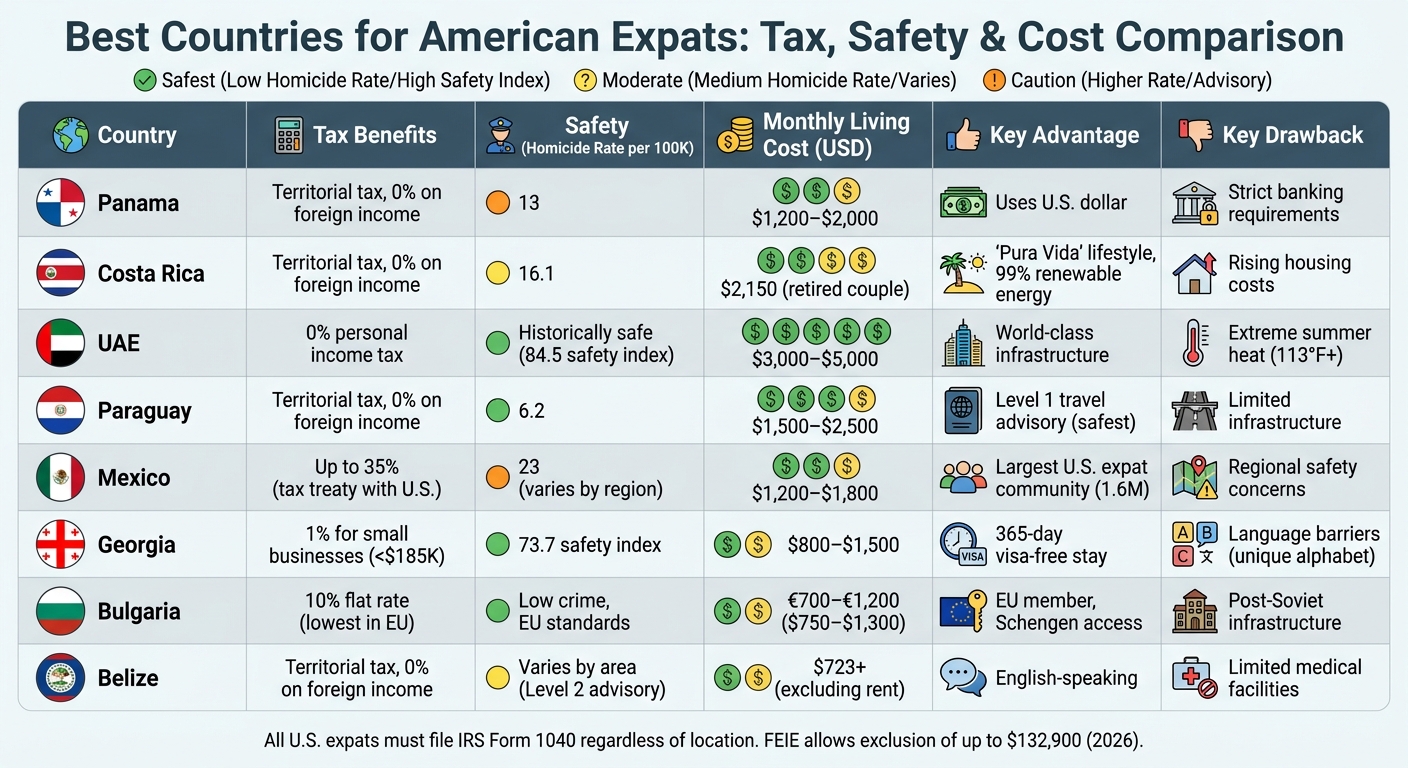
Quick Comparison Table:
| Country | Tax Benefits | Safety (Homicide Rate per 100k) | Monthly Living Cost | Key Drawbacks |
|---|---|---|---|---|
| Panama | Territorial, no tax on foreign income | 13 | $1,200–$2,000 | Strict banking requirements |
| Costa Rica | Territorial, tax-free foreign income | 16.1 | $2,150 (retired couple) | Rising housing costs |
| UAE | 0% personal income tax | Historically safe, recent tensions | $3,000–$5,000 | Extreme summer heat |
| Paraguay | Territorial, 0% foreign income | 6.2 | $1,500–$2,500 | Limited infrastructure |
| Mexico | Tax treaty with U.S., variable rates | 23 | $1,200–$1,800 | Regional safety concerns |
| Georgia | 1% tax for small businesses | 73.7 safety index | $800–$1,500 | Language barriers |
| Bulgaria | 10% flat income tax | Low crime, EU standards | €700–€1,200 | Bureaucracy challenges |
| Belize | Territorial, 0% foreign income | Varies by area | $723+ | Limited medical facilities |
Choosing the right destination depends on your priorities – whether it’s saving on taxes, finding a safer environment, or enjoying a lower cost of living. Always plan for U.S. tax compliance, healthcare coverage, and residency requirements before making the move.
1. Panama
Tax Benefits
Panama operates under a territorial tax system, meaning foreign-sourced income is completely exempt from local taxes. This includes dividends from U.S. stocks, profits from an online business serving non-Panamanian clients, or capital gains from international real estate. Local income, however, is taxed progressively: 0% on the first $11,000, 15% for $11,001–$50,000, and 25% for amounts above $50,000. Additionally, local capital gains are taxed at a flat 10%, and the country maintains a modest 7% Value-Added Tax (ITBMS), among the lowest in the region. There are no wealth, inheritance, or estate taxes in Panama.
For retirees, the Pensionado Visa offers enticing perks like 25% off utility bills and airline tickets, 50% off entertainment, and 20% off medications and medical consultations. To qualify, applicants need a minimum monthly pension of $1,000. Another option is the Qualified Investor Visa, which currently requires a $300,000 real estate investment – though this threshold will rise to $500,000 after October 15, 2026.
It’s worth noting that Panama does not have a tax treaty with the U.S. As a result, U.S. citizens must report worldwide income to the IRS but can take advantage of the Foreign Earned Income Exclusion and Foreign Tax Credit to reduce their tax liability. Conveniently, Panama uses the U.S. dollar as its official currency, which eliminates exchange rate risks. However, local banks demand detailed documentation for account openings and report account data to the IRS under FATCA.
Personal Safety
Panama isn’t just appealing for its tax advantages – it’s also considered one of the safest countries in Latin America. According to the 2025 Global Peace Index, Panama ranks higher than countries like Mexico, Colombia, Brazil, and Costa Rica. The country has no standing military, with security managed by the National Police, SENAN (National Aeronaval Service), and SENAFRONT (National Border Service). Violent crime is relatively low and tends to be concentrated in specific areas, such as Colón and certain neighborhoods in Panama City (San Miguelito, El Chorrillo, Curundu), which expats typically avoid.
The homicide rate in 2024 was approximately 13 per 100,000 inhabitants, with most incidents occurring in Panama City and Colón. For comparison, the U.S. average is about 6.3 per 100,000, but in Panama, crime is more geographically isolated. Expats often settle in safer areas like Boquete, Coronado, or upscale neighborhoods in Panama City, many of which offer 24/7 gated security.
Panama’s location outside the hurricane belt adds another layer of safety, as it avoids the tropical storms that impact other parts of the Caribbean and Central America. For added precautions, expats are advised to use ride-sharing apps like Uber instead of unregulated taxis, register with the Smart Traveler Enrollment Program (STEP) for emergency updates, and avoid flaunting cash or expensive jewelry.
Quality of Life
Panama combines modern conveniences with a welcoming environment for expats. The country boasts reliable infrastructure, including high-speed internet (with Starlink available in rural areas), dependable electricity, and drinkable tap water. Its road network is among the best in the region, and the healthcare system features world-class facilities like Punta Pacifica Hospital (affiliated with Johns Hopkins International) and The Panama Clinic. Many doctors are U.S.-trained and fluent in English, with routine doctor visits costing less than $20 without insurance. Approximately 14% of the population speaks English, especially in business hubs and expat communities.
The Panama Canal’s historical significance has fostered a friendly expat culture. In a 2025 survey, 94% of expats reported being happy with their life in Panama.
"Panama stands out among the world’s expat destinations because it offers solid infrastructure and First World amenities close to North America." – International Living
While public healthcare is available, private insurance ensures access to top-tier facilities. A 66-year-old can secure local health insurance for around $117 per month, and MiniMed offers memberships starting at just $20 per month. Globally, Panama’s healthcare system ranked 95th among the top 100.
Cost of Living
Living in Panama is affordable compared to many Western countries. A single person can live comfortably on $1,200 to $1,500 per month, while couples typically spend $1,500 to $2,000. Panama City and Coronado are on the pricier side, but towns like Boquete offer excellent value. For instance, a two-bedroom rental in Boquete averages $750 per month, with utilities costing around $25 (without air conditioning), groceries about $300, and internet/cable at $60. Dining out is also budget-friendly – a meal at a local fonda costs as little as $4.
The Pensionado Visa further reduces living expenses through discounts on utilities, entertainment, and healthcare. However, opening a bank account in Panama requires thorough preparation. Banks typically request reference letters, apostilled proof of funds, and other documentation. Additionally, Panama complies with CRS and FATCA, so bank account information is shared with the IRS.
sbb-itb-39d39a6
2. Costa Rica
Tax Benefits
Costa Rica has a territorial tax system, meaning only income earned within the country is taxed. This makes it an attractive option for retirees and expats with U.S.-based income sources like Social Security, pensions, or 401(k) withdrawals, as these remain untaxed. Andrew Coleman, CPA, explains:
"Costa Rica operates on a territorial tax system – only income earned within the country is taxed. So if your money comes from US Social Security, foreign rental properties, or overseas investments, Costa Rica tax on foreign income simply doesn’t apply."
For remote workers, the Digital Nomad Visa offers a tax exemption on local income for up to two years, provided they earn at least $3,000 monthly (or $4,000 with family). For those earning locally, the tax system is progressive: the first ₡918,000 CRC per month is tax-free, with rates rising to 25% for income above ₡4,727,000 CRC. Additionally, Costa Rica has no estate or inheritance taxes, and capital gains are mostly untaxed unless tied to regular business activities. Property taxes are low, just 0.25% of the registered value – on a $200,000 property, that’s about $500 annually.
However, Costa Rica doesn’t have a tax treaty with the U.S., so expats must rely on the Foreign Earned Income Exclusion and Foreign Tax Credit to avoid double taxation. The country also applies a 13% Value-Added Tax (IVA) on goods and services.
Beyond its tax policies, Costa Rica provides a stable and welcoming environment for expatriates.
Personal Safety
Costa Rica’s political stability adds to its appeal. The country abolished its military in 1948, maintaining peace and stability for decades[24,25]. However, the homicide rate rose to 16.1 per 100,000 inhabitants in 2025, up from around 11 per 100,000 earlier in the decade. Most violent crime is concentrated in port areas like Limón and Puntarenas, while expat neighborhoods and tourist zones remain largely unaffected. According to Numbeo, Costa Rica’s Safety Index is 46 out of 100, slightly lower than the U.S. at 50.
Petty crimes such as theft and vehicle break-ins are more common in urban areas like downtown San José. Many expats opt for safer neighborhoods like Escazú, Santa Ana, or Rohrmoser, or gated communities in beach towns like Nosara and Tamarindo. Mikkel Thorup, CEO of Expat Money, emphasizes:
"The rise in violent crimes most of the time doesn’t affect ordinary citizens or expats who aren’t related to any of these gang disputes."
While Costa Rica is located on the Pacific Ring of Fire, seismic activity rarely results in fatalities. Over the decade leading to 2023, only five deaths were linked to earthquakes, mostly due to heart attacks rather than structural damage. Public hospitals provide free emergency care for residents, expats, and visitors.
Quality of Life
Costa Rica pairs its tax and safety advantages with a high quality of life. The healthcare system includes both public (CAJA) and private options. Public coverage costs between $40 and $80 per month, while private insurance ranges from $100 to $200 for faster service. Many expats combine both systems for comprehensive care.
The country is also a leader in sustainability, generating 99% of its energy from renewable sources and hosting 5% of the planet’s biodiversity. The Nicoya Peninsula is recognized as a "Blue Zone", where residents often live past 100 due to lifestyle and environmental factors. The "Pura Vida" philosophy embodies a relaxed, health-focused approach to life.
Travel to and from Costa Rica is convenient, with direct flights to major U.S. cities taking just 3 to 6 hours. The Central Valley enjoys comfortable temperatures (70–80°F), while coastal areas like Guanacaste offer warmer, beach-friendly climates.
Cost of Living
Costa Rica’s affordability is another key draw for expats. The average monthly cost for an expat lifestyle is around $2,800. Retired couples typically spend about $2,150 per month, including housing ($1,000), healthcare ($250), and groceries ($450). Dining out is budget-friendly, with a traditional "casado" lunch plate costing $5 to $8.
For those seeking residency, the Pensionado Visa requires proof of a $1,000 monthly lifetime pension, which also grants access to public healthcare. Residents contribute 5% to 11% of their income to CAJA for health coverage.
All these factors combine to make Costa Rica an appealing destination for expats looking for a balance of affordability, safety, and quality of life.
3. United Arab Emirates
Tax Benefits
The UAE is well-known for its 0% personal income tax. This applies to earnings from employment, self-employment, investment returns, capital gains, and even inheritance. For U.S. citizens, the Foreign Earned Income Exclusion (FEIE) allows up to $134,000 of earned income to be excluded in 2026. Additionally, Dubai qualifies as a high-cost city, which means an extra Foreign Housing Exclusion of $37,000–$42,000 may apply. However, there’s no comprehensive tax treaty between the U.S. and the UAE, so treaty-based exemptions aren’t available.
U.S. citizens are still on the hook for a 15.3% self-employment tax, and passive income like dividends, interest, and rental income remains taxable in the U.S. On top of that, the UAE enforces a 5% VAT on goods and services. The country maintains a fixed exchange rate with the U.S. dollar at 3.6725 AED per dollar.
To put this into perspective, a California-based professional earning $120,000 could face an effective tax rate of about 29.5% in the U.S. In contrast, the same individual in the UAE would see a 0% effective tax rate when leveraging the FEIE.
Personal Safety
In March 2026, the UAE faced temporary security concerns due to escalating tensions from the Iran war. This period saw missile interceptions over Dubai and attacks on oil infrastructure, prompting the U.S. State Department to recommend that American citizens leave the Gulf region.
That said, the UAE has historically been one of the world’s safest countries. In 2025, it ranked second globally on Numbeo’s Safety Index with a score of 84.5, and violent crime remains rare. Even with recent challenges, the country’s long-standing safety measures and efficient governance remain robust. Extensive surveillance systems and a stable federal monarchy, trusted by 74% of residents, continue to uphold public safety. While recent events have temporarily impacted its security profile, the UAE still boasts modern infrastructure and amenities that contribute to a comfortable lifestyle.
Quality of Life
The UAE combines cutting-edge infrastructure with conveniences like reliable high-speed internet and direct flights to major U.S. cities, including JFK, LAX, SFO, and ORD. Healthcare is another highlight, with top-tier facilities such as Cleveland Clinic Abu Dhabi and American Hospital Dubai offering shorter wait times compared to the U.S. A routine doctor’s visit costs between $55 and $136, while an MRI ranges from $408 to $817.
The expat community is thriving, with about 3.5 million people from over 200 nationalities calling the UAE home. English is widely spoken, and American-curriculum schools – aligned with U.S. Common Core standards and offering AP courses – cater to families with annual tuition ranging from $12,250 to $28,600. U.S. citizens can also easily convert their driver’s license to a UAE license without additional testing.
However, the summer heat can be intense, with temperatures often exceeding 113°F from June through September, making outdoor activities difficult. Private health insurance is mandatory, with basic plans costing between $800 and $1,360 annually. Additionally, during Ramadan, eating, drinking, or smoking in public during daylight hours is prohibited.
Cost of Living
Living comfortably in Dubai as a single professional typically requires a budget of $3,000–$5,000 per month. Rent for a one-bedroom apartment in sought-after areas like Dubai Marina or Downtown ranges from $1,360 to $2,450 monthly. Grocery bills usually fall between $400 and $600, while dining out may cost $300 to $500. Utilities, including air conditioning, add another $150 to $300 per month.
For those considering long-term residency, the UAE’s Golden Visa program offers 5- or 10-year residency to property investors who purchase real estate worth at least $545,000 (roughly AED 2 million). Abu Dhabi, while slightly less expensive than Dubai, offers housing that’s 10% to 20% cheaper. However, it’s worth noting that rental payments in the UAE are often made in 1 to 4 annual installments rather than monthly.
4. Paraguay
Tax Benefits
Paraguay’s territorial tax system means you’re only taxed on income earned within the country. This makes it a haven for remote workers and investors, as foreign income – like earnings from U.S. companies, international investments, or dividends – carries a 0% tax rate. For local income, the tax rate is progressive, ranging from 8% to 10%, one of the lowest in South America.
The country has no wealth, inheritance, gift, or exit taxes. Value-added tax (VAT) is set at 10%, with a reduced 5% rate on essentials like basic goods and residential rentals. U.S. expats can also take advantage of the Foreign Earned Income Exclusion (FEIE), which allows them to exclude up to $132,900 of qualifying foreign income from U.S. taxes in 2026. However, self-employment tax and passive income remain subject to U.S. taxation.
"I was paying $3,500/month rent in Austin, plus taxes eating 30% of my income. Now I live in a luxury apartment in Asunción for $600, my remote income is tax-free here, and I’m using FEIE to exclude it from US taxes too. Same work, 3x the savings." – American software developer, Expat in Paraguay
To maintain the 0% tax rate, ensure your income qualifies as foreign-sourced. If you’re physically working in Paraguay for international clients, the tax authority (DNIT) might classify it as Paraguayan-source income. To secure a tax residency certificate without spending 120 days in the country, keep your RUC (tax ID) active by filing monthly VAT returns, even if they show zero income.
Personal Safety
Paraguay has a Level 1 Travel Advisory from the U.S. State Department (as of April 2026), placing it in the safest category alongside countries like France and Germany. Its homicide rate of 6.2 per 100,000 people is among the lowest in South America. Upscale neighborhoods in Asunción, such as Villa Morra and Recoleta, offer safety levels comparable to U.S. suburbs.
While Paraguay does face issues like organized crime and corruption, these are more prevalent in border areas like Ciudad del Este and the northeastern regions, not in expat-friendly zones like Asunción. The government, under President Santiago Peña, has been cracking down on organized crime through initiatives like Operation Veneratio and is expanding the national police force by 5,000 officers annually.
Quality of Life
Paraguay’s EST-1 timezone (UTC-4) aligns well with U.S. East Coast working hours, making it ideal for remote workers. High-speed fiber internet (200+ Mbps) is widely available in Asunción for $30–$50 per month, and direct flights to Miami take about 7 hours.
Healthcare in Paraguay is both affordable and reliable. Private hospitals like Sanatorio Italiano and Hospital Privado Bautista provide care on par with U.S. standards, with English-speaking, U.S.-trained doctors. Private health insurance costs between $75 and $200 per month, far less than in the U.S. Since Medicare doesn’t cover services in Paraguay, securing local insurance is a must.
While English is common in expat neighborhoods, learning basic Spanish helps with day-to-day interactions. The residency process is straightforward, typically taking 3–6 months for temporary residency, with no initial investment or income requirements. However, you’ll need an FBI background check with an apostille before leaving the U.S., as this document cannot be obtained in Paraguay. U.S. Social Security benefits are paid without reductions and are not taxed by the Paraguayan government.
Cost of Living
Paraguay offers an affordable lifestyle that’s especially appealing to American expats. Living comfortably in Asunción typically costs between $1,500 and $2,500 per month. Rent for a one-bedroom apartment in desirable neighborhoods like Villa Morra or Recoleta ranges from $400 to $800 per month. Groceries cost around $200–$350 monthly, and dining out is inexpensive, with meals priced between $5 and $15. A dinner for two averages $20–$40, and a 10-minute Uber ride costs just $3–$5.
The full residency process, including lawyer fees and government charges, usually costs $2,000–$3,500. Overall, living in Asunción is about 70% cheaper than in major U.S. cities. Household help is also affordable, costing $30–$50 per week. However, direct Amazon shipping is limited, so most expats use Miami-based forwarding services like Courier Box or Aerobox, which charge $8–$15 per pound.
5. Mexico
Tax Benefits
Mexico offers a mix of tax advantages, living conditions, and safety factors that appeal to American expats. The country uses a worldwide taxation system for residents, but temporary residents often enjoy territorial treatment, meaning foreign-sourced income might not be taxed locally. You’re considered a tax resident after spending 183 days in Mexico. The top income tax rate is 35% for earnings over approximately 5.1 million MXN (about $253,000 USD) in 2026, which is slightly lower than the U.S. federal rate of 37%.
The U.S.–Mexico tax treaty helps prevent double taxation on business profits, dividends, interest, royalties, and pensions. Additionally, the Foreign Tax Credit (FTC) allows U.S. taxpayers to offset taxes paid in Mexico, while the Foreign Housing Exclusion can reduce taxable income by covering certain housing expenses.
Mexico does not impose wealth, inheritance, estate, or gift taxes. Capital gains tax on stocks traded on recognized exchanges is a flat 10%, and if you sell your primary residence after living there for at least two years, you could be exempt from gains up to roughly $272,000 USD (5.5 million MXN). To earn income in Mexico, you’ll need an RFC (tax ID) from the SAT.
"Mexico-based expats have substantial tax savings opportunities amid some complexity." – Chip Moreno, Licensed Tax Professional
For expats using the Foreign Earned Income Exclusion (FEIE), the Bona Fide Residence Test often offers more flexibility than the Physical Presence Test since it allows for more trips back to the U.S..
Personal Safety
Safety in Mexico can vary greatly depending on the region. While the national homicide rate in 2024 was 23 per 100,000 people, many popular expat areas are as safe as mid-sized cities in the U.S.. Mérida, the capital of Yucatán, is frequently hailed as the safest city in Mexico and one of the safest in Latin America. Yucatán itself has been the country’s most peaceful state for eight consecutive years.
The U.S. State Department advises against travel to certain states, including Sinaloa, Tamaulipas, Guerrero, Michoacán, Colima, and Zacatecas, due to organized crime. However, most violence is related to drug trafficking and rarely involves foreigners. In 2026, Mexico scored 58 out of 100 for safety – lower than Costa Rica’s 72 – but saw a 5.3% drop in its homicide rate in 2023.
"Mexico is the world’s most popular destination for American and Canadian expats." – WhereNext
In Mexico City, neighborhoods like Roma and Condesa are popular with expats and offer safety levels comparable to suburban areas in the U.S. For safer travel, especially at night, it’s recommended to use ride-hailing apps like Uber or Didi instead of street taxis.
Quality of Life
With around 1.6 million Americans living there, Mexico boasts the largest U.S. expat community worldwide. In the 2025 Expat Insider survey, Mexico ranked 3rd overall and 1st globally for "Ease of Settling In." About 35% of expats reported that their social circles were primarily made up of locals – more than double the global average of 16%.
Mexico City is a hotspot for digital nomads, thanks to its U.S.-aligned time zones, fast internet (80–150 Mbps), and vibrant coworking spaces. The city’s pleasant climate, with temperatures ranging from 59°F to 79°F year-round, and its proximity to major U.S. cities (just 2–4 hours by flight), make it an attractive base for remote workers.
Healthcare in Mexico is another strong point. The private sector, especially in major cities, offers top-tier services with many U.S.-trained doctors and internationally accredited hospitals. Private health insurance typically costs $100 to $300 per month, while legal residents can access the public IMSS system for about $50 annually, though wait times can be lengthy. Many expats also take advantage of medical tourism, with procedures like elective surgeries and dental work often costing 50–70% less than in the U.S..
While many expats initially enter Mexico on a 180-day tourist permit, stricter immigration enforcement on repeat "visa runs" has made the Temporary Resident visa a better option for long-term stays. If you’re buying property within 31 miles (50 km) of the coast or 62 miles (100 km) of the border, you’ll need to use a fideicomiso (bank trust).
Cost of Living
Mexico offers a comfortable lifestyle at a fraction of what it costs in the U.S. In Mexico City, a single person can live well on $1,200–$1,800 per month, while in smaller cities like Oaxaca or Mérida, monthly expenses range from $800 to $1,400. Rent for a one-bedroom apartment in central Mexico City is typically $700–$1,200, compared to $400–$800 in Mérida.
Property taxes (predial) are very low, ranging from 0.02% to 0.2% of the property’s assessed value. The VAT on goods and services is 16%. However, residency card fees have increased, with first-year costs reaching $600–$700 in 2026.
A stronger peso has made living in Mexico more expensive for those earning in U.S. dollars. Experts suggest negotiating rents in pesos to mitigate this impact. Still, about 86% of American families cite affordability as their main reason for relocating to Mexico.
6. Georgia
Tax Benefits
Georgia runs on a territorial tax system, meaning residents aren’t taxed on income earned outside the country. Articles 82 and 104 of the Tax Code outline the types of foreign income exempt from taxation. These include interest from foreign banks, foreign pensions, royalties unrelated to Georgian activities, and dividends from foreign companies.
One of Georgia’s standout features is the Individual Entrepreneur (IE) status. This offers a tax rate of just 1% on turnover for small businesses making up to 500,000 GEL annually (around $185,000). For instance, a freelancer earning $100,000 in remote income would only pay $1,000 in taxes. Beyond this, Georgian-source income is taxed at a flat 20%, while passive income like dividends and interest is taxed at only 5%. Additionally, there’s no capital gains tax on crypto-assets for individuals.
"Georgia takes $1,000 [on $100,000 of remote income]. The single biggest financial optimization available to a remote worker is… choosing where to establish tax residency." – WhereNext
To establish tax residency, one must spend 183 days or more in Georgia within a 12-month period. Expats are encouraged to obtain an annual tax residency certificate from the Georgia Revenue Service to avoid complications with dual residency. However, U.S. citizens must still file IRS Form 1040 to report worldwide income and submit an FBAR if foreign account balances exceed $10,000. Using the Foreign Earned Income Exclusion (FEIE), U.S. citizens can exclude up to approximately $132,900 of foreign earned income from U.S. taxes for the 2026 tax year.
Next, we’ll explore how Georgia’s tax benefits align with its reputation for safety and public security.
Personal Safety
Georgia is considered one of the safest countries in Eastern Europe and the Caucasus, with a safety index of 73.7 and a crime index of just 26.3. Violent crime is extremely rare, and foreigners are seldom targeted. Following the 2003 Rose Revolution, sweeping reforms transformed the police force, making it both professional and free of corruption. Tbilisi’s homicide rate is lower than in most major European cities, and petty crime is less frequent than in places like Rome or Barcelona.
Although 20% of Georgia’s territory (South Ossetia and Abkhazia) remains under Russian occupation, this has little impact on daily life in expat-friendly cities like Tbilisi and Batumi. Public protests, often tied to EU-related issues, are typically peaceful and limited to areas like Rustaveli Avenue. For transportation, ride-hailing apps like Bolt or Yandex Go are recommended to avoid inflated fares from street taxis.
These safety measures contribute to Georgia’s appeal as a balanced and secure place to live.
Quality of Life
Americans can stay in Georgia visa-free for 365 days, with the option to reset this period by leaving and re-entering the country ("border runs"). Georgia is welcoming to Americans, though the unique 33-character Mkhedruli alphabet and language can be a hurdle outside Tbilisi. The capital, however, blends modern conveniences with a lively coffee culture, a celebrated wine scene, and internet speeds averaging 75–80 Mbps, with up to 200 Mbps in prime locations.
Healthcare in Georgia is both affordable and accessible. Private clinics like MediClub and New Hospitals offer modern facilities and English-speaking staff at costs far below those in the U.S. A general practitioner visit typically costs $15–$30, dental cleanings range from $30–$50, and an MRI scan is priced between $100 and $200. Private insurance plans from providers like Aldagi or GPI cost about $30–$80 per month. However, U.S. Social Security payments require a U.S.-based bank account and mailing address, as Georgia is on the SSA restricted list.
Cost of Living
Georgia offers an affordable lifestyle, with monthly living expenses ranging from $800 to $1,500. This makes it easier for expats to capitalize on the tax savings offered by IE status. Rent for a one-bedroom apartment in central Tbilisi is typically $400–$700, while apartments in outer districts cost around $200–$350. A meal at a local restaurant costs $4–$7, metro rides are just $0.20, and fiber internet is $10–$20 per month. Monthly grocery bills generally fall between $200 and $350, and utilities range from $30 to $80.
To maximize tax benefits, it’s crucial to register for IE status as soon as you arrive, as income earned beforehand is taxed at the standard 20% rate. Additionally, expats should consider establishing domicile in a no-income-tax state like Florida or Texas before moving to Georgia to avoid lingering state tax obligations. Starting February 2026, all foreign nationals working or self-employed in Georgia will need to obtain a "Right to Work" permit.
7. Bulgaria
Tax Benefits
Bulgaria boasts a flat personal income tax rate of 10%, the lowest in the European Union. This rate applies universally, regardless of income level. Freelancers enjoy an even lower effective rate of about 7.5%, thanks to a 25% automatic deduction for recognized expenses. Corporate income is also taxed at a flat 10%, while dividends are taxed at just 5%.
"Bulgaria charges 10% flat income tax – the lowest rate in the European Union." – Innovires
For foreign retirees, pensions are tax-free during their first ten years in the country. Additionally, there’s no wealth tax, and inheritance taxes are 0% for spouses and direct family members. Since adopting the Euro on January 1, 2026, Bulgaria has eliminated currency exchange risks for those earning in euros. A tax treaty with the U.S., signed in 2007, helps prevent double taxation, though Americans are still required to file IRS Form 1040. To establish tax residency, you’ll need to spend over 183 days in Bulgaria within a 12-month period. Filing your tax return electronically by March 31 earns you a 5% discount (up to €255.65).
Personal Safety
Bulgaria joined the Schengen Area in 2024, offering free movement across Europe and solidifying its position as a stable EU member since 2007. Cities like Sofia, Plovdiv, and Varna are home to established expat communities and are considered safe for families, retirees, and digital nomads. The country follows EU legal and consumer standards, ensuring a reliable framework for residents. English proficiency is around 25%, primarily among younger professionals in urban areas. The unemployment rate, as of early 2026, stands at a low 5.2%. This secure and structured environment enhances Bulgaria’s appeal for those seeking a balanced lifestyle.
Quality of Life
In the first half of 2025, Bulgaria issued over 35,000 work permits to non-EU nationals, addressing labor shortages in sectors like tech and tourism. The newly introduced Digital Nomad Visa allows non-EU remote workers earning approximately €31,000 annually to live in Bulgaria. Affordable private health insurance, costing €30–€80 per month, provides excellent care with English-speaking professionals. Upon arriving, you’ll need to register your address with the local municipality within 90 days to obtain a registration certificate. These conveniences, paired with Bulgaria’s low cost of living, make it an attractive destination for expats.
Cost of Living
Bulgaria remains one of the most budget-friendly countries in the EU, with prices averaging about 47% of the EU standard. A single expat can live comfortably on €700–€1,200 per month. Renting a one-bedroom apartment in central Sofia costs €300–€500, while similar apartments in Plovdiv or Varna range from €250–€400. Monthly utilities typically fall between €80–€150. Public transportation passes cost €20–€30, and groceries usually amount to €150–€250 per month. The minimum wage for 2026 is set at €620.20 per month.
"Bulgaria is the country that budget-conscious expats keep discovering and never want to leave." – WhereNext
8. Belize
Tax Benefits
Belize uses a territorial tax system, which means you only pay taxes on income earned within the country. Income from foreign sources – like U.S. investments, Social Security, or retirement pensions – is entirely tax-free locally and not subject to additional local taxes. Plus, there’s no capital gains tax, wealth tax, or inheritance tax.
"Belize’s tax rules are refreshingly simple. The country has a territorial tax system, which means that residents pay tax only on income earned within Belize." – Vincenzo Villamena, CPA, Online Taxman
The Qualified Retirement Program (QRP) is a standout option for expats aged 40 and older. To qualify, you need to show a foreign income of at least US$2,000 per month and spend at least 30 consecutive days in Belize each year. QRP participants enjoy tax exemptions on all foreign-sourced income and can import household goods and a vehicle duty-free in their first year. For income earned within Belize, a flat tax of 25% applies, but earnings under US$14,500 are exempt. Property taxes are impressively low, often under US$100 annually, and the General Sales Tax (GST) is 12.5%. While Belize doesn’t have a tax treaty with the U.S., American citizens still need to file IRS Form 1040. The 2026 Foreign Earned Income Exclusion (FEIE) allows up to US$132,900 to be excluded from taxable income.
Personal Safety
Belize’s safety landscape has its nuances. The U.S. Department of State rates Belize as Level 2: Exercise Increased Caution due to crime. Violent crime is mainly concentrated in specific neighborhoods of Belize City, such as Southside, which is rated Level 3: Reconsider Travel. However, expat-friendly areas like Ambergris Caye, Placencia, Caye Caulker, and the Cayo District are much safer.
Belize operates as a stable parliamentary democracy and a Commonwealth realm, with its legal system rooted in English common law. That said, local police resources can be limited, so many expats rely on community networks and home security measures like motion-activated lights and window bars. Economically, the Belize dollar is pegged to the U.S. dollar at a steady 2:1 ratio, which adds a layer of financial stability. To minimize risks, avoid driving between cities at night and walking alone after dark, even in tourist-friendly areas.
Quality of Life
Belize stands out as the only English-speaking country in Central America, making it easier for American expats to handle everyday tasks and legal matters. Its culture is a lively mix of Creole, Latino, and British influences, combined with a relaxed "island time" vibe. Routine doctor visits are affordable, costing between US$25 and US$50. However, advanced medical care is limited, so having international health insurance with evacuation coverage is highly recommended.
The country’s infrastructure can be hit or miss, with occasional power and water outages in certain areas. Road conditions vary, and coastal residents need to be prepared for hurricane season, which runs from June through November. Renting before buying property is a smart move, and consulting professional real estate agents can help avoid scams. With its straightforward tax system, English-speaking environment, and laid-back lifestyle, Belize continues to attract American expats.
Cost of Living
Belize offers a budget-friendly lifestyle to complement its tax and safety perks. On average, a single person’s monthly expenses (excluding rent) are around US$723. Renting a one-bedroom apartment in a central area costs about US$481 per month, while a three-bedroom apartment averages US$784. Basic utilities for a standard apartment run approximately US$88 monthly. Dining out is also affordable, with a simple meal priced at around US$8 and a nice dinner for two costing about US$34.
Property transfer taxes are roughly 5%, with attorney fees adding another 2%. Compared to Boston, rent in Belize City is about 670% cheaper, and groceries cost nearly 100% less. While having a local bank account is necessary for residency and utility payments, it’s wise to keep U.S. accounts for Social Security deposits and international transfers.
Advantages and Disadvantages by Country
Each country comes with its own mix of benefits and challenges. Here’s a comparison of some top destinations, highlighting what they offer and where they might fall short.
Panama uses the U.S. dollar, which removes currency exchange risks, and its Pensionado program provides retirees with 25–50% discounts on flights, utilities, and entertainment. Costa Rica is celebrated for its "Pura Vida" lifestyle and impressive reliance on renewable energy (99% of its energy comes from renewables). However, rising housing costs in areas popular with expats have become a growing concern. The UAE offers zero personal income tax and world-class infrastructure, but expats need to fully fund their retirement, as there is no state pension system. Paraguay, with its territorial tax system, is a great option for remote workers earning foreign income, though its infrastructure may not be as developed as other countries.
Mexico is particularly appealing due to its proximity to the U.S. and its large expat community – around 1.6 million Americans now call it home. On the flip side, its national safety score of 62/100 varies by region, making careful city selection essential. In Georgia, the 1% tax rate for small businesses earning under $500,000 is incredibly appealing, though expats might encounter bureaucratic challenges and language barriers. Bulgaria boasts one of the EU’s lowest flat tax rates at 10% and offers very low living costs. However, expats may find the post-Soviet infrastructure and Cyrillic alphabet difficult to navigate.
Belize, the only English-speaking country in Central America, offers an easy cultural adjustment for Americans. However, its limited medical facilities make it wise to budget $300–$500 monthly for evacuation insurance. Healthcare and living costs vary widely across countries: Mexico tends to have lower expenses, while places like Belize, Panama, and Costa Rica present a range of trade-offs. Since Medicare doesn’t cover treatment abroad, many expats allocate $100–$300 per month for international health insurance.
Safety rankings also differ significantly. For example, Costa Rica has a high safety score of 78/100, while Mexico scores 62/100, emphasizing the need for thorough city-level research. Political stability plays a role too – Costa Rica abolished its military in 1948, redirecting those funds to healthcare and education, which has contributed to its strong safety reputation in the region.
For Americans, tax compliance is a critical consideration. The 2026 Foreign Earned Income Exclusion (FEIE) allows expats to exclude up to $132,900 of foreign-earned income from U.S. taxes. However, filing IRS Form 1040 remains mandatory, regardless of where you live.
Ultimately, choosing the right expat destination comes down to your personal priorities – whether you’re focused on tax savings, safety, or quality of life, weigh these pros and cons carefully to find your perfect match.
Conclusion
Deciding where to settle as an American expat comes down to what matters most to you. Whether you’re aiming to cut down on taxes, find a safer place to live, or improve your quality of life without breaking the bank, the right choice will depend on your personal goals. For tax advantages, Panama and the United Arab Emirates stand out. If safety and quality healthcare are top priorities, Costa Rica offers a great balance. And for those who value staying close to the U.S. while keeping costs low, Mexico remains a strong contender. Ultimately, the best destination is the one that aligns with your unique priorities.
It’s important to note that moving abroad doesn’t free you from U.S. tax obligations. As Katelynn Minott, CPA & CEO of Bright!Tax, explains:
"Living in a low tax country doesn’t mean skipping your U.S. tax return. The IRS still expects to hear from you every year, no matter how far you roam."
In fact, for the 2026 tax year, about 62% of expats owe $0 in U.S. taxes after applying credits, thanks to current exclusion limits and deductions.
Before committing to a new country, spend two to four weeks there to get a real sense of daily life. Also, plan for international health insurance, which typically costs between $100 and $300 per month, since Medicare won’t cover you outside the U.S.. Don’t overlook the importance of understanding FBAR, FATCA, and tax treaty implications, especially as the IRS now uses AI to track foreign bank inflows against reported income.
Navigating these complexities is no small task, so consulting experts in expat taxation and relocation is a smart move. They can help you decide between the Foreign Earned Income Exclusion and the Foreign Tax Credit, guide you in cutting ties with high-tax states like California or New York, and ensure you stay compliant with changing regulations. This professional advice can save you significant money and help you avoid costly errors.
FAQs
Will I still owe U.S. taxes if I move to a low-tax country?
U.S. citizens are required to pay taxes on their worldwide income, regardless of where they live – even in countries with low tax rates. However, there are certain tax benefits that can help reduce your overall U.S. tax liability. These include options like the Foreign Earned Income Exclusion (FEIE) or Foreign Tax Credit (FTC). It’s worth reviewing your eligibility for these benefits to potentially lower your tax burden while living abroad.
How do I pick a safe city within countries like Mexico or Belize?
To find a safe city in Mexico or Belize, consider key factors like crime rates, political stability, and overall community safety. Prioritize cities with reliable infrastructure, low crime levels, and vibrant expat communities. Dive into neighborhood-specific research to identify areas known for safety, and explore insights from expat forums or local resources for firsthand perspectives. Additionally, check official safety reports and government travel advisories to pinpoint locations that provide security, access to healthcare, and a comfortable quality of life.
What health insurance do I need if Medicare won’t cover me abroad?
If you’re relying on Medicare, it’s important to know that it usually doesn’t cover healthcare outside the U.S., except in rare emergency situations. That means if you’re planning to live or travel abroad, you’ll need to look into private health insurance that includes international coverage. Be sure to choose a policy that specifically covers medical care in the countries you’re visiting or moving to.
