
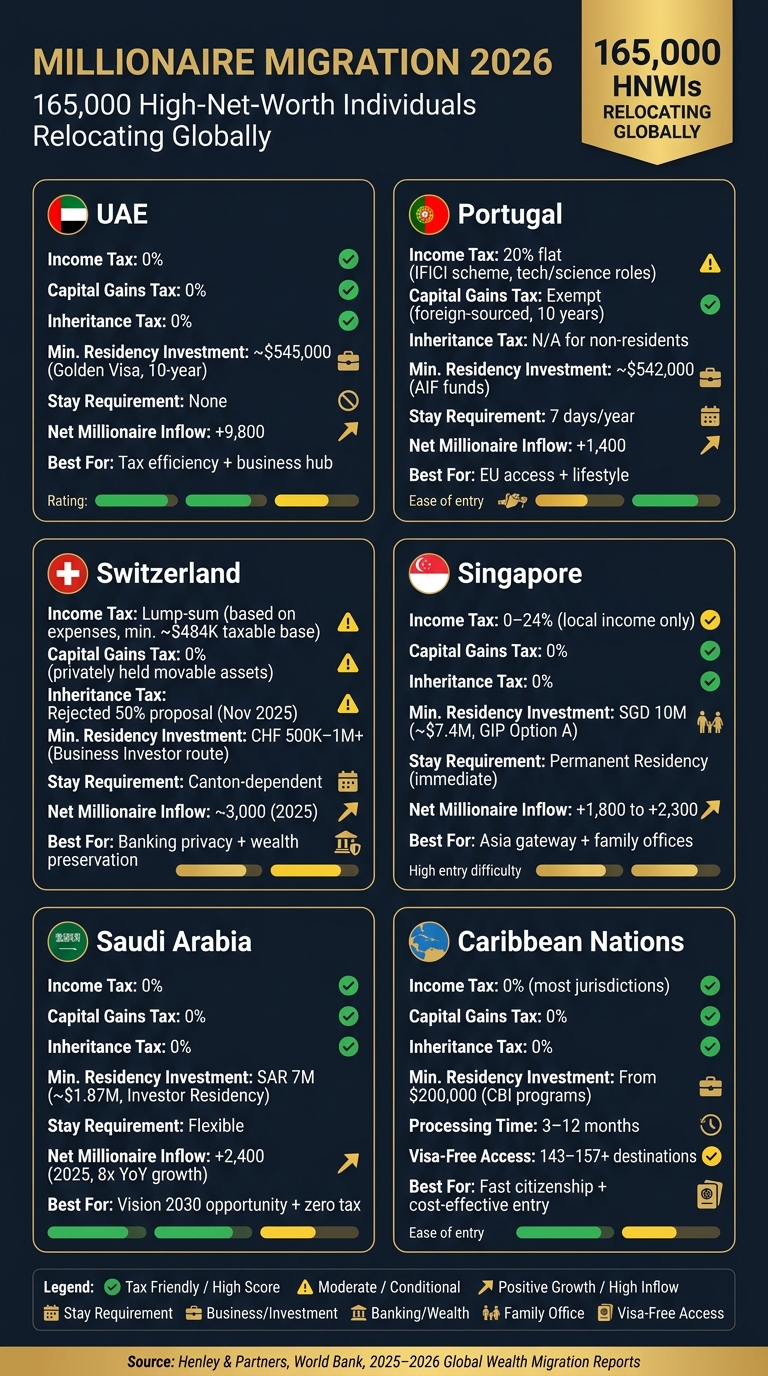
In 2026, millionaire migration is hitting record numbers, with an estimated 165,000 high-net-worth individuals relocating globally. The wealthy are choosing destinations based on tax benefits, residency programs, asset protection, and lifestyle considerations. Key trends include:
- UAE: Zero personal income tax, long-term residency options, and strong business infrastructure.
- Portugal: EU residency with minimal stay requirements, attractive tax regimes for professionals, and a high quality of life.
- Switzerland: Lump-sum tax system, top-tier financial privacy, and unmatched political stability.
- Singapore: Territorial tax system, robust asset protection, and family-friendly residency programs.
- Saudi Arabia: No personal income tax, investor-friendly residency schemes, and rapid economic transformation.
- Caribbean Nations: Quick citizenship-by-investment programs, tax-free environments, and flexible wealth management options.
Each destination offers unique advantages tailored to different priorities, from tax efficiency to lifestyle preferences. Early planning is crucial as global policies tighten. Below is a quick comparison of key factors across these locations.
Quick Comparison
| Destination | Tax Benefits | Residency Highlights | Asset Protection | Lifestyle Perks |
|---|---|---|---|---|
| UAE | 0% income, capital gains, inheritance tax | Golden Visa (10-year, ~$545K investment) | Strong legal framework | Modern infrastructure, global hub |
| Portugal | Flat 20% tax for tech/science roles | 7 days/year residency for EU access | EU legal protections | Affordable living, mild climate |
| Switzerland | Lump-sum tax based on expenses | Flexible investor residency routes | Banking privacy, stability | Neutrality, world-class services |
| Singapore | No capital gains or inheritance tax | Global Investor Program (min. ~$7.4M investment) | Regulated financial landscape | Safe, multicultural, top schools |
| Saudi Arabia | No personal income tax | Premium Residency, investor-focused tracks | Business-friendly zones | Growing urban appeal, safety |
| Caribbean | 0% income, capital gains tax | Citizenship-by-investment (from $200K) | Offshore trusts, LLCs | Warm climate, lower cost of living |
Carefully consider your financial goals and family priorities to choose the best destination. Early action can secure better terms as policies evolve.
1. United Arab Emirates
The UAE stands out as a top destination for millionaire migration in 2026, welcoming a net inflow of 9,800 high-net-worth individuals. The country has carefully created an environment aimed at attracting and retaining wealth.
Tax Policies
The UAE’s tax system is straightforward and highly appealing: 0% personal income tax, 0% capital gains tax, and 0% inheritance tax for qualifying residents. There’s also no federal wealth tax, and the UAE has established over 140 double tax treaties to prevent residents from being taxed twice on international income.
What sets the UAE apart is its regulatory consistency. Unlike some European countries where tax laws frequently change, the UAE provides a stable legal framework. For instance, Cabinet Decision No. 85 of 2022 clearly defines tax residency based on factors like physical presence, permanent home, or the "center of vital interests".
"The UAE’s appeal lies in clarity. Families can plan around known rules without fear of sudden retroactive changes, which have become a growing concern in parts of Europe." – Kalpesh Khakhria, Group Chairman, Klay Group
Residency Options
The UAE’s Golden Visa is a key tool for attracting affluent migrants. To qualify for a 10-year renewable residency permit, applicants must invest a minimum of AED 2 million (around $545,000) in real estate. This program also extends to families, allowing the main applicant to sponsor spouses, unmarried children of any age, and parents. However, the investment must be fully owned, as loan-financed portions typically don’t count toward the AED 2 million threshold.
| Visa Type | Min. Investment | Stay Requirement | Family Coverage |
|---|---|---|---|
| Golden Visa (10-Year) | AED 2M (~$545K) | None | Spouse, children, parents |
| Golden Visa (5-Year, 55+) | AED 1M (~$272K) | None | Spouse, children, parents |
| Property Investor Visa (2-Year) | AED 1M (~$272K) | Must visit every 180 days | Spouse and children |
Asset Protection
The UAE’s free zones, such as the Dubai International Financial Centre (DIFC) and Abu Dhabi Global Market (ADGM), offer 100% foreign ownership of companies. These zones are particularly attractive for creating holding structures to manage global assets.
Residents seeking to benefit from the UAE’s tax treaties must secure a Tax Residency Certificate (TRC) from the Federal Tax Authority. It’s important to note that holding a Golden Visa alone doesn’t automatically sever tax ties with a previous country; families must document their physical presence and demonstrate their "center of vital interests".
Lifestyle and Stability
The UAE’s appeal goes beyond tax benefits and residency options. By 2026, Dubai’s population surpassed 4 million, solidifying its status as a global financial hub. Non-oil sectors now contribute over 70% of the UAE’s GDP, and greenfield foreign direct investment (FDI) reached $33.2 billion in 2025, a 78% increase from the previous year.
However, risks remain. A missile campaign in February 2026 briefly impacted confidence, as reflected in a 37% year-over-year drop in Dubai residential transaction volumes in early March. This highlights that even seemingly stable markets can face disruptions.
"The UAE offers an unmatched mix of zero personal income tax, long-term residency options, strong infrastructure and a stable regulatory environment." – Dominic Volek, Group Head of Private Clients, Henley & Partners
sbb-itb-39d39a6
2. Portugal
Portugal has emerged as one of Europe’s top destinations for wealthy migrants, with a projected net gain of over 1,400 high-net-worth individuals by 2026. This appeal comes from its combination of EU access, a high standard of living, and a tax structure designed to reward specific professionals.
Tax Policies
Portugal’s Non-Habitual Resident (NHR) scheme ended in late 2024, replaced by the Tax Incentive for Scientific Research and Innovation (IFICI). Under IFICI, qualified professionals enjoy a flat 20% tax rate on Portuguese-sourced income for 10 years. This is a stark contrast to the standard progressive rates, which can climb as high as 48% for income over €83,696 (about $90,700). Additionally, most foreign-sourced passive income – such as dividends, interest, and capital gains – remains exempt from Portuguese taxes during the same 10-year period, provided the income originates from a country with a Double Taxation Agreement with Portugal.
However, IFICI benefits are limited to highly skilled professionals, researchers, and executives in tech startups. Retirees and passive investors are subject to the standard progressive tax rates. To qualify, applicants must file by March 31 of the year following their residency.
"The visa is the easy part. The tax architecture underneath it determines whether your relocation actually preserves wealth or quietly destroys it." – Ipanema Partners
Portugal’s tax policies, combined with its streamlined residency options, make it a magnet for high-net-worth professionals.
Residency Options
Portugal’s Golden Visa (ARI) is one of the few remaining EU residency-by-investment programs, especially after Spain ended its equivalent program in April 2025. Following the removal of the real estate investment route in October 2023, the primary pathway now requires a minimum €500,000 (~$542,000) investment in qualifying Alternative Investment Funds (AIFs). With a minimal physical presence requirement of just seven days per year, this visa is ideal for wealthy individuals seeking EU residency without a full relocation.
Here’s a quick comparison of Portugal’s residency options:
| Visa Type | Best For | Min. Requirement | Stay Requirement |
|---|---|---|---|
| Golden Visa | Investors | €500,000 in qualifying funds | 7 days/year |
| D7 Visa | Retirees | ~€920/month passive income | 183+ days/year |
| D8 Visa | Remote Workers | €3,680/month active income | 183+ days/year |
These residency options highlight Portugal’s flexibility for both investors and professionals. However, prospective citizens should note the 2026 Nationality Law reform, which extended the residency requirement for citizenship from five to ten years. Since the clock starts at the application date, early planning is crucial.
Asset Protection
Portugal also offers robust asset protection, supported by its legal stability and strategic non-residency planning. The country scores 0.71 on the World Bank Political Stability Index and ranks 7th globally on the 2025 Global Peace Index. There is no global wealth tax, and foreign assets held by non-tax residents are beyond Portuguese jurisdiction.
Wealthy individuals holding a Golden Visa can avoid becoming tax residents by ensuring their "center of vital interests" – such as primary home, family, and economic ties – remains outside Portugal. By staying in the country for fewer than 183 days per year, they can avoid Portuguese taxes on worldwide income. Pre-immigration restructuring of global holdings is highly recommended to navigate the Common Reporting Standard (CRS) effectively.
"Setting up an active company in Portugal is notably straightforward, future dividends, capital gains, interest, salaries and fees from non-Portuguese source will be fully exempt from Portuguese tax for 10 years." – Shelley Wren, Head of Business Development, Sovereign Portugal
Lifestyle and Stability
Portugal’s lifestyle offerings are equally compelling. In 2025, Lisbon was ranked Europe’s top city for millionaire relocation, scoring 7.27 out of 10 in categories like lifestyle, affordability, and safety. The cost of living is 30–40% lower than in the United States, and private health insurance is available for as little as $43–$97 per month for a single adult under 50.
Andrew Rosener, the founder of MediaOptions, who relocated in 2018, reported a 250% increase in his property value, along with improved safety and education. He described Portugal as "the single greatest immigration culture on Earth". This sentiment is echoed by 88% of wealthy expats who expressed high satisfaction with their decision to move to Portugal.
"Portugal in 2026 serves two distinct investor profiles: exceptional for the non-resident fund investor playing the long game to an EU passport, and excellent for specialized tech talent." – Ipanema Partners
3. Switzerland
Switzerland has long been a magnet for the ultra-wealthy, and the trend shows no signs of slowing down. In 2025 alone, around 3,000 multi-millionaires made Switzerland their home, bringing along assets worth approximately $16.8 billion.
Tax Policies
Switzerland’s tax system is one of its biggest draws for high-net-worth individuals. Its lump-sum taxation regime (known as forfait fiscal) calculates taxes based on living expenses rather than global income or assets. Typically, this is set at seven times the annual rent of the taxpayer’s Swiss property. The federal minimum taxable base is CHF 434,700, which translates to about $484,000.
"Instead of basing taxes on global income and wealth, it uses the taxpayer’s living expenses as a surrogate tax base. This means that it is not necessary to report actual global earnings and assets." – Hugues Salomé, Partner, Head of Private Clients, KPMG Switzerland
For those not eligible for or uninterested in the lump-sum option, Switzerland offers ordinary taxation in certain cantons, with combined income tax rates as low as 20% to 25%. Additionally, capital gains on privately held movable assets are completely tax-free under this system. In November 2025, Swiss voters rejected a proposed 50% national inheritance and gift tax on wealth exceeding CHF 50 million, further cementing the country’s wealth-friendly reputation.
Switzerland also offers flexible residency options, making it even more attractive to the global elite.
Residency Options
Switzerland provides two main residency pathways for non-EU/EFTA nationals:
- Lump-Sum Route: Designed for retirees and passive investors managing global assets from outside Switzerland.
- Business Investor Route: Tailored for entrepreneurs who establish a Swiss company with substantial economic activity, often requiring an investment of CHF 500,000 to CHF 1 million or more.
Both routes grant a B Permit, allowing visa-free travel across the Schengen Area. However, canton selection plays a crucial role. For example, Zurich and Basel-Stadt have abolished lump-sum taxation, while cantons like Vaud, Geneva, and Zug actively support it.
| Route | Best For | Min. Financial Commitment | Key Restriction |
|---|---|---|---|
| Lump-Sum Taxation | Retirees, passive investors | CHF 250,000–1M+ (annual tax) | No gainful employment in Switzerland |
| Business Investor | Entrepreneurs, CEOs | CHF 500,000–1M+ (capital investment) | Must actively manage a Swiss entity |
Switzerland’s appeal isn’t just about favorable taxes and residency programs – it also offers unparalleled asset protection.
Asset Protection
Switzerland has built a reputation for safety and stability, making it an ideal destination for wealth preservation. Ranked 6th out of 163 countries on the 2024 Global Peace Index, the country benefits from a stable federal structure and strong public support for wealth-friendly policies. For instance, nearly 60% of voters rejected a proposal to abolish the inheritance tax back in 2014, reinforcing Switzerland’s commitment to protecting wealth.
Lump-sum residents also enjoy the freedom to manage their private assets within Switzerland without violating the no-employment rule. This combination of legal safeguards and financial privacy makes the country a haven for the ultra-wealthy.
Lifestyle and Stability
Switzerland pairs its financial advantages with an exceptional quality of life. Italian billionaire Lapo Elkann, who moved to Switzerland in 2025, summed it up perfectly:
"We are living in complicated times, marked by uncertainty. Switzerland embodies security, quality of life, and is located at the heart of Europe."
This sentiment is widely shared. Klaus-Michael Kühne, the 86-year-old majority shareholder of Kuehne + Nagel, resides in Schwyz with an estimated CHF 41 billion in wealth. Similarly, Gianluigi Aponte, founder of Mediterranean Shipping Company, and his wife, with a combined wealth of CHF 30 billion, have also made Switzerland their home.
For many, Switzerland offers more than just a place to live – it provides a foundation for family life, education, and long-term wealth planning.
4. Singapore
Singapore stands out as a prime destination for affluent individuals, blending appealing tax policies with robust asset protection. Over the past decade, the city-state has seen its millionaire population grow by 62%, reaching 242,200 residents. By 2026, an expected net inflow of 1,800 to 2,300 millionaires highlights its continued allure. This sustained interest stems from more than just tax advantages.
Tax Policies
Singapore’s tax structure is designed to attract both individuals and businesses. Only locally earned income is taxed, while foreign-sourced income is generally exempt. On top of that, there’s no capital gains tax, inheritance tax, or estate duty. Personal income tax rates for residents range from 0% to 24%, and gains from foreign investments or dividends from Singapore-resident companies remain untaxed.
For families managing substantial assets, Sections 13O and 13U tax exemption schemes – targeting family offices with assets between SGD 20 million and SGD 50 million – have been extended through 2029. However, starting January 1, 2024, gains from foreign asset sales by entities without sufficient local economic presence will be taxed under the Section 10L framework, making pre-relocation planning essential.
Residency Options
Singapore complements its tax benefits with straightforward residency pathways tailored for high-net-worth individuals. The Global Investor Programme (GIP) is the primary route, offering immediate Permanent Residency in exchange for qualifying investments. Applicants can choose from three options:
| GIP Option | Minimum Investment | Target Profile |
|---|---|---|
| Option A: Business Investment | SGD 10 million into a new or existing Singapore business | Entrepreneurs willing to create local jobs |
| Option B: GIP-Select Fund | SGD 25 million into an EDB-approved fund | Investors seeking less operational involvement |
| Option C: Family Office | AUM ≥ SGD 200 million; ≥ SGD 50 million deployed locally | Ultra-wealthy families with established investment teams |
The approval process typically takes 4 to 8 months. Permanent Residency holders can apply for citizenship after two years, though Singapore requires renouncing other nationalities due to its single-citizenship policy.
"Singapore’s Global Investor Program provides a residence by investment pathway into one of the world’s most stable and sophisticated jurisdictions." – Dr. Juerg Steffen, CEO, Henley & Partners
Asset Protection
Singapore’s regulatory environment offers exceptional wealth protection. The Monetary Authority of Singapore (MAS) ensures a transparent and well-regulated financial landscape, fostering long-term investor confidence. Single-family offices managing private wealth are exempt from MAS licensing, reducing administrative hurdles. Additionally, Variable Capital Company (VCC) structures provide flexibility for managing diversified portfolios without the need to establish a full-fledged family office.
Lifestyle and Stability
Beyond financial incentives, Singapore excels in quality of life. It ranks first in Asia for political stability, quality of life, and depth of financial services. Its location makes it a strategic gateway to key regional markets like China, India, Indonesia, and Vietnam.
"For affluent families, Singapore’s appeal lies in its political and economic stability, high levels of personal safety, and world-class education, healthcare, and transport." – Dr. Juerg Steffen, CEO, Henley & Partners
Families relocating to Singapore often find the transition smooth, thanks to its English-speaking environment and multicultural society. With over 60 international schools, top-tier healthcare, and efficient infrastructure, the city-state offers both practicality and prestige. Its strong safety record and modern amenities further enhance its status as a leading destination for the wealthy.
5. Saudi Arabia
Saudi Arabia is quickly becoming a hotspot for high-net-worth individuals, with projections estimating over 2,400 inbound millionaires in 2025. This marks an eightfold increase compared to the previous year, making it the fastest-growing destination in global wealth migration reports for 2025–2026.
"Saudi Arabia is emerging as the Gulf’s next frontier for globally mobile wealth… shifting from a predominantly hydrocarbon-based economy towards a diversified, innovation-led hub." – Dr. Juerg Steffen, CEO, Henley & Partners
This shift toward a more diversified and innovation-driven economy aligns with the goals of wealth management and asset preservation that appeal to wealthy individuals worldwide.
Tax Policies
Saudi Arabia offers a straightforward tax environment for individuals: no personal income tax, no taxes on foreign-sourced income, and no inheritance, estate, or gift taxes. Instead of taxing wealth or income, the country imposes a 15% VAT on most goods and services and a 5% Real Estate Transaction Tax on property sales – levies that focus on consumption and transactions rather than personal assets.
For businesses, especially those operating in Special Economic Zones (SEZs) like King Abdullah Economic City (KAEC), the tax benefits are even more appealing. These zones offer reduced corporate tax rates and exemptions from customs duties, making Saudi Arabia an attractive hub for entrepreneurs and companies looking to establish a regional presence.
This tax-friendly environment complements the country’s residency options, making it a prime destination for wealthy migrants.
Residency Options
The Premium Residency Program, often referred to as the "Saudi Green Card", is the cornerstone of Saudi Arabia’s residency offerings for high-net-worth individuals. This program eliminates the need for a local employer sponsor, allowing residents to live, work, invest, and own property independently.
| Residency Product | Primary Requirement | Duration |
|---|---|---|
| Investor Residency | SAR 7M (~$1.87M) capital + 10 jobs created | Permanent |
| Real Estate Owner | SAR 4M (~$1.07M) in residential property | Tied to ownership |
| Unlimited Duration | Proof of financial capability + SAR 800K fee | Permanent |
| Special Talent | SAR 35K–80K monthly salary (exec/health) | 5 years, renewable |
These residency options extend benefits to family members, including spouses, children under 25, parents, and unmarried daughters over 25. By 2026, Saudi Arabia is also planning a dedicated residency track for ultra-high-net-worth individuals with a verified net worth of at least $30 million.
Asset Protection
Premium Residency holders enjoy several privileges, including the ability to own real estate directly, conduct business under Saudi Investment Law, and switch freely between private sector employers. They are also exempt from expatriate fees typically imposed on foreign residents and their dependents. These benefits create a stable and autonomous framework for long-term wealth management.
Lifestyle and Stability
Beyond financial incentives, Saudi Arabia is undergoing a massive transformation to elevate its urban appeal. Cities like Riyadh and Jeddah are seeing significant infrastructure investments, positioning them as global urban hubs. The country also ranks 3rd among G20 nations in the Security Indicator, making it one of the safest environments for wealthy families. Since the Premium Residency program expanded in 2024, more than 8,000 permits have been issued, highlighting the growing interest in the Kingdom.
With its zero personal taxes, rapidly improving urban infrastructure, and strategic location connecting Africa, Asia, and Europe, Saudi Arabia is becoming an increasingly attractive option for millionaires seeking a new home base.
6. Caribbean Nations
The Caribbean has become a hotspot for high-net-worth individuals seeking tax-free environments, strong asset protection, and expedited second citizenship options. Five Eastern Caribbean nations – Antigua & Barbuda, Dominica, Grenada, St. Kitts & Nevis, and St. Lucia – offer citizenship-by-investment (CBI) programs regulated by the Eastern Caribbean Citizenship by Investment Regulatory Authority (ECCIRA), established in 2026. These programs combine financial perks, simplified residency processes, and an appealing lifestyle, solidifying the region’s status as a prime destination for millionaire migration in 2026.
"The Caribbean is no longer reactive to global regulatory pressure; it is proactively shaping its role within the international financial system." – Dr. Luigi Wewege, President of Caye International Bank
Tax Policies
Tax advantages are a cornerstone of the Caribbean’s appeal. Many jurisdictions, including the Cayman Islands, the British Virgin Islands (BVI), the Bahamas, and Anguilla, impose no personal income, capital gains, inheritance, or wealth taxes. Meanwhile, countries like Panama and Belize use territorial taxation systems, taxing only income earned locally and exempting foreign-sourced income.
Puerto Rico offers a unique model. As a U.S. territory, it provides Act 60 benefits, including a 4% corporate tax rate on export services and a full exemption on dividends, interest, and capital gains for qualifying residents. U.S. citizens can take advantage of these benefits without giving up their citizenship, provided they live on the island for at least 183 days a year.
Residency Options
The Caribbean pairs its tax-friendly policies with simplest citizenship programs in the world. CBI programs in the region are among the fastest, requiring a minimum investment of $200,000 and processing times ranging from 3–4 months (Grenada) to 10–12 months (St. Lucia).
| Program | Contribution | Property Minimum | Visa-Free Destinations |
|---|---|---|---|
| St. Kitts & Nevis | $250,000 | $400,000 | 157+ |
| Antigua & Barbuda | $230,000 | $200,000 | 151+ |
| Grenada | $235,000 | $270,000 | 147+ |
| St. Lucia | $240,000 | $300,000 | 147+ |
| Dominica | $200,000 | $200,000 | 143+ |
Data source: [38]
Each program comes with distinct benefits. Grenada, for instance, is the only Caribbean nation offering access to the U.S. E-2 Treaty Investor Visa, which is particularly attractive for those with U.S. business interests. St. Kitts & Nevis, home to the region’s oldest CBI program (launched in 1984), boasts a highly regarded passport. Families may find Antigua & Barbuda appealing due to its cost-effective pricing for larger groups through the University of the West Indies (UWI) Fund option. However, applicants should be aware that as of October 2025, Schengen visa-free access for CBI passport holders may face restrictions due to European Parliament decisions.
Anguilla offers another route to residency. By purchasing property worth at least $400,000 and paying an annual tax of $75,000, individuals can secure tax residency.
These programs not only provide fast citizenship but also complement the region’s robust wealth protection offerings.
Asset Protection
The Caribbean boasts a well-established framework for asset protection. Jurisdictions like St. Kitts & Nevis and Belize offer offshore LLCs, trusts, and foundations that ensure financial privacy through nominee director structures. The BVI and Cayman Islands, operating under English common law, provide a stable legal environment for international investors.
For those managing wealth across multiple jurisdictions, the region allows for strategic separation of asset custody, residency, and business operations. This diversification minimizes the risk of any single tax authority or political change threatening a family’s entire financial structure. Annual fees for offshore companies in the BVI are relatively low, ranging from $550 to $1,350, making these options cost-effective.
This solid asset protection infrastructure is complemented by the region’s appealing lifestyle.
Lifestyle and Stability
Beyond financial benefits, the Caribbean offers an exceptional quality of life. Barbados, for example, supports generational wealth planning through trusts and LLCs. Residents earning foreign income can also benefit from the Foreign Currency Earnings Allowance (FCEA), which reduces tax liabilities by up to 65%. The region’s pristine beaches, year-round warm weather, and living costs that are 30% to 60% lower than comparable U.S. cities make it a magnet for affluent retirees and remote professionals.
"Wealth migration is no longer about escape; it is about optionality."
For many wealthy individuals, the Caribbean stands as a flexible and tax-efficient base that also offers an enjoyable lifestyle for the next chapter of their financial journey.
Pros and Cons by Destination
Every destination comes with its own set of advantages and challenges. It’s essential to weigh tax policies, residency requirements, asset protection, and lifestyle factors against your personal and financial priorities.
| Destination | Tax Policies | Residency Options | Asset Protection | Lifestyle & Stability |
|---|---|---|---|---|
| UAE | ✅ 0% income, capital gains, and inheritance tax; ⚠️ 9% corporate tax on profits over AED 375,000 | ✅ 10-year Golden Visa (~$545,000); ⚠️ No direct path to citizenship | ✅ Strong legal framework; growing family office infrastructure | ✅ World-class infrastructure; ⚠️ Cultural adaptation required |
| Portugal | ⚠️ NHR closed; NHR 2.0 (IFICI) limited to tech/science roles; progressive rates up to 48% for others | ✅ Only 7 days/year presence required; 5-year path to citizenship | ✅ EU legal protections; stable property rights | ✅ High safety, mild climate, and affordable living |
| Switzerland | ✅ Lump-sum tax based on lifestyle expenses rather than global assets | ⚠️ High cost of entry; residency tied to cantonal approval | ✅ Gold standard for banking privacy and wealth management | ✅ Political neutrality, top-tier healthcare, and education |
| Singapore | ✅ Territorial tax; 0% capital gains; no inheritance tax | ⚠️ High investment thresholds for Global Investor Program | ✅ English common law; strong regulatory environment | ✅ Safe, multicultural with world-class education and healthcare |
| Saudi Arabia | ✅ No personal income tax; access to Vision 2030 opportunities | ✅ Premium Residency for investors and talent; long-term/indefinite | ⚠️ Evolving legal framework; less established than peers | ⚠️ Rapid modernization; lifestyle restrictions easing but still present |
| Caribbean Nations | ✅ 0% income, capital gains, and inheritance tax in most jurisdictions | ✅ Fastest CBI programs globally; from $200,000; 3–12 months | ✅ Offshore LLCs, trusts, and foundations with strong privacy | ✅ Warm climate and lower cost of living |
This table highlights the key trade-offs for those considering relocation.
The UAE stands out for its tax-friendly environment and quick setup process. However, maintaining physical presence is crucial to meet CRS compliance standards. Meanwhile, Portugal provides a strategic path to citizenship through its updated NHR 2.0 program, though benefits are now more focused on specific sectors like tech and science.
For those prioritizing long-term wealth preservation, Switzerland and Singapore remain top choices. Both countries offer exceptional legal frameworks, sophisticated financial systems, and stable governance. These features make them reliable options for safeguarding wealth, though they come with high entry costs and complex residency or citizenship processes.
Saudi Arabia, on the other hand, presents a unique opportunity. Its tax-free framework and Vision 2030 initiatives offer exciting potential, but these come with some unpredictability as its regulatory systems continue to develop. Early adopters willing to navigate these uncertainties may gain access to a rapidly expanding economy.
"Wealthy families who treat these choices as deliberate elements of long-term strategy… will be best placed to absorb shocks, harness emerging possibilities, and preserve long-term optionality." – Dr. Juerg Steffen, CEO, Henley & Partners
Finally, the Caribbean Nations remain the easiest entry point for those seeking fast and cost-effective solutions. With low taxes and quick Citizenship by Investment (CBI) programs, they are ideal for forming part of a broader wealth strategy.
Conclusion
The migration of millionaires in 2026 reflects a deliberate approach centered on tax certainty, legal stability, and preserving wealth. With an estimated 165,000 individuals expected to relocate that year, this trend marks a notable shift in how the wealthy manage their assets and future.
"Wealth migration has shifted from discretionary to defensive, with jurisdictional risk management at its core." – Sarah Mitchell, Senior Immigration Advisor, WorldPath AI
Each destination offers unique advantages. For instance, the UAE attracts individuals with its zero personal income tax and streamlined processes. Switzerland and Singapore appeal to those who value legal security and long-term planning, while Portugal and the Caribbean offer accessible entry points paired with lifestyle perks. Deciding where to move depends on your personal objectives, family priorities, and financial setup.
Timing is critical – global residency and citizenship programs are becoming more restrictive, making early action essential to secure the best terms. Much like adjusting an investment portfolio, your migration strategy must adapt to changing international policies.
Consulting experienced advisors is a crucial first step. Experts can guide you through the complexities of investment thresholds, tax exposure modeling, and compliance requirements across jurisdictions. Andrew Raming, Associate Director of Private Clients at Henley & Partners, notes that wealthy individuals are now treating jurisdictional choices "the same way they treat asset allocation". By applying the same level of precision to your relocation plans as you do to your investments, you can align your migration strategy with your broader wealth management goals and seize emerging opportunities effectively.
FAQs
How do I avoid being taxed by two countries after I move?
To steer clear of double taxation after moving abroad, consider settling in a country with tax-friendly policies. Take advantage of international tax agreements and double taxation treaties to minimize your liabilities. Adjusting how your assets and income are structured can also help ensure you meet local regulations. It’s crucial to work with legal and tax experts from both countries to stay compliant and make the most of tax planning opportunities.
Which destination fits me best if I want residency without living there full-time?
Countries such as Portugal, Malta, and various Caribbean nations provide residency programs that require little to no physical presence. These programs let you obtain legal residency without the need to reside in the country full-time, offering a flexible solution for those who value mobility.
What’s the fastest way to get a second passport in 2026?
The fastest route to securing a second passport in 2026 is through citizenship by investment programs. These programs are designed to offer swift processing, with some countries granting citizenship in just a few months. However, the specifics – like the required investment amount and how long the process takes – differ from one country to another. It’s essential to explore options that fit your personal objectives and circumstances.
