
Holding money or assets abroad is legal for U.S. citizens – but only if you follow the rules. The U.S. government requires you to disclose foreign accounts annually through FBAR (Report of Foreign Bank and Financial Accounts) and FATCA (Foreign Account Tax Compliance Act). These are separate filings, and failing to comply can lead to severe penalties, including fines up to $500,000 and even prison time for willful violations.
Here’s what you need to know:
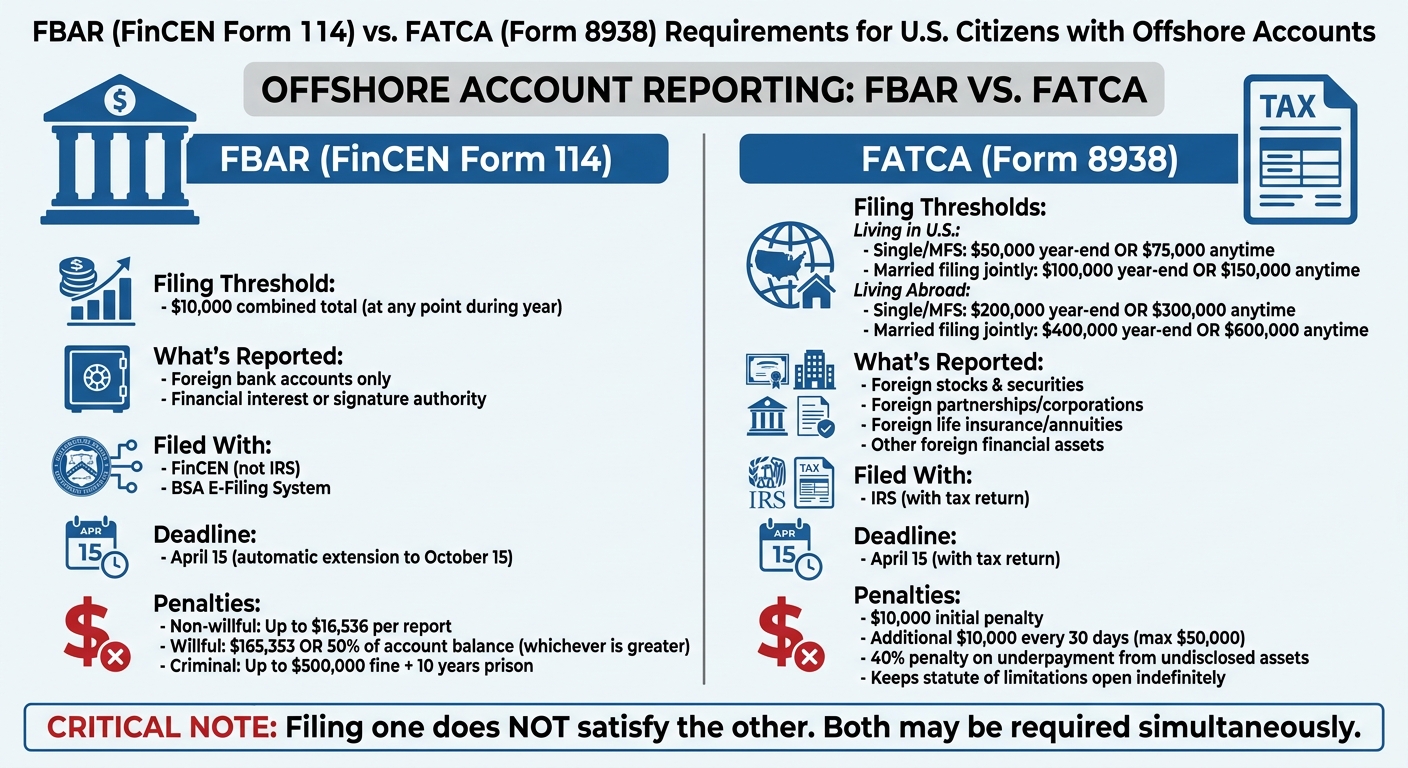
- FBAR applies if your total foreign account value exceeds $10,000 at any time during the year. File it electronically with FinCEN (not the IRS) by April 15, with an automatic extension to October 15.
- FATCA requires Form 8938 if your foreign assets exceed thresholds (e.g., $50,000 for single U.S. residents or $200,000 for expats). This is filed with your tax return.
- Penalties for non-compliance are steep: up to $10,000 for FATCA violations and $165,353 (or 50% of account value) for willful FBAR violations.
- Offshore trusts, corporations, and partnerships may trigger additional forms (e.g., 3520, 5471) with their own penalties.
To stay compliant:
- Identify all foreign accounts and assets.
- Meet FBAR and FATCA filing requirements.
- Consult a qualified tax advisor for complex cases.
- Use official programs like the Streamlined Filing Compliance Procedures if you’ve fallen behind.
The rules are strict, but proper reporting ensures you avoid penalties while protecting your wealth. This is a core component of offshore asset protection. Offshore accounts aren’t about secrecy anymore – they’re about transparency and compliance.
FBAR: How to Report Foreign Bank Accounts
The Report of Foreign Bank and Financial Accounts (FBAR), officially called FinCEN Form 114, is an annual filing requirement under the Bank Secrecy Act. It’s used to report your financial interest in or signature authority over foreign financial accounts. Unlike your tax return, the FBAR is submitted separately to the Financial Crimes Enforcement Network (FinCEN), not the IRS.
You must file an FBAR if the total value of your foreign accounts exceeds $10,000 at any point during the year. For instance, if you have three accounts with peak balances of $4,000, $3,500, and $5,000, the combined total of $12,500 surpasses the threshold, triggering the filing requirement. Let’s break down who needs to file and how to meet the deadlines.
Who Must File FBAR?
The FBAR filing rule applies to U.S. persons who meet the $10,000 threshold. This includes U.S. citizens, Green Card holders, resident aliens, and domestic entities like corporations, partnerships, LLCs, trusts, and estates. Filing is mandatory whether you directly own the account or only have signature authority over it.
What’s important to note is that the requirement is based on the account’s location, not whether the income is taxable. Additionally, if you and your spouse jointly own all foreign accounts, you can file a single FBAR using FinCEN Form 114a, as long as specific conditions are met.
How to File and Key Deadlines
FBARs must be filed electronically through the FinCEN BSA E-Filing System. Individual filers don’t need to register, but tax professionals filing on behalf of clients do. Paper filings are allowed only if you obtain an exemption by contacting the FinCEN Resource Center.
The filing deadline is April 15 of the year following the reporting year. If you miss this date, you automatically receive an extension until October 15 – no formal request needed. Additional extensions may be available for those affected by natural disasters.
When completing the FBAR, report the highest balance each account reached during the year in its local currency. Then, convert that amount to U.S. dollars using the Treasury Department’s official Year-End Exchange Rate for December 31 of the reporting year. Keep all account records – such as account names, numbers, bank details, account types, and maximum balances – for five years from the FBAR due date.
Penalties for Missing FBAR Filings
Failing to file an FBAR comes with steep penalties. For non-willful violations – those caused by negligence, mistakes, or lack of awareness – the civil penalty can reach up to $16,536 per report for 2026. This penalty applies per report, per year.
For willful violations, the consequences are far more severe. These include intentional breaches or cases of willful ignorance. In 2026, the penalty for a willful violation is either $165,353 or 50% of the account’s balance at the time of the violation – whichever is greater. This penalty applies per account, per year, with no maximum limit. Criminal charges for willful violations can result in fines of up to $500,000 and prison sentences of up to 10 years.
If you realize you haven’t filed FBARs but have correctly reported all income on your tax returns, you may qualify for the Delinquent FBAR Submission Procedures. This allows you to file late without penalties, as long as the IRS hasn’t contacted you yet. However, if you have unreported income, avoid “quiet disclosures” (filing late without using an official program), as these can lead to audits and harsh penalties.
sbb-itb-39d39a6
FATCA: Reporting Foreign Financial Assets
The Foreign Account Tax Compliance Act (FATCA) was enacted in March 2010 to ensure U.S. taxpayers with foreign accounts properly report and pay taxes owed on those assets. While the FBAR focuses solely on foreign bank accounts, FATCA expands the scope to include a wide range of foreign financial assets. To comply, taxpayers must file IRS Form 8938 alongside their annual tax return.
"If the FBAR is FinCEN’s tool for monitoring foreign liquidity, FATCA is the IRS’s mechanism for uncovering offshore wealth." – Ipanema Partners
FATCA also requires foreign financial institutions to report account details directly to the IRS, creating a system that matches global financial data with individual tax returns.
What FATCA Requires and Who Must File
Form 8938 applies to specific groups, including U.S. citizens, resident aliens, certain nonresident aliens, and certain domestic entities like closely held corporations, partnerships, and trusts. Filing is required only if you already need to submit an annual income tax return.
The thresholds for reporting depend on your residency and tax filing status. For U.S. residents:
- Single filers or married filing separately: Report if foreign assets exceed $50,000 at year-end or $75,000 at any point during the year.
- Married filing jointly: Report if assets exceed $100,000 at year-end or $150,000 at any point during the year.
For those living abroad (defined as having a tax home in another country and being physically present there for at least 330 days):
- Single filers or married filing separately: Report if assets exceed $200,000 at year-end or $300,000 at any point.
- Married filing jointly: Report if assets exceed $400,000 at year-end or $600,000 at any point.
| Taxpayer Category | Year-End Asset Value | Peak Asset Value (Anytime) |
|---|---|---|
| Living in U.S. (Single/MFS) | > $50,000 | > $75,000 |
| Living in U.S. (MFJ) | > $100,000 | > $150,000 |
| Living Abroad (Single/MFS) | > $200,000 | > $300,000 |
| Living Abroad (MFJ) | > $400,000 | > $600,000 |
How to Complete Form 8938
To complete Form 8938, you must report a variety of foreign financial assets, including:
- Foreign stocks or securities issued by non-U.S. persons
- Interests in foreign entities (e.g., partnerships or corporations)
- Foreign-issued life insurance or annuity contracts with cash value
- Financial instruments or contracts with non-U.S. issuers
FATCA covers assets beyond those reported on the FBAR. For example, it includes physical stock certificates, interests in foreign hedge funds, and stakes in foreign partnerships. However, directly held foreign real estate, precious metals, and physical cash in a safe deposit box are generally excluded.
Use the same balance and currency conversion methods as the FBAR. If an asset is already reported on another form (e.g., Form 3520 or Form 5471), you must note this in Part IV of Form 8938. Filing one form does not exempt you from filing the other.
Penalties for FATCA Violations
Failing to file Form 8938 results in a $10,000 penalty, with an additional $10,000 added every 30 days after a 90-day delay, up to a maximum of $50,000. Additionally, a 40% penalty applies to any underpayment caused by an undisclosed asset.
"Failing to file Form 8938 keeps the statute of limitations open indefinitely for your entire tax return. The IRS can audit any part of your return, with no time limit." – Ipanema Partners
For non-willful violations due to negligence or lack of awareness, you may qualify for the Streamlined Filing Compliance Procedures, which could waive penalties. However, avoid "quiet disclosures" (filing late forms without using official amnesty programs), as these can lead to audits or even criminal investigations.
Other Required Forms for Offshore Trusts and Entities
U.S. citizens managing offshore trusts, corporations, or partnerships face additional reporting requirements beyond FBAR and FATCA. Failing to meet these obligations can result in penalties that surpass the taxes owed.
Forms 3520 and 3520-A for Foreign Trusts
If you’re involved with a foreign trust – whether by creating, funding, or receiving distributions – you’ll need to file Form 3520 (Annual Return To Report Transactions With Foreign Trusts and Receipt of Certain Foreign Gifts). Meanwhile, the trust itself must submit Form 3520-A, which details its income, assets, and the U.S. owners and beneficiaries. If the foreign trust doesn’t file Form 3520-A, the U.S. owner is required to complete a substitute Form 3520-A and attach it to their own Form 3520 to avoid penalties.
"A foreign trust with a U.S. owner must timely file a complete and accurate Form 3520-A and furnish the required annual statements to its U.S. owners and U.S. beneficiaries in order for the U.S. owner to avoid penalties." – Internal Revenue Service
Certain offshore retirement accounts – like UK SIPPs, Australian superannuation funds, and Indian provident funds – may be classified as foreign trusts and require these filings. However, Canadian RRSPs and RRIFs often fall under exceptions if they meet specific IRS criteria.
Here are the deadlines to keep in mind:
- Form 3520: Due April 15, alongside your individual tax return.
- Form 3520-A: Due by the 15th day of the third month after the trust’s year-end (usually March 15).
Don’t forget to secure an Employer Identification Number (EIN) for the foreign trust when filing Form 3520-A. Using your Social Security Number or ITIN is not permitted.
Forms 5471 and 8865 for Foreign Corporations and Partnerships
Form 5471 applies to U.S. persons who serve as officers, directors, or shareholders in certain foreign corporations. Typically, this is required when a U.S. person owns at least 10% of the voting power or value of the corporation’s stock. Reporting duties vary based on your level of involvement, categorized under the "Category of Filer" system. Additionally, new rules under the One Big Beautiful Bill Act (OBBBA) of July 2025 will affect tax years for Specified Foreign Corporations starting after November 30, 2025, limiting certain tax year options.
Form 8865 is required for U.S. persons with ownership or control in foreign partnerships. If you control a foreign corporation, remember that reporting its bank accounts on an FBAR, its equity interest on Form 8938, and its details on Form 5471 are separate obligations.
Penalties for Missing These Filings
The consequences of missing these forms can be severe. For Form 3520, the penalty is 35% of the transferred or distributed property value. For Form 3520-A, it’s 5% of the trust’s gross value, with a minimum penalty of $10,000.
"The penalties for missing Form 5471 alone start at $10,000 per entity, per year, escalating to $50,000 if you ignore the IRS after they notify you." – Ipanema Partners
For Form 5472 (required for foreign-owned U.S. LLCs), the base penalty starts at $25,000 and increases by $25,000 every 30 days of continued non-compliance. Here’s a breakdown of penalties:
| Form / Requirement | Base Penalty | Maximum / Escalated Penalty |
|---|---|---|
| Form 3520 (Foreign Trusts) | 35% of transaction value | N/A |
| Form 3520-A (Foreign Trusts) | 5% of trust assets; minimum $10,000 | N/A |
| Form 5471 (Foreign Corporations) | $10,000 per entity annually | Up to $50,000 after IRS notification |
| Form 5472 (Foreign-owned US LLC) | $25,000 | Additional $25,000 every 30 days |
If you’ve missed these filings due to negligence or lack of awareness, you might qualify for the Streamlined Filing Compliance Procedures, which can eliminate penalties. However, avoid "quiet disclosures" – filing late forms without using an official amnesty program. The IRS actively monitors such cases and may initiate audits or further investigations.
How to Choose the Right Offshore Jurisdiction
When selecting an offshore jurisdiction, it’s crucial to strike a balance between protecting your assets and meeting U.S. compliance requirements. Most offshore asset protection trusts are structured as tax-neutral foreign grantor trusts, simplifying reporting and ensuring they align with U.S. laws. The focus should always be on strong creditor protection – steering clear of any tax evasion schemes.
What Makes a Good Offshore Jurisdiction
The best jurisdictions for asset protection share a few key traits. First, they have robust creditor protection laws that disregard foreign judgments. This means creditors must start legal proceedings locally, often under stricter legal standards. Second, the statute of limitations for challenging asset transfers is an important factor. Leading jurisdictions like Nevis and the Cook Islands typically cap this period at just two years.
The burden of proof is another critical consideration. For example, in Nevis, creditors must prove "actual fraud" with a "beyond a reasonable doubt" standard – roughly 90% certainty – compared to the U.S. civil standard of "preponderance of the evidence", which is only about 50%. Additionally, some jurisdictions impose financial barriers to lawsuits. In Nevis, creditors must post a $25,000 bond, while other jurisdictions may require bonds as high as $150,000.
It’s also important to differentiate between privacy and secrecy. Modern offshore privacy laws, such as Jersey’s "firewall" statutes, safeguard assets from creditors and civil litigants but remain transparent to tax authorities. As Ipanema Partners explains:
"True privacy in 2026 is not about hiding from the government. It’s about protection from everyone else".
Carefully evaluating these jurisdictional features ensures that your asset protection strategy aligns with compliance requirements.
Comparing Top Offshore Jurisdictions
Here’s a quick comparison of some of the leading offshore jurisdictions, highlighting their protection features and compliance requirements:
| Jurisdiction | Minimum Deposit | Key Protection Feature | Compliance Impact |
|---|---|---|---|
| Cook Islands | $250,000+ | 2-year statute of limitations; no foreign judgment recognition | Full FATCA/CRS reporting; requires Forms 3520 and 3520-A |
| Nevis | $250,000+ | "Beyond a reasonable doubt" proof standard; $25,000 bond to sue | Full FATCA/CRS reporting; requires Forms 3520 and 3520-A |
| Belize | $250,000 | High bank liquidity requirements (23%); crypto-friendly | Full FATCA/CRS reporting; requires Forms 3520 and 3520-A |
| Switzerland | $500,000 | AAA credit rating; institutional-grade wealth management | Full FATCA/CRS reporting; enhanced due diligence |
| Cayman Islands | $250,000 | Aa3 credit rating; specialized in hedge fund structures | Full FATCA/CRS reporting; requires Forms 3520 and 3520-A |
How Jurisdiction Choice Affects Compliance
While the jurisdiction you choose impacts asset protection, it does not alter your IRS reporting obligations. Instead, the right jurisdiction enhances protection while keeping you compliant. These factors work alongside detailed FBAR and FATCA requirements, ensuring transparency without changing what you need to report.
Filing Forms 3520 and 3520-A is a critical part of maintaining compliance. According to Tresp, Day & Associates, Inc.:
"Staying in compliance by filing [Form 3520-A] annually can be some of your best evidence of the legality and legitimacy of your Offshore Trust if faced with a skeptical judge during a lawsuit".
Additionally, confirm whether the jurisdiction has Tax Information Exchange Agreements (TIEAs) or Intergovernmental Agreements (IGAs) to facilitate transparent data sharing. The quality and reputation of local trustees, corporate service providers, and banks also matter. Always opt for service providers with a proven history of reliability and professionalism.
Choosing the right jurisdiction is a key step in building a compliant offshore strategy that protects your assets effectively.
How to Build a Compliant Offshore Strategy
Creating a compliant offshore strategy involves a careful balance between safeguarding your assets and meeting U.S. reporting obligations. This process can be broken down into three main steps: analyzing your current offshore accounts and structures, collaborating with experienced tax and legal professionals, and keeping an accurate compliance calendar.
Review Your Current Accounts and Structures
Start by confirming your status as a "U.S. Person." This includes U.S. citizens, Green Card holders, resident aliens, or U.S.-based entities. Once established, calculate the total maximum value of all your foreign financial accounts by identifying the highest balance in each account during the year. If the combined total exceeds $10,000, filing an FBAR (Foreign Bank Account Report) is mandatory.
Next, identify foreign financial assets that require FATCA (Foreign Account Tax Compliance Act) reporting. These might include foreign stock certificates, partnership interests, hedge funds, private equity, debt instruments, or foreign trusts. Additionally, gifts from foreign individuals exceeding $100,000 or from foreign entities over $18,567 must be reported. Ownership of at least 10% in a foreign corporation (Form 5471), partnership (Form 8865), or disregarded entity (Form 8858) also triggers specific reporting obligations.
Evaluate whether any prior non-compliance was willful or non-willful. Interestingly, about 62% of Americans filing from abroad owe no federal income tax, yet they remain subject to FBAR and FATCA rules. Keep in mind, the IRS and FinCEN now use automated systems to cross-check financial data from over 100 countries against individual tax returns.
Finally, ensure you report accounts where you hold signature authority but lack financial interest, such as corporate accounts. Avoid filing late forms outside official amnesty programs – so-called "quiet disclosures" – as these can lead to audits and steep penalties. Once you have a clear understanding of your holdings, it’s time to seek expert advice.
Work with Qualified Tax and Legal Advisors
Offshore compliance is intricate, so it’s essential to work with Board-Certified Tax Law Specialists who have experience in offshore disclosures. Be transparent with your advisor – sharing all relevant details and relying on their guidance in good faith can help establish a "reasonable cause" defense against penalties.
As James W. Standard Jr., Partner at Taylor English, emphasizes:
"Reasonable cause… will generally be met where the taxpayer has retained a competent tax adviser, supplied the adviser with all relevant information, and relied on the adviser’s advice in good faith".
Tax professionals can help align your strategy with FBAR, FATCA, and other reporting requirements. They can also assist with drafting non-willful certification narratives for Streamlined Filing Compliance Procedures and managing the overlap between FBAR (handled by FinCEN) and FATCA (overseen by the IRS). For example, certain assets like foreign stock certificates may appear on Form 8938 but not on the FBAR, and accurate reporting is crucial.
Professional guidance is especially important when deciding between the Streamlined Procedures for non-willful conduct and the Voluntary Disclosure Practice for willful violations. In late 2025, the IRS proposed changes to the Voluntary Disclosure Practice, reducing the civil fraud penalty from 75% to a 20% accuracy-related penalty for the six-year disclosure period.
Once you’ve established a plan with your advisor, focus on staying ahead of deadlines with a compliance calendar.
Set Up a Compliance Calendar
An organized compliance calendar is essential for tracking deadlines and avoiding penalties. Key filing dates include:
- April 15: FBAR and FATCA filings (with an automatic extension to October 15)
- March 15: Foreign trust annual returns (Form 3520-A)
- Year-end: Recalculate account values using the Treasury Department’s official December 31 exchange rate
FBARs must be filed electronically through FinCEN’s BSA E-Filing System, while FATCA and other international forms are submitted to the IRS.
If you live abroad, document your physical presence outside the U.S. for at least 330 full days (using passport stamps, boarding passes, etc.) to qualify for higher FATCA thresholds and penalty-free programs like the Streamlined Foreign Offshore Procedures.
For entities, add deadlines for forms like 5471 or 8865, as penalties for non-compliance start at $10,000 per year. Missing Form 5472 filings for foreign-owned U.S. LLCs can result in a $25,000 base penalty, increasing every 30 days of non-compliance. Lastly, review digital assets such as cryptocurrencies, stablecoins, and NFTs to determine if they meet FATCA thresholds. The IRS is ramping up enforcement in this area, introducing Form 1099-DA to improve oversight.
Conclusion
Navigating offshore compliance demands strict attention to disclosure rules. For U.S. citizens, holding offshore assets is perfectly legal – as long as all reporting requirements are met. It’s critical to understand that FBAR and FATCA are separate systems with unique thresholds and penalties. Filing one does not fulfill the other. FBAR applies if the combined value of your foreign accounts surpasses a specific limit, while FATCA covers a broader array of assets, including foreign stock certificates, partnership interests, and even foreign-issued life insurance policies with cash value.
The stakes for non-compliance are high. Even non-willful violations can lead to hefty penalties, while willful violations result in even more severe fines. On top of that, failing to file Form 8938 could leave your entire tax return vulnerable to indefinite IRS audits.
"The era of offshore banking secrecy is functionally over." – Ipanema Partners
With automated systems now cross-referencing data from over 100 countries, the IRS has unparalleled insight into foreign financial accounts. This makes compliance an ongoing obligation, not a one-time task. If you’ve fallen behind, programs like the Streamlined Foreign Offshore Procedures offer a way to catch up without penalties for non-willful violations.
To protect your offshore assets effectively, proactive compliance is essential. Work closely with a knowledgeable tax adviser who understands the complexities of FBAR, FATCA, and other reporting requirements. Keep an accurate compliance calendar, use official Treasury Department exchange rates for currency conversions, and maintain thorough documentation. Remember, reporting is mandatory even if your foreign accounts don’t generate income or result in taxes owed. Taking these steps now ensures your assets and legal standing remain secure.
FAQs
Do I need to file both FBAR and Form 8938?
Yes, U.S. individuals might need to submit both FBAR and Form 8938 if their foreign financial holdings meet the required thresholds. The FBAR is necessary when foreign account balances exceed $10,000 at any point during the year. On the other hand, Form 8938 applies to specific foreign assets that surpass certain value limits. While there is some overlap between the two, the reporting requirements for each form are distinct.
What counts as a foreign account or foreign asset?
A foreign account or asset refers to any financial holdings located outside the U.S. that U.S. taxpayers are required to report under FATCA (Foreign Account Tax Compliance Act) and FBAR (Report of Foreign Bank and Financial Accounts). These holdings can include:
- Bank accounts
- Brokerage accounts
- Foreign stocks and securities
- Partnership interests
- Mutual funds
Reporting thresholds differ between FATCA and FBAR:
- FBAR: Reporting is mandatory if the total value of foreign accounts exceeds $10,000 at any point during the year.
- FATCA: Individuals must disclose foreign assets if their value exceeds $50,000 (with higher thresholds for joint filers).
Understanding these requirements is critical to ensure compliance with U.S. tax laws.
What should I do if I missed past FBAR or FATCA filings?
If you missed filing FBAR or FATCA, you can submit delinquent FBARs electronically through FinCEN’s BSA E-Filing System. Be sure to include an explanation for the delay. If your failure to file was non-willful, you might be eligible for the Streamlined Foreign Offshore Procedures, which let you file past returns without facing penalties. For more complicated situations, it’s a good idea to review IRS guidelines or seek advice from a professional to ensure compliance and reduce the risk of penalties.
