
The short answer: I’d name Estonia the cleanest country in the world in 2026. It ranks No. 1 on the 2026 EPI with a score of 75.3, based on tracked data like air quality, drinking water, sanitation, waste handling, and emissions.
If you want the quick version, here it is:
- Estonia is first on the latest EPI.
- It is also one of only seven countries that meet WHO air quality guidelines.
- Other countries near the top include Luxembourg, the United Kingdom, Finland, and the Netherlands.
- This result is based on measured data, not public image or travel opinion.
For me, that’s the key point: if you want a clean country based on numbers you can compare, Estonia is the strongest answer in 2026.
Quick comparison
| Country | What stands out |
|---|---|
| Estonia | Strong scores across air, water, sanitation, and emissions |
| Luxembourg | High marks for water and sanitation systems |
| United Kingdom | Strong overall EPI showing |
| Finland | Low air pollution and strong forest protection |
| Netherlands | High overall score across multiple measures |
So if you’re asking, “Which country is the cleanest right now?” I’d keep it simple: Estonia comes out on top when I look at the latest global data.
sbb-itb-39d39a6
How global cleanliness is measured in 2026
Cleanliness can feel subjective. One person notices spotless streets. Another cares more about tap water, air quality, or how trash is handled. To compare countries on the same terms, researchers use standard data. In 2026, the Environmental Performance Index (EPI) is the main benchmark for that.
The Environmental Performance Index: the main benchmark
The EPI, produced by Yale and Columbia researchers, scores 177 countries on 47 indicators across 12 categories on a 0–100 scale. Higher scores point to cleaner, healthier conditions.
The index groups those indicators under three policy objectives: Environmental Health, Ecosystem Vitality, and Climate Change. For travelers and expats, Environmental Health tends to matter most because it reflects daily life: air, water, sanitation, and waste. That setup helps explain why Estonia ranks first in 2026.
Supporting indicators: air, water, sanitation, and waste
Looking past the headline EPI score, a few metrics say the most about what people deal with day to day.
PM2.5 air pollution is near the top of the list. The EPI calls air pollution "the most serious environmental threat to public health". Only seven countries currently meet WHO air quality guidelines: Australia, Finland, Grenada, Iceland, Mauritius, New Zealand, and Estonia.
Drinking water and sanitation metrics track access to safe drinking water, dependable sanitation systems, and wastewater treatment. Waste management adds another piece by looking at solid waste handling, recycling rates, and waste-to-energy systems.
Here’s how those categories connect to things residents and travelers would notice in daily life:
| Metric | What It Measures | Real-World Impact |
|---|---|---|
| Air Quality (PM2.5) | Fine particulate matter concentration | Directly affects respiratory health and everyday comfort |
| Drinking Water Access | Safe tap water coverage and treatment rates | Safer drinking water and lower disease risk |
| Sanitation Coverage | Safely managed sewage and wastewater systems | Helps prevent waterborne illness |
| Waste Management | Recycling rates; landfill diversion | Cleaner streets and less pollution in soil and water |
| Climate & Emissions | Greenhouse gas trajectory; decarbonization rate | Indicates a country’s future stability and environmental governance |
Taken together, these metrics show why Estonia sits at No. 1 in 2026.
Why Estonia is the cleanest country in the world in 2026
Estonia’s top ranking across multiple cleanliness metrics
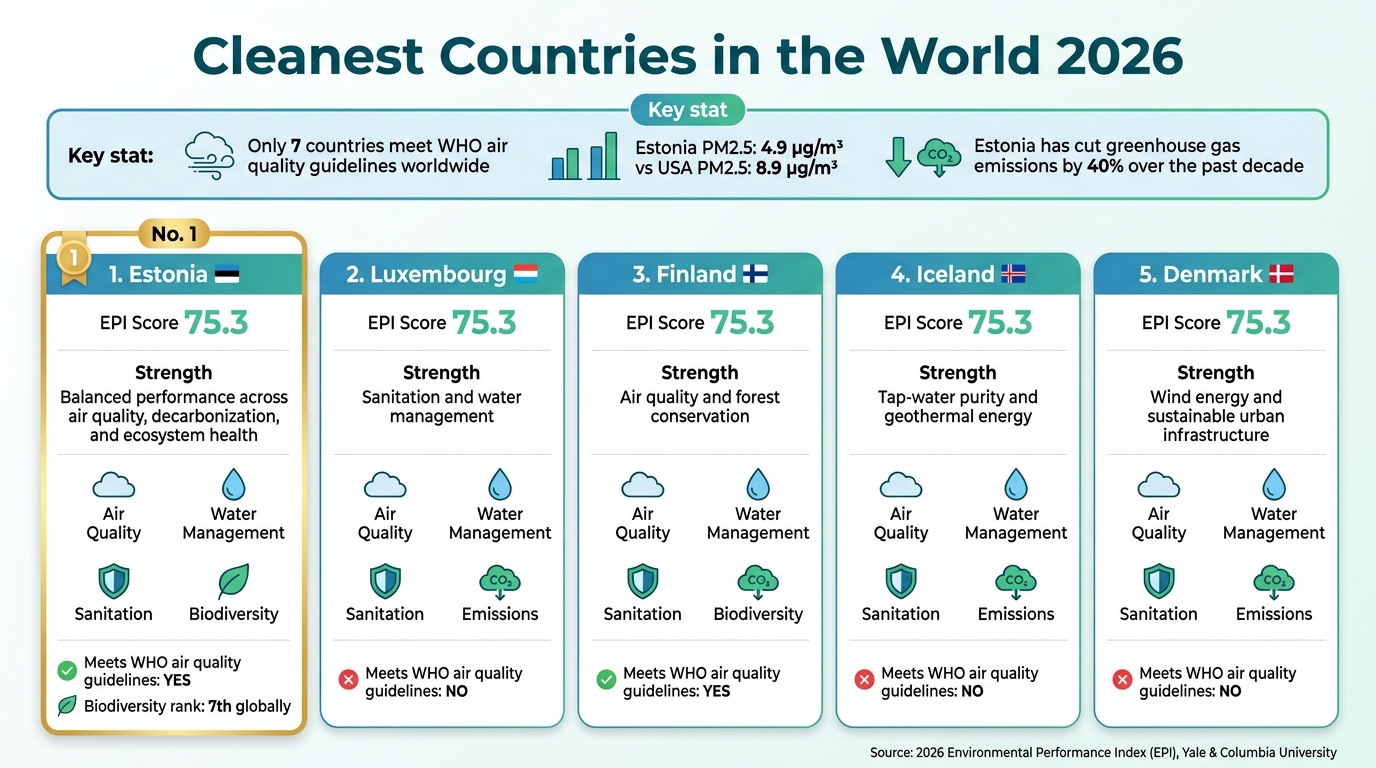
Estonia sits at No. 1 because it performs well across the board, not because of one unusually high score. The country posted an overall EPI score of 75.3, ranks 7th in the world for biodiversity and habitat preservation, and is one of only seven countries with air quality clean enough to meet WHO standards.
That matters because the 2026 EPI isn’t rewarding a single win. Estonia leads in large part because it has cut emissions while still posting strong results for air, water, waste, and habitat measures.
Those numbers aren’t just for reports and charts. They show up in normal day-to-day life.
What Estonia’s air, water, and sanitation data mean in daily life
In practical terms, this ranking points to clean air, safe tap water, and up-to-date wastewater and sewage systems. That’s the kind of thing people notice without thinking much about it. You turn on the faucet, step outside, or walk through a city, and the system simply works.
Estonia has also cut greenhouse gas emissions by 40% over the past decade, which points to steady progress over time.
The policy and infrastructure that support Estonia’s lead
Estonia’s environmental performance didn’t happen by accident. It comes from policy choices made over time. The country has moved away from oil shale power generation and toward wind, solar, and biomass. It also uses digital monitoring tools to track air quality and help manage natural resources.
Strict EU standards have played a big part too, along with Estonia’s long-term move away from oil shale. Put simply, the country didn’t land at the top through one short burst of progress. It built systems that keep things clean year after year.
"Europe’s strong showing is partially attributable to very strong environmental regulations and a commitment to decarbonization." – Alex de Sherbinin, Director of CIESIN
How Estonia compares with other leading clean countries
Countries that also rank near the top for cleanliness
Estonia sits in a small group of top performers alongside Luxembourg, Germany, Finland, and the United Kingdom. And the main point here isn’t which place looks the cleanest at first glance. It’s which country performs best across the measures that matter most.
Luxembourg does better on sanitation and water systems. Finland stands out for air quality and forest cover. Germany is strong on recycling and the shift away from fossil fuels. Iceland is known for tap-water purity. Estonia, though, delivers the steadiest all-around showing.
| Country | Main cleanliness strength |
|---|---|
| Estonia | Balanced performance: air quality, decarbonization, and ecosystem health |
| Luxembourg | Sanitation and water management |
| Finland | Air quality and forest conservation |
| Iceland | Tap-water purity and geothermal energy |
| Denmark | Wind energy and sustainable urban infrastructure |
That gap matters most for travelers, expats, and digital nomads who care about day-to-day life, not just a flashy headline rank.
Why some lists name Denmark, Iceland, or Finland instead
Not every ranking measures the same thing. Some put more weight on transit, energy, or public perception. The EPI looks at environmental health, ecosystem vitality, and climate as a combined picture.
Denmark tends to climb when a list gives more credit to cycling infrastructure and wind power leadership. Iceland often lands higher when the focus is water purity and 100% renewable energy from geothermal and hydro sources. Finland does well when air quality and forest conservation carry more weight.
That’s why Estonia comes out on top in the 2026 EPI: it scores well across the board, while countries with one standout area and weaker marks elsewhere end up lower overall.
For travelers and expats, the next thing that matters is how that ranking shows up in daily life.
What the ranking means for travelers, expats, and relocation planning
What US readers should expect from daily life in Estonia
For travelers and expats, this ranking matters most in day-to-day life. It shows up in what people see, breathe, and use once they’re there.
Estonia’s cleaner air is part of that. Average PM2.5 is 4.9 micrograms per cubic meter, compared with 8.9 in the United States. That puts Estonia among the small group of countries with steadily low air pollution.
And this isn’t just a spreadsheet win. You notice it in the streets, parks, and public areas. City centers feel clean, nature is close by, and public spaces look well kept. Estonia also ranks 7th globally for biodiversity and habitat, and people living there also get reliable drinking water and lots of green space.
For U.S. readers, the biggest lifestyle shift is the colder Baltic climate. That’s probably the part you feel first.
For remote workers, there’s another plus. Estonia’s digital utility systems and modern energy infrastructure can make daily life feel smooth and organized, while still keeping that cleaner-living edge.
Key takeaway: Estonia is the strongest evidence-based answer for 2026
If you’re trying to figure out whether Estonia is a good fit, the comparison with the United States is where this ranking becomes most useful. For U.S. readers, the main point is simple: Estonia scores higher than the United States on the same index, with stronger results on biodiversity and climate measures.
For travelers and people planning a move, air, water, green space, and the condition of the places around you aren’t abstract ideas. They shape daily life. That’s why Estonia stands out as the strongest evidence-based choice for clean-living comparisons in 2026.
FAQs
Why is Estonia ranked No. 1 in 2026?
Estonia ranks No. 1 in the 2026 Environmental Performance Index, driven in large part by a sharp drop in power-sector greenhouse gas emissions over the past decade.
That result didn’t happen by accident. Estonia has also stood out for moving away from oil shale and toward renewables. On top of that, the country has shown strong performance in biodiversity and ecosystem protection, with protected areas covering about one-fifth of its land.
Another piece of the story is Estonia’s long-term, digital-first approach to environmental monitoring and decarbonization policy. Put simply, it hasn’t just set goals on paper. It has built systems to track progress and support the shift over time.
How does the EPI measure cleanliness?
The Environmental Performance Index (EPI) tracks cleanliness and sustainability across 177 countries using 47 indicators in 12 categories. Those categories roll up into three policy objectives: environmental health, ecosystem vitality, and climate change.
When it comes to cleanliness, the EPI focuses mainly on air quality, drinking water, sanitation, and heavy metal exposure. It then weights each indicator to calculate an overall score.
What does Estonia’s ranking mean for daily life?
Residents enjoy a high-quality living environment with clean air, steady access to clean water, efficient waste management, and well-kept natural surroundings.
Day-to-day life is also shaped by Estonia’s digital-first infrastructure. Tools that track energy and resource use in real time help people see what’s happening as it happens. At the same time, lower-impact habits and ecosystem protection are built into everyday civic life.
