
If I had to answer in one line: Singapore looks like the safest all-around pick in Asia for 2026, while Japan, Taiwan, and South Korea each make more sense for different needs.
I’d break it down like this:
- Singapore: best overall for low crime, order, and day-to-day ease
- Japan: best for public order and top medical care, but earthquake risk is a big factor
- Taiwan: strong for families and remote workers, with good healthcare and internet
- South Korea: a top choice if fast medical access matters most
- UAE and Qatar: very low crime and secure city life, but stricter laws and very hot weather
- Malaysia and Oman: lower-cost options with good daily safety, but more tradeoffs
This article compares crime, healthcare, political stability, infrastructure, disaster risk, cost, and daily living across Singapore, Japan, Taiwan, South Korea, the UAE, Qatar, Malaysia, and Oman.
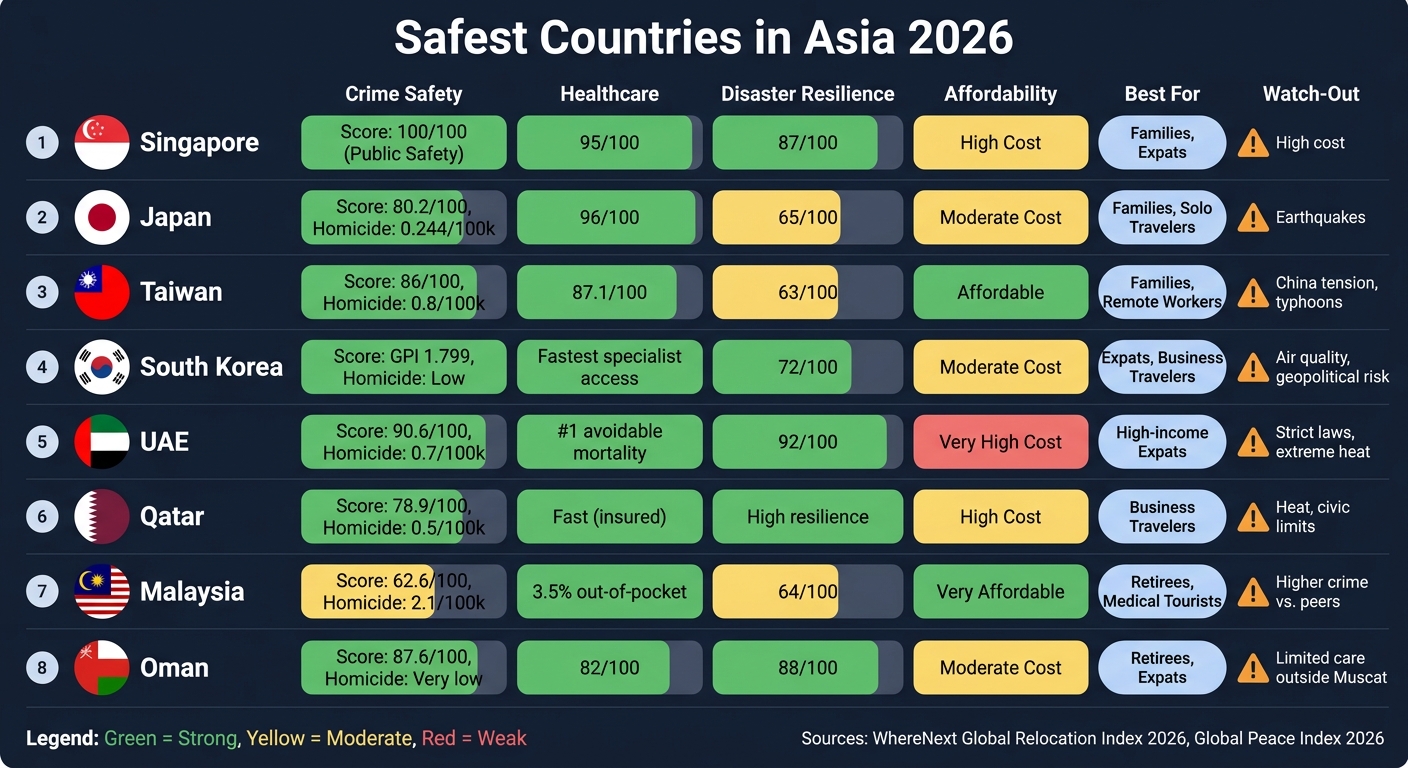
Quick Comparison
| Country | Best Known For | Main Watch-Out | Best Fit |
|---|---|---|---|
| Singapore | Very low crime and smooth daily life | High cost | Families, expats, long-term moves |
| Japan | Public order and top healthcare | Earthquakes | Families, solo travelers |
| Taiwan | Healthcare + digital life | China tension, typhoons | Families, remote workers |
| South Korea | Fast medical access | Air quality, regional tension | Expats, business travelers |
| UAE | Secure urban life | Strict laws, extreme heat | High-income expats |
| Qatar | Low crime and calm city living | Heat, civic limits | Short-term expats, business travel |
| Malaysia | Lower-cost living and medical care | Higher crime than top-ranked peers | Retirees, medical travelers |
| Oman | Street safety and stability | Less care depth outside Muscat | Retirees, expats |
The short version: if you want the lowest day-to-day risk, I’d look at Singapore first. If you care more about healthcare, Japan and South Korea stand out. If you want a mix of safety, cost, and digital life, Taiwan is one of the strongest options.
sbb-itb-39d39a6
1. Singapore
Singapore tops Asia’s safety rankings in 2026, with a near-zero homicide rate of 0.1 to 0.2 per 100,000 people and a perfect 100/100 public safety score on the WhereNext Global Relocation Index 2026. For residents and visitors, that translates to very low day-to-day risk.
What makes Singapore stand out is how steady it is across the board. It posts political stability of 92/100, faces very low natural disaster risk because it has few major earthquake or storm threats, and earns 95/100 for emergency healthcare quality. Public transit is dependable and trusted for daily use. Put simply, it works well on the things people lean on most: healthcare, infrastructure, and personal security.
That mix makes Singapore a strong pick for families, expats, and travelers who want predictability instead of surprises. The upside is clear. The downside isn’t safety. It’s price.
Singapore is also especially strong for women’s safety, though LGBTQ+ protections are weaker because same-sex marriage is not recognized.
The main tradeoff is cost. Singapore tends to suit high earners best, especially professionals and families making more than $250,000 per year. For digital nomads or budget travelers, the high cost floor can make it a hard sell.
Singapore sets the bar high, but the next country brings a different mix of safety and affordability.
2. Japan
Japan has a different safety mix than Singapore. Day-to-day security is almost as strong, but the country faces more natural disaster risk. In 2026, Japan ranks #2 in Asia and #4 globally for safety, with a score of 80.2/100. Its intentional homicide rate is only 0.244 per 100,000 people, which points to strong social order and stable public systems.
Japan’s biggest edge is healthcare. It scores 96/100, ranks #1 globally, and keeps household out-of-pocket costs low at just 2.6% of direct exposure. That matters in a big way. If you’re moving with kids, aging parents, or just want peace of mind, strong medical care can change the whole picture.
The main tradeoff is earthquake risk. Japan’s natural disaster risk score is 65/100, versus Singapore’s 87/100, and seismic and volcanic activity are the main reasons Japan doesn’t sit at the top of the regional list. For anyone relocating, this isn’t a small detail. It makes sense to focus on housing that follows modern Japanese building codes.
Language can also be a hurdle. English proficiency is low at 42.9/100, especially outside major cities and large hospitals. Translation apps can help in a pinch, but rural areas and local clinics may still be tough to handle without Japanese. In plain English: daily life may feel smooth in Tokyo or Osaka, then get a lot harder once you’re off the beaten path.
Japan fits families, solo travelers, and expats who want very low violent crime and top-tier healthcare. High earners, though, should also keep an eye on the roughly 55% top marginal tax rate.
That mix gives Japan a strong safety case, even if it comes with more disaster exposure than some of its regional peers.
3. Taiwan
Taiwan scores 86/100 for safety and 1.562 on the Global Peace Index, with a violent crime rate of 0.8 per 100,000 and a street safety score of 83/100. Day to day, that puts Taiwan close to Japan on personal safety, though the risk profile is a bit different.
One place Taiwan shines is healthcare and digital access. Its National Health Insurance (NHI) system uses a single-payer model, and wait times for both primary care and specialist visits are very short. Out-of-pocket healthcare costs are just 5.1%. On top of that, healthcare quality scores 87.1/100, while digital infrastructure comes in at 88.9/100.
The main downside is that Taiwan asks you to weigh safety at the street level against bigger external risks. Its conflict risk score is 73/100, and tension with China is still a serious issue for anyone thinking about a long-term move. Natural hazards matter too. Typhoon season runs from June through October, the climate risk score is 52/100, and seismic activity pushes the natural disaster risk score to 63/100.
English access can also be a hurdle. Taiwan scores 52/100 here, so translation apps often help with everyday tasks like reading menus, asking for directions, or dealing with local services. Residency is another sticking point. Long-term status is harder to get, with a typical 5-year naturalization period and usually limited dual citizenship.
For families and remote workers, though, Taiwan still has a lot going for it. It ranks #2 globally for families and #5 for digital nomads in the 2026 Relocation Index, backed by an education score of 86.6/100 and that same 88.9/100 digital infrastructure score. South Korea is another low-crime choice, but the mix shifts more toward cost, healthcare access, and dense city living.
4. South Korea
South Korea sits in the middle of the pack in a good way: day-to-day life is very safe, but there are more tradeoffs here than in the top-tier choices. It ranks 27th in the world for safety and posts a Global Peace Index score of 1.799. In cities like Seoul and Busan, solo travelers and families can usually move around with little stress. Public transit is dependable, public spaces are well run, and getting from point A to point B tends to feel smooth. If your top concerns are urban safety, healthcare access, and reliable transit, South Korea checks all three boxes.
Healthcare is where South Korea pulls ahead. It has the highest hospital bed capacity on this list, and access to specialists is fast under the National Health Insurance system. That matters. When you need care, speed and system capacity can make a big difference. The catch is cost: out-of-pocket healthcare spending accounts for 5.5% of household budgets, which is higher than Singapore, Taiwan, and Japan.
Political stability is steady overall, but the main long-term issue is geopolitical risk. Its conflict risk score is 69/100, and regional tension is not just background noise for people thinking about a long stay or a permanent move.
The clearest day-to-day downside is air quality, especially during spring yellow dust. That’s the biggest reason South Korea doesn’t place higher for long-term residents, even though it performs well in other areas.
South Korea is still a strong fit for expats, business travelers, and remote workers. It ranks #16 for entrepreneurs in relocation indexes, and its digital infrastructure score of 88/100 supports steady daily connectivity. The next destination shifts the safety discussion away from East Asia’s dense city life and toward a more controlled Gulf setting.
5. United Arab Emirates
The UAE’s safety model rests on three big things: strict enforcement, modern infrastructure, and very low crime. Violent crime is extremely low, with a rate of 0.7 per 100,000 people, and both Dubai and Abu Dhabi are known for strong public order and visible security. Across the Gulf, this kind of safety often comes from tight public order, strong infrastructure, and lower exposure to major disasters. The UAE’s total safety score of 90.6 puts it near the top worldwide.
Where the UAE stands out most is disaster resilience. It scores 92/100 in that category, ahead of Japan (60/100), Taiwan (62/100), and South Korea (72/100). A big reason is simple: the UAE faces far less seismic and volcanic risk than many parts of Asia. On healthcare, the country ranks #1 globally for the lowest avoidable mortality rate, at 112 deaths per 100,000 people, and care access is rated "Very Fast" for insured residents. That last part matters a lot. Fast care depends on having insurance.
The tradeoffs are hard to ignore. The UAE’s legal system is strict, and it does not treat citizens and non-citizens the same way. Institutional transparency is also weaker than in Singapore and Japan. Then there’s the climate. Extreme heat is the main drawback on that front. Broader geopolitical tensions in the Persian Gulf also remain a background risk heading into 2026.
In practice, the UAE tends to fit high-income professionals, luxury travelers, and expat families who want strong physical security and modern infrastructure. Qatar has a similar Gulf safety profile, though the scale and pace are different.
6. Qatar
Like the UAE, Qatar offers the kind of safety many people look for in the Gulf, but in a smaller and calmer setting. Crime is very low, and public order is tight. The violent crime rate is just 0.5 per 100,000 people, while intentional homicide stands at 0.336 per 100,000. Qatar also ranks as the 9th safest country globally in 2026, with a 78.9 safety score, which puts it in the resilient tier.
Day to day, Doha tends to feel secure, and street crime is uncommon. That said, this level of safety comes with a more controlled legal and social setting than many travelers expect. Qatar’s Freedom Score is 54/100, and its corruption-control score is 62/100. The biggest weak spots are more limited protections for non-citizens and the risk tied to the region.
Healthcare is well resourced, and insured residents can usually get care without long waits. In plain terms, health insurance matters before you arrive because fast access depends on it.
The main downsides are the heat and regional risk. Summer temperatures can make outdoor life hard for much of the year, and tensions in the Gulf still matter for long-term plans. Qatar tends to fit high-income professionals, business travelers, and expat families who care most about personal safety, solid infrastructure, and fast medical access.
7. Malaysia
Malaysia moves the list back to Southeast Asia. It’s safer than many nearby countries, but it doesn’t sit in Asia’s top safety group. Its Global Safety Score is 62.6, and its GPI score is 1.427. In places like Kuala Lumpur and Penang, day-to-day life is usually comfortable, though not quite top-tier safe.
Crime is the main thing to watch. The violent crime rate is 2.1 per 100,000 people, and the intentional homicide rate is 0.871 per 100,000. Those numbers place Malaysia below the strongest safety group on this list. In cities, it’s smart to stick with registered taxis or well-known ride-hailing apps.
One of Malaysia’s biggest strengths is healthcare. The country has a public system as well as strong private hospitals. Private hospitals often mean fast access to specialists, and out-of-pocket healthcare costs are relatively low at 3.5%. Public elective procedures can take longer, so expats and long-term residents may want private medical insurance.
The main downside is environmental risk. Malaysia has a Planetary Resilience Score of 64, which is lower than Singapore and Japan, with air quality and climate resilience standing out as the main concerns. So while daily life can be comfortable, the country faces more pressure on this front than the top-tier places in this ranking.
Malaysia is politically stable, although corruption control is weaker than in Singapore, Japan, and Taiwan. It tends to suit cost-conscious expats and medical tourists who want solid healthcare at a lower cost than Singapore or Japan. It’s a practical middle ground before the list moves to Oman.
8. Oman
Compared with the UAE and Qatar, Oman feels quieter and less built-up. It ranks among Asia’s safest countries in 2026, with a Total Safety Score of 87.6.
Oman’s biggest strength is day-to-day street safety. Its Crime & Safety Score is 95/100, and street crime is extremely low. Political stability scores 88/100, which puts it ahead of the UAE and Malaysia on that measure.
Healthcare is solid, with a system-quality score of 82/100. Access is better in Muscat than in areas outside the capital.
Oman’s Natural Disaster Resilience Score is 88/100, though extreme heat is still its main drawback on the climate side.
Oman can be a good fit for expats and retirees who want low crime and don’t mind the tradeoffs: less transparency, different legal protections for non-citizens, and thinner healthcare coverage outside Muscat. Those points matter most in the pros-and-cons comparison below.
Pros and Cons of the Safest Asian Countries
No country on this list will be the right fit for everyone. Each one comes with a different mix of strengths and drawbacks. So instead of asking, "Which country is safest?" it makes more sense to ask: safest for what?
The table below gives you the main tradeoffs at a glance. You can use it to line up each country with what matters most to you, whether that’s crime levels, healthcare access, residency options, or day-to-day ease of living.
| Country | Biggest Safety Strength | Biggest Safety Limitation | Best For | Less Ideal For |
|---|---|---|---|---|
| Singapore | Reliable infrastructure and services with strict law enforcement | High cost of living and strict regulations | High-earning families and people prioritizing urban security | Budget travelers and those seeking more relaxed regulations |
| Japan | Exceptional public order and women’s safety | High earthquake and natural disaster risk | Solo travelers and families | Anyone relying on English for administrative tasks |
| Taiwan | Accessible healthcare and family infrastructure | Typhoon risk and geopolitical tensions | Families and digital nomads | Those seeking easy permanent residency |
| South Korea | Advanced healthcare and fast specialist access | Geopolitical exposure and language barrier | Tech-savvy families | High earners sensitive to tax burdens |
| UAE | Robust street security and luxury infrastructure | Strict legal and cultural restrictions | Luxury travel and corporate expats | LGBTQ+ travelers seeking liberal legal protections |
| Qatar | Strong urban security backed by wealth and enforcement | Limited broader civic freedoms | Travelers seeking secure short-term urban stays | Those seeking stronger democratic institutions |
| Malaysia | Medical tourism and multicultural hospitality | Higher crime rates than East Asian peers | Retirees and medical travelers | Those seeking the lowest possible crime levels |
| Oman | High personal security and political stability | Lower systemic healthcare redundancy | Expats seeking high personal security | Those needing high-tier emergency care depth |
What this shows is pretty simple: "safe" isn’t one thing. Singapore and Japan stand out for public order and daily predictability. Taiwan and South Korea look stronger if healthcare and family life sit near the top of your list. The UAE and Qatar may appeal more to people focused on secure urban living, while Malaysia and Oman can make sense for retirees, expats, or people with very specific lifestyle goals.
That’s why the best pick depends on what you care about most: street security, healthcare, disaster risk, or long-term stability.
Conclusion
After looking at crime, healthcare, infrastructure, and disaster risk, one thing is clear: there isn’t one country that’s safest for every person. The right pick depends on what matters most to you – low crime, strong healthcare, political stability, or easy day-to-day living.
Singapore comes out ahead in the region for families and long-term relocation. It pairs near-zero violent crime with tight public order. The downside is simple: it costs more.
Japan is close behind, but for a different reason. It’s the best all-around option for people who care most about low street crime and strong public order.
Taiwan stands out for families and digital nomads because it brings together safety, good healthcare, and solid affordability. South Korea is the leader for healthcare access, which makes it the best fit if fast, dependable medical care is non-negotiable.
The Gulf options change the tradeoff. Instead of weather and language being the main issue, the focus shifts to strict rules and tightly managed city life. If your goal is secure urban living with low day-to-day risk, the UAE and Qatar are the best match.
Taken together, these countries serve different safety needs rather than fitting into one simple ranking. Choose Singapore for maximum overall safety, Japan or Taiwan for strong daily livability, South Korea for healthcare, and Malaysia or Oman for a more affordable base.
FAQs
How should I define safety before choosing a country in Asia?
Define safety in practical terms. It’s not just about military power or GDP. A place can be rich and still feel risky in day-to-day life.
Instead, think of safety as a mix of things working together:
- Protection from crime and violence
- Strong healthcare
- Medical costs people can handle
- Disaster risk that’s realistic and planned for
It also helps to look at safety from two angles: the traveler’s view and the resident’s view. For travelers, that often means low crime, political stability, and access to emergency care if something goes wrong. For residents, the bar is a bit higher. People also need a healthcare system they can use without huge financial strain, plus public systems that are ready for floods, earthquakes, wildfires, or other threats.
There’s another point people miss: safe doesn’t mean risk-free. Even countries with low crime can have weaker spots, whether that’s one region versus another, petty theft in tourist areas, or a higher chance of natural disasters. So the better way to judge safety is to look at the full picture, not just one headline metric.
Which country is safest for long-term relocation versus short-term travel?
For short-term travel, it makes sense to put places with strong tourist infrastructure at the top of your list. Singapore and the United Arab Emirates stand out here. Petty crime is low, public transit works well, and English is widely used, which makes day-to-day travel much easier.
For long-term relocation, the checklist changes. Political stability, conflict risk, and residency pathways matter a lot more when you’re planning to stay for years, not weeks. Japan and Taiwan are strong choices for long-term safety, but you still need to think through residency rules, language barriers, and property rights before making a move.
How much should disaster risk affect my choice?
Disaster risk should be a major factor in long-term livability, but it works best when you look at it alongside other safety issues.
Take Japan. It faces more exposure to earthquakes, tsunamis, and typhoons. Still, strong infrastructure and solid preparedness can lower the damage when those events happen.
South Korea, by contrast, has lower climate and disaster risk. That can make it more appealing if long-term stability matters a lot to you.
It also helps to look past the headline risk and focus on the details: building codes, warning systems, and your own emergency readiness all matter.
