
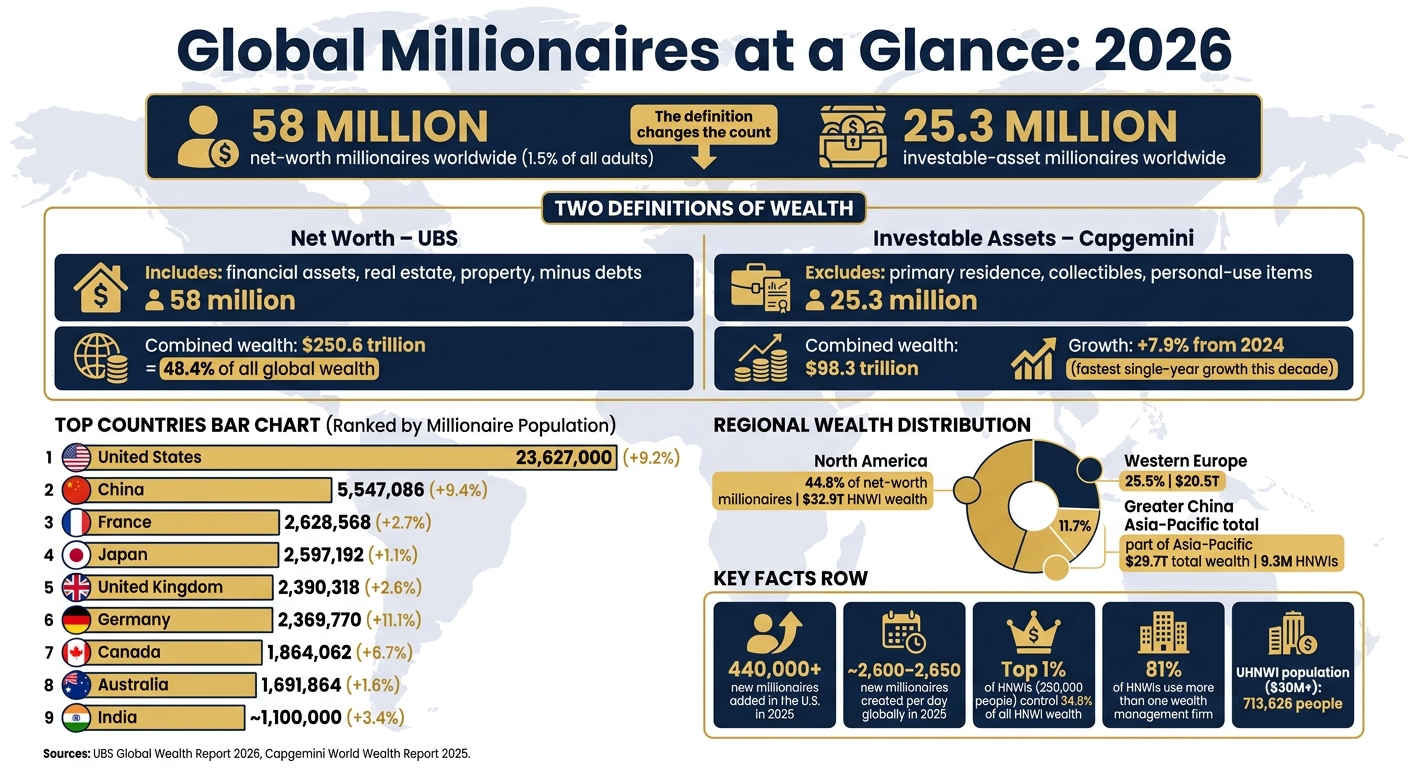
Here’s the short answer: about 58 million people worldwide are millionaires in 2026 by net worth, but only 25.3 million qualify if I use investable assets only.
That gap is the whole story. One count includes homes and other property. The other focuses on money and assets that can be invested more directly. If you want the clearest view, you need to look at both numbers.
If I boil the article down, here’s what matters most:
- 58 million people have at least $1 million in net worth
- 25.3 million have at least $1 million in investable assets
- The U.S. leads by far, with 23,627,000 net-worth millionaires
- Millionaires hold a huge share of global wealth: $250.6 trillion, or 48.4% of the total
- In 2025, the U.S. added more than 440,000 new millionaires
- The top end is tightly grouped, with about 250,000 people controlling 34.8% of HNWI wealth
Quick comparison
| Measure | What it includes | 2026 global count |
|---|---|---|
| Net worth | Financial assets, real estate, other property, minus debts | 58 million |
| Investable assets | Invested and investable wealth, minus debts, but not a primary home or personal-use items | 25.3 million |
Put simply: your definition changes the answer. And if you care about wealth movement, tax exposure, or cross-border planning, that difference matters more than the headline number.
What counts as a millionaire in 2026?
"Millionaire" sounds simple, but the total depends on the definition. Put plainly: the definition changes the count.
Net worth millionaires vs. investable-asset millionaires
Net worth is the broader measure. It includes financial assets and non-financial assets, with real estate playing a big role, and then subtracts debts. UBS uses this broader standard.
Investable assets is a narrower standard. Capgemini defines a millionaire as someone with $1 million or more in investable assets, excluding a primary residence and personal-use assets. That one detail changes a lot. For many people in the $1 million to $5 million range, residential property is the main asset. That’s why many net worth millionaires don’t show up in Capgemini‘s count.
So yes, the two definitions can lead to very different 2026 totals.
Why global wealth reports show different millionaire counts
The definition is the big driver, but it isn’t the only one.
Currency conversion matters because both reports use U.S. dollars. If the dollar weakens, more non-U.S. assets can move above the $1 million mark. Inflation and stock markets also shift the numbers. Easing inflation and strong equity-market gains, especially AI-related rallies, were major drivers of wealth creation in 2025.
There are also differences in coverage, reporting dates, and population estimates. When you put the two methods side by side, the gap makes more sense.
| Feature | UBS (Net Worth) | Capgemini (Investable Assets) |
|---|---|---|
| Primary residence included | Yes | No |
| Collectibles/durables included | Yes | No |
| Debts subtracted | Yes | Yes |
| Global millionaire count | 58 million | 25.3 million |
| Markets covered | 56 | 71 |
Neither approach is wrong. Net worth measures total household balance-sheet wealth. Investable assets measures wealth that can be moved and managed more directly. That’s often the better fit for cross-border planning and asset protection.
With the definitions set, the next section shows how many millionaires each measure captures in 2026.
sbb-itb-39d39a6
Global millionaire count in 2026: best estimates and recent growth
Estimated number of net worth millionaires worldwide in 2026
UBS estimates that the world had 58 million net worth millionaires in 2026, which works out to 1.5% of all adults worldwide. That’s slightly below the 2022 peak of 59.4 million.
That figure matters because it looks at balance-sheet wealth, not just cash or brokerage accounts. In plain English, it includes things like homes and other non-liquid assets.
This group held a combined $250.6 trillion, or 48.4% of all global wealth.
Estimated number of investable-asset millionaires worldwide in 2026
Capgemini puts the number of global investable-asset millionaires at 25.3 million. This measure leaves out primary residences, collectibles, consumables, and consumer durables.
That total was up 7.9% from 2024, the fastest single-year growth rate of the decade so far.
Together, these millionaires controlled $98.3 trillion in investable wealth, up 8.7% year over year. In 2025, the world added about 2,600 to 2,650 new millionaires per day. It was also the first year on record when HNWI growth was positive in every market.
The next step is to look at where these millions are clustered.
Comparison table: millionaire estimates from 2022 to 2026 by measurement type
| Year | Net Worth Millionaires (UBS) | Investable-Asset Millionaires (Capgemini) | Key Driver |
|---|---|---|---|
| 2022 | 59.4 million | 21.7 million | Market volatility |
| 2023 | – | 22.8 million | Equity recovery |
| 2024 | – | 23.4 million | Continued market growth |
| 2026 | 58 million | 25.3 million | AI-driven market gains |
The difference between the two totals comes down to scope. Net worth includes homes and other non-liquid assets. Investable assets do not. That split helps explain why the counts are so far apart, and it sets up the country and regional breakdowns that follow.
Where the world’s millionaires are concentrated
Countries with the largest millionaire populations
Global millionaire totals are clustered in a small group of countries.
The United States leads by a wide margin. It has 23,627,000 net-worth millionaires. Using the investable-asset measure, the U.S. has 8.7 million.
China ranks second in net-worth millionaires, with 5,547,086. After that, the numbers drop quite a bit. France, Japan, and the U.K. each have about 2.4 million to 2.6 million net-worth millionaires, while Germany’s net-worth millionaire population grew 11.1% in 2025. India has about 1.1 million net-worth millionaires, up 3.4% in 2025.
The same pattern shows up when you zoom out from countries to regions.
Regional distribution and wealth concentration
UBS data shows that net-worth millionaires are heavily clustered in North America, Western Europe, and Greater China. North America accounts for 44.8% of the world’s net-worth millionaires. Western Europe follows at 25.5%, and Greater China comes next at 11.7%.
Capgemini’s investable-asset measure paints a similar picture, with one small twist. Asia-Pacific has 9.3 million HNWIs, slightly ahead of North America’s 9.2 million. But North America still holds more total HNWI wealth: $32.9 trillion versus $29.7 trillion.
Millionaire density tells a different story. Instead of total headcount, it looks at how many millionaires exist relative to population size. On that basis, Luxembourg, Switzerland, and Hong Kong rank highest per capita.
The top end is even more concentrated. The top 1% of HNWIs – about 250,000 people – control 34.8% of all HNWI wealth worldwide.
Average and median wealth show this gap in another way. The U.S. ranks second globally for average wealth per adult at $696,277, yet only 28th for median wealth at $68,998. That gap says a lot: wealth in the U.S. is large in total, but not spread evenly. Luxembourg ranks first in median wealth, at $394,005.
Comparison table: top countries and regions by millionaire count
| Country | Estimated Net-Worth Millionaire Count | 2025 Growth |
|---|---|---|
| United States | 23,627,000 | Up 9.2% |
| China | 5,547,086 | Up 9.4% |
| France | 2,628,568 | Up 2.7% |
| Japan | 2,597,192 | Up 1.1% |
| United Kingdom | 2,390,318 | Up 2.6% |
| Germany | 2,369,770 | Up 11.1% |
| Canada | 1,864,062 | Up 6.7% |
| Australia | 1,691,864 | Up 1.6% |
| India | ~1,100,000 | Up 3.4% |
| Region | HNWI Population (Investable-Asset Measure) | HNWI Wealth |
|---|---|---|
| North America | 9.2 million | $32.9 trillion |
| Asia-Pacific | 9.3 million | $29.7 trillion |
| Europe | 6.1 million | $20.5 trillion |
(Source: [3])
That concentration helps explain why cross-border planning matters for mobile wealth.
What these numbers mean for migration, asset protection, and cross-border planning
The count matters most when wealth becomes mobile.
Millionaire migration: a small but meaningful flow of mobile wealth
Most millionaires stay where they are. Still, the group that moves carries outsized weight. These are often some of the most internationally mobile households on the planet, and even a small slice can shift money, tax receipts, and business activity across borders.
The global UHNWI population – people worth more than $30 million – reached 713,626 in 2026. Between 2021 and 2026, about 89 people per day crossed the $30 million mark. That may sound like a narrow stream, but when people at that level relocate, the ripple effect can be large.
Taxes sit near the center of that movement.
For U.S.-connected readers, this tends to show up in a few places: currency exposure, entity setup, and residency planning.
What U.S.-connected high-net-worth readers should take from the data
The U.S. added more than 440,000 new millionaires in 2025. That was nearly half of all new millionaires added worldwide that year. More wealth usually means more moving parts, and many households still plan for it later than they should.
One pressure point is currency risk. The drop in the U.S. dollar in 2025 boosted wealth gains in other regions. EMEA grew by 17.5%, while the Americas grew by 8.5%. That gap matters. A family can look stronger or weaker on paper depending on where assets sit and which currency does the measuring.
Another shift is the mix of assets. Wealthy households are leaning more toward liquid, investable holdings instead of depending only on residential real estate. Once assets are easier to move, cross-border structuring starts to matter more.
Fragmentation is another issue. 81% of HNWIs now use more than one wealth management firm, up from 61% in 2019. On one hand, that points to demand for niche advice. On the other, it can create handoff problems between advisors.
If one firm handles investments, another oversees trusts, and a third deals with tax, small gaps can turn into expensive ones. LLCs and trusts should be reviewed across all providers so tax residency reporting, succession planning, and privacy measures don’t drift out of sync.
How Global Wealth Protection fits into this planning landscape

Global Wealth Protection offers U.S. LLCs, offshore companies, and offshore trusts for asset protection, privacy, and succession planning. The Global Escape Hatch program gives clients a step-by-step relocation plan, and private consultations are available for jurisdiction-specific guidance.
That’s why the headline count is only the starting point.
Conclusion: the clearest 2026 takeaway on global millionaire counts
In 2026, the world has about 58 million net-worth millionaires or 25.3 million investable-asset millionaires, depending on how you define the term.
That single distinction changes the picture in a big way. The United States leads by a wide margin and holds the largest share under both measures. And the wealth at the top is packed into a very small group: just 58 million people – about 1.5% of adults – control nearly half of global wealth.
That concentration matters most when wealth can move. For high-net-worth readers, the practical takeaway is direct: primary residences count in net worth, but not in investable-asset totals. That gap shapes residency, entity, and asset-protection decisions across borders.
FAQs
Why do millionaire counts vary so much?
Millionaire totals differ because groups use different ways to define and measure wealth.
Some count assets like a primary home, collectibles, and consumer goods. Others look only at liquid, investable assets.
The numbers can also shift with U.S. dollar exchange-rate changes. On top of that, results depend on the financial models being used, including which markets are included and how wealth is estimated across adult populations.
Does owning a home make you a millionaire?
It comes down to how you define wealth.
A lot of financial reports look at investable assets only. That means they leave out your primary home. So even if you own a $1 million house, that alone would not make you a millionaire under that definition.
A broader way to measure wealth is net worth. That includes home equity. By that math, your home can make you a millionaire.
The catch? Home equity is usually less liquid than stocks, cash, or other market-based holdings. In plain English, the value may be there on paper, but it’s not always easy to turn into spendable money.
Why does the U.S. have so many millionaires?
The U.S. has so many millionaires for a simple reason: stocks have done very well over time, and many people have built wealth by saving steadily and reinvesting what they earn.
That trend got an extra boost in 2025, when global personal wealth rose 10.8%. As a result, the U.S. made up nearly half of all new millionaires created worldwide that year.
