
If I had to sum it up in one line: the best country depends on whether you want low costs, short waits, public coverage, or easy private care.
From this list, Portugal, Spain, Costa Rica, and Germany fit people who want public-system access. Thailand, Mexico, Singapore, and the UAE lean more toward private care, with very different price points.
A few facts stand out right away:
- Spain, Portugal, and the UAE may require proof of health insurance for residency or visa approval.
- A medical evacuation can cost more than $130,000.
- Singapore has top-tier care, but foreigners often pay full private rates.
- Thailand and Mexico usually offer lower day-to-day private costs.
- Germany and Spain give many residents strong public access, but waits can be long.
- Costa Rica requires legal residents to join La Caja.
- Portugal often works best as a public-plus-private mix.
If I were choosing fast, English-friendly care, I’d look at Singapore, the UAE, or private hospitals in Thailand. If I wanted lower monthly costs, I’d look at Mexico, Costa Rica, or Thailand. If I wanted a public backstop for family life or retirement, I’d start with Spain, Portugal, or Germany.
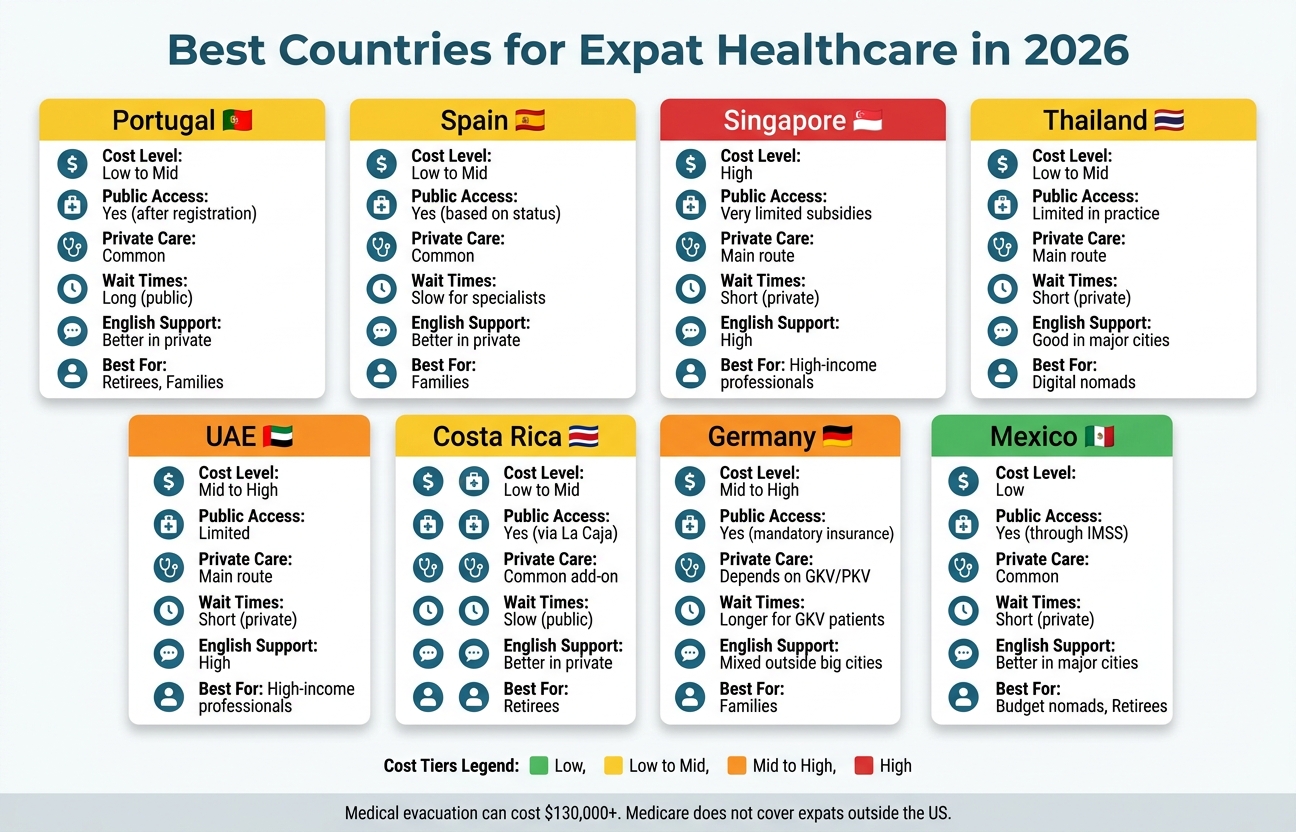
Quick Comparison
| Country | Cost level | Public access for expats | Private care use | Wait times | English support |
|---|---|---|---|---|---|
| Portugal | Low to mid | Yes, after registration | Common | Public can be long | Better in private |
| Spain | Low to mid | Yes, based on status | Common | Public specialists can be slow | Better in private |
| Singapore | High | Very limited subsidies | Main route | Usually short in private | High |
| Thailand | Low to mid | Limited in practice | Main route | Usually short in private | Good in major cities |
| UAE | Mid to high | Limited | Main route | Usually short in private | High |
| Costa Rica | Low to mid | Yes, through La Caja | Common add-on | Public can be slow | Better in private |
| Germany | Mid to high | Yes, mandatory insurance system | Depends on GKV/PKV | Public-insured waits can be longer | Mixed outside big cities |
| Mexico | Low | Yes, through IMSS | Common | Private usually short | Better in major cities |
Bottom line: I’d match the country to your visa path, insurance budget, and how long you’re willing to wait for specialist care.
sbb-itb-39d39a6
1. Portugal
Portugal has a universal public healthcare system called the Serviço Nacional de Saúde (SNS). For legal residents, it offers low-cost care. That said, many expats don’t rely on the public system alone. They often split their care between public services and private clinics.
Care quality
The SNS is dependable for emergencies and routine primary care. The main issue is speed. Non-urgent specialist visits and elective procedures can come with long waits, so many expats turn to private clinics when they want faster appointments and easier access to English-speaking staff.
Cost and insurance
Care through the SNS usually includes small co-payments for doctor visits and hospital care, although many of these fees are waived for children, pensioners, and lower-income residents.
Private insurance costs can vary a lot by age. International health plans often cost about €900 to €1,500 per year for adults in their 20s and 30s. For people ages 55 to 65, that can climb to around €3,500 to €6,000 per year. A local supplemental plan is far cheaper, usually about €150 to €250 per year.
Public access rules
To use the SNS, you first need to register at a local centro de saúde and show proof of address and residency status. That process can take weeks or even months. During the first residency stage, private insurance is often required.
This matters for visa applicants. People applying for D7 visas, Digital Nomad visas, and Golden Visas generally need to show proof of private health coverage before residency is approved.
Wait times and language
English support is uneven in the public system. In private clinics, especially in bigger cities, finding English-speaking staff is usually much easier.
For many expats, Portugal makes the most sense as a hybrid setup: SNS for routine care and emergencies, private coverage for faster access. It gives you a public backup while making day-to-day care simpler and less frustrating.
2. Spain
Spain’s Sistema Nacional de Salud (SNS) is one of Europe’s stronger public health systems. Primary care is broad, and public hospitals are generally well regarded. For expats, though, the big issue isn’t the system on paper. It’s how easy it is to get care when you need it.
Like Portugal, Spain has a public-private setup. But there’s one big difference: residents who qualify through work or social security usually get much broader access to public care.
Care quality
The SNS handles emergencies, primary care, and hospital stays well. Where many expats run into trouble is specialist care. Non-urgent appointments and elective procedures can come with long waits, which is one of the main reasons private insurance often shifts from nice-to-have to almost necessary.
Cost and insurance
If you live in Spain, work, and pay into social security, you get full access to the SNS without direct charges for consultations, hospital stays, and surgeries.
If you want faster access to specialists, a local supplementary policy usually costs about €150 to €250 per year. A private expat plan is a bigger step up in price. For adults ages 25 to 35, it usually runs around €900 to €1,500 per year, while more complete coverage tends to fall between €1,800 and €2,500 per year.
Public access rules
Access has less to do with nationality and more to do with your legal route into residency.
- Employed and self-employed residents pay into social security and get full SNS access.
- EU retirees can move their healthcare rights from their home country with an S1 form.
- Non-working residents from outside the EU who don’t pay into social security can still use the public system through the convenio especial, a pay-in option that opens SNS access for a low monthly fee.
Wait times and language
Wait times for public specialists are a real pain point. That’s often where the public system starts to feel slow, especially if the issue isn’t urgent. English support is also limited in public facilities.
Private clinics usually offer shorter waits and more English-speaking specialists. For many expats, that makes private care the more practical path, even if they still qualify for the public system.
3. Singapore
Singapore ranks 14th globally in the 2025-2026 Health Care Index. The system is top-tier, but foreigners without permanent residency pay full price.
Care quality
Private hospitals in Singapore meet international standards, and many specialists trained in the UK, US, or Australia. Well-known hospitals for expats include Mount Elizabeth Orchard, Gleneagles, and Raffles Hospital.
If you call 995, you can get free ambulance transport. But there’s a catch: non-citizens still pay full emergency department rates.
Cost and insurance
Costs sit much closer to Western markets than to most of the region.
| Service | Estimated Cost |
|---|---|
| Private GP visit | S$50–S$90 |
| Specialist consultation | S$150–S$300+ |
| Hospital ward (per night) | S$500–S$1,500+ |
| Emergency department | S$200–S$600+ |
| Maternity delivery | S$5,000–S$18,000 |
Most expats depend on employer group insurance. If you’re working through an offer, it’s smart to ask for A-class private hospital ward coverage. That one detail can make a big difference.
Self-employed expats usually look at international plans. Those plans cost S$2,400 to S$7,200 per year, depending on age and coverage. Local plans are about 20% to 30% cheaper, but they don’t cover treatment abroad.
For many expats, this is where the math gets simple: Singapore works best if your employer gives you strong coverage or you can afford a higher insurance budget. In practice, insurance is the main gatekeeper.
Public access rules
Employment Pass holders get no subsidies and no access to MediShield Life or Integrated Shield Plans. Public polyclinics are still open to them, but non-citizens pay S$30 to S$50 per visit, while citizens pay S$8 to S$12.
That price gap often pushes routine care into the private system.
Wait times and language
English is the main language used across the healthcare system. Private hospitals usually offer fast specialist access and short waits for elective procedures. For smaller issues, teleconsultations often cost S$20 to S$40.
Singapore is the region’s premium fast-access option. Thailand has a very different cost setup next.
4. Thailand
Thailand stands out for high-quality specialist care at lower prices. In Bangkok, hospitals like Bumrungrad, Samitivej, and BNH are central to expat healthcare. The big draw is simple: good care, lower costs, and easy access for foreigners.
Care quality
In major cities, most expats use private hospitals by default. They tend to offer strong standards, modern facilities, English-speaking medical staff, and short wait times.
Public hospitals are open to legal residents. Still, many expats stick with private care because it’s faster and easier to navigate.
Cost and insurance
Private care in Thailand is still low-cost by international standards. Here are the typical 2026 ranges:
| Service | Estimated Cost |
|---|---|
| Specialist consultation (private) | $30–$60 |
| Hospitalization (per night, private) | $300–$800 |
| Local Thai insurance (adult under 45) | $300–$700/year |
| International private insurance (age 25–35) | $900–$2,500/year |
Because care is fairly low-cost, many expats buy local Thai insurance and pay routine medical bills out of pocket. That setup often works well for people living mainly in Thailand.
Local policies are usually the best fit if Thailand is your main base. International plans make more sense if you want worldwide coverage and higher claim limits.
Public access rules
Long-stay visas usually require proof of health insurance, so this isn’t something to leave until the last minute. A smart move is to start insurance applications 3–6 months before relocating.
Wait times and language
Private hospitals usually mean short waits and English-language service. Public hospitals are often slower and less convenient for most expats.
Thailand is the value benchmark here: strong private care, low prices, and insurance that many expats can manage without much strain. It works especially well for people who want easy access and lower day-to-day medical costs, though it may feel less formal than systems built around more structured expat coverage.
5. United Arab Emirates
The UAE requires expats to carry approved private health insurance to get and keep residency. Expats don’t receive free public healthcare, and coverage is part of the residency setup. In plain English: the UAE runs on a private-first model, not the public-backed approach you see in Portugal and Spain.
Care quality
Private hospitals in Dubai and Abu Dhabi are modern, well-equipped, and staffed by international medical teams. Cleveland Clinic Abu Dhabi is a standout, with high-end specialty care in cardiac, oncology, and neurology. Across both cities, top hospitals tend to offer fast access to specialist treatment and a high standard of care.
Cost and insurance
If you’re employed, there’s good news: employers are legally required to provide health insurance for their staff, so most expats on work contracts are covered from day one. If you’re self-employed or on a freelance visa, you’ll need to buy your own plan that meets Dubai Health Authority (DHA) or Abu Dhabi DoH rules.
Typical private-care costs in the UAE look like this:
| Service | Estimated Cost |
|---|---|
| GP consultation | $40–$120 |
| Specialist visit | $80–$200 |
| Hospital stay (per night) | $500–$2,000 |
| Basic annual insurance (DHA/DoH approved) | $820–$2,180 |
Basic plans may cover up to AED 150,000 per year, but maternity care and chronic conditions often mean paying for a higher-tier plan. That’s where a more complete International Private Medical Insurance (IPMI) plan can make sense. One small detail can save a lot of hassle: check that your preferred hospitals are in the cashless network before you buy.
Public access rules
Public hospitals such as Rashid Hospital in Dubai and Sheikh Khalifa Medical City in Abu Dhabi do treat expats at subsidized rates, but the system for non-nationals is still geared toward private care. Emergency care is strong, and 998 is the standard emergency number. Insurance covers emergency treatment at any facility.
For routine or non-emergency appointments, private care is the usual path. It’s also smart to check UAE prescription rules before traveling with medication, since some drugs that are common elsewhere can face tighter controls.
Wait times and language
English is the main working language across UAE healthcare, which makes appointments, paperwork, and diagnoses much easier to deal with. Wait times at private facilities are usually short, and booking is highly digital through apps like Okadoc and Healow.
Costa Rica offers a lower-cost model with a very different split between public and private care.
6. Costa Rica
Costa Rica changes the comparison quite a bit. Instead of a high-cost private setup, it uses a lower-cost hybrid model. The system combines public and private care: La Caja covers residents, while many expats still go to private clinics for faster appointments and easier English communication.
Care quality
Private hospitals in Costa Rica often deliver more than people expect. Hospital CIMA, Hospital Clínica Bíblica, and Hospital La Católica are internationally accredited and offer advanced diagnostics, surgical units, and specialist care. All three are in the San José area, mainly around Escazú and Santa Ana. Costa Rica is also a medical tourism hub, and many procedures cost 60% to 70% less than in the United States.
Cost and insurance
La Caja enrollment usually costs $60 to $150 per month, based on declared income, and there are no added point-of-care fees. Private GP visits tend to cost $40 to $60, while specialist visits usually run $60 to $100. Private insurance for expats generally falls between $100 and $250 per month. Expats on Costa Rica’s Pensionado retirement visa may also qualify for 15% to 20% discounts on a range of healthcare services.
Public access rules
La Caja enrollment is mandatory for all legal residents. Once you have residency, you must register and pay into the system. After that, public hospital and clinic care is covered. The public system is organized, but non-urgent care can move slowly.
Wait times and language
Many private-sector doctors are U.S.-trained and bilingual, so English access is usually straightforward. Public facilities work mainly in Spanish, and English support depends on the location and staff.
For expats, the rule is simple: enroll in La Caja, then use private care when speed or English access matters.
7. Germany
Germany offers high-quality care, but there’s an early fork in the road: public insurance (GKV) or private insurance (PKV). That choice shapes how you use the system day to day. For expats who want dependable care, Germany is a strong pick, especially if they don’t mind a more formal insurance setup.
Care quality
Germany has a large hospital network with modern facilities and highly skilled medical professionals. Specialists are easy to find, though GKV patients often wait longer than PKV patients. Support for long-term and chronic care is strong, which matters if you need regular treatment rather than the occasional doctor visit.
Cost and insurance
Germany runs on a public-private insurance model built around statutory insurance (GKV) and private insurance (PKV). In practice, PKV often means faster access to specialists. It’s also a common path for expats who want shorter waits and a bit more choice in how they get care.
Public access rules
Health insurance is mandatory for residents, and access depends on whether you’re in GKV or PKV. Most people sign up with a Hausarzt, who serves as the main doctor and manages specialist referrals. That step matters. GKV patients can run into longer waits for specialist appointments, while PKV holders are often seen sooner.
Wait times and language
For expats, the Hausarzt referral system is probably the biggest practical detail to learn early. GKV patients usually go through their primary care doctor before seeing a specialist. PKV holders, on the other hand, tend to get faster direct access.
Language can also shape the experience. English is common in major cities and private clinics, but public paperwork and referral documents are usually in German.
For most expats, the big call is simple: does GKV or PKV make more sense for your residency status and budget? After that, the issue becomes whether a lower-cost setup gives you enough access without Germany’s admin-heavy process.
8. Mexico
Mexico is the budget-friendly pick in this group. In major cities, private care is strong. Public care is weaker, and everyday costs are very low. Private treatment is cheap enough that many expats just pay out of pocket for routine visits. That setup works well for retirees and remote workers who stay near big cities and want low-cost private care.
Care quality
Cities such as Mexico City, Monterrey, Guadalajara, and Puebla have accredited private hospitals and many specialists trained in the U.S., Canada, or Europe. Hospital Médica Sur in Mexico City stands out for its international reputation and accreditation.
That said, Mexico’s healthcare system is very city-focused. Care can be excellent in the main hubs, but it becomes much less dependable once you leave them. Outside major urban centers, quality drops in a noticeable way, and rural facilities are often under-resourced and outdated.
Cost and insurance
Costs are low across the board. A private GP visit usually costs $20 to $40, while a specialist visit tends to run $40 to $80. MRI scans often cost $200 to $400, and a dental crown is usually $250 to $450. Major surgeries in Mexico are often 70% to 80% cheaper than the same procedures in the U.S..
Private insurance in Mexico usually costs $800 to $3,000 per year, although many expats skip it for routine care and pay directly instead.
If you want a backup plan without paying for full private coverage, a hybrid setup can make sense: enroll in IMSS for basic coverage at about $500 to $600 per year, then add a private catastrophic policy for major emergencies.
Public access rules
Public coverage is available through IMSS, but most expats still use private clinics because they’re faster and easier to deal with. Legal residents can enroll in Mexico’s public system, IMSS (Instituto Mexicano del Seguro Social), for around $500 to $600 per year. Coverage includes doctor visits, hospitalization, prescriptions, and surgeries.
The trade-off is simple: IMSS costs less, but it’s slower and more crowded than private care.
Wait times and language
In private clinics in major cities, wait times are usually short, and English-speaking doctors are often available. Public IMSS care is different. Waits for specialists and elective procedures can stretch into months.
English-speaking staff are common in private settings, especially in big cities, but you shouldn’t assume every clinic will have them. In public clinics, basic Spanish helps a lot.
Pros and Cons by Expat Profile
The best country depends on what matters most to you: lower costs, fast private care, access to a public system, or service that’s easier to use in English. The table below turns those trade-offs into a simple country-by-profile match.
| Country | Best advantages | Main drawbacks | Best-fit profile |
|---|---|---|---|
| Portugal | Public access for residents; low-cost private top-up | Long public wait times; limited English in public care; private insurance required for initial visa approval | Retirees, families |
| Spain | Broad public access; strong primary care | Long specialist waits; uneven English support in public clinics | Families |
| Singapore | Fast, high-quality care | Very high private costs; no government subsidies for most expats | High-income professionals |
| Thailand | Excellent value; high-standard private hospitals | Limited public-system access for non-working expats; language barriers in rural facilities | Digital nomads |
| UAE | Modern facilities; mandatory employer-funded insurance | No free public option for expats; private plans with broad coverage can get expensive | High-income professionals |
| Costa Rica | Mandatory public coverage; strong private-clinic options | Slow elective care; private hospitals concentrated in San José | Retirees |
| Germany | Universal coverage; high standards of specialist care | High mandatory social security contributions through payroll | Families |
| Mexico | Low out-of-pocket costs; strong private care in major cities | Quality drops sharply outside urban centers | Budget nomads, retirees |
In plain English, the right pick comes down to three things: your residency status, your budget, and how patient you are with wait times.
Conclusion
No single country works for every expat. What matters more is how each system lines up with the kind of life you plan to live abroad. That’s why the best option depends so much on your expat profile. In plain English: retirees often lean toward Costa Rica or Portugal, families tend to do well in Spain or Germany, digital nomads often pick Thailand, and high-income professionals usually look at Singapore or the UAE.
For Americans, there’s one more thing that changes the equation. U.S. expats should remember: Medicare does not cover you outside the United States. So no matter where you move, local or international private medical insurance isn’t optional in practice. It’s part of the baseline plan, and in many countries, it’s also required for a visa.
Healthcare choices should line up with residency rules, insurance requirements, and your budget before you move.
FAQs
How do I choose between public and private care?
Choose based on your residency status, budget, and how long you’re willing to wait for care. Public care is often open to legal residents and can cost much less, but there’s usually a trade-off: longer waits for non-urgent treatment and, in some cases, language barriers.
Private insurance is sometimes required for a visa or residency permit. A lot of expats also buy it for faster access to specialists, private hospitals, and extra coverage for dental, vision, or care outside the country.
Which country is best for pre-existing conditions?
The Netherlands is a strong option for people with pre-existing conditions because its state-regulated health insurance system requires private insurers to accept all applicants, no matter their health history.
That’s a big difference from many international private plans. Those plans often exclude pre-existing conditions or add waiting periods and extra charges. So before you sign anything, look closely at the medical questionnaire and the policy terms. Even broad coverage in places like Qatar can come with much higher premiums for chronic conditions.
Do I need international insurance before I move?
Yes. Getting health insurance before you move is often a must, and it may be required for a long-term visa or residency permit.
Health coverage from your home country usually stops applying once you relocate. That means you’ll often need an international plan or a local policy both to meet legal rules and to protect yourself if something goes wrong.
Start the process 3 to 6 months before departure.
