
If I had to give the short answer first, it’s this: for all-around quality of life in 2026, I’d put Denmark, Switzerland, Finland, the Netherlands, Austria, New Zealand, Canada, Portugal, Spain, and Luxembourg at the top of the list.
Here’s the simple breakdown:
- Best for public services and safety: Denmark, Finland, Austria, the Netherlands, Luxembourg
- Best for high earners who can handle high costs: Switzerland, Luxembourg
- Best for lower day-to-day costs and mild weather: Portugal, Spain
- Best for nature and slower pace: New Zealand, Canada
- Best for English speakers moving abroad: Canada, New Zealand, the Netherlands
A few numbers explain why these countries stand out:
- Finland was #1 in the World Happiness Report 2025
- Denmark scored about 212.2 on Numbeo’s 2026 Quality of Life Index
- Luxembourg scored about 211.9
- Switzerland stays near the top for income, safety, health, and clean daily living
- Portugal and Spain still give some of the lowest living costs in Western Europe
The trade-off is simple: the countries with the best public systems often cost more, while the places with lower monthly costs may come with slower healthcare, more bureaucracy, or fewer job options.
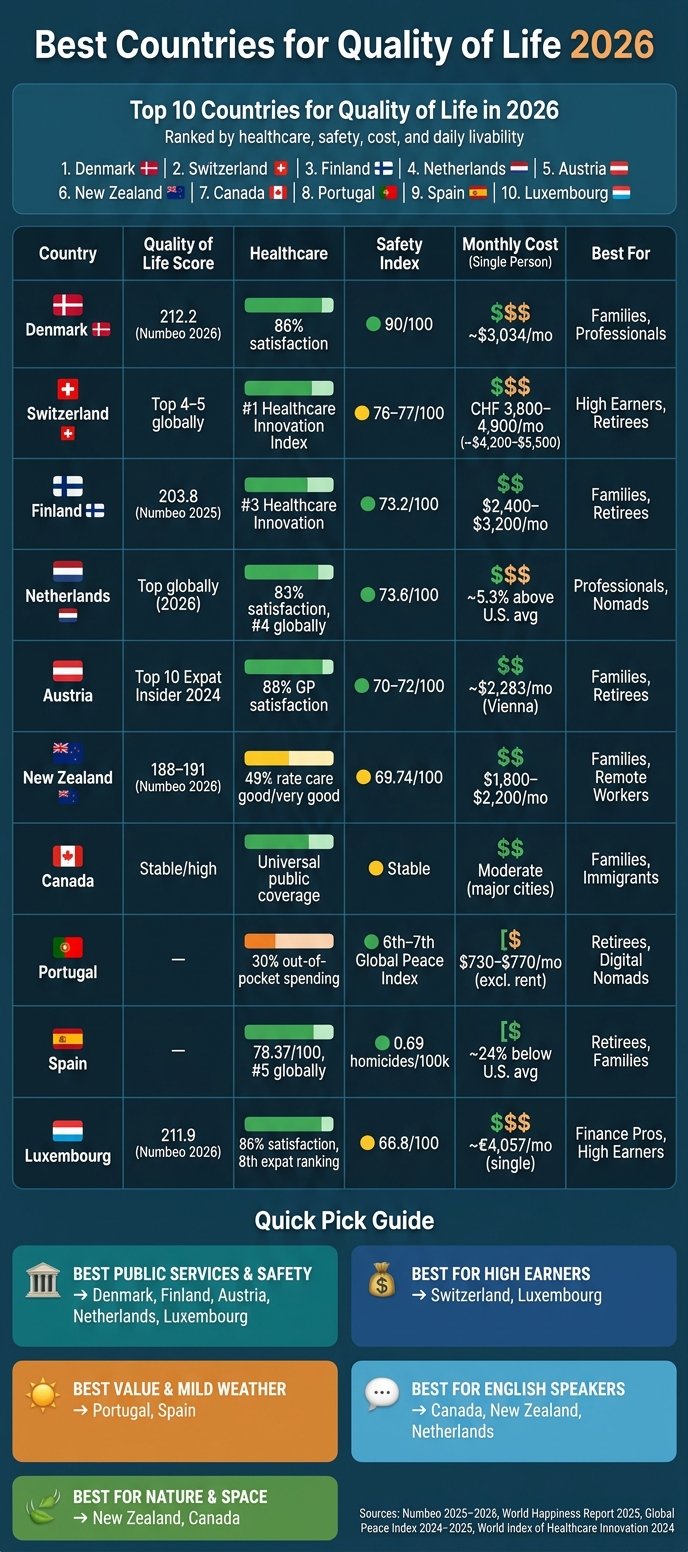
Quick comparison
| Country | Best known for | Main downside | Best fit |
|---|---|---|---|
| Denmark | Safety, public services, smooth daily life | High taxes and high rent | Families, professionals |
| Switzerland | Fast care, high pay, order | Very high costs | High earners, retirees |
| Finland | Safety, trust, public systems | Dark winters, slower access in some care | Families, retirees |
| Netherlands | English-friendly, biking, transit | Housing pressure | Professionals, remote workers |
| Austria | Order, healthcare, central location | Taxes and Vienna housing costs | Families, retirees |
| New Zealand | Nature, space, slower pace | Housing and distance from everything | Families, remote workers |
| Canada | Familiar system, stability | Wait times and taxes | Families, long-term movers |
| Portugal | Lower costs, mild weather | Slow public systems at times | Retirees, digital nomads |
| Spain | Healthcare, climate, work-life balance | Bureaucracy, regional tax differences | Retirees, families |
| Luxembourg | Public transit, income, safety | Housing costs | Finance workers, high earners |
If you’re choosing based on daily life, I’d narrow it like this:
- Pick Denmark or Finland if you want safety, trust, and strong public systems
- Pick Switzerland or Luxembourg if money is less of a problem
- Pick Portugal or Spain if you want better value
- Pick New Zealand or Canada if you want an English-speaking move with more space
- Pick the Netherlands or Austria if you want a strong middle ground
The best country is not the one ranked highest on paper. It’s the one that fits your budget, healthcare needs, weather preference, and pace of life.
sbb-itb-39d39a6
1. Denmark
Denmark sits near the top of quality-of-life rankings for a simple reason: daily life tends to run well. Its institutions are strong, infrastructure is dependable, and the overall standard of living is high. Numbeo’s 2026 Quality of Life Index gives Denmark a score of about 212.2, rated "Very High," with standout marks for safety, healthcare, and low pollution. The catch is pretty clear. Denmark offers a very comfortable place to live, but you pay for it.
Healthcare
Denmark has a universal, publicly funded healthcare system that gives residents broad access to primary care, hospitals, and specialist services. For covered services, care is generally free at the point of use. By late 2024, average waits for elective surgery were about 38 days, which put them close to pre-COVID levels, and 86% of residents said they were satisfied with healthcare availability. About 42% carry private supplemental coverage to move faster for specialist or elective care.
That mix tells you a lot about how Denmark works. The public system covers a lot and does it well, but some people still pay extra to cut down on waiting time.
Safety & Stability
Denmark scores 90/100 on a July 2026 safety assessment, and 88% of people say they feel safe walking alone after dark. Its intentional homicide rate is about 0.8 per 100,000, lower than the European average of 1.6. Add in political stability, predictable law, and high public trust, and you get a country that feels steady in day-to-day life.
Cost of Living
Denmark is expensive. Copenhagen ranks among the top 10 most expensive cities in the world, and Denmark is Europe’s 4th most expensive country by Numbeo’s 2026 data. A single person in Copenhagen should plan on about $3,034 per month, including rent and basic expenses.
Housing is a big part of that. One-bedroom apartments outside the center often cost DKK 8,700–12,500 per month, and rents have climbed 7.1% since 2022. Copenhagen’s average net salary is about $5,051 a month, but high taxes still leave Denmark expensive by most measures.
Daily Livability
This is where Denmark stands out. Daily life tends to feel smooth thanks to good public transportation, short commutes, and clean cities. Copenhagen has one of the world’s densest protected bike networks, and cycling is a normal year-round way to get around. Work-life balance is strong, and hygge points to the country’s focus on comfort and ease.
That said, settling in can take time. New arrivals often need a while to integrate, and expats often point to cost as the main downside. Denmark works best for people who want a high-comfort lifestyle and are ready for the price that comes with it.
Denmark fits families, professionals, and retirees who care more about stability, safety, and public services than low monthly costs.
2. Switzerland
Switzerland lands around 4th to 5th worldwide in 2026 composite rankings that look at income, health, safety, and the environment. The deal here is pretty clear: top-tier day-to-day life, paired with very high prices.
Healthcare
Switzerland requires every resident to buy basic health insurance from an approved private insurer within three months of arrival. If you miss that window, penalties can apply. The standard plan covers primary care, hospital care, and many medications, and people usually get fast access plus a broad choice of doctors and clinics.
That system performs well by global standards. In the 2024 World Index of Healthcare Innovation, Switzerland ranked 1st out of 32 countries with a score of 66.19. Numbeo’s Healthcare Index also puts Switzerland at around 71–72, which is rated “High.”
The downside is cost. In cities like Zurich or Geneva, adult premiums usually fall around CHF 350–450 per month, or about $400–$500. A routine doctor visit often runs CHF 90–140 ($100–$155) before reimbursement. If you’re healthy, you can cut monthly premiums by choosing a higher deductible or a managed-care plan.
Safety & Stability
Switzerland is one of those places where people tend to feel secure in daily life. Major cities like Zurich and Bern score around 76–77 on Numbeo’s Safety Index, which is rated “High.” It also ranks about 6th worldwide on the Global Peace Index with a score of 1.35.
The violent crime picture is also very low by global standards. The intentional homicide rate is about 0.6 per 100,000 people. Add in a federal political system, stable public policy, and low social unrest, and it’s easy to see why families and retirees pay attention to Switzerland.
There is, however, a social adjustment period. New arrivals need to get used to strict local rules around noise, recycling, and day-to-day community behavior.
Cost of Living
Switzerland sits among the most expensive places in Europe and the world, with a Cost of Living Index of around 110–112. In Zurich or Geneva, a single person usually needs about CHF 3,800–4,900 per month ($4,200–$5,500) for a moderate lifestyle. A family of four should plan on roughly CHF 6,500–8,500 per month ($7,200–$9,400).
Housing is a big part of that. Central Zurich rents are around CHF 23 per square meter. On top of that, health insurance premiums climbed another 4–6% between 2025 and mid-2026.
Swiss wages do help soften the blow. The country’s Local Purchasing Power Index is around 176, which means local salaries go a long way compared with many other high-cost places. Even so, the math works best for:
- High earners
- Financially secure retirees
- Remote workers earning strong U.S. dollar income
Daily Livability
Day-to-day life in Switzerland tends to run with very little friction. Trains, trams, and buses are punctual and tightly connected, so living without a car is practical in most cities. Air and water quality are strong, and mountains, lakes, and hiking trails are close to where people live.
Work-life balance is also part of the appeal. Labor protections are strong, vacation time is generous, and there’s a clear social view that leisure and family life matter.
Switzerland fits high-earning professionals, foreign executives, and financially secure retirees especially well. Remote workers paid in U.S. dollars can make it work too, but once housing and insurance are on the table, there isn’t much room for mistakes.
Finland takes a different path: less expensive, less flashy, but just as strong on livability.
3. Finland
Finland is calmer and less expensive than Switzerland. Switzerland gives you a high-end lifestyle with a high-end bill. Finland gets you to a similar Nordic standard for less each month. It has also ranked No. 1 in the World Happiness Report for seven straight years as of 2024. Numbeo’s 2025 Quality of Life Index gives Finland a score of 203.8, along with a Safety Index of 73.2, a Healthcare Index of 77.5, and a Pollution Index of 11.8.
Healthcare
Finland’s tax-funded system keeps routine care fairly low-cost, though waiting times and regional gaps can make access harder. A typical GP visit costs about $20–$30, and prescription drugs are heavily subsidized.
The quality side looks strong. Finland ranked 3rd globally in the 2024 World Index of Healthcare Innovation, and mortality from treatable causes dropped by about 18% between 2012 and 2021. Still, access is where the system gets frustrating. In 2024, 12.4% of people who needed medical care said they did not receive it, mostly because of waiting times and regional differences.
Some expats, especially temporary residents, use private insurance instead. That usually costs around $80–$150 per month and can mean faster appointments plus English-speaking providers. So the trade-off is pretty clear: lower costs, but slower access.
Safety & Stability
Finland is one of the most stable, least corrupt, and most transparent countries in the world. Numbeo data show an overall perceived crime level of 24.44 and a safety-walking-alone-at-night score of 66.86. Recorded crimes fell 1.8% in 2024 compared with 2023, with robberies down 5.1% and assaults down 2.6%.
That shows up in daily life. Things tend to feel steady, orderly, and safe.
Cost of Living
Finland is less expensive than Switzerland, but it isn’t cheap by global standards. A comfortable lifestyle for one person runs about $2,400–$3,200 per month, including housing, food, transportation, and basic leisure.
In Helsinki, a one-bedroom apartment in the city center averages around $1,100–$1,320 per month. In cities like Tampere and Turku, costs are often about 27%–33% lower.
Daily Livability
Finland ranked 4th globally on the 2024 Environmental Performance Index with a score of 73.8, and 6th for air quality. Helsinki’s public transit system is one of the best in Europe, with 75%–82% of users satisfied and a monthly pass costing about $65–$75.
Daily life also gets a boost from easy access to forests, lakes, and coastal areas. Commutes stay short too, with a Traffic Commute Time Index of just 25.5. Digital nomads and short-term residents should check Kela eligibility before counting on public coverage.
The Netherlands is the closest next option for readers who want similar livability in a denser, more international setting.
4. Netherlands
After Finland’s calm, high-trust setup, the Netherlands offers a similar standard of living in a more urban, globally connected setting. It also ranks at the top of Numbeo’s 2026 Quality of Life Index, which strengthens its case as one of the best all-around places to live in 2026.
Healthcare
The Dutch system requires residents to carry private health insurance, while the government regulates premiums and helps lower-income households with subsidies. Coverage is almost universal, with about 99.9% of the population insured.
That setup also gets strong marks from residents. In 2024, 83% of residents reported being satisfied with the availability and quality of local healthcare. The country also ranked 4th globally in the 2024 World Index of Healthcare Innovation.
Safety & Stability
The Netherlands is a stable parliamentary democracy with strong institutions and dependable rule of law. Numbeo’s 2024 data show a national crime index of 26.3 and a safety index of 73.6.
Still, not every city feels the same. Amsterdam’s crime index is 28.5, while The Hague comes in at 20.3 and Eindhoven at 22.2. That gap matters. Families and retirees often lean toward The Hague or Eindhoven over Amsterdam if they want a quieter, lower-stress day-to-day life.
The main downside is cost, and Amsterdam is where that hits hardest.
Cost of Living
The Netherlands is not cheap. Overall costs are about 5.3% higher than the U.S. average. Amsterdam is also much more expensive than other Dutch cities.
For many expats, places like Rotterdam, The Hague, or Eindhoven offer a better deal. Rents are lower, and rail connections are still strong. So while you may pay plenty to live in the country, you don’t always have to pay Amsterdam prices to get the Dutch lifestyle.
Daily Livability
Daily life is where the Netherlands starts to feel especially easy to navigate. The country has more than 35,000 km (about 21,750 miles) of dedicated cycle paths, and 63% of Amsterdam residents use their bikes daily. Public transit also does a lot of heavy lifting, with frequent intercity trains that often make car ownership unnecessary.
For U.S. readers, the language piece stands out too. The Netherlands ranks No. 1 globally in the EF English Proficiency Index 2024 with a score of 636. That can make work, housing, and local paperwork much less of a headache for English speakers.
Air and environmental conditions also hold up well. The Netherlands ranked 13th globally on the 2024 Environmental Performance Index and posted a low pollution index of around 20.9.
5. Austria
Austria offers a calmer, less crowded feel than the Netherlands while still delivering many of the same quality-of-life perks. It has ranked in the top 10 of the Expat Insider Quality of Life Index every year since 2014 and came in 2nd worldwide in 2024.
Healthcare
Austria covers more than 99% of residents through statutory health insurance funded by payroll contributions, taxes, and copays. The country spends about $8,401 per person on health, well above the OECD average of $5,967, and life expectancy reached 82.3 years in 2024.
People also tend to like the care they get. In a 2019 survey, 88% said they were satisfied with their GPs, and 85% said the same about specialists. About one-third of residents also carry supplementary private insurance for more choice. For retirees and families, that adds up to dependable care without huge out-of-pocket bills.
Safety & Stability
Austria ranked 4th globally on the 2025 Global Peace Index with a score of 1.294. Serious crime is rare, and petty theft in tourist areas is the main issue travelers and locals are likely to run into. Numbeo’s Safety Index for Austria sits around 70–72.
In day-to-day life, that usually means a lower-stress routine. Kids can often walk or bike to school, and most people aren’t shaping their day around safety worries.
Cost of Living
Austria is not cheap, but it’s also not at the very top end by Western European standards. Numbeo places Austria’s Cost of Living Index around 60–68, with a Purchasing Power Index of 110.0.
In Vienna, a single person can expect to spend about $2,283 per month including rent, or about $1,364 excluding rent. A family of four should plan for closer to $4,332 per month including housing. Rent for a one-bedroom averages about €1,100 per month in the city center and roughly €780 outside the center.
Daily Livability
Vienna keeps showing up near the top of global livability rankings, and it’s not hard to see why. Employees get at least 25 paid vacation days plus 13 public holidays, which is a big deal if work-life balance matters to you.
Public transit also makes daily life easier. The KlimaTicket makes car-free travel practical across most of Austria for about €1,095 per year. And if you like having nature nearby without giving up city comforts, Austria has a strong mix of both. Mountains, lakes, and hiking trails sit close to major cities, which works well for retirees, families, and remote workers who want solid public services and easy outdoor access.
Austria suits readers who want order, outdoor access, and strong public services without the sharper price tags found in some higher-cost markets.
6. New Zealand
New Zealand trades dense European convenience for something different: an English-speaking country with more space, more nature, and a slower rhythm. It ranks near the top of 2026 livability lists, with a Numbeo Quality of Life Index score of about 188–191 and another index placing it #2 globally. That mix tends to fit families, retirees, and remote workers who want clean air, easy access to the outdoors, and a calmer day-to-day life. It also lines up well with this article’s main filters: livability, safety, environment, and work-life balance.
Healthcare
New Zealand’s public health system is broad, but speed can be an issue. It runs a tax-funded universal system that covers hospital care, emergency treatment, and most primary care for eligible residents. The country spends about 10% of GDP on health, and life expectancy is around 82 years. About 49% of New Zealanders say the care they receive is good or very good, which is above the global average of 44%.
The catch is wait times and system strain. 76% of residents say the system feels overstretched, and 62% say understaffing is the main problem. Around 37% of residents have private insurance to get faster access to elective procedures and specialist visits. For Americans, that often means lower out-of-pocket costs, but also slower access to non-emergency care if you rely only on the public system.
Safety & Stability
New Zealand is politically stable and ranks among the safest countries in the world. On a 2026 safety list, it ranks 4th safest, with a Global Peace Index score of 1.282 and a low-risk classification. Numbeo’s safety-while-walking-alone-in-daylight score is a strong 69.74. The government also reported a 2% drop in total victimizations and a 58% reduction in ram raids in 2024 compared with 2023.
The main issues are property crime in larger cities and earthquake risk in Wellington and Christchurch. Even so, strict building codes and active emergency planning help cut that risk in a meaningful way.
Cost of Living
The biggest pressure point in New Zealand is housing, not day-to-day spending. The country’s overall cost of living indexes sit around 60–65. Auckland is the most expensive city, with a one-bedroom apartment downtown averaging about $1,275/month, while Christchurch is closer to $810/month. A single person can expect total monthly costs of about $1,800–$2,200, while a family of four will likely spend around $3,650–$4,000, depending on location.
Housing affordability stands out for the wrong reason. The median property value is 7.7 times gross annual median household income, and the usual time needed to save a deposit is about 10.2 years. Average weekly rent rose 9.0% to $465.50 in the year ended June 2024. Groceries and imported goods also cost more than they do in many U.S. cities, largely because New Zealand is geographically isolated.
Daily Livability
New Zealand’s biggest strength is how much the setting shapes daily life. It ranks 4th in the world for air quality in the 2024 Environmental Performance Index, and its Numbeo Pollution Index is only 26–27. Its climate score is around 97, pointing to temperate weather and year-round access to beaches, mountains, and national parks.
Commute times are shorter than in many large U.S. metro areas. That changes the feel of everyday life in a pretty direct way. Cities are manageable, the pace is slower, and spending time outside is part of normal life, not just a weekend plan. For remote workers earning in U.S. dollars, smaller cities like Wellington or Christchurch can deliver a strong lifestyle at a lower cost than Auckland.
7. Canada
Canada has a public-service setup that feels a lot like the Nordic model, but the trade-offs look different once you factor in its size, weather, and tax load.
Healthcare
Canada’s publicly funded system covers core medical care without direct bills at the point of service. That’s a big plus on paper.
The catch is access. Wait times can be slower, especially for specialists, elective procedures, and urgent care that doesn’t count as an emergency. For families and retirees, that can be a sticking point, since follow-up care and specialist referrals often matter just as much as the first appointment.
Safety & Stability
Canada is stable, orderly, and backed by strong institutions. Basic services tend to work well, and daily life feels predictable in a good way.
For U.S. readers, that familiarity matters. The move often feels less like stepping into a totally different system and more like learning a nearby version of one you already know. That can make the settling-in process easier.
Cost of Living
Canada is less appealing for readers focused on tax efficiency. Taxes can be heavy, especially for higher earners and business owners.
That pressure can eat into the upside of strong public services. So while the public model has clear upsides, the math may feel less favorable if keeping more of your income is high on your list.
Daily Livability
Canada tends to fit families and long-term residents who want public services, stability, and familiar institutions. The trade-off is slower care and higher taxes.
If you’re after warmer Southern European weather and lower day-to-day costs, the next choices change that balance.
8. Portugal
If Canada feels familiar but too expensive, Portugal offers a lower-cost option in Europe with milder weather. It stands out for three things that matter in day-to-day life: lower costs, soft winters, and a pace that feels less rushed.
Healthcare
Portugal’s SNS is a universal, tax-funded system that covers most residents at low or no direct cost. The trade-off is wait time. Non-urgent specialist visits can take months, MRIs for non-urgent cases usually take 3 to 4 months, and getting assigned a family doctor in Lisbon or Porto can take 6 to 18 months.
Another detail surprises a lot of people: out-of-pocket spending is still fairly high. It makes up roughly 30% of total health spending, which is about double the EU average.
Because of that, many expats use the public system for basics and add private insurance on top. Private coverage usually costs about $55 to $165 per month, depending on age and plan. That often means faster appointments and more access to English-speaking doctors, without running into U.S.-level premiums.
That mix of low-cost basics and slow non-urgent care says a lot about life in Portugal more broadly. It works well for many people, but it helps to go in with your eyes open.
Safety & Stability
Portugal ranks around 6th to 7th globally on the 2024 and 2025 Global Peace Index, and its homicide rate is well under 1 per 100,000 people. The U.S. State Department also rates it at Level 1, which is its lowest advisory level.
Lisbon’s Numbeo Crime Index is around 34/100, much lower than major peer cities such as London, Paris, and Madrid. For most expats, the main issues are non-violent ones like pickpocketing in tourist zones or break-ins involving parked cars. For families and retirees, that tends to make daily life feel calm and predictable.
So while Portugal doesn’t come with the cost profile of Northern Europe, it still gives many people the sense that they can walk around, settle in, and breathe a little easier.
Cost of Living
Portugal is one of the cheapest countries in Western Europe, with overall costs about 30% lower than in the United States before rent. A single person can cover core monthly expenses for roughly $730 to $770, while a family of four usually spends about $2,600 to $3,050.
Rent is where location changes everything. Lisbon is the priciest market, with asking rents around $21 to $23 per square meter in the private market. Porto is cheaper, and cities like Braga or Coimbra can cut rent by 30% to 40% compared with the capital.
A few rough lifestyle ranges help make that more concrete:
- A retired couple in the Algarve can live comfortably on about $2,500 to $3,500 per month all-in.
- A single digital nomad outside central Lisbon can often manage on $1,800 to $2,500.
Portugal’s old Non-Habitual Residence regime is largely gone in 2025 and 2026, though some foreign pensions may still be taxed at 10%.
Daily Livability
Portugal’s Mediterranean climate, walkable city centers, and café culture shape the feel of daily life. Winters are mild, summers are warm, and coastal spots like Cascais and the Algarve stay pleasant through the year. Infrastructure is solid too, with modern highways, expanding fiber-optic internet, and Lisbon metro service that works well for remote workers.
This setup tends to fit a few groups especially well: retirees who want safety and community, families looking for lower housing costs and low-crime streets, and remote workers who want EU-standard infrastructure without EU-level costs.
The main shift for many U.S. residents is tempo. Bureaucracy can move slowly. Small businesses often close on Sundays or during August holidays. And August, in particular, can feel oddly quiet if you’re used to constant motion. People who settle into that rhythm often find Portugal easy to live in. People who want everything fast, all the time, may struggle with it.
9. Spain
Spain keeps the Mediterranean feel that draws people to Southern Europe, but it adds better rail, bigger cities, and more regional variety. You get universal healthcare, a strong work-life balance, and lower costs than many Western European countries. That makes Spain a strong pick for retirees, families, and remote workers in 2026.
Healthcare
Spain’s national health system, the SNS, offers near-universal coverage and broad benefits. It scores 78.37 out of 100 and ranks 5th in the world in one global healthcare quality ranking.
The main tradeoff is wait time. Public hospital consultations take about three months on average, and nonurgent surgeries take about four months. Private insurance can shorten that a lot, with specialist visits dropping to about 10 to 16 days and surgery to about 24 days. So if speed matters to you, private backup coverage can make a big difference.
Public opinion is still mostly positive, though the average satisfaction score slipped to just over 6 out of 10 in 2025.
Safety & Stability
Spain is a stable democracy with strong institutions, and its membership in the EU and Eurozone adds another layer of stability. In the 2024 Global Peace Index, Spain ranked 29th out of 163 countries.
Its homicide rate is about 0.69 per 100,000 residents, which is far below the U.S. rate of 6.8. That gap says a lot.
City to city, though, the picture changes a bit. Madrid has a Numbeo Crime Index of about 28.7, while Barcelona is higher at around 51.9. So place matters, and even neighborhood choice can shape your day-to-day experience. In tourist zones, petty theft is still the main issue.
Cost of Living
Daily costs in Spain run about 24% below U.S. levels on average. Housing is a big part of that math. A one-bedroom apartment can cost from about €515 to €1,169 per month, depending on where you live.
Secondary cities such as Valencia and Málaga often give you the best mix of price and lifestyle. That’s a big reason Spain works so well for people on fixed retirement income and for remote workers paid in U.S. dollars. Many of these professionals utilize the Spain Digital Nomad Visa for long-term residency.
And lower costs go even further when they’re paired with shorter workweeks and a strong transit network. It’s not just cheaper on paper. It can make daily life feel easier.
Daily Livability
Spain ranks 4th among OECD countries for work-life balance, and workers get about 36 days of statutory annual leave. That’s a big part of the country’s day-to-day appeal.
Intercity rail is efficient and links most regions well, which makes car-free living possible in much of the country. For many people, that means fewer errands built around driving and more freedom to move around with less hassle.
Valencia stands out for its climate, lower pollution, and high livability, with a Numbeo Quality of Life Index between 194 and 203. Málaga is another strong coastal option. Regional differences matter too. Navarra, La Rioja, and the Basque Country often lead Spain’s national quality-of-life rankings.
That blend of lower costs, pleasant climate, and easy daily living is a big reason Spain stays near the top for 2026.
10. Luxembourg
Luxembourg sits near the top for a simple reason: it packs strong public services, safety, and easy day-to-day movement into a small, well-run country. In Numbeo’s 2026 mid-year country ranking, it scored 211.9 on the quality-of-life index, which put it 2nd worldwide. The big draw is clear enough – good services, simple mobility, and a strong sense of safety. The catch is housing.
Healthcare
Luxembourg’s public health system is strong and low-cost at the point of care. Out-of-pocket spending is roughly 1.6% of total household spending, and only around 1% of residents report unmet medical needs. About 86% of residents say they are satisfied with the availability of quality care.
The results back that up. Life expectancy is about 83.4 years, which is above the OECD average, and InterNations’ 2026 expat report ranked Luxembourg 8th for healthcare. For families, retirees, and working professionals, that mix of broad coverage and strong health outcomes stands out.
Safety & Stability
Luxembourg is one of the safer countries in Europe for daily life. It has a safety index of 66.8, and InterNations’ 2026 expat rankings placed it 2nd in the world for safety and security.
It is also a stable parliamentary democracy with stable institutions and a long record of rule of law. Still, there is a wrinkle worth noting. The 2025 police report recorded 41,489 cases, up 1.3% from 2024, while robberies involving violence or threats climbed 30.8% to 731 cases. So yes, Luxembourg remains low-crime, but normal city caution still makes sense.
Cost of Living
This is where the trade-off hits. In 2023, average household expenses were about €6,027 per month, while single-person households spent about €4,057 per month. Rent averages €30.22 per square meter, and property purchase prices average €8,322 per square meter.
That helps explain why InterNations ranked Luxembourg only 29th for personal finance and cost of living in 2026, even though its livability scores are much higher. In plain terms, Luxembourg tends to work best for higher-earning professionals in finance, law, tech, or EU institutions, where pay is strong enough to offset the steep housing costs.
Daily Livability
Daily life is one of Luxembourg’s strong points. Buses, trams, and second-class trains are free nationwide, making Luxembourg the first country to offer free public transit. That alone can make everyday life feel a lot easier.
Numbeo’s 2026 data also shows an average commute time of 26.4 minutes and a pollution index of 22.7. The country is compact and multilingual, with Luxembourgish, French, and German as official languages, while English is widely used in business and among expats, especially in finance and EU roles. English goes a long way at work, but some French or German helps with administration and healthcare. Mercer’s 2023 Quality of Living Survey ranked Luxembourg City 16th out of 241 cities globally.
Taken together, these countries make different trade-offs on cost, access, and day-to-day life; the next section compares them by the factors that matter most.
How Each Country Compares Across the Factors That Matter Most
The best pick comes down to what you care about most: healthcare access, personal safety, housing costs, or how day-to-day life feels. This comparison focuses on the trade-offs that shape daily living: healthcare, safety, cost, and livability. The country profiles above explain what makes each place stand out. Here, the focus is the practical side.
Healthcare
The biggest split is simple: speed vs. cost.
Switzerland and Luxembourg tend to offer the fastest access. Portugal, Spain, Canada, and New Zealand usually come with lower public costs, but waits can be longer. Portugal and Spain stand out for lower out-of-pocket spending. Switzerland and Luxembourg make more sense for higher-income households that want faster access to specialists. Canada and New Zealand offer strong coverage too, though some provinces or rural areas can mean longer waits.
| Country | System Type | Care Quality | Wait Times | Best For |
|---|---|---|---|---|
| Denmark | Universal public | Top tier | Moderate | Families |
| Switzerland | Mandatory insurance | Top tier | Short | High-income retirees |
| Finland | Universal public | Top tier | Moderate | Families |
| Netherlands | Regulated private | Top tier | Short to moderate | Professionals |
| Austria | Social insurance | High | Short to moderate | Retirees |
| New Zealand | Public + private option | High | Moderate | Lifestyle retirees |
| Canada | Universal public | High | Longer in some provinces | Retirees |
| Portugal | Public + private option | High | Short in cities | Expats |
| Spain | Universal public | High | Short in cities | Long-term residents |
| Luxembourg | Mandatory insurance | Top tier | Short | High-income professionals |
Healthcare can narrow the list fast. After that, safety and stability often make the final cut.
Safety & Stability
The spread here is tighter than it is on cost. Denmark, Switzerland, Finland, Austria, and Luxembourg offer the safest day-to-day settings. Portugal, Spain, and Canada are still low-crime by global standards, though some cities call for more caution around petty theft.
Austria ranked 3rd globally on the 2024 Global Peace Index. New Zealand, Switzerland, Portugal, and Denmark also placed in the global top 10. Portugal and Spain do deal with the usual big-city petty crime in tourist zones, but violent crime rates are much lower, and both countries also benefit from stable EU membership and working democratic institutions.
| Country | Crime Level | Stability | Business Stability |
|---|---|---|---|
| Denmark | Low | Highly stable EU democracy | Strong rule of law |
| Switzerland | Low | Highly stable, neutral | Excellent; strong financial system |
| Finland | Low | Highly stable EU democracy | Strong; low corruption |
| Netherlands | Low | Highly stable EU democracy | Strong; open economy |
| Austria | Low | Highly stable EU democracy | Strong; stable institutions |
| New Zealand | Low | Mature, stable democracy | Strong; transparent legal system |
| Canada | Low | Mature, stable democracy | Strong; English-language legal system |
| Portugal | Low (petty crime in cities) | Stable EU democracy | Good; improving business environment |
| Spain | Low (petty crime in cities) | Stable EU democracy | Good; large open economy |
| Luxembourg | Low | Highly stable EU democracy | Excellent; major financial center |
Once safety feels covered, cost usually becomes the clearest dividing line.
Cost of Living
This is where the gap gets widest.
Switzerland and Luxembourg rank among the most expensive places in the world, with housing and everyday costs well above what many people pay in a typical U.S. city. Denmark, the Netherlands, Finland, and Austria are also expensive, although strong public services help soften part of that hit. Canada and New Zealand land closer to, or a bit below, major U.S. coastal cities. Portugal and Spain are the clearest value plays in the group.
Portugal often supports a comfortable lifestyle at about €1,500–€2,500 per month, which makes it the easiest entry point here for retirees and remote workers living on a fixed income.
| Country | Cost vs. U.S. | Typical Housing Cost | Taxes vs. Services | Best For |
|---|---|---|---|---|
| Denmark | High | High in Copenhagen | Very high tax; very strong public services | Professionals |
| Switzerland | Very high | Very high in Zurich, Geneva | High insurance costs; world-class services | High-income retirees |
| Finland | High | High in Helsinki | Very high tax; strong public services | Families |
| Netherlands | High | High in Amsterdam | High tax; strong public services | Entrepreneurs |
| Austria | Moderate-high | Moderate-high in Vienna | High tax; solid public services | Retirees |
| New Zealand | Moderate | Moderate in Auckland | Moderate tax; good public services | Lifestyle retirees |
| Canada | Moderate | Moderate in major cities | Moderate tax; universal healthcare | Families |
| Portugal | Below U.S. | Lower outside tourist zones | Moderate tax; improving services | Expats |
| Spain | Below U.S. | Lower outside tourist zones | Moderate tax; strong public services | Long-term residents |
| Luxembourg | Very high | Very high | Mandatory insurance; top-tier services | High-income professionals |
After cost, the last screen is how life feels on an ordinary Tuesday.
Daily Livability
This is where the small daily things start to matter: transit, climate, internet speed, and work-life balance.
Denmark, the Netherlands, Switzerland, Austria, Finland, and Luxembourg all do well on public transit, broadband, and commute times. Canada and New Zealand have strong systems in major cities, but the picture gets less even in rural areas. Portugal and Spain offer solid city infrastructure and growing digital connectivity, which helps explain why remote workers keep showing up there.
Climate can be a deal-maker on its own. Portugal and Spain offer mild winters and lots of sunshine. New Zealand draws families and lifestyle-focused entrepreneurs with its mild weather and easy access to nature. Across the European countries in this group, work-life balance tends to be stronger than in the U.S. Canada and New Zealand also usually feel slower-paced than the U.S., which many people see as a plus.
| Country | Transit/Infrastructure | Digital Connectivity | Climate | Work-Life Balance | Best Fit |
|---|---|---|---|---|---|
| Denmark | Excellent | Excellent | Cold winters, mild summers | Very strong | Families, professionals |
| Switzerland | Excellent | Excellent | Temperate, four seasons | Strong | High-income professionals |
| Finland | Excellent | Excellent | Cold winters | Very strong | Families, remote workers |
| Netherlands | Excellent | Excellent | Temperate, mild | Very strong | Families, entrepreneurs |
| Austria | Excellent | Excellent | Temperate, four seasons | Strong | Families, retirees |
| New Zealand | Strong in cities | Strong in cities | Mild, temperate | Balanced | Families, lifestyle entrepreneurs |
| Canada | Strong in cities | Strong in cities | Varies widely | Balanced | Families, professionals |
| Portugal | Good; improving | Strong fiber coverage | Mild, sunny | Strong | Retirees, digital nomads |
| Spain | Good | High-speed in hubs | Warm, sunny | Strong | Retirees, digital nomads |
| Luxembourg | Excellent | Excellent | Temperate | Strong | High-income professionals |
Pros and Cons of Each Country at a Glance
This snapshot pulls together the same four filters used above: healthcare, safety, cost, and day-to-day livability.
The table below sums up the trade-offs and makes it easier to see which type of reader each country fits best.
| Country | Best For | Biggest Strengths | Main Trade-Offs | Overall Fit |
|---|---|---|---|---|
| Denmark | Families, professionals comfortable with high taxes | 86% healthcare satisfaction and strong work-life balance | Top marginal income tax around 55–56% and high cost of living | Best for families and professionals who care more about stability than low taxes |
| Switzerland | High earners, entrepreneurs, high-net-worth households | Top-ranked healthcare system and strong purchasing power for local earners | Among the most expensive countries in the group | Best for affluent households that can handle high costs |
| Finland | Families, retirees | High trust and low crime, with strong public education | Personal tax rates above 55%, long dark winters, and geographic remoteness | Best for families and retirees who put social equity and safety ahead of tax efficiency |
| Netherlands | Entrepreneurs, digital nomads | Easiest for English speakers, with strong logistics and connectivity | Top marginal tax near 50% and major housing pressure in big cities | Best for globally mobile professionals who can structure income through international planning |
| Austria | Retirees, families | Quiet, orderly cities with strong healthcare and easy European travel access | Top marginal tax around 55%, rising housing costs in Vienna, and German-language requirements | Best for retirees and families who want safe cities and strong public services in central Europe |
| New Zealand | Families, remote workers, digital nomads | Safe, outdoor-focused lifestyle with top work-life balance scores | Geographic remoteness, high housing costs, and thinner infrastructure outside main cities | Best for families and lifestyle-focused professionals who value nature and a relaxed pace |
| Canada | Families, immigrants, retirees | Familiar institutions for English speakers and multicultural cities | High cost of living in major cities, long winters, and longer public healthcare waits in some provinces | Best for families and retirees who want an English-speaking country with strong institutions |
| Portugal | Retirees, digital nomads | Lower cost of living at roughly €1,500–€2,500/month and D7/D8 visa pathways | Uneven infrastructure outside coastal cities and tightening residency rules | Best for retirees and remote workers seeking lower costs and mild weather |
| Spain | Retirees, remote workers, families | Strong healthcare and Beckham Law tax benefits for new residents | Top tax rates above 50% with regional surcharges and bureaucratic complexity | Best for lifestyle-focused retirees and remote workers |
| Luxembourg | High earners, finance professionals, families | Free nationwide public transit and a Numbeo Quality of Life score of 211.9 | Very high cost of living and top personal tax rates above 40% plus solidarity surcharges | Best for high-income professionals who can pair residency with asset-protection planning |
The conclusion below turns these trade-offs into a final shortlist based on priority.
Conclusion
There’s no one-size-fits-all answer here. The best country for you depends on what you care about most, and every option comes with trade-offs.
With that in mind, the strongest picks fall into three broad groups. If you want strong public services and safety, Denmark, Finland, the Netherlands, Switzerland, Austria, Luxembourg, and Canada stand out. This top group is packed pretty tightly, so the better choice usually comes down to fit, not rank. The main downside is cost, especially taxes and housing.
If you care more about value than premium pricing, the next group deserves a close look. Portugal and Spain offer the best value for retirees and remote workers. Denmark, the Netherlands, New Zealand, and Canada are often a better match for people who put more weight on services, safety, and family life.
Once you narrow your options, the decision gets a lot more practical. Shortlist 2 to 3 countries based on healthcare, budget, pace of life, and residency fit. Then check visa rules, U.S. tax exposure, and expat reports from current expats before you make the call.
FAQs
Which country is best for families?
For families, Thailand, Croatia, and Malta stand out because they make day-to-day life a lot easier. They offer family-friendly policies, lower living costs, and access to international schools.
Thailand is a strong pick for families that want flexibility and good city services. It offers flexible long-term visas, and cities like Bangkok and Chiang Mai have strong healthcare.
Croatia appeals to families that want stability without the price tag of many Western European countries. It’s safe, politically stable, and more affordable than many parts of Western Europe.
Malta is often a natural fit for English-speaking families. English is widely spoken, which makes school, errands, and settling in much simpler. The country also has international schools that use British and American curricula.
Which country is best for retirees?
Panama is often the first place U.S. retirees look at, and it’s not hard to see why. It’s close to the United States, has modern infrastructure, a warm climate, an expat-friendly feel, lower-cost private healthcare, and a territorial tax system.
One of its biggest draws is the pensioner visa. It requires at least $1,000 per month in pension income and offers permanent residency along with discounts.
Other strong options include Mexico, Portugal, and Costa Rica.
How should I choose between high quality and lower cost?
Take a disciplined approach here. Don’t just split the difference and hope it works. Set clear weights for the things that matter most to you – like healthcare, connectivity, taxes, and safety – then score each destination against those priorities.
It also helps to look past pricey major capitals. Second-tier cities and rural areas can offer similar infrastructure at a lower cost. And a 90-day pilot stay in your top picks can show you whether day-to-day life actually fits your standards and your budget.
