
If I had to give the short answer first: Iceland is the safest for day-to-day peace, Switzerland is the top pick for healthcare and legal stability, Austria is the best all-around choice for public systems, Slovenia gives the best mix of safety and lower costs, and Portugal is still the easiest starting point for many expats.
If you’re moving from the U.S. to Europe in 2026, safety is not just about crime. I’d look at violent crime, healthcare access, political stability, infrastructure, natural-risk exposure, and how hard it is to get residency.
Here’s the fast breakdown:
- Iceland: lowest stress, very low violent crime, hard residency path
- Switzerland: top healthcare access, very high costs, strict entry path
- Austria: strong public systems, fast care, high taxes
- Slovenia: safe and lower-cost, but more paperwork friction
- Portugal: safe and more open to expats, but slower public healthcare and longer citizenship timeline
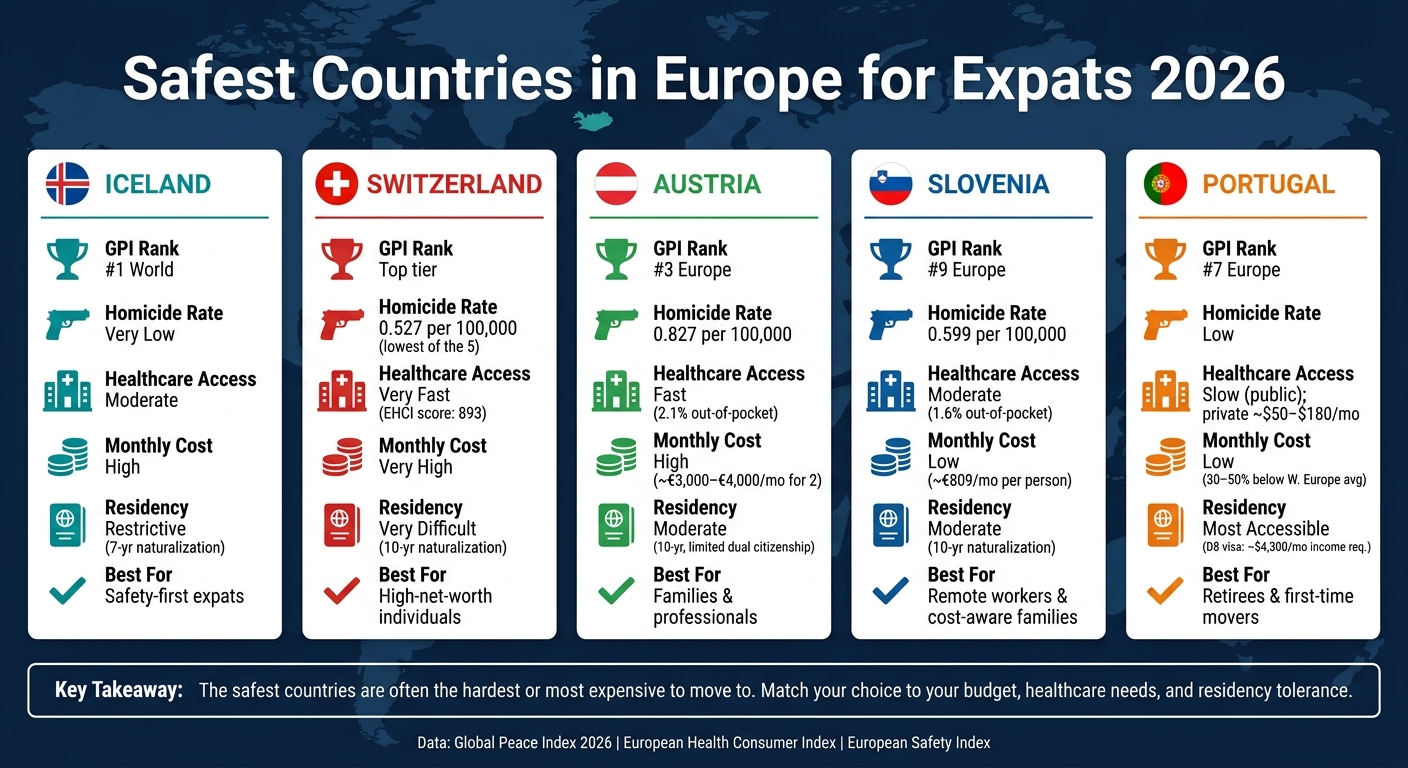
Quick Comparison
| Country | Best Known For | Main Trade-Off | Best Fit |
|---|---|---|---|
| Iceland | Peace and personal safety | Harder access, high living costs | Safety-first expats |
| Switzerland | Healthcare and legal stability | Very expensive, hard residency | High-net-worth expats |
| Austria | Balance of safety and public services | High taxes, tighter citizenship rules | Families and professionals |
| Slovenia | Safety at a lower price | Bureaucracy, tax load | Remote workers and cost-aware families |
| Portugal | Easier path in | Slow public care, longer naturalization | Retirees and first-time movers |
A few numbers stand out right away:
- Iceland ranks #1 on the Global Peace Index
- Switzerland has the lowest homicide rate here at 0.527 per 100,000
- Austria has fast healthcare access
- Portugal has the lowest safety score of the five at 61.6, but it stays popular because entry is less rigid
- Slovenia sits in the middle with a safety score of 74.3 and lower monthly living costs
My takeaway is simple: the safest places are often the hardest or most expensive to move to. So if you want the best country for you, I’d match your choice to your budget, your healthcare needs, and how much residency friction you can deal with.
sbb-itb-39d39a6
1. Portugal
Personal Security
Crime is low by European standards, and violent crime is rare. Most women report feeling safe walking alone at night.
That said, petty theft and pickpocketing do happen in tourist-heavy areas, especially in central Lisbon and parts of Porto. Outside those tourist zones, the risk drops a lot. The Algarve and Madeira are also safe places for expats and retirees to base themselves.
Stability and Healthcare
Portugal’s public healthcare system, the SNS, is universal and affordable for residents. The trade-off is speed: access is rated “Slow” when compared with countries like Switzerland or Austria. Because of that, many expats use the SNS for general coverage and add private insurance to get specialist care faster. Private health insurance for a healthy adult under 50 usually runs from $50 to $180 per month.
The political setting is stable, and police presence is easy to spot.
Infrastructure and Resilience
Lisbon and Porto have dependable public transit, but once you get into rural areas, you’ll usually want a car. Portugal also scores well for air quality, at 86.4, though its climate resilience score is lower at 76.1. The main weather-related risks are wildfires and extreme heat.
Residency and Expat Fit
Portugal works well for retirees (who often utilize the D7 visa), families, and remote workers who want low violent crime and lower living costs. For remote workers, the D8 Digital Nomad Visa calls for a monthly income of about $4,300. The Golden Visa is still available, but now it goes through fund investment or cultural donations. The real estate route is no longer open.
Day to day, Portugal feels safe. The slower part is residency. As of May 2026, the standard naturalization period has moved from 5 years to 10 years, or 7 years for EU and CPLP nationals. AIMA processing can take 12 to 36 months, so if you’re planning long-term travel or family reunification, that delay needs to be part of your timeline.
Portugal is the lower-cost safety option. Switzerland is the stronger benchmark, but it comes at a much higher price.
2. Switzerland
Personal Security
Switzerland is one of the safest countries in Europe. Its average intentional homicide rate is 0.527 per 100,000 people, which is about seven times lower than in the United States. Property crime is also uncommon, even in major cities like Zurich and Geneva.
Stability and Healthcare
Neutral since 1815, Switzerland has one of Europe’s strongest legal systems. Emergency services are fast, and the country ranks first in Europe for care access speed. The European Health Consumer Index gave Switzerland its top score at 893 points.
The catch is cost. Switzerland uses a required private insurance system, and households pay 5.3% of health spending out of pocket. That’s higher than Austria at 2.1% or Luxembourg at 1.4%.
Infrastructure and Resilience
Switzerland also stands out for its ability to handle stress well. Backed by an AAA credit rating across major agencies, it scores 91.2 for climate resilience and 89.5 for air quality, which puts it among Europe’s strongest countries on both measures. Its avoidable mortality rate is 114 per 100,000, the best in its peer group.
Residency and Expat Fit
Switzerland is a strong match for ultra-high-net-worth individuals, largely because of its lump-sum tax regime. Under this setup, residents are taxed on estimated living costs rather than worldwide income. Annual tax bills often start around CHF 250,000 and can go past CHF 1 million, depending on the canton. Cantons like Vaud, Valais, and Ticino still offer this path, while Zurich and Basel do not.
For most other expats, though, getting residency is tough. Non-EU citizens usually need employer sponsorship, family ties, or major wealth to qualify, and naturalization usually takes 10 years. International school fees in Zurich average about $30,738 per year.
So yes, Switzerland can be a top-tier option if money and access aren’t a problem. But for many expats, the visa route is strict and expensive.
That makes Switzerland the premium safety choice; Iceland offers a different balance next.
3. Iceland
Personal Security
Iceland ranks first in the world for peace in 2026, with a GPI score of 1.095. Violent crime is very rare, and incidents happen so infrequently that they often become national news. Police do not carry firearms, and organized crime is limited.
For solo female expats and families, that kind of day-to-day safety is a big plus. Iceland ranks 6th globally for women’s safety, and 98% of residents report having someone to count on in a crisis. For expats, that makes Iceland a low-crime, low-drama place to live, even if it isn’t the easiest or most comfortable option in every other way.
That peace does come with trade-offs, especially when you look at cost and access to care.
Stability and Healthcare
Iceland’s public healthcare system offers universal coverage, and household out-of-pocket costs are just 2.5%. Health outcomes are strong too, with an avoidable mortality rate of 150 per 100,000 residents.
The catch is speed. Care access is rated "Moderate," behind Switzerland’s "Very Fast" and Austria’s "Fast" ratings. Outside Reykjavik, wait times for specialist referrals and elective procedures can get long, so many expats add private medical insurance to help fill those gaps.
So the issue isn’t coverage. It’s how fast you can get seen when you need something beyond basic care.
Infrastructure and Resilience
Iceland’s air quality score is 98.2, its climate resilience score is 94.0, and its Planetary Resilience Score of 96 is the highest in the European Safety Index. That’s a strong setup on paper.
The main risk comes from geology. Volcanic activity, earthquakes, and harsh winter weather mean basic preparedness matters. Living in Iceland is safe, but it’s not carefree.
Residency and Expat Fit
Iceland has no Golden Visa or investment-based residency program. For non-EU/EEA citizens, the main paths are skilled employment, family reunification, or study. Standard naturalization usually takes 7 years of residency, and citizenship requires proficiency in Icelandic. Iceland also scores relatively low in economic opportunity at 47.5 compared with other top-ranked countries.
That makes Iceland a better fit for some expats than others. It works best for:
- EU/EEA movers
- People with skills that qualify for employer sponsorship
- Expats who can handle Iceland’s high cost of living in exchange for top-tier safety
For expats who care most about security, Iceland offers a calm and steady base. For those who want easier access, more visa flexibility, or a stronger job market, it can feel harder to manage.
Iceland sets the peace standard; Slovenia offers a more accessible balance of safety, cost, and mobility.
4. Slovenia
If Iceland sets the bar for peace, Slovenia feels like the more practical middle ground: safe, lower-cost, and easier to handle day to day.
Personal Security
Slovenia is one of Europe’s quieter expat bases. Homicide is rare at 0.599 per 100,000 residents, political stability is strong at 82 out of 100, and Ljubljana adds a safe, walkable city center. Terrorism risk is low. Put together, that makes Slovenia a calm, low-friction place to live.
Stability and Healthcare
Slovenia has universal compulsory insurance and very low out-of-pocket costs at just 1.6%, which is a big plus for routine care. The trade-off is that specialist access is only moderate, so many expats add private coverage. Avoidable mortality stands at 187 per 100,000 residents, a sign that the system tends to serve everyday care better than urgent specialist needs.
Infrastructure and Resilience
Slovenia has strong banking and digital infrastructure. At the same time, exposure to natural hazards is moderate, and winters can feel limiting, especially outside Ljubljana.
Residency and Expat Fit
For non-EU nationals, the main residency routes are skilled employment or family reunification. There’s no Golden Visa or passive investment path. Naturalization takes 10 years, and dual citizenship is normally allowed.
Property is where things get trickier. Non-EU buyers face restrictions and often need a Slovenian-registered company to buy real estate. Taxes are also high: the top income tax rate reaches 50%, and some foreign income can be taxed at 55%.
That said, the cost offset is real. Estimated monthly living costs for one person are around €809. For families that want safety without the price tag or residency hassle of Switzerland, Slovenia can make a lot of sense.
Austria has a similar safety profile, but with a larger and more established expat market.
5. Austria
Austria is one of the safer places in Europe for expats. Violent crime is low, public systems work well, and care is easy to get. Compared with Slovenia, Austria looks similar on safety, but it has stronger public systems, more built-out infrastructure, and a bigger expat scene.
Personal Security
Austria’s intentional homicide rate is 0.827 per 100,000 residents. Vienna backs that up in day-to-day life, with low crime, solid public order, and transit people can count on. For most residents, the bigger risks aren’t crime. They’re environmental issues like flooding and alpine dangers such as avalanches.
Stability and Healthcare
Austria scores 88.5 for political stability and 99.5 for currency and banking stability. Its healthcare system is based on social insurance, and households pay just 2.1% of healthcare costs out of pocket. Access to care is also rated as fast. Avoidable mortality stands at 155 per 100,000 residents, which is better than the UK, though still behind Switzerland’s 114.
Infrastructure and Resilience
Austria has reliable infrastructure, broad public transportation, and strong alpine rescue capacity. Flooding is still a concern in some parts of the country, and its digital infrastructure scores 73 out of 100.
Residency and Expat Fit
Austria is a strong match for families and entrepreneurs. Safe public spaces, high-quality education, and steady currency conditions all help. The trade-off is cost through taxation: top income tax rates go up to 50%, and 55% for the highest earners.
For non-EU nationals, residency usually means skilled work sponsorship or a business investment route. Naturalization typically takes 10 years, and Austria often limits dual citizenship, which can mean giving up your original nationality. Property rules are also tighter for non-EEA buyers, who need approval from state-level land transfer authorities, with rules that change by province.
Those limits make access narrower, but they also add to Austria’s long-term stability. That balance of safety and structure makes it a strong benchmark for the category comparison that follows.
Which Country Wins by Category and Key Trade-Offs
No single country wins across the board. Each of these five countries has one clear edge and one clear downside. So the best pick comes down to what matters most to you.
Iceland ranks highest for personal security, but residency is restrictive. Switzerland stands out for safety and healthcare, but residency is hard and costs are high. Portugal is the easiest for residency access, with investment-based visa options and dual citizenship, but public healthcare can be slow. Slovenia is the top low-cost, high-safety pick for remote workers. Austria sits in the middle: strong public systems, fast care, and higher taxes.
| Country | Personal Security | Healthcare | Residency Access | Infrastructure | Best For |
|---|---|---|---|---|---|
| Iceland | Highest (GPI #1) | Moderate | Restrictive | High (Energy/Digital) | Safety-first expats |
| Switzerland | Very strong (Lowest homicide) | Top-tier | Very difficult | High (Banking/Transit) | High-net-worth individuals |
| Austria | Very strong (GPI #3) | Fast | Moderate (10-year path) | High (Transit/Hospitals) | Families & professionals |
| Portugal | Strong (GPI #7) | Slow (public) | Accessible | Moderate | Retirees & investors |
| Slovenia | Strong (GPI #9) | Moderate | Moderate (business route) | High (Digital) | Remote workers & families |
In day-to-day terms, retirees often lean toward Portugal. Families tend to look at Slovenia or Austria. Remote workers often pick Slovenia. High-net-worth individuals usually look at Switzerland.
The pattern is pretty clear: the safest countries are often the hardest to access or the most expensive. The next section breaks down the pros and cons of each, so you can line them up against your own priorities.
Pros and Cons by Country
Here’s the short version: all five countries are safe. The bigger question is what you give up for that safety – easy access, lower taxes, faster healthcare, or a smoother path to residency.
Portugal is still the easiest place to get into, even if the process isn’t as smooth as it once was. Residency now moves more slowly, and naturalization takes longer too. Public healthcare can drag, and wildfire risk isn’t just theoretical. Still, the cost of living is about 30% to 50% lower than in many Western European options. That price gap is a big reason retirees and remote workers keep looking at Portugal.
If Portugal is the easy on-ramp, Switzerland is the premium benchmark.
Switzerland gives you one of the strongest mixes of safety, income, and public systems. The catch is the price tag. Health insurance is expensive, and out-of-pocket medical spending can sting. Residency is hard to get, and citizenship usually takes 10 years. For high-net-worth individuals, there’s also the lump-sum tax regime, which runs from CHF 250,000 to more than CHF 1 million per year depending on the canton. Switzerland makes the most sense for expats who care more about security than convenience.
If Switzerland is the top-shelf option, Iceland swaps easier access for deep peace and quiet.
Iceland feels like the safest country on this list, but it doesn’t offer a passive-investment residency path. Its location also limits healthcare choices outside Reykjavik, and volcanic and seismic activity are part of the deal. Average net monthly salaries run from €3,800 to €4,800, which helps with the high cost of living. Even so, Iceland is the calmest option here – not the easiest place to set up a full life.
If Iceland is the pure safety bet, Slovenia sits in the practical middle.
Slovenia gives you strong safety at a lower price point. Real estate and day-to-day costs stay well below many Western European norms. The tradeoff is friction. Bureaucracy can slow both residency and everyday paperwork, especially for non-EU nationals. Income tax goes up to 50%, and language barriers still show up outside the main cities. It’s safe, affordable, and doable, but not friction-free.
Austria fills the gap for people who want stronger systems, even if that means paying more.
Austria pairs dependable transit with fast healthcare and high stability. Taxes are heavy, with income tax reaching 55% on income above €1 million. It’s also one of Europe’s strictest countries on dual citizenship. And for a comfortable life, a two-person household should plan on about €3,000 to €4,000 per month. For expats who want systems that work, Austria is the most even tradeoff on this list.
| Country | Main Pros | Main Cons |
|---|---|---|
| Portugal | Low cost of living, accessible residency, sunny climate | Slow public healthcare, wildfire risk, slower naturalization |
| Switzerland | Elite healthcare speed, banking security, high wages | Extreme cost of living, high out-of-pocket medical costs, hard residency |
| Iceland | Unmatched peace, very low violent crime, strong social safety net | No passive-investment residency, geographic isolation, volcanic risk |
| Slovenia | Affordable real estate, green environment, high safety ranking | 50% top income tax, bureaucracy slows residency, limited English outside cities |
| Austria | Fast healthcare, reliable transit, high stability | Up to 55% income tax, no dual citizenship, bureaucratic residency process |
Conclusion
There’s no one-size-fits-all answer here. The safest country for one expat may be the wrong fit for another. It comes down to what safe means to you. And the trade-off is pretty clear: the places that feel safest aren’t always the easiest to move to, the least expensive, or the fastest when you need care.
Here’s the short version:
- Iceland is the peace-first pick.
- Switzerland stands out for healthcare and legal security.
- Austria offers the best mix of stability and public services.
- Slovenia is the value pick.
- Portugal is the easiest place to start.
To narrow your options, use the five-country comparison as a filter and focus on three things: your healthcare needs, the residency path that matches your timeline, and the monthly budget you can carry for the long haul.
All five countries are safe by European standards. What changes from one to the next is the mix of crime levels, healthcare, stability, cost, and ease of residency. That’s the lens that makes the most sense when picking a base in 2026.
FAQs
Which country is safest for families?
Several European countries stand out as safe places for families. They pair low crime rates with good schools, solid healthcare, and strong social support.
- Finland: world-class education and strong support for student well-being
- Denmark: strong family benefits and safe schools
- Switzerland, Austria, and Slovenia: good schooling, reliable infrastructure, and family-friendly communities
How much income do I need to move?
The income you need to move to Europe depends on where you’re going, how you plan to live, and which residency route you use. There’s no single minimum. Costs change a lot from one country to another, and visa rules do too.
For example, living in Lisbon or Porto may cost about €1,500 to €2,200 per month. Switzerland can cost far more, whether through taxes or lump-sum arrangements. In some places, residency may also depend on investment, real estate, or a job-based permit.
Which country is easiest for U.S. expats?
For U.S. expats, Ireland is often one of the easier options. The shared language and familiar social norms can make the move feel less like a leap and more like a transition.
If English access is a top concern, the Netherlands also stands out. On the other hand, Switzerland and Iceland can be tougher picks because of residency rules or language hurdles. Greece, meanwhile, is often seen as an accessible path for people looking at investment-based residency.
