
If I had to give the short answer first: Uruguay is the safest all-around pick in 2026, followed by Chile, Costa Rica, Panama, and Paraguay.
I’d judge “safe” by more than street crime. I’d also look at political calm, healthcare, internet and roads, weather risk, and daily life. That changes the picture fast. A country can post a lower homicide rate and still feel less safe if protests, storms, weak hospitals, or poor roads affect daily life.
Here’s the fast read:
- Uruguay: best all-around safety, strong institutions, high cost
- Chile: strong internet and property rights, but protests and earthquake risk (ideal for digital nomad opportunities in Latin America)
- Costa Rica: good fit for families and retirees, but theft and storm risk matter
- Panama: good private hospitals and retiree appeal, but safety varies by area
- Paraguay: lowest costs and simple tax setup, but weaker services and more uneven safety
Key numbers from the article:
- Uruguay: homicide rate 10.4 per 100,000, global peace rank #48
- Chile: homicide rate 5.099 per 100,000, global peace rank #62
- Costa Rica: homicide rate 11.864 per 100,000, global peace rank #54
- Panama: homicide rate 10.97 per 100,000, global peace rank #84
- Paraguay: global peace rank #75
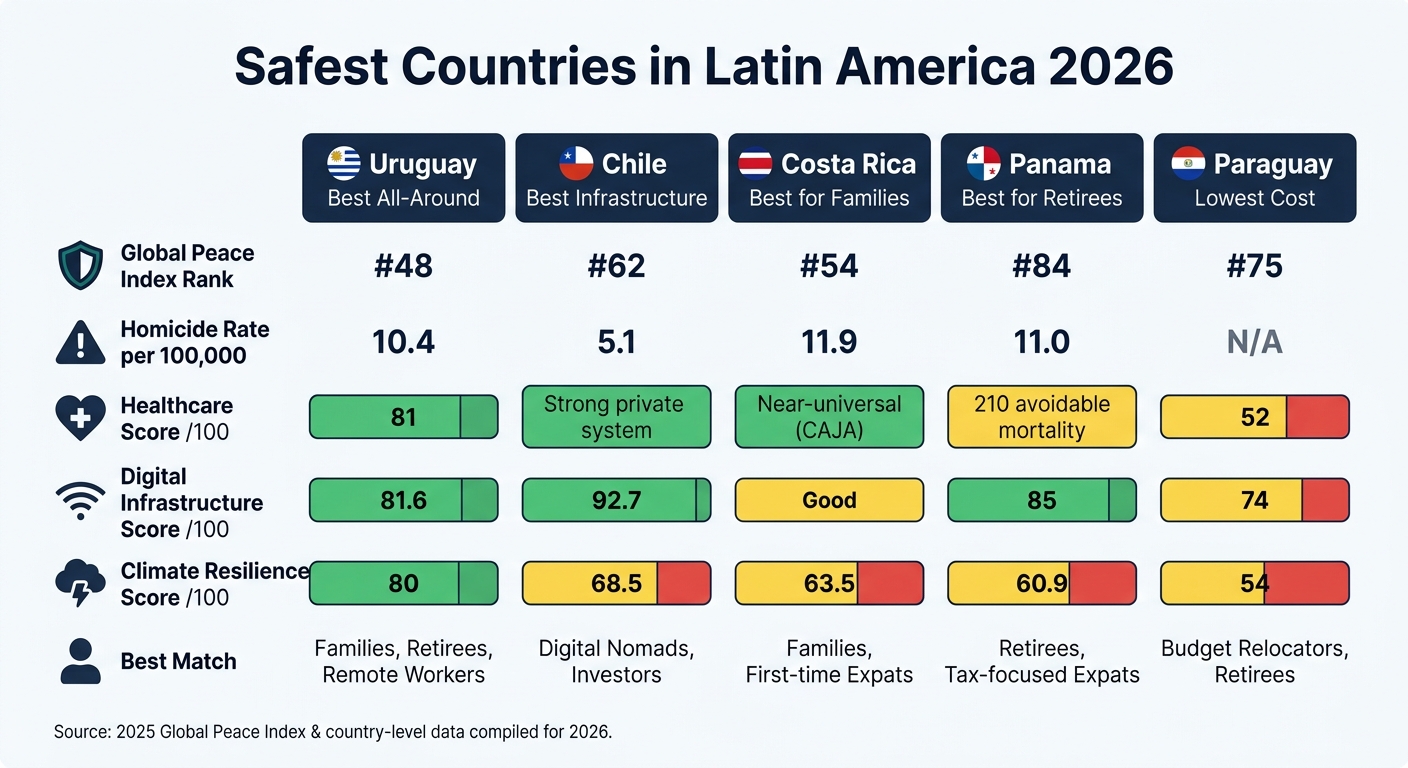
Quick Comparison
| Country | Main Safety Edge | Main Trade-Off | Best Match |
|---|---|---|---|
| Uruguay | Stable institutions, low disaster threat, strong healthcare and internet | Highest living costs, petty theft | Families, retirees, remote workers, investors |
| Chile | Low violent crime, top-tier internet, strong legal system | Protests in Santiago, earthquake exposure, slow public care | Digital nomads, investors |
| Costa Rica | Stable politics, broad healthcare access, strong livability | Theft in tourist zones, hurricane and flood risk | Families, retirees, first-time expats |
| Panama | Private hospitals, U.S. dollar use, retiree-friendly visas | Protests, uneven district-level safety, bank friction | Retirees, tax-focused expats |
| Paraguay | Low cost of living, low taxes on local income, easy residency paths | Weaker healthcare, weaker roads, border crime pockets | Budget-minded relocators, retirees |
So if you want the safest all-around base, I’d start with Uruguay. If you want the best internet and legal stability, I’d look at Chile. If you care most about low costs, Paraguay moves up the list fast.
sbb-itb-39d39a6
1. Uruguay
Uruguay is often called the "Switzerland of South America", and the numbers back up that reputation. It ranks #2 in South America and #48 globally on the 2025 Global Peace Index. A lot of that comes down to stable institutions, low corruption, and a strong rule of law. You feel that steadiness most in day-to-day life, starting with public safety.
Crime and Stability
Uruguay’s homicide rate is about 10.4 per 100,000 people. For most people, the main concern is petty theft. Violent crime is not common, though basic city caution still makes sense in places like Montevideo and Punta del Este.
Healthcare and Infrastructure
Uruguay scores 81/100 for healthcare quality, and its Universal Health Coverage index stands at 85. The country’s mutualista cooperative network helps keep out-of-pocket medical costs low. That said, specialist appointments can take time. Expats who want faster treatment or English-speaking doctors will likely want private insurance on top of the public system.
Uruguay also scores 81.6/100 for digital infrastructure. That puts it near the top in the region for remote work. If you need steady internet, solid systems, and a place that simply works, Uruguay makes a strong case.
Disaster Risk
Unlike Chile and Peru, Uruguay does not face major seismic or volcanic threats. Its main risks are flooding and drought, and it scores 80/100 on natural disaster resilience. Air quality is another plus, with a score of 89.2.
Best Fit and Trade-Offs
Uruguay fits best for retirees, high-net-worth individuals, families, and remote workers who care about legal certainty and quality of life. The downside is cost. It is the most expensive country in South America, with a single person’s monthly cost of living at about $1,900. Its tax regime is still appealing, but 2026 residency and investment rules are stricter.
Uruguay is the safest all-around option in this group, but the price tag is often what sends readers to Chile next.
2. Chile
After Uruguay’s broad safety edge, Chile stands out for stronger infrastructure, but day-to-day security is less even. It still ranks high for safety. In 2026, Chile is the 4th safest country in Latin America, with a Global Peace Index score of 1.899 and a global rank of 62nd. That lower spot, compared with Uruguay, reflects recent unrest and uneven police reforms.
Crime and Stability
Chile’s average intentional homicide rate is 5.099 per 100,000 people, which is lower than both Uruguay and Costa Rica. Violent crime is still low by global standards, but recent increases have been concentrated in Santiago and other urban areas.
The bigger day-to-day concern is political protest and civil unrest, especially in Santiago. These flare-ups tend to spike on Friday afternoons and evenings. By contrast, rural and tourist areas like Torres del Paine and the Atacama Desert remain peaceful.
If you’re in Santiago, it helps to stay clear of central protest zones on Friday afternoons and evenings. Motorbike snatch theft is also a real issue in the capital, so keep phones and bags secure in crowded places.
Healthcare and Infrastructure
Chile’s private healthcare system is one of the strongest in Latin America. The public system, though, is very slow and faces heavy pressure on elective wait times. Households still pay 5.9% of health costs out of pocket, which is why private coverage matters.
For expats, private health insurance is the safer bet. It can help you get around long waits and improve access to care. On the infrastructure side, Chile is hard to ignore: it scores 92.7/100 for digital infrastructure, which makes it especially appealing for remote workers.
Disaster Risk
Chile has major earthquake exposure, but strict building codes lower the danger. Climate risk is also high, at 83/100. There’s another issue to watch: the Araucanía, Biobío, and Los Ríos regions carry added security risk because of the ongoing Mapuche conflict.
Best Fit and Trade-Offs
Chile is a strong match for digital nomads and investors who care about infrastructure, institutions, and property rights. For foreign buyers, property rights score 90.0/100. That’s a big plus.
The tax upside, however, doesn’t last forever. Chile offers a territorial tax window for three years, and after that, worldwide income becomes taxable. That means early tax planning matters.
Next is Costa Rica, which trades Chile’s institutional strength for a different safety profile.
3. Costa Rica
Costa Rica ranks as the 3rd safest country in Latin America in 2026 and 54th globally on the 2025 Global Peace Index. That standing still ties back to its political stability and long-running no-military model. But safety here isn’t mainly about violent unrest. It’s more about petty crime on one side and climate exposure on the other.
Crime and Stability
The main issue is theft, not violence. Costa Rica’s average intentional homicide rate is 11.864 per 100,000 people. For most visitors and expats, the more common problem is pickpocketing or bag snatching, especially in crowded tourist zones and public transit hubs. Robberies have also gone up in southern regions.
For day-to-day life, Escazú, Santa Ana, Manuel Antonio, and Monteverde are common home bases for expats and retirees. A simple rule helps a lot: use Uber or licensed taxis, not street taxis, and keep your phone out of sight in busy areas.
That edge in day-to-day living also shows up in healthcare. Access is broad, but many people pay extra for faster private care.
Healthcare and Infrastructure
Costa Rica’s public healthcare system, the Caja Costarricense de Seguro Social, offers near-universal coverage. The catch is wait times. Elective care can take longer, which is why many expats lean on private clinics. The country’s avoidable mortality rate is 190 per 100,000, which is lower than the U.S. and Chile.
Private hospitals and expat clinics often have English-speaking staff, which makes things much easier if your Spanish is limited. Out-of-pocket health costs account for 2.9% of household spending.
The bigger trade-off sits outside the clinic: weather and natural hazards.
Disaster Risk
Costa Rica faces real exposure to earthquakes, flooding, and hurricanes, with hurricane season running from June through November. Its climate resilience score is 63.5 out of 100, below Uruguay at 74.8 and Chile at 68.5.
At the same time, Costa Rica does very well on a few quality-of-life measures. Its air quality score is 91.1, and 99% of its electricity comes from renewables.
Best Fit and Trade-Offs
Costa Rica is a strong match for retirees, families, and first-time visitors, especially through the Pensionado visa. The downside is paperwork. Residency and investment processing can move slowly, and naturalization takes 7 years.
If you plan ahead and leave room in your budget for private health coverage, those trade-offs are usually manageable.
Panama offers a different balance of safety, residency access, and regional connectivity.
4. Panama
Panama ranks 84th in the world on the 2025 Global Peace Index, with a score of 2.006, which makes it the second-safest country in Central America after Costa Rica. That puts Panama in a safer middle tier: stronger than much of the region, but not as steady as Uruguay or Chile. For many people, that’s the appeal. Panama often feels like a middle path between safety, access, and day-to-day convenience.
Crime and Stability
Panama’s average intentional homicide rate is 10.97 per 100,000 people. That’s a bit higher than Uruguay’s 10.45, but lower than Costa Rica’s 11.86. The bigger problem in recent years has been civil unrest. Protests in Panama City have hurt the country’s safety profile, and areas like El Chorrillo and Curundu call for extra care at night.
Outside the capital, the picture changes. Expat centers such as Boquete and Bocas del Toro are generally calmer, and the San Blas Islands remain mostly insulated from unrest in Panama City. So the day-to-day experience can vary a lot depending on where you live.
Healthcare and Infrastructure
Panama City’s private hospitals are one of the country’s biggest selling points. For insured expats, access is often faster than what you’d get in many public systems across the region. The avoidable mortality rate stands at 210 per 100,000, and out-of-pocket healthcare costs make up just 3.1% of household spending, compared with Chile’s 5.9%. In practice, private insurance is usually the baseline option.
Infrastructure is another reason Panama stays on many shortlists. The country scores 85 out of 100 for digital infrastructure, which makes it a good match for remote workers. Panama also uses the U.S. dollar as legal tender, which makes money matters simpler and adds a layer of financial stability for American expats and investors.
Disaster Risk
Panama’s climate resilience score is 60.9, the lowest in this group. The wet season runs from May through November, and hurricanes affect the Caribbean coast most from June through November. Air quality scores 84.7 out of 100. That’s solid, though still below Costa Rica’s 91.1.
Best Fit and Trade-Offs
Panama stands out for retirees and investors. The country taxes foreign-sourced income lightly, which helps people who earn money from abroad. Residency is available through investment-based paths, including the Friendly Nations and Qualified Investor visas. Naturalization usually takes 5 years, and dual citizenship is normally allowed.
The trade-offs are pretty clear. Banking has become more of a hassle, and living costs are higher than in Paraguay. As of February 2026, Panama is on the EU’s list of non-cooperative tax jurisdictions, so opening a bank account now usually means showing up in person and going through source-of-wealth checks. And because the economy is dollarized, everyday costs often run higher than they do in Paraguay.
Paraguay pushes the low-cost angle further, but you give up some infrastructure and get a different day-to-day safety picture.
5. Paraguay
Paraguay ranks 75th on the 2025 Global Peace Index, which puts it behind Uruguay, Chile, Costa Rica, and Panama in this comparison. It sits below the Southern Cone’s safer markets, but it still does better than much of the region. In day-to-day life, that middle-ground position matters. Safety can change a lot depending on the neighborhood.
Crime and Stability
When considering is Paraguay safe, the most common safety problems are petty theft and motochorros, or motorbike thieves, especially in busy areas like Mercado 4 in Asunción. Violent crime is more concentrated in drug-trafficking hotspots near the Brazilian border, such as Pedro Juan Caballero, and in areas like Chacarita in Asunción.
Outside those areas, the main rule is pretty simple: stay low-key. Don’t flash cash, jewelry, or expensive gear. That kind of discretion goes a long way.
Paraguay’s political stability score is 48 out of 100, which puts it below the region’s stronger systems.
Healthcare and Infrastructure
Healthcare is one of Paraguay’s clearest weak spots. The country scores 52 out of 100 for healthcare quality, the lowest in this group. For expats, private medical insurance is a smart starting point if you want more dependable access to care.
Road safety is also weak, so many expats choose not to drive themselves. Border crossings can be slow and inconsistent too. That’s why healthcare and transport often matter just as much as crime stats on paper.
Digital infrastructure scores 74 out of 100.
Disaster Risk
Paraguay’s climate risk score is 54 out of 100, the lowest in this comparison group. Summer temperatures often go above 95°F (35°C), and rainfall is spread through the year in the eastern region. In plain terms, that leaves the country more exposed to climate-related strain than neighbors like Uruguay.
Best Fit and Trade-Offs
Where Paraguay stands out most is cost and tax policy. It scores 97.3 out of 100 for affordability. It also applies a flat 10% tax on local income and charges zero tax on foreign-sourced income. On top of that, property rights for non-citizens score 90 out of 100, and visa pathways score 85 out of 100, which makes residency fairly straightforward compared with much of the region.
For retirees, digital nomads, and investors who care most about low overhead and simple residency routes, Paraguay can offer more than its safety rank might suggest. The trade-off is direct: low costs and tax-friendly rules in exchange for weaker services and less even safety.
That trade-off tends to work best for people who can live with weaker public services in return for low costs and simple taxes.
Those trade-offs are easiest to see in the side-by-side summary below.
Pros and cons of each country at a glance
The table below compares the five countries on the factors that matter most: crime, stability, healthcare, infrastructure, disaster risk, and livability.
| Country | Biggest Safety Advantages | Main Risks and Drawbacks | Best For |
|---|---|---|---|
| Uruguay | Lowest conflict risk, strong institutions, strong property rights | High cost of living, petty theft after dark | Retirees and digital nomads seeking stability |
| Chile | Low violent crime, strong institutions | Major seismic risk, civil unrest in Santiago, slow public healthcare | Remote workers and investors who want infrastructure and legal stability |
| Costa Rica | Stable politics, strong livability, lower day-to-day violence than much of the region | Rising robberies in southern regions, high weather risk from hurricanes and flooding | Families, retirees, and remote workers who can manage theft and weather risk |
| Panama | Dollarized economy, retiree-friendly residency, and strong private hospitals | Uneven safety by district, political protests in Panama City, private care is usually the baseline for reliable access | Retirees and tax-conscious expats |
| Paraguay | Low-cost living (97.3 out of 100), territorial tax system, fewer tourist-targeted theft risks outside major hubs | Weaker infrastructure and healthcare quality, drug smuggling near border areas, dangerous driving conditions | Cost-conscious relocators and retirees |
These trade-offs help narrow the best fit for your goals in 2026.
Which country fits your goals in 2026?
There isn’t one country that works best for everyone. The better move is to match the country to your mix of crime risk, stability, healthcare, and day-to-day comfort.
After you compare crime, political stability, healthcare, and climate, the next step is simple: line those strengths up with how you want to live. The table below pairs each country with the kind of safety profile it offers.
| Reader Type | Best Country Match | Key Reason |
|---|---|---|
| Family with Children | Uruguay | Strong education and stable day-to-day life |
| Retiree | Panama | Retiree-friendly residency and territorial tax treatment |
| Digital Nomad | Chile | Best digital infrastructure and strong legal stability |
| Investor | Uruguay | Strong property rights and the steadiest legal environment |
| Budget-Conscious Relocator | Paraguay | One of the most affordable countries in the region and immediate permanent residency through its SUACE program for a $70,000 investment commitment |
| Nature-Focused Expat | Costa Rica | Best mix of nature access, renewables, and livability |
This is where fit starts to matter more than rankings. A country can score well on paper and still feel wrong for your budget, pace of life, or residency plan.
It also helps to stay grounded about local conditions. Even in safer cities, some neighborhoods carry more risk than others, so your district choice can matter just as much as the country itself.
Pick the country that lines up with your daily risk tolerance, budget, and long-term residency goals.
FAQs
How much does city choice affect safety?
Where you stay can have a big impact on your safety. In many places, crime is clustered in certain cities, neighborhoods, or tourist zones instead of being spread evenly across the whole country.
Big cities often have more petty theft, scams, and pickpocketing. Rural areas are often quieter by comparison. But the gap can be sharp even within the same city, which is why it helps to look into specific districts, not just the country’s general reputation.
Which country is best for long-term relocation?
It comes down to how you live, because no country comes out on top in every area. Argentina, Uruguay, and Chile are often viewed as the safest picks for expats, retirees, and digital nomads.
For retirees, Panama and Uruguay stand out thanks to taxes, residency options, and healthcare. Chile tends to appeal to digital nomads in particular because of its digital infrastructure and lower cost of living.
Should I prioritize crime rates or healthcare and infrastructure?
Yes. Crime rates, healthcare, and infrastructure all play a central role in personal safety and day-to-day well-being when relocating or traveling in Latin America.
Crime rates give you a baseline sense of physical safety. Healthcare and infrastructure shape what happens when something goes wrong, whether that’s a medical issue, a power outage, or a transportation problem. Since quality can vary a lot between cities and rural areas, it’s smart to look at each destination’s local resilience, including access to hospitals and dependable transportation.
