
Looking for a safe place in Latin America? Here’s a quick breakdown of the top digital nomad opportunities in Latin America and expat destinations:
- Chile: Modern infrastructure, reliable healthcare, and effective law enforcement. Best for those needing stable internet and urban amenities.
- Uruguay: Known for strong institutions, minimal corruption, and a peaceful environment. Great for long-term stability and democratic governance.
- Costa Rica: Offers universal healthcare, low corruption, and a tranquil lifestyle. Ideal for retirees and nature lovers.
- Argentina: Low homicide rate and affordable living costs. A solid choice for budget-conscious expats seeking a vibrant city life.
- El Salvador: Remarkable safety improvements in recent years. Affordable, with strong internet and growing appeal for digital nomads.
Each country has unique strengths in crime rates, political stability, healthcare quality, and infrastructure reliability. Your choice depends on your priorities – whether it’s safety, affordability, or lifestyle preferences.
Quick Comparison
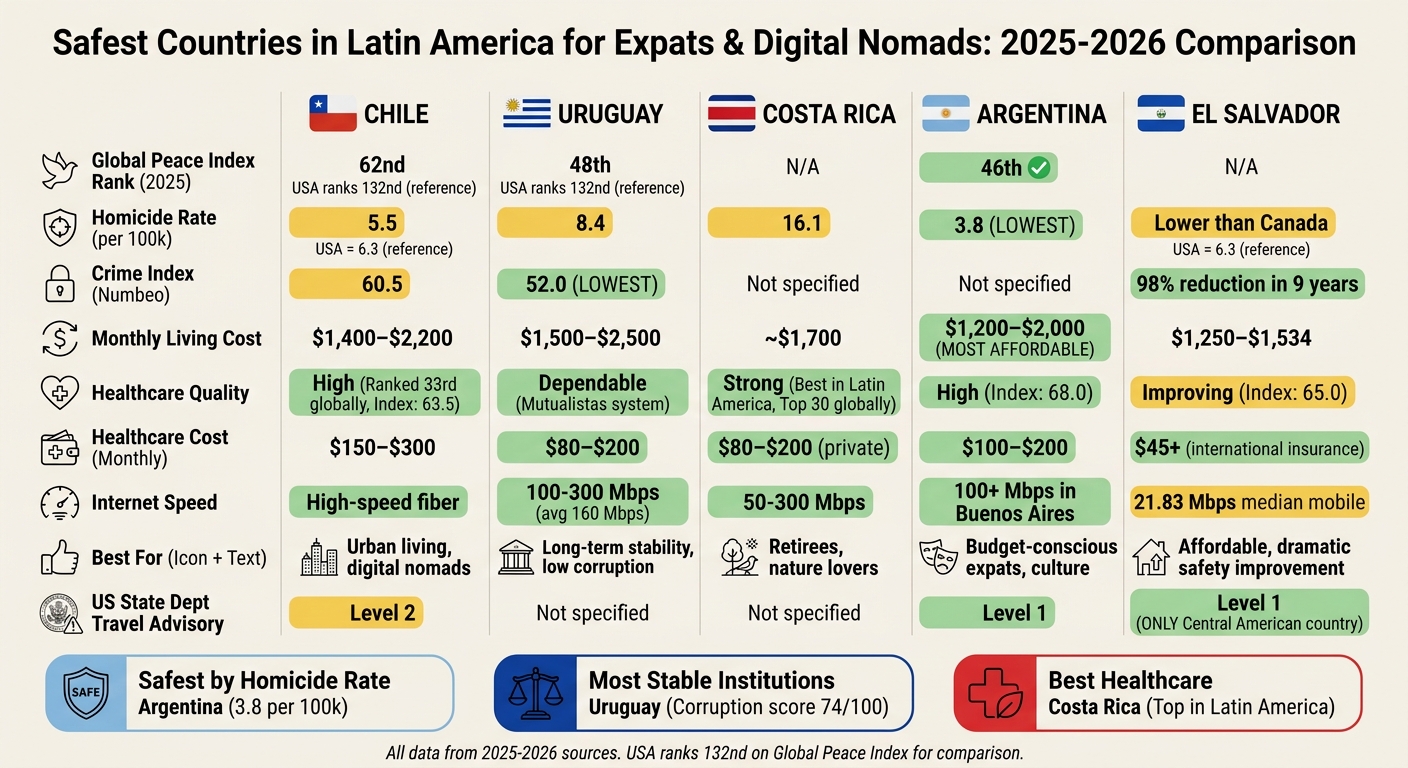
| Country | Homicide Rate (per 100k) | Global Peace Index Rank (2025) | Monthly Living Cost | Healthcare Quality | Best For |
|---|---|---|---|---|---|
| Chile | 5.5 | 62 | $1,400–$2,200 | High | Urban living, digital nomads |
| Uruguay | 8.4 | 48 | $1,500–$2,500 | Dependable | Long-term stability |
| Costa Rica | 16.1 | N/A | ~$1,700 | Strong | Retirees, nature enthusiasts |
| Argentina | 3.8 | 46 | $1,200–$2,000 | High | Budget-conscious expats |
| El Salvador | Lower than Canada | N/A | $1,250–$1,534 | Improving | Affordable, safer urban areas |
Choose the destination that aligns with your lifestyle and budget. Safety, infrastructure, and healthcare vary, so weigh your needs carefully.
1. Chile
Chile stands out for its modern infrastructure and professional law enforcement. With a homicide rate of 5.5 per 100,000 people, it’s 13% lower than the United States, which sits at 6.3 per 100,000. On the 2025 Global Peace Index, Chile ranks 62nd globally, significantly ahead of the U.S., which ranks 132nd.
Crime Rates
Chile’s national police force, the Carabineros, is well-regarded for its professionalism and integrity. Bribing an officer is not only frowned upon but also a criminal act. However, Santiago has seen a rise in crime, with a Numbeo Crime Index of 60.5 in recent years. As of 2026, the U.S. Department of State has issued a Level 2 travel advisory for Chile.
Safety can vary widely depending on the neighborhood. Business districts like Providencia, Las Condes, Vitacura, and Lo Barnechea in Santiago’s eastern areas are known for their lower crime rates and better security measures. These neighborhoods are particularly safe for expats and digital nomads. While exploring Santiago, it’s wise to use registered ride-hailing apps at night instead of street taxis and to stay vigilant against pickpocketing, especially on the Santiago Metro.
Beyond everyday crime, Chile’s strong political framework plays a key role in maintaining its overall safety.
Political Stability
Chile is known for its strong democratic institutions, low levels of corruption, and a well-developed middle class. Joining the OECD in 2010 marked its status as one of the region’s more stable countries. President José Antonio Kast, who took office on March 11, 2026, has focused on dismantling transnational criminal networks and improving border security. After a post-2019 spike in violent crime, the country has seen a steady decline in its homicide rate over the past three years, reaching 5.4 per 100,000 people in 2025.
"Chile remains one of the most recognized countries in Latin America due to its strong institutions, political stability, and relatively predictable economy." – Mikkel Thorup, CEO of Expat Money
Healthcare Quality
Chile’s healthcare system is divided into public (FONASA) and private (ISAPRE) networks. Ranked 33rd globally by the World Health Organization, Chile’s healthcare system has a Healthcare Index score of 63.5. Private clinics in Santiago deliver care comparable to U.S. standards but at much lower costs. Private health insurance typically ranges from $150 to $300 per month. English-speaking doctors are widely available in major cities, especially in private hospitals. To fully access the healthcare system, expats need a Chilean ID card. Many also maintain international coverage with providers like Allianz or Cigna for added protection.
Infrastructure Reliability
Chile leads South America in infrastructure quality, with strict building codes designed to withstand large earthquakes. Reliable electricity and internet make it an excellent choice for digital nomads who rely on dependable connectivity. Many choose to relocate here by applying for one of the best digital nomad visas available globally. High-end residential areas in Santiago offer modern amenities and robust private security. Many expats further enhance their safety with monitored alarm systems and reinforced entryways.
This combination of reliable infrastructure and safety measures makes Chile an appealing option for those seeking a secure and connected lifestyle.
sbb-itb-39d39a6
2. Uruguay
Uruguay has earned the title "Switzerland of South America" due to its strong institutions, low levels of corruption, and a stable middle class. While its homicide rate of 8.4 per 100,000 is higher than Chile’s and the United States’, it boasts the lowest Numbeo Crime Index in South America at 52.0. Globally, Uruguay ranks 48th on the 2025 Global Peace Index, far ahead of the United States, which sits at 132nd.
Crime Rates
Uruguay’s safety profile highlights a country where violent crime is rare, particularly in major cities like Montevideo and Punta del Este. Petty theft and pickpocketing remain the most common issues in urban areas, but the country’s overall safety stems more from equitable wealth distribution and a strong middle class than from heavy policing. In Montevideo, neighborhoods such as Pocitos, Punta Carretas, and Carrasco are widely regarded as the safest for expats. After dark, it’s best to use licensed ride-hailing services for transportation.
Political Stability
Uruguay stands out as Latin America’s only full democracy and the least corrupt country in the region, achieving a score of 74/100 on global corruption indices. It even outperforms nations like the United States and France in this area. Peaceful political transitions and strong democratic institutions provide the legal and social stability that expats need for long-term planning. This stability also supports reliable public services, including healthcare.
"Uruguay’s safety does not come from a heavy-handed police presence; rather, it is the result of strong democratic institutions, a highly educated population, and the most equitable wealth distribution in Latin America." – Nawafez
Healthcare Quality
Uruguay’s healthcare system operates through mutualistas – nonprofit health plans that offer a wide range of services, from routine checkups to major surgeries, for $80 to $200 per month. While the system is dependable by regional standards, some facilities may lack the advanced equipment found in top North American hospitals. Many expats prefer Montevideo’s Hospital Británico for its high standards and English-speaking staff. Doctor visit copays range from $8 to $24, and newcomers are advised to secure private insurance for the first few months before transitioning to a mutualista plan.
Infrastructure Reliability
Uruguay leads the way in renewable energy, with over 95% of its electricity generated from wind and hydro sources. Antel, the national provider, offers reliable fiber internet with speeds ranging from 100 to 300 Mbps at prices between $25 and $40 per month, with an average speed of 160 Mbps. The country also benefits from minimal natural disaster risks, and tap water is safe to drink everywhere.
3. Costa Rica
Costa Rica continues to attract expats with its blend of political stability and natural beauty, though its safety profile has shifted in recent years. It’s currently considered the safest country in Latin America, earning a safety score of 72 out of 100, and ranks 8th out of 62 countries in the 2026 Expat Index for livability. With approximately 70,000 American expats among its 5.2 million residents, the country remains a favorite for remote workers and retirees. Similar to Chile and Uruguay, Costa Rica offers a mix of strong institutions and appealing lifestyle options for expats.
Crime Rates
Although violent crime targeting foreigners is uncommon, Costa Rica’s reputation for safety has been affected by an increase in property crimes, such as vehicle break-ins, burglaries, and petty theft, particularly in areas frequented by tourists and expats. The homicide rate, recorded at 16.1 per 100,000 people in 2025, is largely tied to gang-related drug trafficking in port provinces, rather than in expat-heavy regions. To mitigate risks, expats are advised to avoid leaving items visible in parked vehicles. Many opt for gated communities in areas like Escazú, Santa Ana, and Rohrmoser, as well as beach towns such as Tamarindo and Uvita, where security is often prioritized. Interestingly, rip currents pose a greater threat to safety than crime-related incidents. These realities highlight the importance of taking practical precautions, especially in areas with high expat populations.
Political Stability
Costa Rica’s decision to abolish its military in 1948 and redirect resources toward education and healthcare has fostered strong public institutions and low levels of corruption. This political stability provides a predictable and secure environment for expats, further supported by a territorial tax system that exempts foreign-sourced income from local taxation. This combination of historical reforms and modern governance reinforces Costa Rica’s appeal as a reliable destination for expats.
"Costa Rica remains a stable, predictable Plan-B: strong institutions, no army, and a security-dependent tourism economy." – Mikkel Thorup, CEO, Expat Money
Healthcare Quality
Costa Rica’s healthcare system is ranked the best in Latin America and is among the top 30 globally. Its public healthcare program, the Caja Costarricense de Seguro Social (CAJA), offers coverage to legal residents for monthly fees ranging from US$50 to US$150, depending on income. While the system is comprehensive, long wait times for non-urgent procedures lead many expats to purchase private insurance, which costs between US$80 and US$200 per month. Private consultations typically cost US$50 to US$90, while specialist visits range from US$90 to US$160. JCI-accredited hospitals like Hospital CIMA and Hospital Clínica Bíblica provide care comparable to Western standards, often with English-speaking staff. For digital nomads without residency, the Medismart discount plan, priced at around US$15 per month, can help reduce healthcare expenses.
Infrastructure Reliability
In the Central Valley, remote workers benefit from reliable fiber-optic internet, offering speeds of 50–300 Mbps for US$30–US$60 per month, and a time zone (CST, UTC-6) that aligns with North American working hours. However, the Greater Metropolitan Area (GAM) faces significant traffic congestion, and rural or mountainous areas often have challenging road conditions. For mobile coverage, Kölbi SIM cards are generally the most dependable option in remote regions. Expats applying for the Digital Nomad visa must demonstrate a minimum monthly income of US$3,000 (or US$4,000 for those with dependents). Many single expats find that living in popular locations is achievable on a budget of around US$2,500 per month.
4. Argentina
Argentina ranks as South America’s safest country in 2026, holding the 46th spot on the Global Peace Index – far ahead of the United States, which ranks 132nd. With a Level 1 Travel Advisory from the US State Department and a homicide rate of 3.8 per 100,000 people (about 40% lower than the US rate of 6.3 per 100,000), Argentina offers a secure environment for expats and digital nomads. Its consistent safety and stability make it an appealing destination.
Crime Rates
While violent crime against foreigners is rare, petty theft is a common issue in urban areas like Buenos Aires. The primary threat comes from "motochorros" (motorcycle thieves) who target pedestrians near curbs, snatching phones and bags. To stay safe, avoid displaying valuables such as smartphones or jewelry in public, and use ride-hailing apps instead of street taxis. It’s also wise to choose ATMs located inside banks or shopping malls during daylight hours. For those seeking quieter alternatives, cities like Mendoza and Córdoba provide a more relaxed atmosphere ideal for remote workers. These precautions, combined with Argentina’s steady political environment, enhance its appeal.
Political Stability
Argentina enjoys a stable democracy with peaceful political transitions. Recent economic reforms have significantly reduced inflation and stabilized the economy. The unification of exchange rates and the removal of capital controls have narrowed the "blue dollar" premium to just 2–3%, simplifying financial transactions. However, navigating Argentina’s bureaucracy and residency procedures can still be a challenge for expats. On the upside, the Digital Nomad Visa offers a compelling option for remote workers earning over $2,000 per month, allowing a two-year continuous stay.
Healthcare Quality
Argentina’s healthcare system is one of the best in South America, divided into public hospitals, private insurance plans, and social security for employees. Many expats favor private healthcare, which costs between $100 and $200 per month and offers access to facilities like Hospital Alemán and Hospital Británico, which meet Western European standards. Private doctor consultations typically range from $28 to $55 (ARS 40,000–80,000), while the public system is free but may involve long wait times and out-of-pocket medication costs. Non-residents are now required to have private health insurance to enter the country. English-speaking doctors are readily available in major cities, and Argentina’s Healthcare Index score of 68.0 reflects the quality of its medical services.
Infrastructure Reliability
Buenos Aires stands out for its reliable infrastructure, offering fiber-optic internet speeds often exceeding 100 Mbps, compared to the national average of 48–50 Mbps. The city has become a tech hub, home to over 3,000 startups and major companies like MercadoLibre, and it leads Latin America in English proficiency. Road safety standards are also among the best in the region. A single expat can live comfortably in Buenos Aires on $1,500 to $2,200 per month, with one-bedroom apartments in the city center averaging $400 to $500 per month. For long-term leases, services like Finaer help expats meet the "garantía" (local guarantor) requirement without needing local property as collateral. These infrastructure strengths support a productive and secure lifestyle for digital nomads.
5. El Salvador
El Salvador is becoming an increasingly appealing option for those prioritizing safety in their travels. Over the past decade, the country has made remarkable progress, now ranking among the safest in Latin America. Crime rates have dropped by over 98% in nine years, and homicide rates are now lower than those in Canada and nearly all major U.S. cities. In April 2026, the U.S. State Department elevated El Salvador to Level 1 (Exercise Normal Caution) – the only Central American nation to achieve this designation. This rating makes it officially safer than popular destinations like Cancun, Mexico [29, 30]. Additionally, the country has been recognized as the fourth-best option for digital nomads in Central America.
Crime Rates
A significant reduction in crime has been achieved through a government-led crackdown on gangs, initiated in March 2022 under a State of Exception. These measures have greatly improved security in San Salvador and coastal areas [5, 29]. Over 75,000 suspected gang members have been detained since 2022, leading to a 70% drop in homicide rates. While violent crime targeting foreigners is extremely rare, petty theft and scams can still occur in less-developed urban areas. Travelers should exercise caution, especially in urban outskirts, and avoid displaying electronic devices openly. Those with visible tattoos – particularly designs that could be mistaken as gang-related – might face additional scrutiny at security checkpoints.
Political Stability
The improved safety in El Salvador has come with some trade-offs. The prolonged State of Exception, which has been renewed multiple times, has concentrated executive power and temporarily suspended key constitutional rights. While 88% of Salvadorans reported feeling safe as of late 2024, this legal environment does pose risks, including the potential for arbitrary detention and increased scrutiny at checkpoints. Expats should always carry identification and comply with directives from security forces.
On a different note, El Salvador’s adoption of Bitcoin as legal tender has attracted tech-savvy individuals, though it’s wise to carry U.S. dollars as a backup due to occasional payment system issues [28, 29]. For those considering long-term residence, the Pensionado visa requires a monthly income of approximately $1,460.
Healthcare Quality
El Salvador’s healthcare system operates on a public-private model and has a Healthcare Quality Index score of 65/100. Public healthcare is free for registered residents but often struggles with overcrowding, long wait times, and limited resources [31, 28]. For this reason, most expats prefer private healthcare, which offers better facilities and shorter wait times. However, severe medical cases may require evacuation to neighboring countries or the U.S. [28, 31]. International health insurance plans, such as those from SafetyWing, start at around $45 per month and are highly recommended. English-speaking doctors are limited and primarily found in cities like Ilopango, Puerto De La Libertad, and Antiguo Cuscatlan. Expats should also bring a three-month supply of essential medications, along with a doctor’s note [28, 31].
Infrastructure Reliability
El Salvador offers dependable infrastructure at a budget-friendly cost, making it an attractive destination for digital nomads. Monthly living expenses in San Salvador range from $1,250 to $1,534, with one-bedroom apartments in city centers renting for about $739 [28, 27]. High-speed internet plans cost between $15 and $35 per month, and median mobile internet speeds average 21.83 Mbps [28, 27]. In beach towns like El Tunco, monthly Airbnb rentals start at just $347, and meals in colonial cities like Santa Ana cost around $2.50. These affordable living costs, combined with improved safety and reliable services, make El Salvador an increasingly popular choice for remote workers.
Comparison of Safety Factors
When comparing these five countries, distinct differences in safety and other factors become apparent. Argentina boasts the lowest homicide rate in South America, at 3.8 per 100,000 people – roughly 40% lower than the United States’ rate of 6.3. Uruguay stands out for its institutional stability, featuring the lowest Crime Index in the region at 52.0. Meanwhile, Chile is known for having the most advanced infrastructure in Latin America, with an institutional score of 85/100, although petty crime in Santiago has been on the rise. El Salvador, once plagued by high crime rates, has significantly reduced its homicide rate to levels below those of Canada and most major U.S. cities.
Global Peace Index rankings for 2025/2026 further underscore these differences. Argentina ranks 46th globally, Uruguay 48th, and Chile 62nd, while the United States lags behind at 132nd. Beyond safety metrics, institutional and healthcare factors set these countries apart. Uruguay excels with its transparent judicial system and equitable wealth distribution. Costa Rica, on the other hand, owes its stability to decades of investment in education and healthcare, supported by consistent governance.
Cost of living is another critical factor for those considering relocation. Monthly expenses vary widely:
- Argentina: $1,200–$2,000, offering excellent value for money.
- Chile: $1,400–$2,200, placing it in the middle range.
- Uruguay: $1,500–$2,500, reflecting its higher cost of living.
- Costa Rica: Around $1,700, depending on the specific location.
- El Salvador: Among the most budget-friendly, particularly in coastal areas.
Healthcare quality also differs across these nations. Chile leads the region in medical infrastructure, closely followed by Argentina and Uruguay. Both public and private healthcare options are available in these countries, with private facilities often offering shorter wait times and English-speaking staff. Costa Rica is celebrated for its universal healthcare system, which provides high-quality care through a strong social safety net. In El Salvador, healthcare services are steadily improving as the country continues its recovery.
These variations in safety, cost of living, and healthcare provide valuable insights for expats seeking destinations that align with their security, lifestyle, and budget priorities.
Conclusion
When deciding on the safest Latin American country, it all comes down to which security factors matter most to you. For those prioritizing institutional stability, transparent governance, and low corruption, Uruguay stands out. It’s often called the "Switzerland of South America" for a reason. Meanwhile, Argentina offers a compelling mix of low crime rates – its homicide rate is just 3.8 per 100,000 people – and rich cultural experiences, earning it the 46th spot globally on the 2025 Global Peace Index. If modern infrastructure and reliable services are at the top of your list, Chile is an excellent option with its professional police force and high-quality urban standards.
For those concerned about physical safety on the streets, El Salvador has undergone a remarkable transformation, now boasting homicide rates lower than many major U.S. cities. On the other hand, Costa Rica shines as a haven for health and environmental security, thanks to its universal healthcare system and peaceful way of life.
"If your peace of mind comes from a bulletproof justice system, political stability, and an absence of corruption, your undisputed winner is Uruguay." – Nolam.org
Budget also plays a crucial role in choosing the right destination. For digital nomads looking to stretch their dollars, Argentina offers excellent value with a monthly budget of $1,200–$2,000. If you’re willing to invest a bit more, Uruguay provides strong institutional security for $1,500–$2,500 per month. Matching your budget to each country’s safety features can help you achieve both peace of mind and a high quality of life.
No single country checks every box, so the best choice depends on your personal priorities. Whether it’s safety, healthcare, or cost of living, aligning these factors with your lifestyle will guide you to the ideal destination.
FAQs
Which country is safest for solo travelers?
Chile and Uruguay rank as two of the safest choices for solo travelers in Latin America. Chile is well-regarded for its impressive safety ratings, while Uruguay earns recognition for its low crime levels and stable democratic governance. These factors make both countries appealing and secure options for those venturing out alone in the region.
How safe are smaller towns compared to capitals?
Smaller towns in Latin America tend to offer a safer environment compared to bustling capitals. They often have lower crime rates, greater stability, and tightly-knit communities. These factors make them attractive options for expats and digital nomads looking for a secure and friendly place to live or work.
Do I need private health insurance as an expat?
Having private health insurance as an expat is highly advisable. It guarantees access to reliable healthcare and emergency coverage, especially in places where public healthcare systems might differ in standards. This not only offers peace of mind but also ensures better medical care options while living overseas.
