
Asia is usually counted at 48 sovereign states, but this article’s list goes past that baseline because it also includes places often listed in money guides, such as Hong Kong, Taiwan, and Cyprus. If you want the short answer: the article maps each country or territory to its official currency and ISO 4217 code, like JPY for Japan or AED for the UAE.
Here’s what I’d take from it right away:
- 48 sovereign states is the base count used in the article
- The list is split into 6 regions
- Asia has about 50 currencies
- Some names repeat, such as rupee, dinar, riyal/rial, som, and won
- For payments, ISO codes matter more than symbols like $ or ¥
A few points stand out fast:
- Timor-Leste uses the U.S. dollar (USD)
- Cyprus uses the euro (EUR)
- Hong Kong dollar (HKD) is pegged to the U.S. dollar
- Bhutan and Nepal keep their currencies tied to the Indian rupee
- Brunei dollar and Singapore dollar trade at par
- North Korean won (KPW) is tightly controlled
The article is strongest as a lookup guide. But I also notice a gap: some West Asian countries, such as Iran, Iraq, and Yemen, appear in the A-to-Z table but not in the main West Asia section. So the alphabetical list is the better one to trust if you want the broadest country coverage in one place.
| What you get | What it means for you |
|---|---|
| Country + currency + ISO code | You can check payment details fast |
| Regional grouping | You can scan by part of Asia |
| A-to-Z table | You can find one place without reading the full piece |
| Short currency notes | You can spot pegs, shared names, and edge cases |
If I were using this article for a bank transfer, trip planning, or a fact check, I’d use it as a starting list and lean on the ISO code first.
How Many Countries Are in Asia?
Asia is most often counted as 48 sovereign states, though the total can shift once transcontinental countries and special-status places are added.
A big reason for the difference is transcontinental countries. These are states that sit in both Asia and Europe. Russia, Turkey, Kazakhstan, Azerbaijan, Georgia, and Armenia usually fall into this group because their territory crosses the Asia-Europe divide. So the final count depends on the rule a list follows. Some use geography. Others lean on geopolitics. That’s why these countries may show up on an Asian list, a European list, or both.
Special-status cases can also change the number. This comes up most often with Hong Kong, Macau, and Taiwan, which are often listed separately in currency guides.
For this article, 48 sovereign states is the baseline. Transcontinental countries and special-status entities are labeled clearly so the list stays easy to follow. The currency total is a bit higher than the country total, with about 50 currencies across Asia.
| Category | Examples | Count impact |
|---|---|---|
| Transcontinental States | Russia, Turkey, Kazakhstan, Azerbaijan, Georgia, Armenia | Territory in both Asia and Europe |
| Observer state | State of Palestine | Excluded from the 48-state baseline |
| Special Administrative Regions | Hong Kong, Macau | Part of China, but often listed individually in financial or currency guides |
| Disputed/Special Status | Taiwan | Recognition varies by international organization and individual country |
With that baseline in place, the list starts with South Asia.
sbb-itb-39d39a6
What This Full List Covers
Each entry shows the country, its official currency, and its ISO 4217 code. You can use the list to check exchange needs, compare relocation costs, and verify currencies for cross-border payments.
Notes appear only when a currency has special legal status or an unusual day-to-day role. For example, North Korea restricts foreign use of the won. Malaysian ringgit accounts are restricted outside Malaysia. The Brunei dollar and Singapore dollar have been interchangeable at par since 1967.
The regional list starts with South Asia.
1. South Asia
Here’s a quick look at the main currencies used across South Asia:
| Country | Currency | ISO Code |
|---|---|---|
| India | Indian Rupee | INR |
| Pakistan | Pakistani Rupee | PKR |
| Sri Lanka | Sri Lankan Rupee | LKR |
| Bangladesh | Bangladeshi Taka | BDT |
| Nepal | Nepalese Rupee | NPR |
| Bhutan | Bhutanese Ngultrum | BTN |
| Maldives | Maldivian Rufiyaa | MVR |
| Afghanistan | Afghan Afghani | AFN |
A small but useful detail: Bhutan’s ngultrum is pegged to the Indian rupee, and Nepal’s rupee is also pegged to INR.
Next: Southeast Asia.
2. Southeast Asia
Southeast Asia has 11 sovereign states. Timor-Leste is an ASEAN observer.
If you need a quick country-by-country currency reference, use the table below.
| Country | Currency | ISO Code |
|---|---|---|
| Thailand | Thai Baht | THB |
| Vietnam | Vietnamese Dong | VND |
| Indonesia | Indonesian Rupiah | IDR |
| Malaysia | Malaysian Ringgit | MYR |
| Singapore | Singapore Dollar | SGD |
| Philippines | Philippine Peso | PHP |
| Brunei | Brunei Dollar | BND |
| Cambodia | Cambodian Riel | KHR |
| Laos | Lao Kip | LAK |
| Myanmar | Myanmar Kyat | MMK |
| Timor-Leste | U.S. Dollar | USD |
A couple of details are worth noting. The Brunei dollar and Singapore dollar are fixed at par. Cambodia officially uses the riel, but USD is also common, especially in tourism and for larger payments.
Next: East Asia.
3. East Asia
Below are the East Asia entries, along with their official currencies and ISO codes.
| Country / Territory | Currency | ISO Code |
|---|---|---|
| China | Renminbi (Yuan) | CNY |
| Japan | Japanese Yen | JPY |
| South Korea | South Korean Won | KRW |
| North Korea | North Korean Won | KPW |
| Taiwan | New Taiwan Dollar | TWD |
| Hong Kong | Hong Kong Dollar | HKD |
China uses the renminbi, and the yuan (CNY) is the standard unit used in pricing and settlement. Japan uses the Japanese yen, while both the yen and the yuan share the ¥ symbol.
South Korea and North Korea both use a won, but they are not the same currency. KRW is issued by the Bank of Korea, while KPW is tightly controlled and not freely traded.
Hong Kong uses the Hong Kong dollar (HKD), which has been pegged to the U.S. dollar at 7.80:1 since 1983.
Next: West Asia / Middle East.
4. West Asia / Middle East
West Asia includes nine countries. The table below gives you a quick country-to-currency lookup.
| Country | Currency | ISO Code |
|---|---|---|
| Saudi Arabia | Saudi Riyal | SAR |
| United Arab Emirates | UAE Dirham | AED |
| Kuwait | Kuwaiti Dinar | KWD |
| Bahrain | Bahraini Dinar | BHD |
| Qatar | Qatari Riyal | QAR |
| Oman | Omani Rial | OMR |
| Jordan | Jordanian Dinar | JOD |
| Israel | Israeli New Shekel | ILS |
| Turkey | Turkish Lira | TRY |
A few West Asian currencies stay tied to the U.S. dollar, which makes exchange rates easier to track. Saudi Arabia has kept the riyal fixed at 3.75 SAR per USD since 1986. The UAE dirham has stayed at 3.67 AED per USD since 1997. Bahrain’s dinar has been pegged at 1 BHD = 2.659 USD since 1980.
Kuwait stands out for another reason. The Kuwaiti Dinar (KWD) is the highest-value currency in the world.
You’ll also notice some shared currency names across the region. Saudi Arabia, Qatar, and Oman all use a currency called the riyal. Bahrain, Jordan, and Kuwait use the dinar.
Turkey made a major currency change in 2003, when it removed six zeros. Then, in 2009, it dropped the word “New” from the currency’s name. Israel made a similar shift earlier: the new shekel (ILS) replaced the old shekel in 1985.
Next: Central Asia.
5. Central Asia
Central Asia includes five sovereign states: Kazakhstan, Kyrgyzstan, Tajikistan, Turkmenistan, and Uzbekistan. Most of these currencies came into use in 1993, after the Soviet ruble came to an end.
| Country | Currency | ISO Code |
|---|---|---|
| Kazakhstan | Tenge | KZT |
| Kyrgyzstan | Som | KGS |
| Tajikistan | Somoni | TJS |
| Turkmenistan | Manat | TMT |
| Uzbekistan | Som | UZS |
A small detail can trip people up here: Kyrgyzstan and Uzbekistan both use som, while Tajikistan uses somoni. Turkmenistan’s manat is its own separate currency.
To keep things clear, use the ISO codes KZT, KGS, TJS, TMT, and UZS instead of relying on currency names alone.
The next section covers transcontinental and special-status entries.
6. Transcontinental / Special-status
Some Asia-related currencies don’t fit neatly into a standard regional bucket. A few span more than one region, while others sit in border areas or have a special geographic status. That’s why they’re grouped here on their own.
| Country | Currency | ISO Code | Status |
|---|---|---|---|
| Russia | Russian Ruble | RUB | Spans Europe and Asia |
| Georgia | Georgian Lari | GEL | Spans the Caucasus border region |
| Armenia | Armenian Dram | AMD | Geographically in Western Asia |
| Azerbaijan | Azerbaijani Manat | AZN | South Caucasus |
| Cyprus | Euro | EUR | Western Asia; EU member |
Use the regional grouping below for a faster scan.
Regional Grouping for Faster Reference
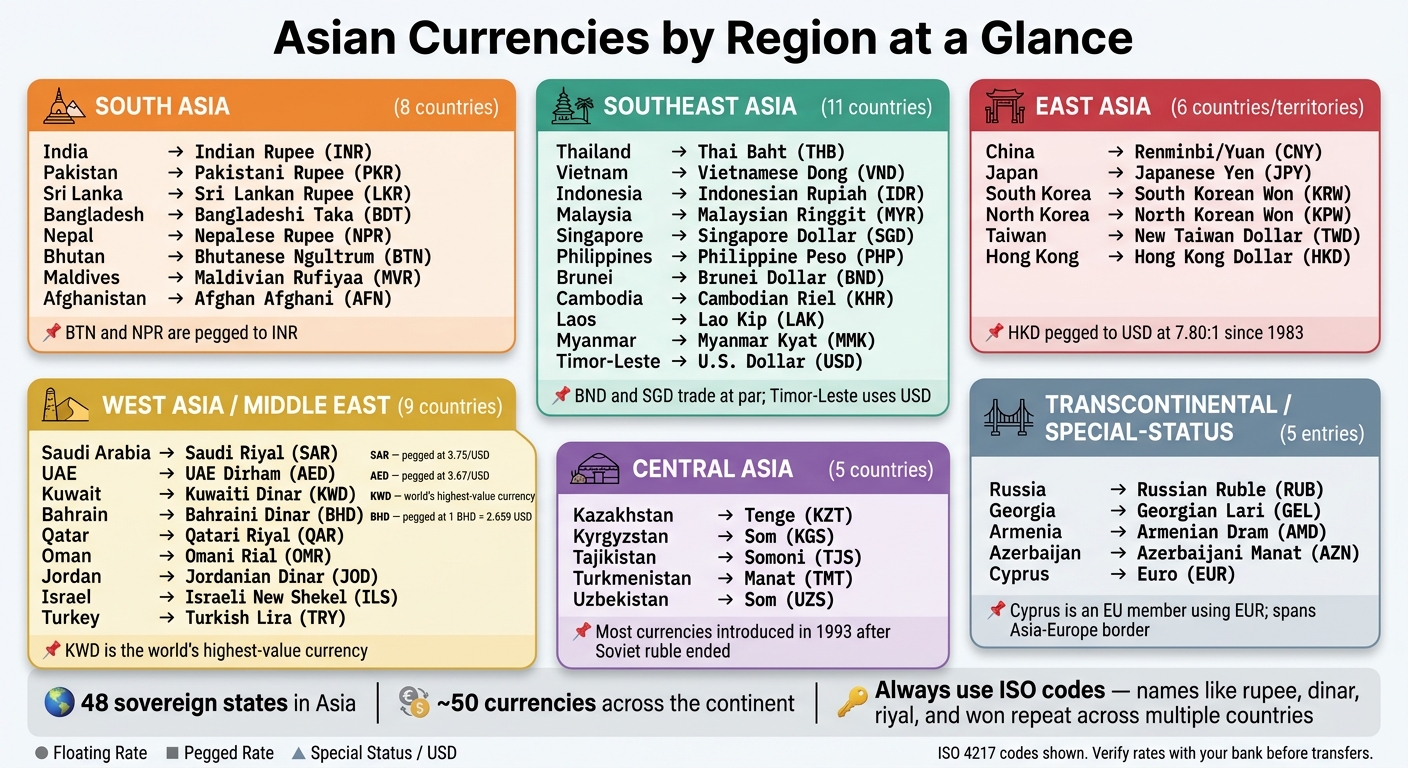
Here’s the fast lookup version of the six regional groups in this guide. If you need edge cases or country-by-country notes, check the detailed regional sections above.
| Region | Representative Countries | Currencies / ISO Codes |
|---|---|---|
| South Asia | India, Pakistan, Bangladesh, Sri Lanka, Afghanistan | Rupee (INR, PKR, LKR), Taka (BDT), Afghani (AFN) |
| Southeast Asia | Singapore, Thailand, Vietnam, Indonesia, Brunei, Timor-Leste | Singapore Dollar (SGD), Baht (THB), Dong (VND), Rupiah (IDR), Brunei Dollar (BND), U.S. Dollar (USD) |
| East Asia | China, Japan, South Korea, Taiwan, Hong Kong, North Korea | Renminbi / Yuan (CNY), Yen (JPY), Won (KRW), New Taiwan Dollar (TWD), Hong Kong Dollar (HKD), North Korean Won (KPW) |
| West Asia / Middle East | Saudi Arabia, UAE, Qatar, Israel | Saudi Riyal (SAR), UAE Dirham (AED), Qatari Riyal (QAR), Israeli Shekel (ILS) |
| Central Asia | Kazakhstan, Uzbekistan, Turkmenistan | Tenge (KZT), Som (UZS), Manat (TMT) |
| Transcontinental / Special-status | Turkey, Russia, Azerbaijan | Turkish Lira (TRY), Ruble (RUB), Manat (AZN) |
Quick Currency Notes Readers May Need
A couple of entries above need a quick note so the list is easier to read:
- Timor-Leste uses the U.S. Dollar (USD) as its official currency.
- Cyprus, geographically in West Asia and an EU member, uses the Euro (EUR).
For a faster country lookup, use the alphabetical table below.
Alphabetical Reference Table
Use this table when you need a fast A-to-Z lookup of Asian countries and territories. It pulls the regional lists above into one alphabetical index.
ISO codes help cut through mix-ups. Names like rupee, dinar, riyal/rial, won, som, manat, and dollar show up in more than one place, so the code is often the clearest way to tell currencies apart.
| Country / Territory | Official Currency | ISO 4217 Code | Region |
|---|---|---|---|
| Afghanistan | Afghan Afghani | AFN | South Asia |
| Armenia | Armenian Dram | AMD | Transcontinental / Special-status |
| Azerbaijan | Azerbaijani Manat | AZN | Transcontinental / Special-status |
| Bahrain | Bahraini Dinar | BHD | West Asia |
| Bangladesh | Bangladeshi Taka | BDT | South Asia |
| Bhutan | Bhutanese Ngultrum | BTN | South Asia |
| Brunei | Brunei Dollar | BND | Southeast Asia |
| Cambodia | Cambodian Riel | KHR | Southeast Asia |
| China | Renminbi (Yuan) | CNY | East Asia |
| Cyprus | Euro | EUR | Transcontinental / Special-status |
| Georgia | Georgian Lari | GEL | Transcontinental / Special-status |
| Hong Kong | Hong Kong Dollar | HKD | East Asia |
| India | Indian Rupee | INR | South Asia |
| Indonesia | Indonesian Rupiah | IDR | Southeast Asia |
| Iran | Iranian Rial | IRR | West Asia |
| Iraq | Iraqi Dinar | IQD | West Asia |
| Israel | Israeli New Shekel | ILS | West Asia |
| Japan | Japanese Yen | JPY | East Asia |
| Jordan | Jordanian Dinar | JOD | West Asia |
| Kazakhstan | Tenge | KZT | Central Asia |
| Kuwait | Kuwaiti Dinar | KWD | West Asia |
| Kyrgyzstan | Som | KGS | Central Asia |
| Laos | Lao Kip | LAK | Southeast Asia |
| Malaysia | Malaysian Ringgit | MYR | Southeast Asia |
| Maldives | Maldivian Rufiyaa | MVR | South Asia |
| Myanmar | Myanmar Kyat | MMK | Southeast Asia |
| Nepal | Nepalese Rupee | NPR | South Asia |
| North Korea | North Korean Won | KPW | East Asia |
| Oman | Omani Rial | OMR | West Asia |
| Pakistan | Pakistani Rupee | PKR | South Asia |
| Philippines | Philippine Peso | PHP | Southeast Asia |
| Qatar | Qatari Riyal | QAR | West Asia |
| Russia | Russian Ruble | RUB | Transcontinental / Special-status |
| Saudi Arabia | Saudi Riyal | SAR | West Asia |
| Singapore | Singapore Dollar | SGD | Southeast Asia |
| South Korea | South Korean Won | KRW | East Asia |
| Sri Lanka | Sri Lankan Rupee | LKR | South Asia |
| Taiwan | New Taiwan Dollar | TWD | East Asia |
| Tajikistan | Somoni | TJS | Central Asia |
| Thailand | Thai Baht | THB | Southeast Asia |
| Timor-Leste | U.S. Dollar | USD | Southeast Asia |
| Turkey | Turkish Lira | TRY | Transcontinental / Special-status |
| Turkmenistan | Manat | TMT | Central Asia |
| United Arab Emirates | UAE Dirham | AED | West Asia |
| Uzbekistan | Som | UZS | Central Asia |
| Vietnam | Vietnamese Dong | VND | Southeast Asia |
| Yemen | Yemeni Rial | YER | West Asia |
Conclusion
Asia has 48 sovereign states and about 50 currencies. This list pairs each Asian country with its official currency and ISO code.
The big takeaway is simple: use the ISO code when you need to identify a currency. It’s the safest option. For payments and transfers, use the ISO code instead of the symbol. The $ sign can refer to HKD, SGD, or BND.
When exchange rates matter, check whether the currency is floating or pegged. For floating currencies like INR and IDR, look up the current rate before you send money. Pegged currencies like AED and SAR tend to move less.
Use the alphabetical table for a fast lookup, and confirm the details with your bank before sending money.
FAQs
Why do some lists count more than 48 Asian countries?
Counts vary because definitions of Asia differ. Some lists include de facto independent territories, dependent territories, or geographic areas such as the Middle East.
That’s why many sources list 48 sovereign states, while others put the total at 50 or more. So the number of currencies tied to Asia can shift too, depending on which places make the list.
What’s the difference between a currency symbol and an ISO code?
A currency symbol is a visual sign, like the dollar sign or yen symbol, used in everyday prices and payments. An ISO code is a standardized three-letter abbreviation, such as USD or JPY.
Symbols are fast visual cues. ISO codes, on the other hand, give you a clear and consistent way to identify currencies in banking, trade, and international financial transactions.
Which Asian currencies are pegged to the U.S. dollar?
Several Asian currencies are pegged to the U.S. dollar to help manage exchange rates and support economic stability.
Some of the clearest examples are the Bahraini dinar, Jordanian dinar, Saudi riyal, and Qatari riyal. These currencies have a fixed link, or a very tight peg, to the U.S. dollar.
Other currencies in the region may also be managed with the dollar in mind, especially because of trade ties with the United States. But when you’re talking about the main Asian currencies with a fixed or near-fixed dollar link, these are the ones people usually point to.
