
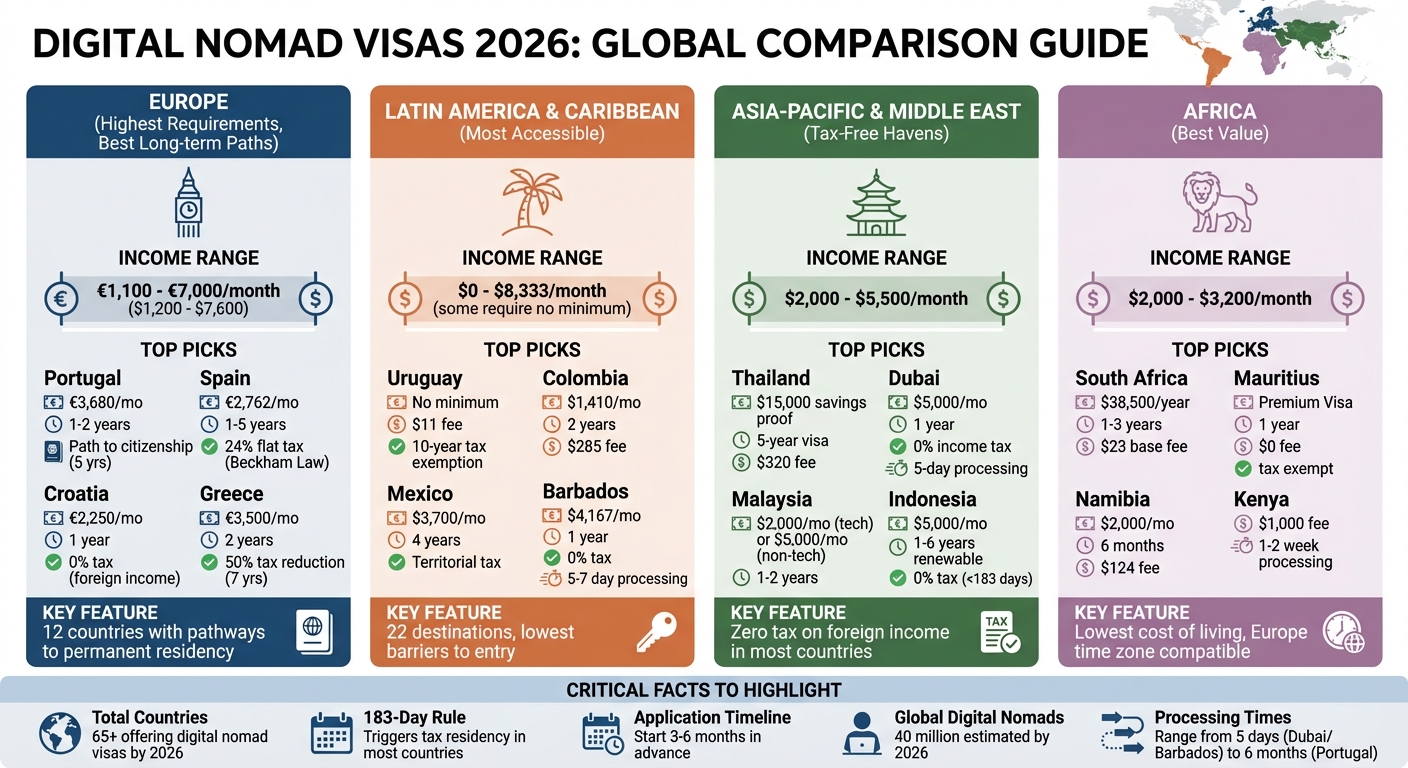
Digital nomad visas are reshaping global work opportunities, offering remote professionals legal residency in over 65 countries by 2026. These visas allow you to work online while residing abroad, with options ranging from short stays to pathways for permanent residency. Income requirements and tax benefits vary widely, making it essential to find a program that matches your financial and lifestyle goals.
Key Highlights:
- Europe: Portugal, Spain, and Greece offer pathways to residency, while countries like Croatia and Estonia provide tax incentives for foreign income.
- Latin America & Caribbean: Uruguay, Mexico, and Costa Rica feature low fees and favorable tax policies, while Barbados and Cayman Islands cater to higher earners.
- Asia-Pacific & Middle East: Thailand, Malaysia, and Dubai stand out with flexible long-term visas and 0% tax on foreign income.
- Africa: South Africa, Mauritius, and Namibia offer affordable options with scenic living environments.
Quick Tip: Start applications early (3–6 months ahead) and consult a tax professional to understand local obligations, especially if staying beyond 183 days.
This guide breaks down requirements, costs, and benefits for 49 countries, helping you choose the best destination for your remote work lifestyle.
1. Europe
Twelve European countries now offer digital nomad visas that allow stays far longer than typical tourist visas. With the EU’s Entry/Exit System (EES) using biometric tracking to monitor overstays, casual visa runs are no longer an option. As RemotifyEurope puts it, "The days of casually overstaying your 90 days are well and truly over". Below, you’ll find a breakdown of some key European destinations and their digital nomad visa details.
Portugal (D8 Visa)
Portugal’s D8 visa requires a monthly income of €3,680 ($4,000), which is four times the country’s 2026 minimum wage. This visa is valid for 1–2 years, renewable, and offers a pathway to citizenship after 5 years. Applicants must secure a Portuguese tax number (NIF), a local bank account, health insurance, and a clean criminal record. Processing can take up to 6 months, with fees ranging from €75 to €90, plus €170 for a residence permit.
Spain (Digital Nomad Visa)
Spain’s program requires a monthly income of €2,762 ($3,000) and provides an initial 1-year visa, renewable for up to 5 years. Through the Beckham Law, eligible workers can enjoy a 24% flat tax rate on income up to €600,000 for six years, with no tax on foreign income. The visa fee is €90, and administrative costs range between €300 and €700. Permanent residency is available after 5 years.
Estonia (Digital Nomad Visa)
Estonia, the first country to launch a digital nomad visa, has a monthly income requirement of €4,500 ($4,900). The visa is valid for 1 year but does not directly lead to permanent residency or renewal. Government fees are under €500, with visa costs between €90 and €120. This program is tailored for location-independent workers, whether employed or self-employed.
Germany (Freiberufler Visa)
Germany’s freelancer visa offers one of the lowest income thresholds in Europe, requiring €1,100 per month ($1,200). Applicants need to submit freelance contracts (preferably including German clients), a business plan, a work portfolio, and proof of German-compliant health insurance. It’s an attractive option for creative professionals and consultants seeking a European base.
Greece (Digital Nomad Visa)
Greece provides a 2-year visa, renewable for up to 5 years, with a monthly income requirement of €3,500 ($3,800). The visa fee is €75, plus €1,016 for the residence permit. A standout benefit is a 50% income tax reduction for 7 years for those who become tax residents. However, since February 2026, applications must be initiated at a consulate in the applicant’s home country.
Croatia (Digital Nomad Visa)
Croatia’s program requires a minimum monthly income of €2,250 ($2,450) and offers a 1-year visa, extendable up to 18 months. The country provides full tax exemptions on foreign-sourced income. Processing takes 7–20 days, but the visa isn’t consecutively renewable, requiring a 6-month gap before reapplying.
Romania (Digital Nomad Visa)
Romania boasts one of the fastest approval times in Europe, with decisions typically made within 10–14 working days. The visa lasts for 1 year and is renewable for up to 2 years, with permanent residency possible after 5 years. Like Croatia, Romania offers full tax exemptions on qualifying foreign income, making it a practical choice for remote workers.
Italy (Digital Nomad Visa)
Italy’s visa requires a monthly income of €2,500 ($2,700) and is valid for 1 year, renewable up to 3 years. Permanent residency is attainable after 5 years of legal stay. However, processing times can be lengthy, ranging from 3 to 6 months, which may deter those seeking quick relocation to the Mediterranean.
Malta (Nomad Residence Permit)
Malta’s program requires a monthly income between €2,700 and €3,500 ($2,900–$3,800), along with a €300 permit fee. The permit is valid for 1 year and renewable for up to 4 years, though it doesn’t offer a path to permanent residency. With widespread English use and a prime Mediterranean location, Malta is especially appealing for UK and US remote workers.
Iceland (Digital Nomad Visa)
Iceland has the highest income requirement in Europe, at €7,000 per month ($7,600). The visa is non-renewable and doesn’t allow family members to join, making it one of the more restrictive options. Still, Iceland attracts remote workers with its high quality of life and stunning natural beauty.
Cyprus (Digital Nomad Visa)
Cyprus offers a 1-year visa, renewable up to 3 years, though it doesn’t lead to permanent residency. The island’s warm climate, relatively low cost of living, and English-speaking communities make it a popular choice. Since tax residency is triggered after 183 days, consulting a tax professional is recommended.
Hungary (White Card)
Hungary’s "White Card" allows for a 1-year stay, renewable for another year. While some sources suggest permanent residency eligibility after 2 years, this pathway is less defined compared to Spain or Portugal. Hungary’s central location and lower living costs make it an attractive option.
Summary Table
| Country | Monthly Income | Initial Duration | Tax Benefits | Path to PR |
|---|---|---|---|---|
| Portugal | €3,680 ($4,000) | 1–2 years | Standard rates | 5 years |
| Spain | €2,762 ($3,000) | 1 year | 24% flat (Beckham Law) | 5 years |
| Estonia | €4,500 ($4,900) | 1 year | Standard rates | No |
| Croatia | €2,250 ($2,450) | 1 year | 0% on foreign income | No |
| Romania | Varies | 1 year | 0% on foreign income | 5 years |
| Greece | €3,500 ($3,800) | 2 years | 50% reduction (7 years) | 5 years |
| Iceland | €7,000 ($7,600) | 1 year | Standard rates | No |
Most European programs trigger tax residency after 183 days, so it’s crucial to understand applicable double taxation treaties. Processing times vary widely, from 10 days in Romania to 6 months in Portugal, so planning ahead is key. Additionally, family inclusion often increases income requirements – Portugal, for instance, requires an extra €5,220 annually per adult dependent, while Spain adds 75% of the minimum salary for the first dependent.
sbb-itb-39d39a6
2. Latin America and the Caribbean
Latin American and Caribbean countries have followed Europe’s lead in creating programs to attract remote workers. Today, the region boasts 22 destinations with digital nomad initiatives, offering options that are both accessible and tax-friendly. Some countries, like Uruguay, Argentina, and Paraguay, don’t require a minimum income, making it easier for remote workers to qualify by simply showing proof of employment. Uruguay, for instance, charges just $11 for its application and provides a 10-year tax exemption on foreign income. This variety in program requirements makes the region appealing to a wide range of remote professionals. This growth reflects the expanding options for digital nomad visas globally.
In countries like Colombia and Ecuador, monthly income requirements hover around $1,410 and $1,446, respectively. Both offer streamlined online application systems, but Colombia has tightened its criteria, prioritizing roles in IT and digital content over general consulting. Ecuador stands out with its pathway to permanent residency after two years on a digital nomad visa. Additionally, for those with a university degree, Ecuador’s Professional Visa lowers the monthly income requirement to just $482.
For higher earners, Mexico and Panama are popular choices. These countries require monthly incomes of $3,700 and $3,000, respectively, and both operate on territorial tax systems. Mexico allows stays of up to four years, while Panama offers an 18-month visa. Both Panama and Ecuador use the US dollar, which eliminates exchange rate worries for those earning in USD. Costa Rica, known for its established expat community, offers a two-year visa with a $3,000 monthly income requirement.
The Caribbean caters to high-net-worth professionals with premium offerings. For example, Barbados charges a $2,000 fee and requires a $4,167 monthly income, while the Cayman Islands set their threshold at $8,333 with a $1,469 application fee. These destinations are known for quick processing times – Barbados often completes applications in just five to seven business days. Many Caribbean programs also allow family applications, though additional fees of $500–$1,000 per dependent are common.
Processing times for these visas vary. Colombia processes applications in 10–15 business days, while Ecuador takes 30–60 days. Applicants should also plan for an extra two to six weeks to handle document apostilles and certified translations. However, staying in countries like Colombia or Brazil for more than 183 days can trigger local tax residency on worldwide income, so it’s wise to consult a tax professional about tax and residency solutions before committing.
Summary Table
| Country | Monthly Income | Initial Duration | Visa Fee | Tax Benefit |
|---|---|---|---|---|
| Uruguay | None | 12 months | $11 | 10-year tax holiday |
| Colombia | $1,410 | 2 years | $285 | Standard rates |
| Ecuador | $1,446 | 2 years | $450 | Standard rates |
| Mexico | $3,700 | 4 years | $56 | Standard rates |
| Panama | $3,000 | 18 months | $250 | 0% on foreign income |
| Costa Rica | $3,000 | 2 years | $100 | 0% on foreign income |
| Argentina | None | 12 months | $200 | Standard rates |
| Brazil | $1,500 | 2 years | $100 | Standard rates |
| Barbados | $4,167 | 12 months | $2,000 | 0% on foreign income |
| Cayman Islands | $8,333 | 2 years | $1,469 | 0% on foreign income |
| Chile | $1,500 | Varies | $300 | Standard rates |
| Paraguay | None | 12 months | $350 | Standard rates |
3. Asia-Pacific and Middle East
The Asia-Pacific and Middle East regions provide a variety of digital nomad visa programs, catering to different lifestyles and budgets. From affordable options in Southeast Asia to high-end alternatives in the Gulf States, these programs are designed with varying income requirements and visa durations to accommodate remote workers.
In the Asia-Pacific region, Thailand stands out with its Destination Thailand Visa (DTV). This five-year, multiple-entry visa requires proof of 500,000 THB (around $15,000) in savings, but there’s no specific monthly income requirement. It allows stays of up to 180 days per entry, extendable to 360 days, and costs $320. Over its five-year validity, the visa permits a cumulative stay of up to 1,800 days.
"The DTV is Thailand’s smartest immigration move in decades – a visa that finally acknowledges remote workers with stable foreign income are ideal long-term residents." – ThailandCorner
Malaysia offers the DE Rantau Nomad Pass, which requires an annual income of $24,000 for tech professionals or $60,000 for non-tech workers. It provides a visa lasting 12 to 24 months and costs about $215 annually, with additional fees for dependents.
Indonesia introduces the E33G visa, a renewable one-year permit that can extend up to six years. Applicants need to show an annual income of $60,000 and pay an application fee of approximately $315. Notably, stays under 183 days come with a 0% tax rate on foreign income.
In the Middle East, Dubai has drawn over 100,000 digital nomads with its Virtual Working Program. This one-year residency visa requires a monthly income of at least $5,000, costs $418 (including the Emirates ID), and provides access to local banking services along with a 0% personal income tax. Applications are typically processed within five business days. Abu Dhabi offers a similar program but with a lower monthly income threshold of $3,500.
For higher earners, Japan and South Korea have more stringent criteria. Japan’s six-month digital nomad visa, available to citizens of 49 countries, requires an annual income of $66,000. South Korea’s Workation Visa allows stays of up to two years but mandates an annual income between $64,000 and $66,000, along with medical insurance coverage of at least $76,000.
It’s worth noting that Thailand’s DTV must be obtained outside the country, and working for Thai companies is not permitted.
Here’s a quick comparison of the financial requirements, durations, fees, and benefits for these programs:
| Country | Financial Requirement | Initial Duration | Visa Fee | Key Benefit |
|---|---|---|---|---|
| Thailand | Proof of ~$15,000 in savings | 5 years | $320 | Long-term, flexible multiple-entry visa |
| Malaysia | ~$2,000/mo (Tech) / ~$5,000/mo (Non-tech) | 1–2 years | $215 | Strong infrastructure with English proficiency |
| Indonesia | ~$5,000/mo (~$60K/yr) | 1–6 years | $315 | Renewable visa with extended total stay |
| Dubai (UAE) | ~$5,000/mo | 1 year | $418 | 0% income tax, fast processing |
| Japan | ~$5,500/mo (~$66K/yr) | 6 months | $0–$30 | Immersion in high-tech cultural hubs |
| South Korea | ~$5,333–$5,500/mo (~$64–66K/yr) | 1–2 years | $90 [33,35] | Advanced connectivity and modern amenities |
| Sri Lanka | ~$2,000/mo | 1 year | $200–$500 | Rapid processing (around 7 days) |
4. Africa and Other Regions
Beyond Europe, Latin America, and Asia-Pacific, Africa and a few other regions expand the list of 49 digital nomad visa destinations for 2026. These regions stand out for their affordable living, vibrant cultures, and time zone advantages. With an estimated 40 million digital nomads globally by 2026, these destinations are becoming increasingly popular for their distinct appeal and cost-effective options.
South Africa introduced its Remote Work Visa in March 2025. To qualify, applicants need an annual income of $35,000–$38,500 (about ZAR 650,796). The visa is valid for an initial one-year stay and can be renewed for up to three years. The base application fee is $23 (ZAR 425), with additional VFS Global service fees ranging from $50 to $110. Applicants must provide medical forms (BI-811 and BI-806), police clearance, and private health insurance. Processing takes 4–8 weeks, and visa holders are prohibited from working for South African employers or local clients.
Mauritius offers a Premium Visa with no application fee. This visa allows stays of up to one year (renewable) and exempts foreign-sourced earnings from local income tax.
Namibia provides a six-month digital nomad visa for remote workers earning at least $2,000 per month. The visa costs about $124 and is non-renewable, requiring applicants to wait 12 months before reapplying.
Kenya charges a $1,000 fee for its digital nomad visa, which requires proof of remote work. Processing is completed in just one to two weeks, making it one of the fastest options in the region.
Cape Verde has a relaxed entry requirement, needing only a sustained bank balance of about $19,000 (around €1,500). Visa fees are approximately $60, and the country boasts sunny weather and beach access year-round.
Seychelles offers a Workcation Retreat Program that allows remote workers to stay for up to one year while enjoying proximity to world-class beaches.
Svalbard (Norway) is a visa-free zone where anyone can live and work indefinitely, provided they can demonstrate self-sufficiency. However, travelers may need a Schengen visa for transit through Norway.
In South Africa, staying more than 183 days in a 12-month period requires registration with the South African Revenue Service. However, foreign-sourced income may remain exempt under certain conditions. Africa’s time zone compatibility with Europe is another draw for remote workers collaborating with European companies. While infrastructure quality varies across the continent, major hubs like Cape Town offer reliable internet, with connectivity rated around 4.0/5. However, rural areas may experience inconsistent service.
| Country | Minimum Income | Initial Stay | Visa Fee | Processing Time | Key Advantage |
|---|---|---|---|---|---|
| South Africa | ~$38,500/year | 1–3 years | Base fee $23 + extra fees | 4–8 weeks | Tech hubs, low living costs |
| Mauritius | Not specified | 1 year | $0 | Varies | Free application, tax perks |
| Namibia | $2,000/month | 6 months | ~$124 | 2–3 weeks | Affordable living |
| Kenya | Not specified | 1–2 years | $1,000 | 1–2 weeks | Fast processing, wildlife |
| Cape Verde | ~$19,000 (bank balance) | 6–12 months | ~$60 | Varies | Low entry requirements |
| Seychelles | Varies | 1 year | Varies | Varies | Beaches, tax benefits |
Conclusion
The digital nomad visa options for 2026 bring exciting opportunities for remote workers looking to establish long-term legal stays abroad. With over 65 countries offering specialized remote work permits, there’s something for nearly every preference, whether it’s about lifestyle, location, or budget. Visa income thresholds vary significantly, catering to diverse economic situations.
Choosing from the best digital nomad visas goes beyond just understanding the terms – it’s about aligning with your personal and professional goals. For those prioritizing tax advantages, countries like Croatia, the UAE, and Indonesia offer 0% local tax on foreign-sourced income, while Greece provides a 50% income tax reduction for up to seven years. If long-term residency is on your radar, Spain and Portugal are great options, offering pathways to permanent residency after five years. On the other hand, Croatia and Malta’s nomad visas don’t count toward residency requirements. Family inclusion is now a standard feature in most programs, though additional income requirements – typically 20–50% per dependent – should be factored into your planning.
"The 2026 digital nomad world is more open and diverse than ever. Choosing the right visa isn’t just an administrative process but a decision about what kind of lifestyle you want." – Digital Nomad Editor Group
It’s wise to start your application process three to six months in advance, as gathering required documents like apostilles and background checks can take time. Additionally, don’t overlook the 183-day tax residency rule – staying beyond this limit in most countries may result in local tax obligations on your worldwide income unless exemptions apply. For U.S. citizens, the Foreign Earned Income Exclusion for 2026 is estimated to be $130,000, offering substantial federal tax relief while living abroad.
The growing global demand for remote talent has paved the way for incredible opportunities. Whether Europe’s tech hubs, Latin America’s affordability, Asia’s advanced digital landscape, or Africa’s rising markets appeal to you, 2026 provides the legal framework to embrace a globally mobile lifestyle. Matching your visa choice with your financial and lifestyle priorities will ensure a smoother transition. Make sure your decision aligns with your income, tax obligations, family needs, and residency goals.
FAQs
Will a digital nomad visa make me a tax resident?
A digital nomad visa doesn’t automatically make you a tax resident. Tax residency is determined by factors such as how long you stay in the country, where your income is earned, and the specific tax laws of that location. Just having the visa alone usually isn’t enough to qualify you as a tax resident in most places.
Can I bring my spouse or kids on a nomad visa?
Yes, many digital nomad visas let you bring your spouse and children along. However, the rules differ from country to country and might involve extra paperwork or fees. It’s important to review the specific guidelines for your destination to confirm that all family members qualify.
Do nomad visas lead to permanent residency or citizenship?
Most digital nomad visas don’t automatically grant a route to permanent residency or citizenship. That said, some countries do provide options for long-term residency or even citizenship after several years – usually between 5 and 8 years – of continuous living there. The requirements for these pathways differ depending on the country and often include conditions like maintaining legal residency status and meeting certain financial or legal criteria.
