
The European Union offers several residency programs tailored for entrepreneurs who want to establish businesses in the region. These programs not only grant residency but also provide tax benefits, access to the EU Single Market, and pathways to citizenship. Here’s a quick rundown of the top five options:
- Portugal D2 Visa: Ideal for small business owners, freelancers, and investors with a business plan. Requires proof of savings (~$12,060/year) and offers tax perks like reduced corporate tax rates.
- Estonia Startup Visa: Focused on tech-driven startups with global growth potential. No minimum investment required, but applicants must present a Minimum Viable Product (MVP).
- Spain Entrepreneur Visa: Designed for scalable, innovative businesses. Prioritizes projects in AI, fintech, and green energy. Requires ENISA approval and proof of ~$34,630 in funds.
- Ireland Start-Up Entrepreneur Programme (STEP): Targets high-potential startups with innovative ideas. Founders need €50,000 (~$54,500) in funding and a business plan demonstrating job creation.
- Italy Italia Startup Visa: For tech-focused ventures with €50,000 (~$54,500) investment. Offers tax incentives and access to funding support for innovative startups.
These programs differ in eligibility, financial requirements, and application processes. Entrepreneurs should choose based on their business model, funding capacity, and long-term goals.
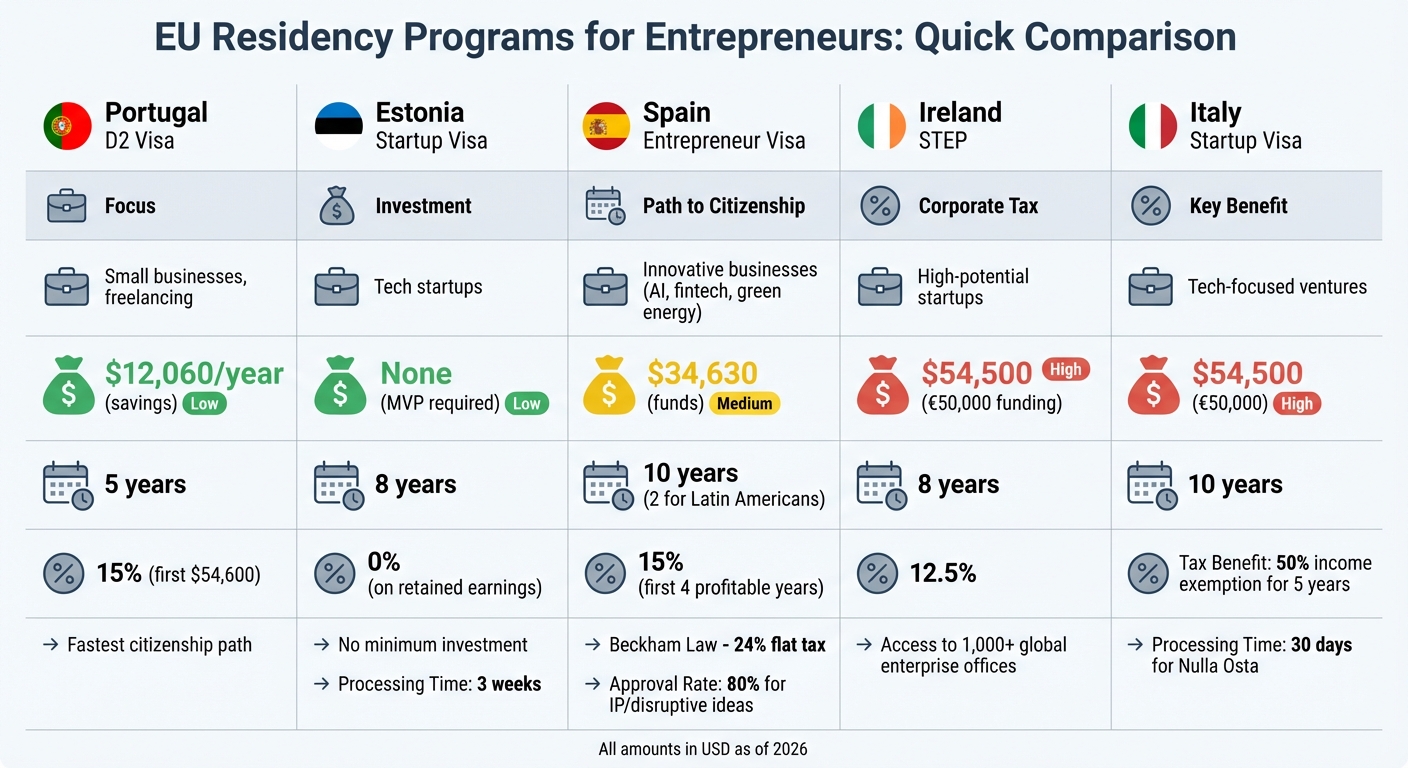
Quick Comparison:
| Program | Focus Area | Investment Required | Path to Citizenship | Key Benefits |
|---|---|---|---|---|
| Portugal D2 Visa | Small businesses, freelancing | ~$12,060 in savings/year | 5 years | Reduced corporate tax, access to EU market |
| Estonia Startup Visa | Tech startups | None (MVP required) | 8 years | 0% tax on retained earnings, digital services |
| Spain Entrepreneur Visa | Innovative businesses | ~$34,630 in funds | 10 years (2 for Latin Americans) | Beckham Law tax perks, fast ENISA approval |
| Ireland STEP | High-potential startups | €50,000 (~$54,500) funding | 8 years | Low corporate tax, strong business ecosystem |
| Italy Startup Visa | Tech-focused ventures | €50,000 (~$54,500) | 10 years | Tax incentives, streamlined application process |
Each program is designed to attract entrepreneurs while supporting business growth and offering residency benefits. Choose the one that aligns with your goals and resources.
1. Portugal D2 Visa
The Portugal D2 Visa is aimed at non-EU/EEA/Swiss entrepreneurs who want to start a business, invest in an existing Portuguese company, or work as independent professionals. It caters to three main groups: founders of new businesses establishing a limited liability company (LDA), investors acquiring shares in Portuguese companies while actively managing them, and freelancers with service contracts from Portuguese clients.
Eligibility Criteria
To qualify, applicants must present a detailed business plan outlining the anticipated economic, social, or cultural impact in Portugal. Financial requirements are tied to Portugal’s minimum wage, which is set at US $1,005 (~€920) per month as of January 1, 2026. Applicants need to show personal savings of US $12,060 (~€11,040) for one year, separate from their business funds. Additional savings are required for family members: US $6,030 (~€5,520) for a spouse and US $3,618 (~€3,312) per dependent child. While there’s no legal minimum for business capital, a suggested amount of around US $5,460 (~€5,000) demonstrates serious intent.
Before applying, entrepreneurs must obtain a Portuguese Tax Identification Number (NIF) and open a local bank account. Other requirements include a clean criminal record from any country where the applicant has lived for over a year, proof of long-term housing (such as a one-year lease), and private health insurance costing between US $327 and $1,092 (~€300–€1,000) annually.
Benefits for Entrepreneurs
The D2 Visa provides access to the EU Single Market and Portugal’s expanding startup scene, which now contributes over 1% of the country’s GDP. Entrepreneurs also enjoy tax advantages, such as a reduced corporate tax rate of 15% on the first US $54,600 (~€50,000) of taxable income, compared to the standard 19%. Additionally, the SIFIDE II program offers tax credits for research and development expenses, covering up to 82.5% of eligible costs.
Visa holders can travel freely across the 26 Schengen countries. After five years of legal residency, they can apply for permanent residency or Portuguese citizenship, gaining full EU mobility rights. A December 2025 ruling clarified that the five-year countdown for citizenship eligibility starts at the residency application date, not the approval date. Family members can join through the D6 Family Reunion Visa, granting them the same residency and work rights, as well as access to Portugal’s National Health Service and public education system.
Application Process
The D2 Visa process has two main stages. First, applicants submit documents – such as a business plan, proof of funds, a valid passport, an apostilled criminal record, and a one-year lease agreement – at a Portuguese consulate in their home country. This stage includes an interview to evaluate the applicant’s business experience and financial projections and results in a 120-day entry visa.
Once in Portugal, applicants attend an in-person appointment with the Agency for Integration, Migration and Asylum (AIMA) for biometric data collection and document verification. The initial residence permit is valid for two years and can be renewed for an additional three years. To maintain residency, permit holders must not be absent from Portugal for more than six consecutive months or eight non-consecutive months during the permit’s validity.
For those seeking professional help, fees for a complete D2 visa application range from US $1,742 to $3,069 (~€1,595–€2,810). Remote NIF services with fiscal representation cost approximately US $164 (~€150). Additionally, government fees include a visa application fee of about US $98 (~€90) and a residence permit issuance fee ranging from US $170 to $186 (~€156–€170).
This well-structured process highlights Portugal’s efforts to attract and support entrepreneurs.
2. Estonia Startup Visa
Estonia has carved out a niche for itself with a tech-focused visa program aimed at non-EU/EEA/Swiss entrepreneurs. The Estonia Startup Visa is tailored for those building technology-driven, scalable businesses. Unlike traditional business visas that often emphasize capital investment, this program prioritizes innovation. No minimum investment is required, making it accessible for startups in fields like SaaS, fintech, AI, or deep tech. The key requirement? Your business must have global growth potential, meaning it can generate significant revenue without needing a proportional increase in workforce.
Eligibility Criteria
To qualify, you’ll need more than just a business idea. Applicants must demonstrate a Minimum Viable Product (MVP) or prototype backed by early user feedback. Purely conceptual ideas or traditional small businesses, like cafes or freelance agencies, won’t make the cut. Applications are reviewed by the Estonian Startup Committee, which evaluates innovation, scalability, and the team’s expertise. Decisions are typically made within 10 business days.
Financially, the requirements are straightforward. You’ll need to show $874 (~€800) per month to cover living costs, totaling $10,488 (~€9,600) for a one-year stay. Health insurance with at least $32,760 (~€30,000) coverage valid across the Schengen area is also mandatory. Once approved, you must register your company address and residence in Estonia within 30 days to keep your permit active.
Benefits for Entrepreneurs
Estonia punches above its weight when it comes to startups. As of 2023, the country boasts over 1,530 startups employing more than 10,000 people and generating more than $1.09 billion (~€1 billion) in turnover. It also has the highest number of unicorns per capita globally. A major draw is its tax system: there’s 0% corporate tax on retained and reinvested profits. Taxes only apply when dividends are distributed, at a rate of 20%.
"Estonia is truly a force-multiplier for any startup that is on a mission to change the world… it allows you to focus on your product, and business idea with its unique ‘Startup Visa & Digital Nomad’ concept." – Emre Tinaztepe, Founder & CEO, Binalyze
Another standout feature is Estonia’s digital government. With 99% of government services available online, you can handle taxes, banking, and company filings from anywhere. The program also allows hiring non-EU employees without strict salary thresholds. After five years of legal residence, entrepreneurs can apply for permanent residency, with citizenship available after eight years.
Application Process
Estonia’s application process reflects its digital-first ethos. Start by completing an online assessment on the Startup Estonia website to confirm your business meets the innovation and scalability requirements. Then, submit your business plan, founder CVs, and MVP evidence to the Startup Committee to receive a "Startup Code." Once approved, apply for a long-term D-visa at an Estonian embassy. The visa costs $131 (~€120) and typically takes about 30 days to process.
After arriving in Estonia, you’ll need to apply for a Temporary Residence Permit (TRP) at the Police and Border Guard Board. This costs $415 (~€380) and processes within 90 days. The initial visa is valid for 12 months, with a possible six-month extension, while the TRP can last up to five years. Registering your company costs about $289 (~€265). Family members can join you as dependents, with full residency and work rights for the same duration.
3. Spain Entrepreneur Visa
Spain’s Entrepreneur Visa is designed for non-EU entrepreneurs aiming to launch innovative, scalable businesses that can contribute significantly to the country’s economy. Unlike standard business visas that focus on capital investment, this visa prioritizes groundbreaking ideas and the potential for job creation. Businesses that utilize cutting-edge technologies or introduce forward-thinking models – like AI platforms, fintech innovations, or green energy solutions – are ideal candidates. However, traditional ventures like cafes or general consulting firms won’t meet the criteria.
Eligibility Criteria
The cornerstone of your application is approval from ENISA (National Innovation Company), which evaluates your business plan based on its innovation, scalability, and ability to create jobs. You’ll need to provide either a relevant university degree or proof of at least three years of professional experience. While the official financial requirement is $7,858 (~€7,200) annually, consulates often expect proof of around $34,630 (~€31,752) in available funds. Additionally, applicants must present a clean criminal record for the past five years and have comprehensive health insurance coverage.
Applications that emphasize intellectual property and market disruption have an impressive 80% approval rate. Family members can also be included in the application, granting them the same residency rights .
These stringent criteria ensure that only businesses with high growth potential and innovative value are prioritized, aligning with Spain’s goals to strengthen its economic landscape.
Benefits for Entrepreneurs
Entrepreneurs under this program gain access to a range of financial and operational perks. Spain has committed $3.82 billion (~€3.5 billion) to tech innovation through its Digital Spain 2026 initiative, focusing on sectors like AI, fintech, and renewable energy. For certified startups, the corporate tax rate is reduced to 15% (from the standard 25%) for the first four profitable years. Additionally, the tax exemption for employee stock options has increased significantly, from $13,084 (~€12,000) to $54,517 (~€50,000) annually.
Another major advantage is the Beckham Law, which allows qualifying entrepreneurs to pay a flat 24% income tax on earnings up to $654,480 (~€600,000) for six years. Foreign-sourced income and assets, including wealth tax, are also exempt from Spanish taxation. These tax incentives not only support business growth but also offer financial security for international entrepreneurs.
The initial residence permit is valid for three years (if applied for within Spain) and can be renewed in two-year increments. After five years, you can apply for permanent residency, and citizenship is available after 10 years – or just two years for nationals from Latin American countries .
Application Process
To start, you’ll need to obtain a NIE (Foreigner Identity Number) from a Spanish consulate or police station. Next, prepare a detailed business plan and submit it through the ENISA online portal. Since mid-2023, well-prepared applications often receive approval within 10 to 15 days. Under Law 28/2022, if ENISA doesn’t respond within three months, certification is automatically granted .
For example, in March 2026, Sarah, a UK entrepreneur, secured approval for her B2B SaaS platform by including signed letters of intent from eight Spanish restaurants and a $163,650 (~€150,000) angel investment term sheet. ENISA approved her plan based on strong market validation and a clear path to profitability by Year 3. Similarly, Ahmed, a Turkish software engineer, received approval in just 12 days for his AI-powered logistics platform, supported by a provisional patent and plans to hire five Spanish developers within the first year.
Once ENISA approves your business plan, submit your residency application to the UGE-CE (Unit for Large Companies) if you’re already in Spain, or apply at a Spanish consulate if you’re abroad. After approval, you’ll have 30 days to provide biometrics and apply for your physical TIE (Foreigner Identity Card). Visa fees range from $87 (~€80) to $182 (~€167) for U.S. citizens, while private health insurance costs between $654 and $1,636 (~€600–€1,500) annually .
A successful application doesn’t just grant residency – it also opens doors to the broader EU market and creates a streamlined path to permanent residency, making this program especially attractive for forward-thinking entrepreneurs.
4. Ireland Start-Up Entrepreneur Programme (STEP)
Ireland has crafted a program tailored for ambitious entrepreneurs looking to establish innovative businesses. The Start-Up Entrepreneur Programme (STEP) is designed for founders of High Potential Start-Ups (HPSU) with groundbreaking, internationally scalable business ideas. The focus is on ventures that bring new or significantly improved products to global markets.
Eligibility Criteria
To qualify, the lead founder must secure €50,000 (approximately $54,500), while each co-founder needs €30,000 (about $32,700). Accepted funding sources include personal savings, business loans, angel investments, venture capital, or state grants. Applicants must hold a leadership role – such as CEO, CFO, CTO, or CIO – and dedicate themselves fully to the business. The company must be headquartered and controlled in Ireland. If relocating an existing business, it must be less than six years old.
The business plan should outline the potential to generate 10 jobs in Ireland and reach €1 million (approximately $1,090,000) in sales within three to four years. Additionally, applicants need to show proof of at least €10,000 (around $10,900) in personal funds to demonstrate financial independence. A clean criminal record, verified by a police clearance certificate, is also mandatory. As of late 2025, applications from Russian and Belarusian citizens will not be accepted.
Benefits for Entrepreneurs
Successful applicants receive an initial two-year permit, renewable for three more years based on the business’s progress. After five years, permits can be renewed in five-year increments, even if the original startup is no longer active. This renewal structure offers long-term stability for entrepreneurs.
Ireland’s business-friendly environment is highlighted by its 12.5% corporate tax rate on trading income and the absence of a net wealth tax. These factors help reduce costs and protect entrepreneurial assets. With over 1,000 global enterprise offices – such as Google, Meta, LinkedIn, and GSK – operating in Ireland, the country offers a thriving ecosystem for networking and partnerships. After eight years of residency and 1,460 days of physical presence, entrepreneurs are eligible for Irish citizenship, which grants visa-free or visa-on-arrival access to 192 countries. Family members, including spouses, partners, and children, can also be included in the residency application.
Application Process
To apply, submit the application form, business plan, and required documents – such as proof of funding and a police clearance certificate – to [email protected]. An application fee of €350 (around $382) must be paid via electronic fund transfer. Be sure to include only "STEP – [Your passport number]" in the reference field to avoid delays.
An independent evaluation committee reviews applications quarterly, focusing on the venture’s innovation, the team’s experience, and the business’s scalability. Once approved, the startup funds must be deposited in a financial institution regulated by the Central Bank of Ireland. Before the residence permit is issued, applicants must provide an affidavit of good character, prepared by an Irish solicitor. It’s wise to account for solicitor fees as part of the application costs. This streamlined process underscores Ireland’s dedication to supporting high-potential startups in the global marketplace.
sbb-itb-39d39a6
5. Italy Italia Startup Visa
Italy’s Italia Startup Visa welcomes non-EU entrepreneurs with tech-focused business ideas, regardless of their age or professional background. The program emphasizes technology-driven ventures and offers a streamlined digital application process. The Technical Committee typically issues the Nulla Osta clearance within 30 days. This program combines clear financial requirements with an efficient digital process to ensure a thorough eligibility review.
Eligibility Criteria
Applicants need to demonstrate access to €50,000 (around $54,500) in unencumbered funds for launching a new innovative startup, or €100,000 (approximately $109,000) if joining an existing one. The business must also meet specific conditions: it should be a limited company, incorporated for less than five years, with annual sales under €5 million (about $5.45 million), and have its headquarters or a branch in Italy.
The startup must fulfill at least one innovation requirement, such as:
- Allocating at least 15% of its turnover or costs to research and development (R&D).
- Employing a highly skilled team (one-third PhDs or researchers, or two-thirds holding master’s degrees).
- Owning an industrial patent or registered original software.
Additionally, applicants must show a minimum annual personal income of €8,500 (roughly $9,265) and secure suitable accommodation in Italy.
Immigration expert Simone Rummolino notes:
"the innovative startup status is not permanent… it is conditional on the company demonstrating measurable progress over time".
Benefits for Entrepreneurs
The Italia Startup Visa provides several advantages. Entrepreneurs can benefit from a 50% exemption on taxable income for five years under the Inbound Workers Tax Regime. Startup investors enjoy a 30% tax relief, and companies can access a free, fast-track public guarantee covering up to 80% of bank loans.
Italy also offers strategic access to a market of 500 million consumers across the EU and 270 million in North Africa and the Middle East. Innovative startups benefit from reduced bureaucracy, including exemptions from various filing fees, and flexible labor contracts with favorable tax treatment for stock options. These incentives, combined with the simplified application process, highlight Italy’s commitment to fostering innovative ventures.
Application Process
To apply, submit your business plan, CV, and proof of financial resources to the Italia Startup Visa Committee via email. Once you receive the Nulla Osta clearance – usually within 30 days – you can apply for a one-year Type D national visa at your local Italian Consulate. This step typically takes 2 to 6 weeks. After arriving in Italy, you must apply for a residence permit at the local police headquarters within eight days. The entire process, from the initial application to obtaining the residence permit, generally takes three to four months.
The total costs include approximately €116 (about $126) for the visa application, €156 (around $170) for residence permit fees, and optional legal assistance fees ranging from €2,000 to €5,000 (approximately $2,180 to $5,450).
Asset Protection and Business Growth Benefits
EU residency programs offer entrepreneurs a mix of tax advantages, legal stability, and access to broader markets, creating opportunities to grow profits while safeguarding long-term wealth.
Tax incentives are a major draw. Take Spain’s "Beckham Law", for instance – it caps income tax at 24% on the first $654,480 (~€600,000) and exempts foreign assets from wealth tax for entrepreneurs who haven’t been Spanish residents in the past five years. Portugal’s NHR 2.0 regime goes a step further, offering 10 years of preferential tax treatment on qualifying income. Hungary’s 9% corporate tax rate and Estonia’s 0% tax on retained earnings are other standout examples, allowing founders to reinvest profits directly into their businesses. These fiscal policies not only protect assets but also fuel reinvestment and growth. Business tax analyst Ciarán Kelly highlights Estonia’s unique approach:
"Estonia is the outlier on tax, not just speed. The combination of 0% CIT on retained earnings… means your money goes further and stays in the business longer".
Beyond tax advantages, these programs provide operational flexibility. Schengen mobility, for example, revolutionizes how entrepreneurs conduct business. EU residency permits allow visa-free travel across 29 Schengen countries, simplifying trips for client meetings, investor pitches, and regional expansion. This mobility also opens access to the EU Single Market, with its vast consumer base and enterprise opportunities.
Investing in productive capital is another way residency programs support entrepreneurs. European governments are increasingly prioritizing investments in regulated venture capital and private equity funds over passive real estate. France, for example, allocated $8.93 billion (~€8.2 billion) to venture capital in 2023, making it the EU’s largest startup ecosystem by investment. Entrepreneurs benefit not only from these funding opportunities but also from the security of well-regulated banking sectors in places like Malta.
Strategic residency decisions also play a key role in exit planning. Capital gains tax rates vary widely across the EU – 20% in Estonia compared to 33% in Ireland. As Kelly points out:
"Choosing a startup visa country is also an exit tax planning decision".
Residency programs also offer other financial advantages. Spain allows entrepreneurs to defer tax payments for their first two profitable years, while Italy provides an annual flat tax of $218,000 (~€200,000) on foreign-sourced income. These policies create a comprehensive framework for protecting and growing entrepreneurial wealth. Together, they underscore how EU residency programs are a powerful tool for safeguarding assets while driving business growth. Up next, we’ll take a closer look at the application requirements and processes for these programs.
Comparing Application Requirements and Processes
This section breaks down the application procedures, investment levels, and documentation requirements for some of the top EU residency programs designed for entrepreneurs.
Each program evaluates applicants differently, with varying degrees of complexity and timelines. Take Spain’s Entrepreneur Visa, for example. It doesn’t have a minimum investment requirement, but it does call for a detailed 25–40 page business plan certified by ENISA. A unique feature here is the "positive administrative silence" rule – if ENISA doesn’t respond within three months, your application is automatically approved. Processing times typically range from 2.5 to 6 months for an initial three-year permit. Interestingly, around 80% of applications focusing on intellectual property or market-disrupting ideas get approved.
Italy, on the other hand, offers a more digital and streamlined process. The Italy Startup Visa requires an investment of approximately $54,500 (around €50,000) to launch a new innovative startup or $109,000 (around €100,000) to join an existing one. Applications are processed through the digital "Nulla Osta" portal, with pre-approval often granted within 30 days. For those not launching a business, the Italy Digital Nomad Visa offers an alternative route. Overall, the process takes about 3 to 4 months for a two-year renewable permit.
Portugal’s fund route presents a different balance between investment size and processing time. This option requires an investment of roughly $545,000 (around €500,000) in venture capital or private equity funds. However, processing times are longer – typically 12 to 18 months – due to administrative backlogs at the AIMA agency. Portugal does offer a minimal physical presence requirement, needing only about seven days per year to maintain residency. After five years, applicants may qualify for citizenship.
When it comes to documentation, Spain has specific requirements. Applicants must provide apostilled and translated criminal records from every country they’ve lived in over the past five years. Health insurance policies must explicitly state "no deductibles or co-pays" to meet consulate standards. While the official financial proof requirement is around $7,850 (about €7,200), consulates often expect closer to $34,600 (about €31,752) for the main applicant.
For entrepreneurs aiming for citizenship, Portugal offers the fastest "low-stay" path, allowing eligibility after five years. In comparison, Spain typically requires 10 years, though this is reduced to two years for nationals from Latin American countries. However, Spain’s criteria for innovation are strict – traditional businesses like retail shops or consulting firms usually don’t qualify. To meet the bar, businesses must involve proprietary technology, R&D-heavy projects, or disruptive business models. Similarly, Italy requires investments in companies certified as "Innovative Startups".
These differences in application processes and requirements allow entrepreneurs to choose the program that best fits their business goals and long-term plans.
Conclusion
Choosing the right EU residency program is about more than just securing a visa – it’s about aligning with your long-term business goals and financial strategy. Each program caters to specific needs, so understanding their nuances is key. For example, Estonia stands out for bootstrapped founders looking for tax efficiency, with a quick and straightforward application process. Spain, on the other hand, is ideal for tech-driven companies, offering a three-year permit under its ENISA certification without requiring a minimum investment. Portugal provides an appealing route to citizenship in just five years with minimal physical presence, while Italy simplifies applications through its digital "Nulla Osta" portal.
Financial requirements also differ greatly between programs. Spain doesn’t require a minimum investment but typically asks for proof of around $31,752 in funds for the main applicant. Italy’s innovative startup option requires approximately $275,000, whereas Portugal’s fund investment route demands around $545,000. Processing times vary too – Estonia’s takes just three weeks, while Portugal’s can take 8–12 weeks. These factors can significantly influence your decision.
Tax planning is another crucial consideration. Proper planning not only safeguards your assets but also ensures your business thrives. As Ciarán Kelly, Business Tax & Structures Analyst, explains:
"Choosing a startup visa country is also an exit tax planning decision".
For instance, Estonia’s 20% capital gains tax is far lower than Ireland’s 33%, which could make a big difference if you’re planning a business exit within the next 5–10 years.
Your business model should also guide your choice. Spain’s innovation-focused visa is a great fit for companies in fields like Fintech, AI, Biotech, or Green Energy, with an 80% approval rate for such applications. However, more traditional businesses, like retail or consulting, might find Portugal’s broader D2 visa criteria more suitable.
Lastly, be prepared to budget between $3,000 and $5,000 for professional services if you need help with ENISA-compliant business plans or navigating legalities. Start gathering key documents early, such as apostilled criminal records from all countries of residence, comprehensive health insurance with no deductibles, and detailed financial projections. By carefully matching the program features to your business needs and financial goals, you can set the stage for growth and asset protection within the EU.
FAQs
Which program fits my business type best?
The right program for you will depend on your business type and objectives. For tech startups or forward-thinking ventures, Spain’s Startup Visa could be a great fit. It provides a 3-year residence permit, access to the Schengen area, and attractive tax advantages. On the other hand, if you’re prioritizing capital investment or aiming to grow a scalable business, Portugal’s D2 Visa or Startup Visa might align better with your goals. Be sure to weigh factors like your business model, investment potential, and long-term residency plans when making your decision.
What counts as “innovative” for Spain or Estonia?
In Spain, the term "innovative" often describes business ideas that showcase high levels of originality, advanced technology, or significant growth potential. This definition is frequently associated with initiatives like the Startup Visa program. On the other hand, in Estonia, the focus is on digital solutions and technology-driven entrepreneurship, a reflection of the country’s advanced digital infrastructure and its e-Residency program. Both countries prioritize forward-thinking concepts that fit seamlessly into their unique innovation landscapes.
How much time must I spend in-country to keep residency?
The time you need to spend in the country varies depending on the residency program. For instance, Spain’s Golden Visa demands very little physical presence since it’s primarily investment-focused. On the other hand, programs like the Spain Entrepreneur Visa or the Portugal Startup Visa typically require more residence or active participation, though the exact time commitment depends on the specific program.
