
Golden Visa programs allow individuals to secure residency by making financial investments, such as in real estate, funds, or businesses. These programs are popular for offering residency rights with minimal physical presence requirements, family inclusion options, and potential pathways to citizenship.
Key updates in 2026 include:
- Portugal: Shifted to fund-based investments starting at $540,000, with a 5-year citizenship pathway requiring only 7 days of annual presence.
- Greece: Introduced tiered pricing, starting at $270,000 for restoration projects and up to $865,000 in premium areas. Citizenship possible after 7 years of residency.
- UAE: Offers a 10-year renewable residency for a $545,000 real estate investment, with no income tax and no citizenship pathway.
- Spain: Ended its Golden Visa program in 2025.
- Malta: Provides both residency and a direct citizenship option, with investments starting at $162,000 for residency and $648,000 for citizenship.
- Cyprus: Requires a $324,000 real estate investment for permanent residency, with a longer citizenship timeline of 7–8 years.
Golden Visas remain an effective way to secure global mobility, protect assets, and access tax-friendly environments. However, recent trends show a move away from real estate investments toward regulated funds and active economic contributions. Each program varies in cost, benefits, and requirements, making it essential to align choices with personal goals and financial strategies.
European Golden Visa Programs by Country
Europe continues to lead the way in offering Golden Visa programs, providing access to the Schengen Zone, strong property rights, and pathways to EU citizenship as an American. However, 2026 has brought notable shifts across the continent. For instance, Spain officially ended its Golden Visa program in 2025, and no new applications are being accepted. Meanwhile, other countries have revamped their programs to align with EU policies favoring investments in "productive capital" rather than passive real estate. These programs not only secure residency but also provide opportunities for protecting assets and enhancing global mobility. Below, we break down the updated programs for 2026.
These programs cater to a variety of investor needs, offering options tailored to different budgets, family setups, and long-term goals.
Greece: Regional Pricing and a Path to Citizenship
Greece has introduced a tiered pricing system based on regional demand, giving investors more flexibility. The minimum investment starts at $270,000 (around €250,000) for projects like converting commercial spaces to residential use or restoring historic properties. In high-demand areas like Athens, Thessaloniki, Mykonos, and Santorini, the threshold climbs to $865,000 (around €800,000). Standard regions outside these premium zones require an investment of $432,000 (around €400,000).
Key features include a 5-year residency permit with no physical presence requirements, making it an appealing option for investors who prefer not to relocate. The program also covers up to three generations, extending benefits to spouses, children up to age 21, and both sets of parents. Citizenship is available after 7 years of actual residence.
However, properties acquired under the $270,000 pathway cannot be used for short-term rentals like Airbnb. This restriction aims to balance investment with the preservation of affordable housing.
Portugal: A Shift to Fund-Based Investments
Portugal has moved away from residential real estate as a qualifying investment, focusing instead on regulated investment funds, venture capital, and cultural donations. Minimum investments include $540,000 (around €500,000) for venture capital or private equity funds and $270,000 (around €250,000) for cultural heritage donations. In low-density areas, the threshold drops to $216,000 (around €200,000).
Portugal remains a top choice with its minimal physical presence requirement – only 7 days per year – and the fastest citizenship pathway in the EU, at just 5 years. A new update for 2026 allows the processing time (typically 12–18 months) to count toward the five-year citizenship period.
"Portugal remains the fastest ‘low-stay’ route to an EU passport. You only need to spend 7 days per year in the country to qualify for citizenship after five years." – Global Investment Reviews
The program also offers family-friendly terms, covering dependent children up to age 26 if they are enrolled in higher education. Residency permits are issued in 2-year increments and must be renewed to maintain status.
Cyprus: Real Estate Investments with Family Restrictions
Cyprus continues to offer a straightforward program requiring a $324,000 (around €300,000) minimum investment in new real estate or shares in a Cypriot company. Applicants must also demonstrate a minimum foreign income of $54,000 (around €50,000) annually. The program grants permanent residency immediately, with a requirement to visit Cyprus just once every two years to maintain it.
Processing times are among the fastest in Europe, typically taking 2 to 6 months. However, family inclusion is more restrictive. While spouses and financially dependent children up to age 25 can be included, the income threshold increases for each dependent – $16,200 (around €15,000) for a spouse and $10,800 (around €10,000) per child.
"In Cyprus, the British influence remains a massive advantage: we operate under common law, which provides a level of property security and transparency that is rare in the Mediterranean." – Nikolas Avgousti, Associate, Philippou Law
Citizenship in Cyprus requires 7 to 8 years of physical residence, making it a longer pathway compared to Greece or Portugal.
Spain: Program Closure and Alternatives
Spain has ceased accepting new applications for its Golden Visa program. Investors seeking similar benefits should explore alternatives in countries like Greece, Portugal, or Italy.
Malta: Dual Residency and Citizenship Options
Malta offers two distinct pathways: the Malta Permanent Residence Programme (MPRP) for long-term residency and a separate direct citizenship option for high-contribution investors. The MPRP requires a total non-refundable expense of $162,000 to $189,000 (around €150,000–€175,000), which includes government contributions, donations to NGOs, and a 5-year lease commitment.
Applicants must show a net worth of at least $540,000 (around €500,000), with $162,000 (around €150,000) in liquid financial assets. The program grants permanent residency with minimal physical presence requirements, offering long-term stability and flexibility.
For those seeking rapid citizenship, Malta’s direct pathway requires a government contribution of $648,000 (around €600,000) with 36 months of residency or $810,000 (around €750,000) with just 12 months of residency. This makes Malta one of the few EU countries offering citizenship within 1 to 3 years, though at a higher investment level than standard residency programs.
sbb-itb-39d39a6
Non-European Golden Visa Programs
While Europe has long been a leader in the Golden Visa market, other regions are stepping up, offering appealing options for investors looking for tax advantages, faster timelines, and fewer residency requirements. Among these, the UAE has emerged as a standout choice for 2026, offering an attractive alternative to European programs, which have recently moved away from traditional property-based investments.
Other programs, such as Singapore’s Global Investor Programme and the U.S. EB-5 program, require larger investments and involve longer processing times.
UAE: Real Estate Investments and Long-Term Residency
The UAE has positioned itself as a top-tier option for Golden Visa seekers, thanks to its flexibility and quick processing. The UAE’s Golden Visa grants a 10-year renewable residency with no mandatory stay requirements. To qualify, investors need to make a minimum investment of AED 2,000,000 (around $545,000) in real estate or other approved public investments. In February 2026, the UAE eliminated the previous rule requiring a 50% down payment, allowing eligibility based on the total property valuation, even if financed through approved UAE banks.
Processing times are relatively short, ranging from 3 to 6 weeks, with associated fees of about AED 10,400 ($2,800). Additionally, the introduction of the AI-powered platform Salama has simplified renewals for Dubai-based visa holders. The program also extends sponsorship privileges, enabling investors to include family members such as spouses, children of any age, and parents.
"0% income tax, 0% capital gains tax, and 0% inheritance tax – making the UAE the most tax-efficient of all major RBI destinations." – AlixirNova Editorial
Although the UAE Golden Visa does not provide a pathway to citizenship, it offers significant tax advantages and lifestyle flexibility. Dubai real estate investments tied to Golden Visas delivered gross rental yields of 5% to 9% in 2025, offering both residency benefits and income opportunities. For U.S. citizens, the Foreign Earned Income Exclusion (FEIE) provides an exclusion of up to $132,900 for the 2026 tax year, though rental income must still be reported as passive income.
Beyond real estate, investors can explore other qualification routes. For example, the entrepreneur pathway requires a project valued at AED 500,000 that is linked to an accredited incubator. Professionals earning between AED 30,000 and AED 50,000 monthly, as well as individuals with exceptional skills in science, medicine, or the arts, are also eligible. These options showcase how non-European programs can diversify residency strategies for global investors.
Comparing Golden Visa Programs
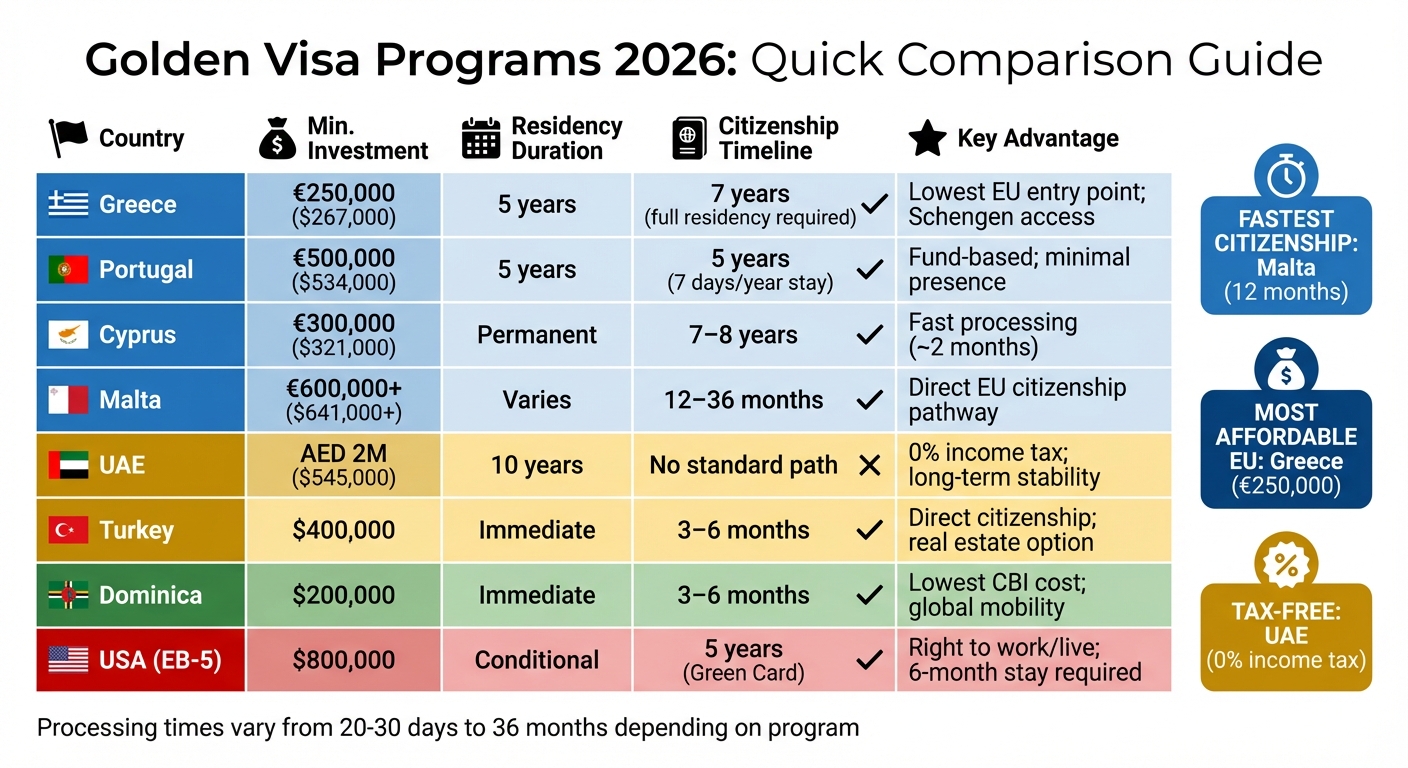
Choosing the right Golden Visa depends on your priorities – whether you’re focused on reducing costs, gaining citizenship quickly, or accessing a broader region. As of 2026, Spain’s program ended in January 2025, while Portugal eliminated its real estate option in October 2023. Spain has fully closed its program, and Portugal now focuses on fund-based investments.
Greece has introduced zone-based pricing for its program, with investments ranging from €250,000 ($267,000) in select heritage areas to €800,000 ($855,000) in high-demand zones. Most European programs provide a 5-year residency path to citizenship, while the UAE offers a renewable 10-year residency without a citizenship option. Portugal stands out for its quicker citizenship timeline – just 5 years with only 7 days of annual presence required. In contrast, Greece requires 7 years of residency for citizenship eligibility. The UAE offers the advantage of 0% income tax and requires just one visit every six months.
Portugal’s shift to fund-based investments now demands €500,000 ($534,000) instead of real estate, reflecting a broader European trend away from property-based options. Meanwhile, the UAE continues to offer a real estate pathway at AED 2,000,000 ($545,000). For those seeking faster citizenship, Caribbean programs like Dominica and St. Kitts & Nevis provide direct citizenship in as little as 3–6 months for investments between $200,000 and $250,000. These differences illustrate how Golden Visa programs are evolving across regions.
Comparison Table of Key Golden Visa Programs
Below is a summary of the main details for leading Golden Visa programs. Processing times can vary widely, ranging from 20–30 days to as long as 36 months.
| Country | Min. Investment | Residency Duration | Citizenship Timeline | Key Advantage |
|---|---|---|---|---|
| Greece | €250,000 ($267,000) | 5 years | 7 years (full residency required) | Lowest EU entry point; Schengen access |
| Portugal | €500,000 ($534,000) | 5 years | 5 years (7 days/year stay) | Fund-based; minimal presence |
| Cyprus | €300,000 ($321,000) | Permanent | 7–8 years | Fast processing (~2 months) |
| Malta | €600,000+ ($641,000+) | Varies | 12–36 months | Direct EU citizenship pathway |
| UAE | AED 2M ($545,000) | 10 years | No standard path | 0% income tax; long-term stability |
| Turkey | $400,000 | Immediate | 3–6 months | Direct citizenship; real estate option |
| Dominica | $200,000 | Immediate | 3–6 months | Lowest CBI cost; global mobility |
| USA (EB-5) | $800,000 | Conditional | 5 years (Green Card) | Right to work/live; 6-month stay required |
Greece continues to offer the most affordable European entry point at €250,000. On the other end of the spectrum, Singapore and New Zealand have some of the highest thresholds, requiring SGD 10 million ($7.4 million) and NZD 5 million ($3 million), respectively. For U.S. citizens, it’s important to note that worldwide income reporting obligations still apply, regardless of the Golden Visa obtained.
Regulatory Changes and Trends in 2026
Golden Visa programs across Europe have seen major shifts over the last two years, significantly altering how investors gain residency. Spain officially ended its investor visa program on April 3, 2025, under Organic Law 1/2025. Between 2013 and 2024, the program had attracted 14,576 investors, but rising rents – up 68% in Barcelona and 54% in Madrid from 2015 to 2024 – fueled political opposition, leading to its closure. While existing permit holders can still renew their residency, new applications are no longer accepted.
Portugal, meanwhile, eliminated its real estate and capital transfer options in October 2023 under the "Más Habitação" law. Despite this, the program experienced a 72% year-over-year surge in 2024, issuing 4,987 golden visas as investors pivoted to fund-based options. The country now requires investments of €500,000 ($534,000) in CMVM-regulated funds, with at least 60% of the capital allocated to Portuguese-headquartered companies. These changes have led to administrative restructuring, including the creation of the new Agency for Integration, Migration and Asylum (AIMA), which replaced the SEF authority. AIMA introduced digital renewals but is now facing a backlog of over 12 months.
"Pure real estate golden visas in Western Europe are dying." – WhereNext
Greece introduced a zone-based pricing model in September 2024, setting the investment threshold at €800,000 ($855,000) for high-demand areas like Athens, Mykonos, and Santorini, while maintaining lower thresholds of €400,000 ($428,000) for regional zones and €250,000 ($267,000) for heritage restoration projects. Hungary revived its Guest Investor Programme in July 2024, offering a €250,000 ($267,000) real estate fund option, making it the most affordable EU entry point.
The European Commission continues to push for stricter security and transparency measures, steering countries away from passive real estate investments and toward active economic contributions, such as venture capital, job creation, and scientific research. Beyond Europe, the UAE offers a stable 10-year Golden Visa with a real estate threshold of AED 2,000,000 ($545,000). This program includes zero income tax and requires only one visit every six months. Elsewhere, Argentina approved citizenship by investment in July 2025, and the Maldives plans to launch its Pearl Residency program in early 2026. These new options stand in stark contrast to Europe’s increasingly restrictive policies.
Changes in European Programs
The decline of passive real estate investments has reshaped strategies across Europe. Portugal now offers fund-based options, such as €500,000 ($534,000) investments in venture capital or private equity, or €250,000 ($267,000) for cultural and artistic projects. Greece’s €800,000 ($855,000) threshold applies to areas with populations above 3,100 residents, with properties needing to meet a minimum size of 120 square meters, encouraging regional development. Italy provides a €250,000 ($267,000) option for innovative startup investments, while Latvia offers the lowest barrier at €50,000 ($53,000) for business investments in companies with annual turnovers exceeding €50,000.
"Portugal’s Golden Visa… is no longer a property acquisition route; instead it has been repositioned as a targeted capital allocation tool." – Annelise Worn, The Traveler
Hungary’s revamped program positions it as a cost-effective alternative to Greece, offering an 8-year path to citizenship at half of Portugal’s requirement. However, the complexity of the Hungarian language can be a hurdle compared to English-speaking Malta. For U.S. citizens, worldwide income reporting obligations remain unchanged regardless of the chosen Golden Visa program. Given the tightening regulations, acting quickly on remaining real estate pathways could be essential. These programs continue to provide practical residency options for investors seeking asset protection and global mobility in 2026.
Conclusion
Golden Visa programs in 2026 present an effective way for high-net-worth individuals to protect their assets, secure global mobility, and ensure long-term wealth preservation. As Henley & Partners aptly put it, "Acquiring a golden visa is the best possible insurance policy against economic and political risk in a volatile world". Whether it’s visa-free access to the Schengen Area, a tax-friendly residency in the UAE with 0% income tax, or a clear 5-year route to Portuguese citizenship, these programs offer tailored solutions to meet various financial and lifestyle objectives.
The focus is shifting from traditional real estate investments to options like regulated funds, innovative startups, and philanthropic contributions. This reflects Europe’s push for active economic involvement over passive property ownership. For instance, Greece offers a tiered pricing model starting at €250,000 (about $267,000) for heritage restoration, Portugal requires a €500,000 fund investment, and Italy provides a €250,000 startup pathway. Beyond Europe, countries like Argentina and the Maldives are broadening the scope, offering new opportunities for geographic diversification. These developments highlight how Golden Visa strategies are becoming essential for safeguarding wealth while enhancing global mobility.
Time is of the essence – Spain’s program closure in April 2025 serves as a reminder that these opportunities won’t last forever. U.S. citizens, however, should remain mindful of worldwide income reporting requirements.
Choosing the right program necessitates a clear strategy. Start by identifying your primary goal: Are you seeking immediate global mobility through Citizenship by Investment, or are you focused on building a long-term residency with potential for naturalization? Consider factors like physical presence requirements, the liquidity of your investment, family inclusion options, and ensure you have all necessary documentation, including proof of wealth and a clean criminal record, to avoid delays during processing.
Finally, consult with legal and tax experts who specialize in migration law and cross-border taxation. The right Golden Visa program can provide your family with the security, flexibility, and freedom to navigate an increasingly interconnected world.
FAQs
Which Golden Visa is best for my goal (tax, Schengen, citizenship)?
The best Golden Visa option really depends on what matters most to you. Here’s a quick breakdown:
- Citizenship opportunities: Portugal stands out with a pathway to citizenship after just five years, requiring minimal residency – only 14 days every two years.
- Tax advantages: The UAE offers a 10-year visa with zero income, capital gains, or inheritance taxes – perfect for those seeking a tax-friendly environment.
- Schengen Zone access: Portugal is excellent for long-term flexibility and future citizenship, but if you’re looking for quick approval with no residency requirements, Greece might be your best bet.
Each option has unique benefits, so it’s all about aligning them with your goals.
What hidden costs come besides the minimum investment?
Additional costs beyond the initial investment can include government fees, legal and administrative expenses, due diligence charges, property maintenance, and ongoing compliance costs. The exact amounts will depend on the specific country and program requirements.
Can my family qualify, and what are the age limits?
Family members can usually be included in Golden Visa applications. Most programs allow applicants to add their spouse and children, though the age limit for children often varies – commonly set at 18 or 21, depending on the specific country’s rules. It’s important to check the guidelines for the country you’re considering to ensure your loved ones qualify.
