
Golden Visa programs in the European Union provide residency to non-EU citizens in exchange for investments. These programs offer benefits like visa-free Schengen travel, family inclusion, and potential citizenship after a set period. In 2026, Latvia, Greece, Hungary, Cyprus, and Malta emerged as top options for affordability and benefits. Here’s a quick summary:
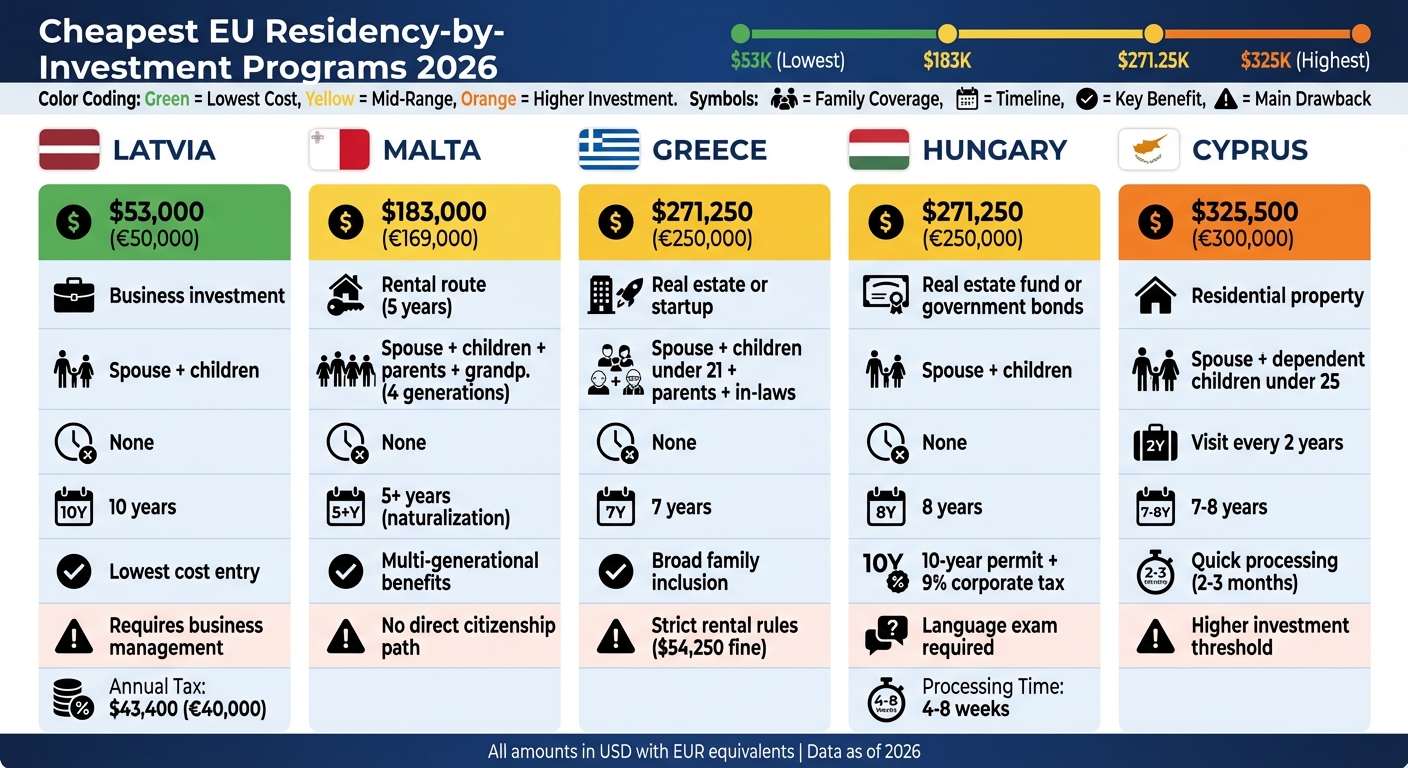
- Latvia: Lowest entry cost at $53,000 (€50,000) via business investment, but requires active management and annual taxes of $43,400 (€40,000).
- Greece: Starts at $271,250 (€250,000) for real estate or startup investments, with no residency requirement but strict compliance rules.
- Hungary: $271,250 (€250,000) for real estate funds or government bonds, offering a 10-year residency permit and low taxes.
- Cyprus: $325,500 (€300,000) for residential property investment, with permanent residency granted immediately.
- Malta: $183,000 (€169,000) via rental route, allowing benefits for up to four generations but no direct path to citizenship.
Quick Comparison
| Program | Min. Investment | Residency Requirement | Citizenship Timeline | Key Benefit | Main Drawback |
|---|---|---|---|---|---|
| Latvia | $53,000 | None | 10 years | Lowest cost entry | Requires business management |
| Greece | $271,250 | None | 7 years | Broad family inclusion | Strict rental rules |
| Hungary | $271,250 | None | 8 years | 10-year permit | Language exam for citizenship |
| Cyprus | $325,500 | Visit every 2 years | 7–8 years | Quick processing | Higher investment threshold |
| Malta | $183,000 | None | 5+ years (naturalization) | Multi-generational benefits | No direct citizenship path |
Latvia offers the cheapest entry, while Malta is ideal for families. Hungary stands out for its long permit duration and low taxes. Choose based on your priorities: cost, family benefits, or citizenship timeline.
1. Latvia Golden Visa Program
Investment Thresholds
Latvia offers four main investment options for its Golden Visa program, with the business route being particularly affordable. Starting at just $53,000 (€50,000), this option is available to companies with fewer than 50 employees and an annual turnover under €10 million. For larger businesses, the required investment doubles to €100,000.
Other investment pathways include:
- Real Estate: A minimum investment of €250,000.
- Government Bonds: A purchase of at least €250,000.
- Bank Deposit: A deposit of €280,000 held as subordinated capital for five years.
The business route is especially attractive to many applicants due to its low initial cost and flexibility.
Key Benefits
The Latvia Golden Visa program provides several advantages, starting with visa-free travel across 29 Schengen Area countries for up to 90 days within any 180-day period. Unlike many similar programs, Latvia does not require investors to maintain a physical presence in the country. A single annual visit to re-register and collect a new ID card is sufficient to keep the residency active.
Family members can also benefit. The program extends to the main investor’s spouse, children under 18, and financially dependent adult children or parents. Residency permit holders enjoy the right to live, work, and study in Latvia, as well as access to EU-standard healthcare and free public education. Since its inception in 2010, the program has attracted over 13,000 investors and their families, generating approximately €1.5 billion in revenue.
Path to Permanent Residency and Citizenship
Temporary residency under this program can lead to permanent residency after five years, provided the investor has lived in Latvia for at least four of those years and passed a Level A2 Latvian language exam. Citizenship becomes an option after 10 years of legal residence – five years on a temporary permit followed by five years as a permanent resident. However, citizenship requires B1-level language proficiency and renunciation of prior nationality.
Overall Costs Including Fees
The program’s costs depend on the chosen investment path:
- Business Route: €10,000 state fee.
- Real Estate: A 5% state fee based on the property price (minimum €12,500) plus a 2% stamp duty.
- Government Bonds: €38,000 state fee.
- Bank Deposit: €25,000 state fee.
Processing fees range from €160 for standard 30-day processing to €560 for expedited 5-day service. If the temporary permit is extended beyond five years rather than transitioning to permanent residency, an additional renewal fee of €5,000 applies. Business investors must also ensure their company pays at least €40,000 annually in taxes to maintain the residency permit.
sbb-itb-39d39a6
2. Greece Golden Visa Program
Investment Thresholds
Greece provides a range of real estate and investment options for its Golden Visa program. The lowest entry point is €250,000, specifically for two categories: commercial properties converted into residential use or the restoration of listed heritage properties. If the restoration isn’t completed, a €150,000 fine applies.
For most areas outside premium zones, the minimum investment is €400,000 for a single property with at least 1,292 square feet. In premium zones – like Athens (Attica), Thessaloniki, Mykonos, Santorini, and islands with populations over 3,100 – the threshold increases to €800,000 for properties meeting the same size requirement. Between January and October 2025, Greece issued 9,394 investor residence permits, marking an 80% jump compared to 5,209 permits during the same period the previous year.
Alternative investment options include €250,000 in startup shares (capped at 33% ownership), €350,000 in mutual or alternative investment funds, or €500,000 in Greek company equity, government bonds (minimum three-year maturity), or term deposits. Properties must be leased long-term, with violations leading to a €50,000 fine and potential permit revocation. These investment choices complement the program’s wide-ranging perks.
Key Benefits
One standout feature of Greece’s Golden Visa is that there’s no minimum physical stay required to maintain or renew the five-year residence permit. The program also has generous family coverage, extending to spouses or partners (including same-sex relationships), children under 21, as well as the investor’s and partner’s parents and grandparents.
While the permit doesn’t grant automatic employment rights, it allows for entrepreneurship and business creation in Greece. Children of permit holders can attend public schools free of charge, and residents gain access to the healthcare system (though private insurance is advised for those not locally employed). Real estate values increased by 7.3% over the past year, with long-term rental yields averaging 5%. These benefits make the program a strong pathway to long-term residency and eventual citizenship.
Path to Permanent Residency and Citizenship
The five-year permit can be renewed indefinitely as long as the investment remains active. Investors may apply for Greek citizenship after seven years of continuous legal residence, provided they secure tax residency, demonstrate ties to the country, and achieve B1-level proficiency in Greek. A Greek passport offers visa-free travel to over 180 countries.
Overall Costs Including Fees
Beyond the investment, additional costs include a 3.09% property transfer tax, a 0.6% land registry fee, and around 1.5% in notary fees plus VAT. Government immigration fees amount to €2,000 for the main applicant and €150 for each family member over 18, with an additional €16 per residence card issued. Greece also offers a flat tax incentive of €100,000 annually for 15 years to high-net-worth individuals who become tax residents. While these fees add to the overall cost, Greece remains one of the more affordable EU residency options, balancing competitive entry points with attractive benefits.
3. Hungary Golden Visa Program
Investment Thresholds
Hungary’s Guest Investor Program (GIP), introduced in mid-2024, offers one of the most affordable entry points among EU Golden Visa programs. The minimum investment required is €250,000 (around $271,250). Investors can choose between two main options: purchasing units in a real estate fund registered with the Hungarian National Bank or investing in Hungarian government bonds. Both require a five-year holding period.
For those interested in direct real estate ownership, a single residential property can be purchased for €500,000 (approximately $542,500). Alternatively, a non-refundable charitable donation of €1,000,000 (about $1,085,000) to a designated higher education institution also qualifies. However, the authorities currently lean toward the real estate fund option as the preferred route.
Key Benefits
Hungary sets itself apart by offering a 10-year initial residency permit – the longest duration among EU Golden Visa programs. This permit is renewable for another decade, with no minimum stay requirement to maintain it, though an annual visit is advised. The program also boasts a quick processing time, typically completing within 4 to 8 weeks, far faster than Portugal’s 12–18 months.
The program extends its benefits to family members, including spouses, dependent children (under 18 or up to 25 if unmarried and studying), and financially dependent parents. Residency permit holders gain visa-free access to all 27 Schengen countries for up to 90 days within any 180-day period. For entrepreneurs, Hungary’s tax structure is appealing, with a 9% corporate tax rate – the lowest in the EU – and a 15% flat personal income tax rate. For example, someone earning €100,000 would pay roughly €24,000 in taxes in Hungary, compared to over €35,000 in many other EU nations.
Path to Permanent Residency and Citizenship
Investors who reside in Hungary for at least 183 days annually can apply for permanent residency after three years. Citizenship is an option after eight years of continuous residency, but applicants must pass a constitutional knowledge test and demonstrate A2-level proficiency in Hungarian. This language requirement can be challenging, as Hungarian is classified as a Category IV language, requiring approximately 1,100 hours of study. Once obtained, a Hungarian passport allows visa-free travel to 38 countries, including the entire Schengen Zone.
Overall Costs Including Fees
Legal fees for the program typically range from $5,425 to $10,850 (€5,000 to €10,000), while upfront administrative costs fall between $8,680 and $16,275 (€8,000 to €15,000). These cover legal services, application processing, bank account setup, and travel-related expenses. For those opting for the government bond route, the effective cost over five years, including management fees and opportunity costs, is estimated at €25,000–€40,000 ($27,125–$43,400). Overall, additional costs beyond the base investment generally add about 5% to 8% to the total.
With no renewal fees for the first 10 years and a cost of living roughly 40% lower than the UK, Hungary’s program offers an appealing option for investors mindful of their budgets. It stands out as a strong contender for those looking for an affordable pathway to EU residency.
4. Cyprus Golden Visa Program
The Cyprus Golden Visa program stands out for its relatively fast processing times and competitive costs, offering a straightforward route to permanent residency.
Investment Thresholds
To qualify for permanent residency under Cyprus’s Regulation 6 program, applicants must make a minimum investment of €300,000 (approximately $325,500). There are four main investment options:
- Purchasing new residential property directly from a developer (up to two units).
- Buying commercial property (new or resale).
- Acquiring shares in a Cyprus-based company employing at least five people.
- Investing in approved funds.
It’s important to note that only first-sale properties purchased directly from developers are eligible under this program.
In addition to the investment, applicants must prove an annual income from abroad of at least €50,000 (around $54,250) for the main applicant. This requirement increases to €65,000 (approximately $70,525) if a spouse is included and €75,000 (about $81,375) with one dependent. Applicants are also required to submit tax returns and visit Cyprus at least once every two years to maintain their residency status.
Key Benefits
Cyprus offers permanent residency immediately after approval, with the application process typically taking just two to three months. Although Cyprus is not yet part of the Schengen Area, the government has plans to join by late 2026, which would provide visa-free travel across the region.
The program extends benefits to spouses and financially dependent children up to the age of 25, provided they are unmarried full-time students. Fees for the main applicant are approximately €500, with an additional €70 per dependent. There’s no requirement to live in Cyprus full-time, making it a flexible option for many investors.
For business owners, Cyprus offers attractive tax incentives, including a 12.5% corporate tax rate and a non-dom tax regime that exempts foreign income from gift, inheritance, and capital gains taxes. The program also provides a clear path to citizenship for those interested in deeper ties to the country. This is a popular route for those looking to get EU citizenship as an American.
Path to Permanent Residency and Citizenship
Permanent residency is granted immediately, though the residency card must be renewed every 10 years. For those pursuing citizenship, the requirements include seven years of legal residence within a 10-year period, with a continuous 12-month stay in the final year before applying (absences are limited to 90 days). Since December 2023, applicants must also pass a B1-level Greek language exam and demonstrate knowledge of Cyprus’s political and social context.
Overall Costs Including Fees
The total cost of obtaining residency in Cyprus exceeds the €300,000 base investment. For residential property purchases, a standard VAT rate of 19% applies, though a reduced rate of 5% may be available on the first €350,000 for primary residences priced up to €475,000. For example, a €300,000 property could end up costing around €360,000 (approximately $390,600) after VAT.
Additional expenses include:
- Legal fees: €1,000–€5,000.
- Annual family health insurance: €500–€1,000.
- Registration and residency card fees: About €140 ($152) per person.
It’s wise to budget roughly 20% above the property purchase price to account for VAT and other fees. Since its inception, over 7,372 applications have been processed, and with Cyprus experiencing a GDP growth of 3.4% in 2024, the program offers a stable and appealing path to EU residency.
5. Malta Permanent Residence Program
The Malta Permanent Residence Programme (MPRP) offers a fast-track to permanent residency, granting this status from day one. It’s particularly appealing for families due to its inclusive application process.
Investment Requirements
To qualify, applicants must demonstrate assets of at least €500,000 ($542,500), with €150,000 ($162,750) allocated to financial assets like stocks, bonds, or deposits. Alternatively, assets totaling €650,000 ($705,250) with €75,000 ($81,375) in financial assets also meet the criteria.
The program involves three mandatory financial commitments:
- An administrative fee of €60,000, split into €15,000 (due within one month of application) and €45,000 (due upon approval).
- A government contribution of €37,000.
- A philanthropic donation of €2,000 to a registered Maltese NGO.
Applicants must also meet property requirements, choosing between:
- Purchasing real estate valued at a minimum of €375,000 ($406,875).
- Renting a property with an annual lease of at least €14,000 ($15,190) for five years.
Benefits of the Program
One of the program’s standout features is its ability to include up to four generations in a single application. Eligible dependents include the main applicant, their spouse, unmarried and financially dependent children, as well as parents and grandparents. For adult dependents (e.g., parents, grandparents, or children over 18), there’s an additional fee of €7,500 per person.
"Malta combines the charm of a Mediterranean lifestyle with the practical benefits of safety, stability, and opportunity."
– Henley & Partners
There’s no residency requirement to maintain the status, but applicants must keep valid health insurance and fulfill the property commitment. Permanent residents enjoy visa-free travel to 29 Schengen Area countries for up to 90 days within a 180-day period. While work rights aren’t automatic, residents can apply for work permits through a simplified process.
Malta also offers a favorable business environment, including corporate tax refunds that can reduce effective tax rates to as low as 0%–10% for eligible businesses. Additionally, the country provides access to excellent educational institutions and healthcare services.
Residency and Citizenship Pathway
Permanent residency is granted immediately, with the entire process typically taking six to seven months. Preliminary due diligence ensures smooth processing, with some agents reporting approval rates above 99%. While the MPRP doesn’t directly lead to citizenship, residents may apply for Maltese citizenship through naturalization after five years of legal residence.
Total Costs and Additional Fees
The starting cost for the program is €169,000 ($183,000) when opting for the rental route over five years. This amount covers:
- €60,000 administrative fee
- €37,000 government contribution
- €2,000 philanthropic donation
- €70,000 in rent (€14,000 annually for five years).
Additional costs include legal fees (€5,000–€10,000), annual health insurance (€1,500–€3,000 for a family), and due diligence expenses. Adding adult dependents incurs an extra €7,500 per person.
"The MPRP’s benefit is that it is structured around defined financial and property thresholds, allowing a residence plan to be aligned with a tangible asset decision and a clear cost architecture."
– Chetcuti Cauchi Advocates
Important Note: Don’t finalize your property purchase or lease until you receive the "Letter of Approval in Principle." Once approved, you’ll have eight months to complete the property commitment.
Pros and Cons
Here’s a quick breakdown of the advantages and challenges for each program, based on the detailed analysis above.
Latvia stands out for its low entry cost of $54,250 (€50,000) through business investment. However, it comes with a hefty annual company tax of $43,400 (€40,000) and requires active business management, making it less appealing for those seeking a hands-off approach.
Greece offers a broad family inclusion policy, extending to parents and parents-in-law, but enforces strict rental rules. Violating these rules can result in fines of $54,250 (€50,000). While residency has no physical presence requirement, the citizenship pathway demands seven years of residency.
Hungary provides a passive investment option via real estate funds and offers the longest initial permit duration at 10 years. It also boasts a favorable 9% corporate tax rate, which is attractive to business owners. On the downside, the citizenship process takes eight years and includes a constitutional studies exam in Hungarian.
Cyprus features quick processing times – typically two to three months – and property security under common law. However, its higher investment threshold of $325,500 (€300,000) and the requirement for biannual visits might deter those looking for minimal physical presence.
Malta allows up to four generations to be included in a single application, covering spouses, children, parents, and grandparents. The rental route offers permanent residency from the start, with an investment of approximately $183,000 (€169,000) over five years. The downside? Malta’s program doesn’t provide a direct citizenship pathway, although naturalization is possible after five years of legal residence.
Conclusion
Latvia offers the most affordable entry point for residency at just $54,250 (€50,000) through its business investment pathway. This option requires active management and comes with an annual company tax of $43,400 (€40,000). In the first half of 2024, 74% of Latvian Golden Visa applications utilized this business route. For entrepreneurs looking for cost-effective options, this program stands out.
Malta provides an appealing choice for families seeking permanent residency without a hefty financial commitment. With a total cost of approximately $183,000 (€169,000) over five years via the rental route, it’s the only program that extends benefits to four generations – spouse, children, parents, and grandparents. This broad family coverage makes it a great fit for multi-generational households.
Hungary distinguishes itself with its fast processing times and tax advantages. Offering a 10-year initial permit, the process takes just 4–8 weeks and benefits from the EU’s lowest corporate tax rate of 9%. The $271,250 (€250,000) real estate fund investment provides a straightforward path to residency without the need to manage a business.
For those focused on citizenship, Portugal presents an efficient 5-year pathway requiring only 7 days of annual presence. Meanwhile, Greece balances family inclusion with a 7-year citizenship track. Cyprus, on the other hand, is known for its quick processing and strong property rights, offering another compelling option.
Choosing the right program depends on your priorities – whether it’s Latvia’s low entry cost, Malta’s family-friendly structure, Hungary’s speed and tax benefits, or Portugal’s fast-track citizenship. Each program caters to different investor needs, so it’s essential to align your decision with your long-term residency and citizenship objectives.
FAQs
Which program is cheapest after fees and taxes?
Hungary’s Guest Investor Program stands out as the most budget-friendly option, requiring a minimum investment of €250,000 in government bonds. This program grants EU residency along with access to the Schengen Area, offering an economical pathway for individuals aiming to secure EU residency.
Do these residencies let me work in the country?
Most residency-by-investment programs in the EU don’t automatically come with permission to work. While these programs often provide residency and visa benefits, securing the right to work usually involves applying for extra permits or visas. It’s important to carefully check the requirements of the specific program you’re interested in to understand how to obtain work authorization.
What can cancel or delay my residency permit?
Residency permits can be revoked or delayed if you don’t meet the program’s requirements. This might happen if you fail to maintain the necessary investment, break residency or legal rules, or submit false information during your application. Staying compliant with all conditions is essential to prevent complications.
