
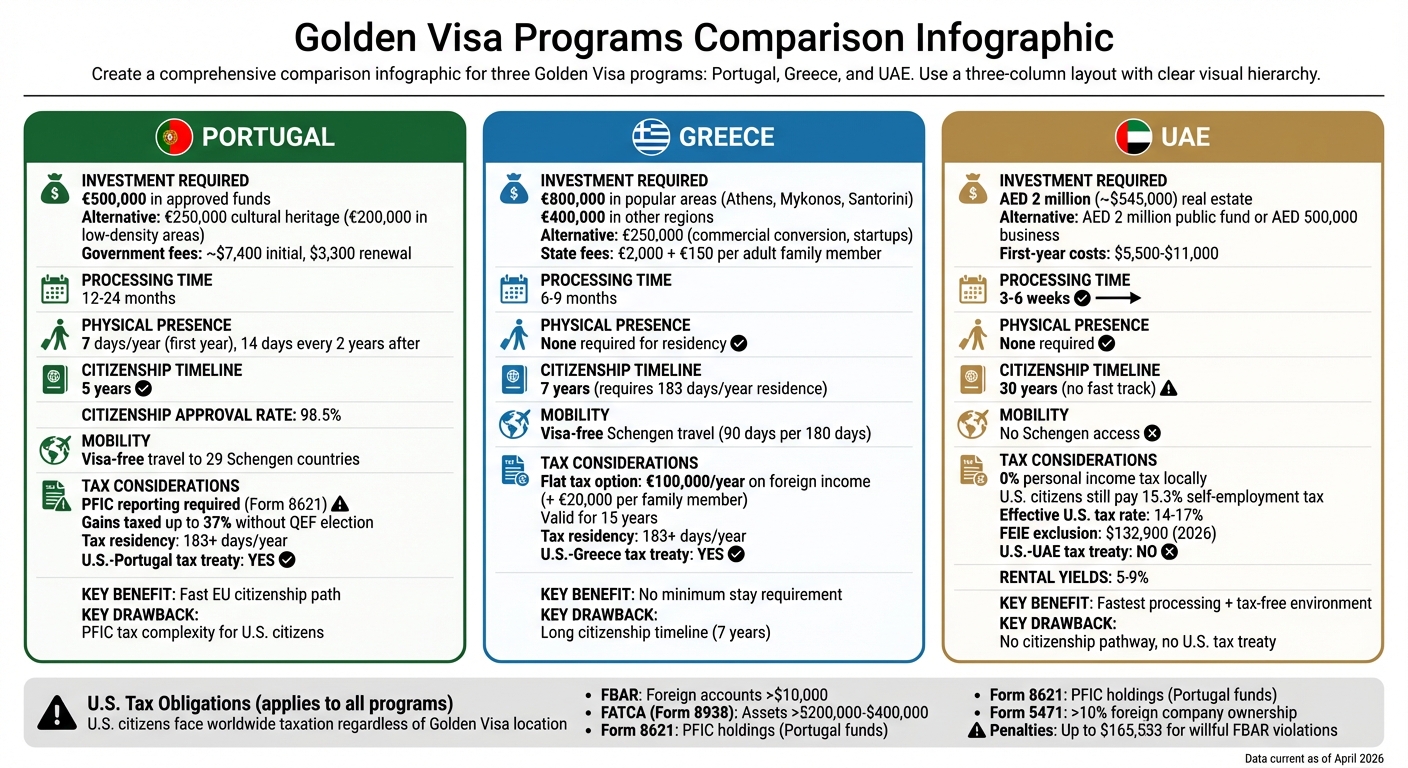
Golden Visas allow you to secure residency by making investments in countries like Portugal, Greece, or the UAE. Each program offers unique benefits, such as access to the EU, tax incentives, or fast processing times. However, U.S. citizens face global taxation, which complicates the financial benefits. Here’s a quick breakdown:
- Portugal: €500,000 minimum investment in funds. Residency requires 7 days/year. Citizenship possible after 5 years. Tax complexities include PFIC reporting for U.S. investors.
- Greece: €250,000–€800,000 investment options. No stay requirement, but 7 years of residency needed for citizenship. Offers a flat tax for high-net-worth individuals.
- UAE: $545,000 real estate investment. No minimum stay, 0% income tax locally, but U.S. taxes still apply. No citizenship pathway.
For Americans, tax obligations like PFIC filings, self-employment tax, and FBAR reporting add layers of complexity. Choosing the right program depends on your goals for mobility, family, and financial planning.
1. Portugal Golden Visa
Investment Requirements
As of October 2023, Portugal has closed its real estate pathway for the Golden Visa, steering investors toward other options. The main route now requires a €500,000 investment in CMVM-regulated venture capital, private equity, or mixed funds, with at least 60% of the capital allocated to Portuguese companies.
"Investment funds are now the primary route to Portuguese residency by investment… it is the route that the vast majority of new applicants are using in 2026."
For those looking for lower-cost alternatives, options include a €250,000 cultural heritage donation (reduced to €200,000 in low-density areas), a €500,000 investment in scientific research, or creating 10 permanent jobs. Initial government fees are approximately $7,400 per person, with biennial renewal fees of $3,300. Legal fees range from $6,500 to $16,300. Due to agency backlogs, processing times currently range between 12 and 24 months.
Mobility Benefits
Meeting the investment criteria opens the door to notable mobility perks. The program provides visa-free travel across 29 Schengen countries. It also requires minimal physical presence in Portugal – just seven days in the first year and 14 days every two years after that. This makes it a practical choice for Americans managing careers or businesses in the U.S..
After five years, investors can apply for Portuguese citizenship, granting them a passport that allows visa-free access to over 170 countries. The visa extends to family members, including spouses, dependent children up to age 26 (if still in school), and dependent parents over 65.
Tax Implications
Tax considerations are a crucial part of the Golden Visa process, especially for U.S. citizens. Many Portuguese Golden Visa funds are classified as Passive Foreign Investment Companies (PFICs) under IRS rules. Without careful planning, gains may be taxed at the highest ordinary income rates, along with interest charges for deferred taxes. Investors must file Form 8621 annually for each PFIC position.
To mitigate these tax burdens, a Qualified Electing Fund (QEF) election can allow for capital gains treatment, provided the fund issues annual PFIC statements. Before investing, ensure your chosen fund offers this documentation, as not all do. Additionally, Portuguese financial institutions report account details directly to the IRS under FATCA regulations.
It’s worth noting that you only become a Portuguese tax resident if you spend more than 183 days per year in the country. The Non-Habitual Resident tax regime ended in 2023 and has been replaced by the narrower IFICI program.
Residency and Citizenship Path
The Golden Visa program also supports long-term residency and citizenship goals, strengthening global asset protection strategies. Portugal’s citizenship approval rate stood at 98.5% as of 2022. The five-year timeline to citizenship remains unchanged as of April 2026, despite attempts to extend it to 10 years. These proposals were vetoed in late 2025 and are still under review.
To transition from residency to citizenship, applicants must pass a basic Portuguese language test at the A2 level. Since its inception in 2012, the program has welcomed over 17,700 main applicants and generated more than $7.9 billion in investments.
sbb-itb-39d39a6
2. Greece Golden Visa
Investment Requirements
Starting in 2026, Greece will implement a tiered real estate investment system. In popular areas like Athens, Thessaloniki, Mykonos, Santorini, and islands with populations exceeding 3,100, the required investment is €800,000 (approximately $870,000). For all other regions, the threshold is €400,000 (around $435,000). Regardless of the tier, the property must feature at least 120 square meters (about 1,290 square feet) of net interior living space, excluding balconies and parking spaces.
Alternatively, investors can explore a €250,000 option. This includes converting commercial properties, restoring historic buildings, or investing in startups registered with "Elevate Greece", provided the startup creates at least two jobs in its first year. Adalberto Pucca, Head of Global Mobility Solutions at Global Citizen Solutions, notes:
"The objective behind creating the start-up investment option is to diversify investment away from real estate and direct capital into business creation and local job growth in Greece."
State fees begin at €2,000 for the primary applicant, with an additional €150 per adult family member and €16 per person for card printing. Other costs include a 3.09% property transfer tax and legal and notary fees ranging from 0.8% to 1.2%. The application process typically takes 6 to 9 months. Properties purchased after September 2024 must be used either as a primary residence or for long-term leases (at least six months), ruling out short-term rentals like Airbnb. These investment paths offer flexibility, as outlined in the mobility benefits below.
Mobility Benefits
The Greece Golden Visa program does not require physical presence to maintain residency, making it ideal for those who wish to stay primarily in the United States. The visa allows for visa-free travel across the Schengen Area for up to 90 days within any 180-day period. These mobility perks provide a strategic way to access the EU without stringent residency requirements. Most administrative tasks can be managed remotely through a Power of Attorney, with only the biometric data collection requiring an in-person visit.
The program extends residency rights to three generations, including spouses, children under 21 (or up to 24 if they are students), and the parents of both spouses. After seven years of legal residency – provided applicants meet the 183-day annual stay requirement and pass language and culture exams – they can apply for Greek citizenship. Citizenship grants full EU rights to live, work, and study anywhere within the European Union.
Tax Implications
Greek tax residency applies only to individuals who spend more than 183 days annually in the country. For those who do, Greece offers the Article 5A flat tax regime. Under this system, high-net-worth individuals pay a flat annual fee of €100,000 on all foreign-sourced income, with an additional €20,000 for each family member. Golden Visa holders are exempt from the additional €500,000 investment requirement typically associated with this tax regime.
The flat tax is valid for up to 15 years and eliminates the need to declare foreign income on Greek tax returns. It also exempts participants from Greek inheritance and gift taxes on assets held abroad. Marc Cantavella, International Tax Lawyer and Manager at The Global Wealth, explains:
"The flat tax fully exhausts Greek tax liability on foreign income. Participants have no obligation to declare foreign income in their Greek tax return, and they are exempt from Greek inheritance and gift tax on foreign assets."
However, U.S. citizens remain subject to U.S. taxation on worldwide income. The Double Taxation Treaty between Greece and the United States helps reduce the risk of being taxed twice. Applications for the flat tax must be submitted by March 31, with payment due by the last working day of July. Missing these deadlines results in the application of progressive tax rates, which can go up to 44%.
Residency and Citizenship Path
The Greece Golden Visa program also offers a pathway to citizenship. In 2025, Greece approved 7,875 applications, marking a 95% increase from the previous year and contributing over €10 billion to the real estate market. Citizenship requires seven years of legal residency, which is longer compared to some other European programs but remains competitive.
It’s important to note that this residency permit does not grant employment rights in Greece. Additionally, investors should draft a specific Greek will, as the country enforces "forced heirship" rules on all property located within its borders, regardless of the owner’s nationality. Given the complexities of urban planning laws and potential property debts, hiring a Greek lawyer is strongly recommended before signing any agreements.
3. UAE Golden Visa
The UAE Golden Visa offers a streamlined and efficient residency option, emphasizing quick processing, diverse investment paths, and tax-friendly policies.
Investment Requirements
To qualify for the UAE Golden Visa, a minimum real estate investment of AED 2 million (around $545,000) is required. As of early 2024, the UAE removed the 50% down payment rule, allowing investors to use mortgage financing to meet the threshold. Other options include investing AED 2 million in a public investment fund or launching a business with a project value of at least AED 500,000 for entrepreneurs.
Real estate investors receive a 5-year visa, while public fund investors and individuals with outstanding talents are eligible for a 10-year visa. The application process is notably quick, taking just 3 to 6 weeks, compared to Greece’s 3 to 6 months or Portugal’s 12 to 18 months. First-year costs range from AED 20,000 to AED 40,000 ($5,500 to $11,000), covering visa fees, health insurance, medical exams, and Emirates ID issuance. In February 2026, the UAE introduced the "Blue Visa", a 10-year residency option for those making exceptional environmental contributions, which requires no financial investment. These options provide flexibility and cater to a range of investor profiles.
Mobility Benefits
One of the standout features of the UAE Golden Visa is the absence of a minimum stay requirement. Holders can visit as often – or as little – as they like without risking their residency status. The visa also allows for self-sponsorship, removing the need for a local employer. Family members, including spouses, unmarried sons up to age 25, and daughters of any age, can be included in the application. Additionally, Golden Visa holders gain access to the Esaad Privilege Card, offering discounts of up to 70% on shopping, healthcare, and accommodations both within the UAE and internationally.
Tax Implications
The UAE boasts a tax-free environment for residents, with 0% personal income, capital gains, and inheritance taxes. However, U.S. citizens remain subject to U.S. taxation on worldwide income. Without a U.S.-UAE tax treaty, Americans cannot claim foreign tax credits to offset U.S. tax liabilities. For 2026, the Foreign Earned Income Exclusion (FEIE) allows up to $132,900 of earned income to be excluded, but this does not cover self-employment tax.
"The UAE has zero personal income tax, but Americans still owe 15.3% US self-employment tax, income tax on earnings above the $132,900 FEIE limit, and must file FBAR/FATCA reports." – Relocate Handbook Research Desk
Freelancers and self-employed individuals must pay a 15.3% U.S. self-employment tax, split as 12.4% for Social Security (up to $184,500) and 2.9% for Medicare (with no cap). Rental income, dividends, and capital gains are fully taxable in the U.S., as they are not covered under the FEIE. For a typical U.S. remote worker in Dubai, the effective tax rate is approximately 14% to 17%. Additionally, a 9% corporate tax applies to business profits exceeding AED 375,000, though small businesses with revenues under AED 3 million are exempt until December 31, 2026. These tax policies make the UAE an appealing option for professionals seeking a tax-friendly residency.
Residency and Citizenship Path
While the UAE Golden Visa provides excellent residency benefits, it does not offer a fast track to citizenship. Naturalization requires 30 years of continuous residency, which is significantly longer than Greece’s 7-year or Portugal’s 5-year timelines. The visa does not automatically grant employment rights unless the holder establishes a business or secures a separate work permit. Non-Muslim residents are advised to register wills through the Dubai International Financial Centre (DIFC) or Abu Dhabi Global Market (ADGM) to avoid default Sharia-based asset distribution rules. Additionally, investors must retain their qualifying property for at least 2 years after the visa is issued.
Despite the lack of a direct citizenship pathway, the UAE Golden Visa stands out for its quick processing times, flexible residency options, and tax advantages, making it a strong choice for those prioritizing mobility and financial benefits over long-term naturalization.
Pros and Cons of Each Program
Understanding the pros and cons of different Golden Visa programs is crucial when deciding which aligns best with your wealth protection and investment goals. Each option comes with its own set of trade-offs.
Portugal offers a relatively quick path to EU citizenship, but recent changes have shifted the landscape. As of October 2023, the country no longer allows real estate investments as a qualifying route. Instead, investors must commit at least €500,000 to approved funds, with processing times often stretching beyond 12 months. Greece, on the other hand, has a lower entry point of €250,000 for certain properties. However, in prime locations like Athens and Santorini, the required investment rises to €800,000, and new regulations now favor long-term leases by restricting short-term rentals, such as Airbnb. Meanwhile, the UAE stands out for its zero personal income tax policy and exceptionally fast processing times – usually between 3 and 6 weeks. However, it does not offer a pathway to citizenship or visa-free access to the Schengen Area.
The mobility and tax benefits also differ significantly across these programs. Portugal and Greece both provide visa-free travel to 29 Schengen countries, while the UAE focuses on tax incentives without offering similar mobility perks. Portugal requires investors to spend at least 7 days per year in the country, whereas Greece imposes no minimum stay requirement. In the UAE, physical presence requirements are flexible but can vary depending on specific circumstances. However, gaining Greek citizenship requires 7 years of actual physical residence along with language proficiency.
Investment returns and liquidity further set these programs apart. Dubai real estate typically offers gross rental yields of 5–9% as of 2025. Greek properties can yield up to 10%, making them attractive for investors seeking rental income. Portugal’s fund units, while offering yields ranging from 2% to 20%, tend to be less liquid. For Americans, the UAE’s tax advantages are somewhat diminished by the lack of a U.S.-UAE tax treaty. This results in a 15.3% self-employment tax, leading to an effective tax rate of around 14–17%.
Each program also carries specific risks. Portugal faces regulatory uncertainty and processing delays, especially after eliminating its real estate investment route. In Greece, tiered pricing and restrictions on short-term rentals may limit flexibility for those looking to generate rental income. The UAE’s Small Business Relief program, which exempts businesses earning under AED 3 million from a 9% corporate tax, is set to expire on December 31, 2026. This could impact financial planning for entrepreneurs. Additionally, British expats in the UAE may see their state pensions lose 30–40% of value over a decade due to the lack of a reciprocal social security agreement.
Tax Implications for US Citizens
Even when living abroad, US citizens face worldwide taxation. This means all global income – whether earned, passive, or investment-based – must be reported to the IRS, regardless of the country issuing your Golden Visa. Holding a US passport ensures that tax obligations follow you everywhere, even in countries with zero-tax policies.
For example, the Foreign Earned Income Exclusion (FEIE) allows US citizens to exclude up to $132,900 of earned income in 2026. However, this exclusion doesn’t apply to investment returns, rental income, pensions, or self-employment tax. In places like the UAE, where there’s no US tax treaty or totalization agreement, freelancers must pay the full 15.3% self-employment tax, leading to an effective tax rate of 14–17%. As the Relocate Handbook Research Desk puts it:
"Zero tax in Dubai. You have heard the pitch… but if you hold a US passport, that single fact tells you almost nothing about what you will actually pay".
Investment Structures and Reporting Complexities
Golden Visa investments, especially in countries like Portugal, bring additional tax complications. Many Portuguese funds qualify as Passive Foreign Investment Companies (PFICs), requiring annual filing of Form 8621. Without making a Qualified Electing Fund (QEF) election in the first year, gains could be taxed at ordinary income rates of up to 37%, plus interest charges. André Bandeira from Explorer Investments emphasizes:
"For US families, a Golden Visa fund is not a tax shelter. It’s a regulated, cross-border allocation that has to sit comfortably within PFIC, FATCA and CRS rules from day zero".
On top of this, Portugal requires non-resident investors to provide a US tax residency certificate annually to their Portuguese bank. Without it, a 28% withholding tax on fund distributions applies.
Key Reporting Obligations
US citizens with foreign financial assets face numerous reporting requirements. For instance:
- FBAR (FinCEN Form 114): Mandatory if foreign account balances exceed $10,000 at any point during the year. Non-compliance can result in penalties up to $16,536 for non-willful violations and as high as $165,353 or 50% of the account balance for willful violations.
- FATCA (Form 8938): Expats must file this if their foreign financial assets exceed $200,000 at year-end or $300,000 at any point during the year.
- Form 5471: Required for those owning at least 10% of a foreign company, such as a UAE free zone company. This introduces compliance challenges related to controlled foreign corporations and potential GILTI tax liabilities.
Here’s a quick breakdown of key reporting thresholds and impacts:
| Requirement | Form | Trigger/Threshold | Key Impact |
|---|---|---|---|
| FBAR | FinCEN 114 | Foreign accounts >$10,000 | High penalties for non-compliance |
| FATCA | Form 8938 | Assets >$200,000–$400,000 | Mandatory disclosure of foreign holdings |
| PFIC | Form 8621 | Holding in non-US mutual/PE funds | Complex filing; potential tax rates up to 37% |
| Foreign Corp | Form 5471 | >10% ownership in foreign company | Additional IRS reporting; may trigger GILTI tax |
| Foreign Trust | Form 3520 | Large gifts or trust distributions | Required for inheritance or trust events |
Tax Treaties and Social Security
Portugal offers some relief through a bilateral tax treaty and totalization agreement with the US, allowing for Foreign Tax Credits and exemption from duplicate social security contributions. Greece also has a tax treaty, though its terms vary depending on the income type. Meanwhile, the UAE lacks both, which can significantly increase the tax burden for self-employed Americans.
Before setting up a foreign entity, consult a tax professional to navigate requirements like Form 5471 and the risks tied to GILTI tax. These hidden complexities can pose major challenges, especially in jurisdictions with zero-tax policies.
When combined with the residency and mobility considerations discussed earlier, these tax obligations highlight the intricate planning required to align Golden Visa investments with wealth protection goals.
Conclusion
Golden Visa programs present a mix of opportunities and challenges, especially when it comes to managing wealth, protecting assets, and enhancing global mobility. Among them, Portugal stands out for US citizens aiming for EU citizenship. With a minimal physical presence requirement of just seven days annually, applicants can qualify for citizenship after five years. However, the shift toward regulated investment funds means that the €500,000 investment is structured but also triggers PFIC reporting for US tax purposes.
For those who are entrepreneurs or high-earning remote workers, the UAE offers compelling advantages. Its tax-friendly environment allows US freelancers to benefit from the Foreign Earned Income Exclusion, resulting in an effective tax rate of around 14–17%, largely due to self-employment taxes. As highlighted by the Relocate Handbook Research Desk:
"The UAE still wins for most self-employed Americans. But for retirees and investors? Europe sometimes comes out ahead."
However, the UAE loses some appeal for retirees. Since pension income doesn’t qualify for the Foreign Earned Income Exclusion, it remains fully taxable in the US, with no offsetting foreign tax credits available.
Meanwhile, Greece offers a relatively accessible entry point with its €250,000 investment threshold, though recent increases now cater more to premium investors. This program provides EU mobility without the tax compliance hurdles of Portugal’s fund-based investments. However, for those seeking citizenship, full-time residence is required, adding another layer of commitment.
Ultimately, navigating these programs requires careful financial planning. Work with a cross-border CPA to assess the ongoing costs, including PFIC filings, FBAR obligations, and overall tax implications. While a Golden Visa can provide residency and greater mobility, it doesn’t erase US tax obligations. Thoughtful cross-border tax strategies are essential to truly benefit from these programs.
FAQs
Which Golden Visa is best for my goal (EU passport, travel, or low taxes)?
The best Golden Visa option depends on what matters most to you: EU citizenship, ease of travel, or tax advantages. Portugal’s Golden Visa stands out as a popular choice for those seeking EU citizenship. It provides a route to residency and citizenship after just five years. Plus, it offers visa-free access to the Schengen Area and attractive tax incentives for investors. That said, U.S. citizens should take a close look at their global tax responsibilities before making a decision.
What extra IRS filings will I face with a Golden Visa (PFIC, FBAR, FATCA, 5471)?
Obtaining a Golden Visa often comes with extra IRS filing requirements. These may include:
- FBAR (Foreign Bank Account Report): Necessary if you hold foreign bank accounts exceeding certain thresholds.
- FATCA (Foreign Account Tax Compliance Act): Involves reporting specific foreign financial assets.
- PFIC (Passive Foreign Investment Company) Disclosures: Required if you invest in certain foreign funds.
- Form 5471: Applies if you have ownership or control in certain foreign corporations.
These obligations depend on your specific investments and accounts, so it’s crucial to understand the rules to stay compliant.
How do I avoid becoming a tax resident while keeping my Golden Visa?
To manage your tax residency while holding a Golden Visa, it’s crucial to distinguish between legal residency and tax residency. Holding a Golden Visa grants you legal residency, but it doesn’t automatically classify you as a tax resident.
To avoid becoming a tax resident, ensure you spend fewer than 183 days in the country each year. Additionally, you might want to establish tax residency in another country with more favorable tax policies. Working with a tax professional can help you navigate the rules and create a plan that aligns with your personal circumstances.
