
Latin America offers several second residency programs, each catering to different needs like asset protection, tax benefits, and global mobility. Panama, Paraguay, Uruguay, Mexico, and Costa Rica stand out due to their flexible residency requirements and tax-friendly systems. Here’s a quick summary:
- Panama: Known for its territorial tax system and multiple visa options, such as the Pensionado Visa (retirees) and Qualified Investor Visa (high-net-worth individuals). Real estate investment starts at $300,000, increasing to $500,000 after October 2026.
- Paraguay: Offers one of the most affordable residency routes with a refundable $4,500 deposit. Permanent residency requires minimal physical presence, and citizenship is possible after three years of staying 183 days annually.
- Uruguay: A safe and stable choice with an 11-year foreign income tax holiday. Residency requires proof of income or a $180,000 real estate investment. Citizenship is available after 3–5 years of residency.
- Mexico: Proximity to the U.S. and quick processing times make it attractive, but it taxes worldwide income. Residency options include income proof (~$4,400/month) or property ownership (~$598,000).
- Costa Rica: Territorial tax system with options like Pensionado (lifetime $1,000/month pension) or Inversionista (investment of $150,000). Citizenship is available after seven years.
Key Takeaway: Choose based on your goals – Panama and Paraguay excel in tax advantages, Uruguay in safety, Mexico in proximity, and Costa Rica in simplicity.
Quick Comparison
| Feature | Panama | Paraguay | Uruguay | Mexico | Costa Rica |
|---|---|---|---|---|---|
| Residency Cost | $2,400–$17,000+ | ~$2,000 | Moderate | Moderate | Varies |
| Tax System | Territorial | Territorial | 11-year holiday | Worldwide | Territorial |
| Time to Citizenship | 5+ years (difficult) | 6 years | 3–5 years | 5 years | 7 years |
| Physical Presence | 1 day/2 years | 1 day/3 years | Medium/High | None | 1 day/year |
Each country offers unique benefits, so weigh costs, tax rules, and residency timelines carefully. Let’s dive into the details.
1. Panama Residency Programs
Panama provides a variety of residency options designed to meet the needs of different applicants.
The Pensionado Visa is tailored for retirees who can demonstrate a lifetime pension of at least $1,000 per month (or $750 if they own Panamanian property valued at $100,000 or more). Retirees benefit from waived government fees of approximately $1,050, with overall costs falling between $1,200 and $5,400.
For those with significant financial resources, the Qualified Investor Visa offers immediate permanent residency with expedited processing – typically within 30 to 45 business days. Qualifying investments include $300,000 in real estate, $500,000 in securities, or a $750,000 bank deposit held for five years. Government fees amount to $10,000 for the main applicant, plus $2,000 per dependent, while legal fees range from $5,000 to $7,000. The $300,000 real estate threshold will stay in effect until October 2026, after which it may rise to $500,000.
The Friendly Nations Visa is open to citizens of around 50 countries, including the U.S., Canada, and EU member states. Applicants can qualify by investing $200,000 in real estate, depositing $200,000 in a Panamanian bank, or securing a valid local employment contract. Unlike the Pensionado and Qualified Investor programs, this visa grants a two-year provisional residency before permanent status can be pursued. These pathways highlight Panama’s appeal as a residency destination, particularly when combined with its tax advantages.
Tax Benefits
Panama’s tax system is another major draw. Its territorial tax structure means only domestic income is taxed. Foreign-sourced earnings – such as pensions, dividends, or income from remote work – are entirely exempt, even if transferred into Panama. Additionally, there are no taxes on wealth, inheritance, gifts, or emigration. Remarkably, 90% of Panamanians pay no direct income tax, as earnings under $11,000 are exempt.
"Panama’s use of the US dollar as its official currency, its territorial tax system, and its strategic location as a global trade hub further distinguish it from other countries in the region." – Pascal Klein
Physical Presence Requirements
Maintaining residency in Panama is straightforward. Permanent residents are only required to visit the country once every two years to keep their status active. There’s no obligation to live there full-time, making it an attractive option for those prioritizing flexibility.
Path to Citizenship
After holding permanent residency for five years, you can apply for Panamanian citizenship. This timeline is shortened to three years for those married to Panamanians or with Panamanian children. Applicants must pass a Spanish language test and demonstrate knowledge of Panamanian history and geography. A Panamanian passport offers visa-free or visa-on-arrival access to 144 countries, including the UK, South Korea, and nations within the Schengen Area.
Costs
Here’s a quick comparison of the costs associated with Panama’s main visa programs:
| Visa Program | Minimum Investment or Income | Government Fees | Legal Fees | Processing Time |
|---|---|---|---|---|
| Pensionado | $1,000/month pension | ~$200–$410 | $1,000–$5,000 | 3–6 months |
| Qualified Investor | $300,000 (Real Estate) | $10,000 + $2,000/dependent | $5,000–$7,000 | 30–45 business days |
| Friendly Nations | $200,000 (Investment/Deposit) | $1,050 | $1,700–$2,600 | 2–4 months |
It’s worth noting that opening a bank account in Panama can be more challenging compared to other Latin American countries. Due to stricter regulations following the Panama Papers, approval may take anywhere from a few days to eight weeks. Applicants must provide six months of bank statements and certified proof of funds, as per updated 2024 requirements.
All residency applications must be filed through a licensed immigration attorney. Be sure to request a detailed cost breakdown from your attorney.
sbb-itb-39d39a6
2. Paraguay Residency Program
Paraguay offers a simple and cost-effective residency program in Latin America. It’s open to foreign nationals aged 18 or older with a clean criminal record. Applicants can include their spouse, dependent children, and parents in a single application.
Eligibility Requirements
There are several ways to qualify for Paraguay residency:
- Bank Deposit: A refundable deposit of about $4,500 (equivalent to 35 minimum monthly wages).
- Investor Route (SUACE): Establish a company with a nominal capital of $70,000, which can be invested over a 10-year period.
- Retiree Option: Show a monthly income of $1,022–$1,300 or purchase at least 10 hectares of agricultural land.
All required documents – such as birth certificates, police records, and marriage certificates – must be translated into Spanish, apostilled, and notarized. However, Paraguay only accepts translations completed by judiciary-authorized translators within the country, so it’s best to handle this after arriving.
Processing Time
The standard processing time for permanent residency is about 90 days. For those taking the SUACE investor route, the timeline shortens to approximately 20 days. The in-person portion of the process typically lasts just 2–5 days.
Costs
Here’s a breakdown of costs for each residency route:
| Route | Financial Requirement | Application Fees | Processing Time |
|---|---|---|---|
| Bank Deposit | ~$4,500 (refundable) | ~$260 per person | ~90 days |
| Investor (SUACE) | $70,000 investment | ~$14,000 | 20–45 days |
| Retirement | $1,022–$1,300/month | ~$260 per person | ~90 days |
If you handle the process yourself, administrative fees range from $609 to $902 per person. Hiring an immigration agent can cost between $1,200 and $2,300.
Tax Benefits
Paraguay’s tax system is another major draw. It operates on a territorial basis, meaning only income earned within Paraguay is taxed. Income earned abroad is completely tax-free for residents. Local income tax is capped at 10%, with rates varying between 8% and 10% depending on income levels. Paraguay has no wealth tax, and individuals are not subject to Controlled Foreign Corporation (CFC) laws. Spending 120 days in the country qualifies you as a tax resident.
However, unlike Panama, Paraguay does impose an inheritance tax. Rates range from 1% to 8% for direct heirs and up to 15% for others. Property tax is relatively low, falling between 0.5% and 1.0% of the property’s value annually.
Physical Presence Requirements
To maintain permanent residency, you only need to visit Paraguay once every three years. There’s no obligation to live there full-time, making it a flexible option for those who prefer not to relocate permanently.
Path to Citizenship
After three years of permanent residency, you can apply for Paraguayan citizenship. To qualify, you must spend at least 183 days per year in the country during the residency period. Other requirements include demonstrating ties to Paraguay (such as owning property or running a local business), basic proficiency in Spanish or Guaraní, and knowledge of Paraguayan history and geography.
A Paraguayan passport offers visa-free or visa-on-arrival access to 147 countries, including the Schengen Area, the UK, and Russia. Paraguay also permits dual citizenship by law, adding to its appeal for those seeking greater international mobility.
3. Uruguay Residency Program
Uruguay offers a straightforward residency program ideal for investors seeking a secure, low-tax environment. Known as the safest country in South America and ranking highly on the Global Peace Index, Uruguay provides clear residency pathways with no fixed minimum investment required. To apply, you’ll need a valid passport, an apostilled birth certificate translated into Spanish, and criminal records from your home country and any other places you’ve lived in the past five years.
Eligibility Requirements
To qualify, applicants must demonstrate sufficient income to support themselves. This typically ranges from EUR 500 to 1,200 per month ($550–$1,300), while retirees need around $1,500 monthly. Investors can fast-track their applications by purchasing real estate worth approximately $180,000 or more. For citizens of MERCOSUR countries, residency can be secured in as little as 1–3 months without income requirements.
Applicants must establish a local address and apply in person after legally entering Uruguay. Remote workers and tech professionals are particularly welcomed due to Uruguay’s territorial tax system, though they must still provide proof of sustainable income. These streamlined processes make Uruguay a reliable choice for those seeking global mobility and financial stability.
Processing Time
Processing times vary depending on the route:
- Standard applications: 6–14 months.
- Investor and MERCOSUR fast-track options: 3–6 months and 1–3 months, respectively.
Within 30–60 days of applying, you’ll receive a provisional residency certificate, enabling you to open bank accounts, sign leases, and work as a freelancer while awaiting your final residency card.
Costs
| Route | Min Income/Investment | Professional Fees | Processing Time |
|---|---|---|---|
| Work/Remote Residency | EUR 500–1,000/month (~$550–$1,100) | EUR 500–2,500 (~$550–$2,750) | 6–14 months |
| Retirement Residency | ~$1,500/month | EUR 500–2,500 (~$550–$2,750) | 6–12 months |
| Investor Residency | ~$180,000 (real estate) | EUR 500–2,500 (~$550–$2,750) | 3–6 months |
| MERCOSUR Fast-Track | None | EUR 500–2,500 (~$550–$2,750) | 1–3 months |
Additional costs include translation fees (EUR 50–150 per document, or $55–$165), government filing fees ($80–$100), and notary fees for income certification ($300–$800).
Tax Benefits
Uruguay taxes only locally earned income. New residents can choose between a 10-year tax exemption on foreign-sourced dividends and interest or a permanent 7% flat rate. This "Tax Holiday 2.0" system begins on January 1, 2026. After the 10-year holiday, foreign-sourced income is typically taxed at 12%.
Other benefits include:
- No inheritance or gift tax.
- Net wealth tax applies only to assets within Uruguay, with foreign assets exempt.
- Property sales are taxed at approximately 12%, but inflation adjustments can reduce the taxable amount.
To qualify for tax residency with reduced physical presence (60 days per year), you must invest at least $510,000 in real estate. Without this, standard tax residency requires 183 days of presence annually.
Physical Presence Requirements
Applicants must reside in Uruguay for about one year during the residency process. To maintain residency, you cannot be absent for more than three consecutive years. For citizenship, habitual residency is required, meaning no more than six months of absence during the qualifying period.
It’s important to note that tax residency and legal residency requirements differ. Tax residency can be achieved with a $510,000 real estate investment and a reduced presence of 60 days annually, while legal residency has other criteria.
Path to Citizenship
Uruguay offers a clear path to citizenship. Married couples or families can apply after three years of residency, while single applicants must wait five years. The timeline starts from your arrival in Uruguay to file for residency, not from when residency is granted.
To naturalize, you’ll need:
- Conversational Spanish skills.
- Proof of social integration.
- A clean criminal record.
A Uruguayan passport allows visa-free or visa-on-arrival access to over 150 destinations, including the EU Schengen Area, the UK, and Japan. Uruguay also permits dual citizenship, so you won’t need to renounce your original nationality.
"Uruguay is one of the few countries in Latin America… where residency is granted directly as permanent residency rather than requiring years of temporary status first." – GoResident
Uruguay, like Panama and Paraguay, offers an appealing mix of financial security and enhanced global mobility.
4. Mexico Residency Program
Mexico offers a residency program centered on economic solvency, making it an appealing choice for North Americans looking for a second residency option. Its proximity to the U.S. and Canada adds to its appeal, but it comes with a key difference compared to countries like Panama and Paraguay. Unlike their territorial tax systems, Mexico taxes worldwide income at progressive rates ranging from 1.92% to 35%, which requires careful financial planning to navigate effectively.
Eligibility Requirements
The financial requirements for residency in Mexico are tied to the country’s UMA (Unidad de Medida y Actualización), which is set at MXN 117.31 per day for 2026. Here’s a breakdown of what’s generally needed:
- Temporary Residency: Proof of a monthly net income of around $4,400 or savings of about $74,000 over the past 12 months.
- Permanent Residency: A higher threshold of $7,400 in monthly income or savings of approximately $298,000, often favored by retirees.
- Property Owners: Real estate valued at roughly $598,000 can also qualify.
- Capital Investment: A minimum of $300,000 invested in a Mexican company is another pathway.
Requirements may vary depending on the local consulate, especially in terms of bank statement duration and currency exchange rates. Additionally, any non-U.S. documents must be apostilled or legalized and translated into Spanish by an official translator. Bank statements should also carry a signature or stamp from the issuing financial institution.
Processing Time
The application process typically takes 1–3 months and involves two stages:
- Consular Application: Begin by applying at a Mexican consulate or embassy abroad. Use the "MiConsulado" portal to schedule your interview.
- In-Country Follow-Up: Once approved, enter Mexico and visit the National Migration Institute (INM) within 30 calendar days to exchange your visa for a resident card.
Incomplete documentation can lead to rejection, and fees are non-refundable. Temporary residency is initially granted for one year, with the option to renew for up to three more years before applying for permanent residency.
Costs
The financial aspect of the process includes various fees:
| Fee Type | Amount |
|---|---|
| Consular Visa Fee | $56 |
| Main Applicant Processing | ~$129 |
| Dependent Processing | ~$129 ($64.50 for ages 65+) |
| First-Year Resident Card (INM) | ~$620 (11,141 MXN) |
| Naturalization Fee | 8,755 MXN |
For foreigners purchasing property in coastal or border areas, a fideicomiso (bank trust) is required. Setting this up costs between $2,000 and $3,000, with annual maintenance fees ranging from $550 to $1,000.
Tax Benefits
Mexico offers some financial advantages, such as no wealth, inheritance, estate, or gift taxes. However, residents are subject to progressive income tax rates, with the highest bracket (35%) applying to annual incomes over approximately $250,000. Tax treaties with countries like the U.S., Canada, and Germany can help mitigate double taxation.
To avoid penalties, residents must activate their electronic mailbox with the Mexican tax authority (SAT) and obtain an RFC (Tax ID). This is mandatory for tasks like opening bank accounts, purchasing vehicles, or claiming capital gains exemptions on property sales. Fines for non-compliance can range from MXN 3,850 to MXN 11,540. Spending more than 183 days in Mexico in a calendar year or establishing your "center of vital interests" there makes you a tax resident, so consulting a cross-border tax advisor is highly recommended.
Physical Presence Requirements
There is no strict requirement to live in Mexico to maintain your visa. Temporary residents can continue using foreign-plated vehicles with a Temporary Import Permit, but permanent residents are generally prohibited from doing so. Instead, they must either export the vehicle or permanently import it.
Path to Citizenship
Mexico offers a clear path to citizenship after five years of legal residency, though this period is reduced to two years for nationals from Latin American countries, Spain, or Portugal. Applicants must not have been absent from Mexico for more than 180 days in the two years leading up to their application. They also need to pass tests on Spanish language proficiency and Mexican history and culture.
Mexico allows dual citizenship, so you can keep your original nationality. A Mexican passport opens up visa-free travel to 144 countries, including the European Union, the U.K., and Canada. However, naturalized citizens risk losing their Mexican nationality if they live outside the country for five or more consecutive years.
5. Costa Rica Residency Program
Costa Rica offers a residency program that appeals to many due to its territorial tax system. This system only taxes income earned within Costa Rica, leaving foreign-sourced income – like U.S. pensions, Social Security benefits, and investment dividends – untouched. For those looking to safeguard their global earnings, this program is particularly appealing.
Eligibility Requirements
There are three main ways to qualify for residency in Costa Rica, each with specific financial criteria:
- Pensionado: Requires proof of a lifetime monthly pension of at least $1,000 from either a government or private source.
- Rentista: Demands a guaranteed monthly income of $2,500 for at least two years or a deposit of $60,000 in a Costa Rican bank account.
- Inversionista: Designed for investors, this option requires a minimum investment of $150,000 in real estate, shares, or other qualifying assets. This is a reduction from the previous $200,000 threshold. Any property purchased must be registered in the applicant’s name, as stipulated by Law 9996.
Applicants must ensure all foreign documents are apostilled and translated into Spanish. Opening a local bank account early is also recommended, as recent bank records are often required by notaries.
Processing Time
The residency process generally takes between 9 and 12 months. However, delays can occur if required documents are missing or CAJA (Costa Rica’s social security system) payments are not kept up to date. Setting up automatic payments can help avoid potential issues.
Costs
The government fees for residency typically total around $565, broken down as follows:
- $250 for the application deposit
- $200 for the change-of-status fee
- $100–125 for the DIMEX residency card
Monthly CAJA contributions range from $90 to $350, depending on your declared income. Additionally, property owners benefit from a low annual property tax rate of about 0.25% of the property’s value.
Tax Benefits
Costa Rica’s territorial tax system offers residents several advantages. There are no taxes on wealth, inheritance, estates, or gifts, and most capital gains are exempt. The standard VAT is 13% on most goods and services. While Costa Rica does not have a formal tax treaty with the U.S., American residents can still use the Foreign Earned Income Exclusion (up to $130,000 for 2025) and the Foreign Tax Credit to reduce their U.S. tax obligations.
Physical Presence Requirements
To maintain temporary residency, you must visit Costa Rica at least once a year. However, if you aim to establish tax residency or work toward citizenship, you’ll need to spend at least 183 days in the country annually. It’s worth noting that temporary residents under the Pensionado, Rentista, or Inversionista categories cannot take salaried jobs with Costa Rican companies during their first three years.
Path to Citizenship
After three years of temporary residency, you can apply for permanent residency. Citizenship becomes an option after seven years of legal residency, though the timeline is shortened to five years for Central Americans, Ibero-Americans, and Spaniards. Applicants under 65 must pass exams in Spanish language and Costa Rican history. Since 1995, Costa Rica has allowed dual citizenship, so you can retain your original nationality. To avoid interruptions, it’s recommended to start the renewal process 3–4 months before your current temporary residency expires.
For more information, consult official Costa Rican residency guidelines.
Next, we’ll explore the overall benefits and challenges of these residency programs.
Advantages and Disadvantages
Latin American residency programs each come with their own set of benefits and challenges, influencing decisions around asset protection and global mobility. Your choice of program can significantly shape both your financial strategy and lifestyle.
Panama is known for offering immediate permanent residency through options like the Pensionado and Qualified Investor visas. Its use of the U.S. Dollar helps reduce currency risks, and Jubilado discounts can help offset the higher application costs. However, the process is complex and expensive, requiring the mandatory hiring of an immigration attorney. Banking in Panama has also become more complicated since the Panama Papers scandal, with account approvals taking up to eight weeks and often requiring a residency card in advance. These factors directly affect how effectively you can manage and protect your assets while maintaining global mobility.
Paraguay takes a simpler and more affordable route. Residency costs are around $2,000, with no income requirements, and the process involves less bureaucracy. Living costs are also significantly lower – about 40% to 50% less than in Panama City. A comfortable monthly budget ranges from $1,200 to $1,800 in Paraguay, compared to $2,500 to $3,500 in Panama. However, the trade-off includes a three-year wait for permanent residency and less developed infrastructure compared to Panama’s modern amenities. These factors are worth considering for long-term asset protection.
Uruguay offers appealing tax benefits, including an 11-year tax holiday on foreign income, followed by an optional 7% flat lifetime tax rate. It is recognized for its political stability and strong property rights. However, obtaining citizenship requires a higher physical presence of 3–5 years, and after the tax holiday period, worldwide income is taxed. These aspects are key when planning for both asset protection and mobility.
Mexico provides a fast route to naturalization and allows dual citizenship, which is a major plus. The process to apply is straightforward, with no strict physical presence requirements to maintain residency. However, residents are taxed on their worldwide income, which might be a drawback depending on your financial plans.
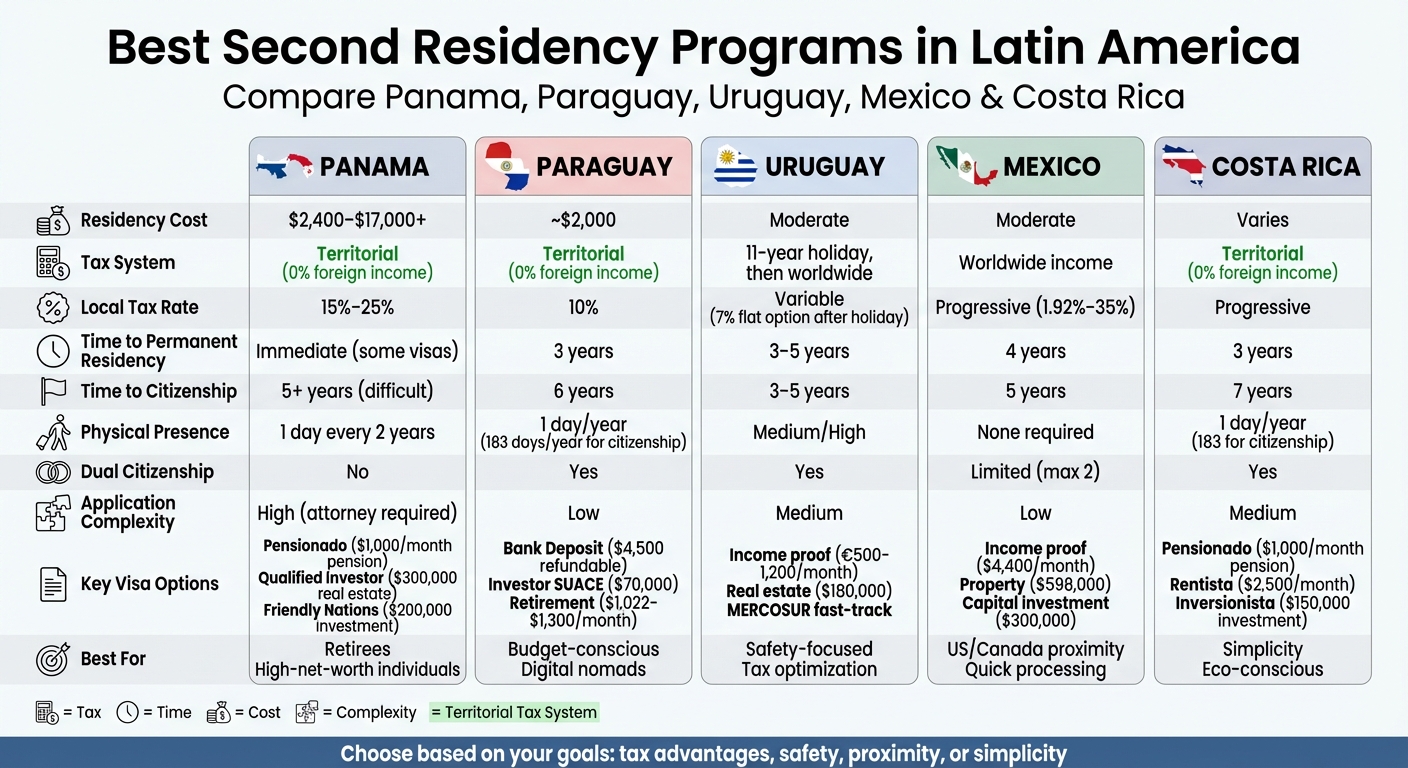
To help navigate these options, the table below compares key features across countries:
| Feature | Panama | Paraguay | Uruguay | Mexico | Costa Rica |
|---|---|---|---|---|---|
| Residency Cost | $2,400–$17,000+ | ~$2,000 | Moderate | Moderate | Varies |
| Tax System | Territorial (0% on foreign income) | Territorial (0% on foreign income) | 11-year holiday, then worldwide | Worldwide | Territorial (0% on foreign income) |
| Local Income Tax | 15%–25% | 10% | Variable | Progressive | Progressive |
| Time to Perm. Residency | Immediate (for some visas) | 3 years | 3–5 years | 4 years | 3 years |
| Time to Citizenship | 5+ years (difficult) | 6 years | 3–5 years | 5 years | 7 years |
| Min. Stay Required | 1 day every 2 years | 1 day/year | Medium/High | None | 1 day/year (183 for citizenship) |
| Dual Citizenship | No | Yes | Yes | Limited (max 2) | Yes |
| Application Complexity | High (attorney required) | Low | Medium | Low | Medium |
Each program has its strengths and limitations, so your decision will depend on your priorities – whether it’s low costs, tax advantages, or ease of application.
Conclusion
Deciding on the right residency program depends on your specific goals, whether it’s asset protection, tax efficiency, or global mobility. Each country offers distinct advantages tailored to different needs.
For retirees, Panama’s Pensionado Visa stands out. With a guaranteed pension of at least $1,000 per month, it provides immediate permanent residency and comes with a range of discounts on everyday expenses, making it a practical choice for those on a fixed income.
Digital nomads face different considerations. Panama’s Short-Stay Visa for Remote Workers allows stays of up to 18 months with a required monthly income of $3,000, though it doesn’t offer a path to permanent residency. Paraguay, on the other hand, offers a more accessible option with no income requirements and minimal government fees, although applicants must go through a temporary residency phase before achieving permanent status.
For high-net-worth individuals, Panama’s Qualified Investor Visa offers expedited processing in exchange for a real estate investment, making it an attractive option for those seeking quick residency solutions. Paraguay also presents an alternative with its SUACE program, which requires a long-term investment commitment but provides a clear route to residency.
Tax considerations play a major role in these decisions. Panama, Paraguay, and Costa Rica all offer territorial tax systems, which can be advantageous for protecting assets. Panama’s use of the U.S. Dollar further reduces risks for those with dollar-based holdings. In contrast, Mexico’s global tax structure demands a more tailored financial strategy.
Ultimately, the best choice depends on your priorities – whether it’s immediate residency, minimal costs, tax benefits, or a pathway to citizenship. For more in-depth strategies and planning tips, check out Global Wealth Protection’s resources to help you navigate your second residency journey.
FAQs
Which residency is best for my tax goals?
When it comes to achieving your tax goals, the ideal residency will depend on your personal situation and objectives. If you’re looking to lower taxes or take advantage of territorial tax systems, here are two options worth considering:
- Panama: This country only taxes local income, meaning any foreign income remains untaxed. It’s a great choice for those focused on safeguarding their assets.
- Paraguay: Paraguay also operates a territorial tax system with low rates, exempting foreign income. It’s especially appealing for expats and remote workers aiming for tax efficiency.
Will I become a tax resident if I rarely visit?
If you don’t spend much time in Panama, you typically won’t qualify as a tax resident automatically. Becoming a resident usually involves meeting specific conditions, like making particular investments or staying in the country for a required period. It’s important to check the economic and physical presence rules to fully understand what’s expected of you.
What documents should I prepare before applying?
Before you start the process of applying for a second residency in Latin America, make sure you have these important documents ready:
- Proof of financial stability, such as recent bank statements or pension documents, if you’re applying to an income-based program.
- A valid passport along with a government-issued ID.
- A criminal background check issued by your home country.
- Documentation showing investment or property ownership, if this is relevant to your application.
Keep in mind that requirements can differ depending on the country and type of visa you’re pursuing, so double-check the specific guidelines for your situation.
