
If I had to give the short answer first, I’d put Mérida at the top for safety, Querétaro as the best all-around inland pick, San Miguel de Allende for walkable expat life, Puerto Vallarta for beach living with better medical access, and La Paz for a quieter coast.
If you’re choosing where to live in Mexico, I’d look at crime levels, healthcare, walkability, traffic, weather, and cost – not just one safety stat. The article’s own numbers show a big spread, from Mérida’s homicide rate of 2.5 per 100,000 to San Miguel de Allende’s 29 per 100,000. That gap matters.
Here’s the simple takeaway:
- Mérida: lowest risk overall, but very hot and humid
- Querétaro: lower violent crime, mild weather, stronger city services
- San Miguel de Allende: big expat scene, walkable center, but higher costs
- Puerto Vallarta: beach city with solid private hospitals, but tourist crowds and humidity
- La Paz: calmer coastal pace, but fewer services and more car dependence
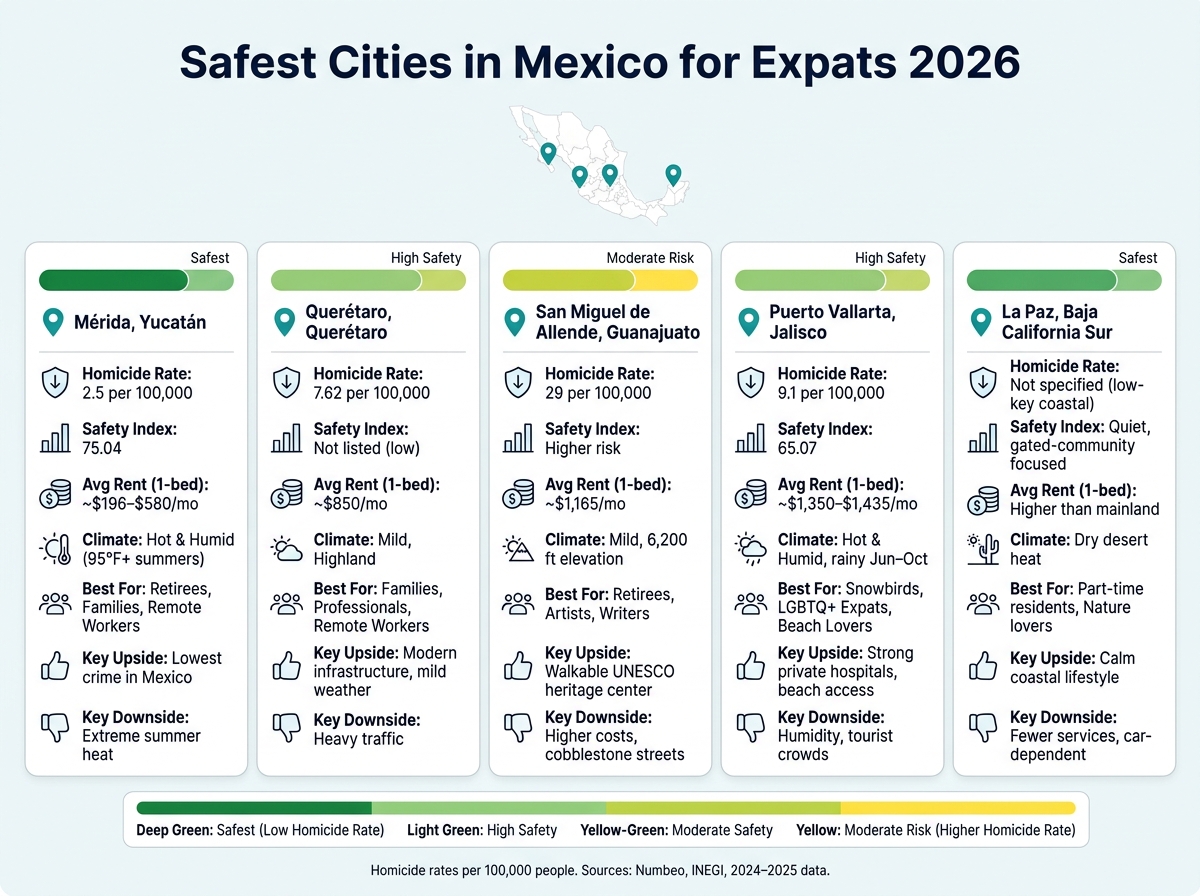
Quick Comparison
| City | Safety Snapshot | Main Upside | Main Downside | Best Fit |
|---|---|---|---|---|
| Mérida | 2.5 homicides per 100,000; Safety Index 75.04 | Lower day-to-day risk | Heat above 95°F in summer | Retirees, families, remote workers |
| Querétaro | 7.62 homicides per 100,000 | Better balance of safety and city services | Traffic | Families, professionals, remote workers |
| San Miguel de Allende | Higher risk picture; 29 per 100,000 | Walkable center, big English-speaking expat base | Higher rent, cobblestones, some care needs require travel | Retirees, artists, writers |
| Puerto Vallarta | 9.1 homicides per 100,000; Safety Index 65.07 | Coast + private healthcare | Humidity, nightlife theft risk, crowds | Snowbirds, LGBTQ+ expats, beach lovers |
| La Paz | Lower-key coastal setting | Quieter day-to-day life | Fewer specialist options, more car use | Part-time residents, nature-focused expats |
So if you want the safest pick, I’d start with Mérida. If you want the best mix of safety and city convenience, I’d look at Querétaro. And if you want the coast, I’d compare Puerto Vallarta and La Paz based on your healthcare needs, budget, and tolerance for heat.
That’s the short version of the full article – clear, direct, and enough to narrow your shortlist fast.
sbb-itb-39d39a6
1. Mérida, Yucatán
Mérida is one of Mexico’s safest major cities. It has a Safety Index of 75.04 and a Crime Index of 24.51, with a homicide rate of 2.5 per 100,000 people compared with the Mexican national average of 29 per 100,000. For expats, that usually means less day-to-day risk, especially in central parts of the city. Mérida also has an estimated 10,000 to 15,000 foreign residents, so it’s not hard to find an expat community.
Crime Patterns
Violent crime is rare, and central areas stay busy late into the night. Police presence is high, and surveillance helps support that safety record.
You feel that in daily life, especially in Centro and the northern neighborhoods, where many expats tend to settle.
Neighborhood Security and Walkability
Mérida is easiest to think of in two parts: Centro and the northern suburbs. Centro stands out for its colonial feel, safety, and walkability. Areas like Paseo de Montejo are also easy to explore on foot.
The northern districts lean more modern. You’ll find gated communities and newer amenities there, but you’ll usually need a car more often.
Healthcare Access
Healthcare is a big part of day-to-day comfort, and Mérida does well here. The city is a regional healthcare hub, with private hospitals like Star Médica offering modern equipment and English-speaking staff. A private GP visit usually costs $20 to $40, while specialist consultations tend to fall between $40 and $80.
Infrastructure and Climate
Mérida’s infrastructure is solid for most expats. Internet speeds average around 91 Mbps in urban areas, and the city is served by the Manuel Crescencio Rejón International Airport.
The main downside is the weather. Summer temperatures often go above 95°F (35°C), and the humidity can be intense. If you’re renting or buying, it’s smart to check that the home has working air conditioning.
Cost of Living
| Expense | Monthly Cost (USD) |
|---|---|
| Rent (1-bed, city center) | ~$196 to $580 |
| Monthly expenses (excl. rent) | ~$649 to $680 |
| Utilities | ~$51 |
Living in Mérida is roughly 43% cheaper than in Savannah, Georgia, and rental prices are about 65% lower.
Who It Suits Best
Mérida is a strong match for retirees who want safety and lower costs. It also works well for remote workers who need steady internet without paying big-city prices. Families tend to do well here too, thanks to low crime and solid livability.
One thing to keep in mind: English is limited outside expat areas, so learning Spanish early can make everyday life much easier.
Next, compare Mérida with Querétaro, which offers a more urban, business-focused alternative.
2. Querétaro, Querétaro
Querétaro is one of Mexico’s safest large cities and a more urban option than Mérida. It sits in Mexico’s central highlands, about a 2.5-hour drive from Mexico City. As of 2024, its homicide rate is 7.62 per 100,000 people, far below Mexico’s national average of about 24.9 per 100,000. That mix matters. You get lower violent crime without giving up the kind of infrastructure many people want for day-to-day life.
Crime Patterns
Safety is strongest in Centro Histórico, Juriquilla, and Zibatá.
Neighborhood Security and Walkability
For expats, the areas that tend to matter most are Centro Histórico, Juriquilla, and Zibatá.
Centro Histórico is a UNESCO World Heritage site with pedestrian-friendly streets. It feels built for walking, not just driving through. Juriquilla, in the north, is an upscale suburban area built around lakes and golf courses. Zibatá is a newer master-planned development known for modern design and walkability.
The main downside is traffic. Fast growth has made cross-city commutes slow.
Healthcare Access
Private hospitals such as Star Médica and MAC are well equipped. Specialist visits usually cost $45 to $85, and a blood panel runs $25 to $60 .
Infrastructure and Climate
The Querétaro Intercontinental Airport (QRO) has direct flights to the U.S. . The city also offers modern telecommunications, including high-speed fiber-optic internet, plus a strong base in aerospace, IT, and manufacturing .
Climate is one of Querétaro’s biggest draws. Its high-altitude setting helps keep temperatures mild through the year, with less humidity than Mérida or many coastal cities . Summers can still get warm.
Cost of Living
| Expense | Monthly Cost (USD) |
|---|---|
| Rent (1-bed, city center) | ~$850 |
| 2-bed apartment or small house | $600 to $900 |
| Building maintenance fees | $50 to $150 |
| Electricity (bimonthly, low usage) | $15 to $30 |
| Total monthly budget (single expat) | ~$2,500 |
Who It Suits Best
Querétaro is a strong fit for families who want good schools, safe public spaces, and a steady living environment. Remote workers can take advantage of the city’s digital setup and its easy access to Mexico City when needed . Retirees who want mild weather, good healthcare, and a city with depth and character often find it comfortable too.
Next, San Miguel de Allende offers a smaller, more walkable option with a different expat profile.
3. San Miguel de Allende, Guanajuato
San Miguel de Allende is, in general, a safe place for expats. But compared with Mérida or Querétaro, the risk picture is a bit more situational. The city’s homicide rate is 29 per 100,000 people, which is much higher than Mérida’s 2.5 and Puerto Vallarta’s 9.1. That said, violent crime does not often touch the foreign community. For most residents, the bigger concern is everyday theft, like pickpocketing or phone snatching in busy tourist zones.
Crime Patterns
On the ground, the kind of crime matters more than the headline rate. In San Miguel, basic street smarts go a long way. Stay aware in crowded places, and skip flashy jewelry or pricey electronics when you’re out and about.
Neighborhood Security and Walkability
Centro Histórico and Guadiana are widely seen as two of the safer and more popular areas for expats. Many people also go for gated communities with 24/7 private guards and controlled access.
The historic center is very walkable, which is a big part of its appeal. But there’s a catch. Cobblestone streets and steep hills can be tough for people with mobility issues or joint pain. Sidewalks are often narrow and uneven too, so sturdy shoes make a difference on those cobblestones and rough sidewalks.
Healthcare Access
For routine care and minor emergencies, San Miguel is usually well served by MAC Hospital and several private clinics. A specialist visit often runs about $30 to $60. More complex procedures, though, may mean a trip to Querétaro. Because of that, private health insurance and a medical evacuation option make sense for expats living here.
Infrastructure and Climate
SMA does not have its own international airport, so most residents fly through Querétaro or León. Daily life in colonial homes also comes with a few trade-offs. Thick stone walls can weaken Wi-Fi signals, central heating is not common, and tap water is not safe to drink. Many households depend on 20-liter water jug deliveries, which cost about $2 to $3 each.
At about 6,200 feet above sea level, the weather stays mild for most of the year. Still, winter nights from November through February can drop into the low 40s°F. That means it’s smart to plan for space heaters and somewhat higher utility bills during those months.
Cost of Living
Typical monthly costs in SMA look like this:
| Expense | Monthly Cost (USD) |
|---|---|
| Rent (1-bed, Guadiana or Centro) | ~$1,165 |
| Rent (2-bed home, San Antonio or Los Frailes) | $1,000 to $1,800 |
| Groceries (two people) | $400 to $700 |
| Utilities (including winter heating) | $100 to $250 |
| Total monthly budget | $1,500 to $2,500 |
Who It Suits Best
SMA tends to work well for retirees, artists, writers, and remote workers who want a walkable city and a large English-speaking expat community. It also has one of the highest concentrations of North American expats in Mexico.
Still, the downsides are hard to ignore. San Miguel is one of the more expensive expat cities in the country. The cobblestones can wear you down. And if you need specialized medical care, you may have to travel to Querétaro or Guadalajara. For expats with major mobility limits or more complex health needs, those trade-offs can feel heavier than they first appear.
Next, Puerto Vallarta shifts the comparison from highland living to a coastal expat market with different trade-offs.
4. Puerto Vallarta, Jalisco
Puerto Vallarta is the one coastal pick on this list, with about 15,000 foreign residents living there year-round. Its homicide rate is 9.1 per 100,000 people, and its Safety Index is 65.07. So it ranks below Mérida, but above San Miguel de Allende. Put simply, Puerto Vallarta gives you beach living, but with a busier risk picture than quieter inland cities.
Crime Patterns
Violent crime against foreigners is rare in Puerto Vallarta. A more likely issue is petty theft, mostly because the city has heavy tourist traffic and an active nightlife scene. The main expat and tourist zones are usually safe, but it’s smart to avoid dark outskirts at night.
After dark, many expats rely on Uber or DiDi instead of walking longer distances. And if you’re heading outside the city, toll roads are the safer bet. In a place like Vallarta, where one area can feel calm and another feels much more hectic, neighborhood choice matters a lot.
Neighborhood Security and Walkability
Well-known expat areas include Zona Romántica, Marina Vallarta, and the South Shore. Zona Romántica has an artsy feel and a long-established LGBTQ+ community. Marina Vallarta is known for modern amenities. The South Shore tends to attract English-speaking retirees.
The Malecón is the city’s main pedestrian corridor. It’s one of the easiest parts of Vallarta to get around on foot. Outside the core areas, though, sidewalks and pedestrian access can be uneven, so a car or ride-share often makes day-to-day life easier.
Healthcare Access
Healthcare is a big draw here too. Hospital CMQ Premier, Hospital CMQ, and Joya are popular with expats, especially for specialist care. English-speaking pharmacists and specialists are clustered near the Malecón.
Private specialist visits usually cost $40 to $80, and expats can also enroll in IMSS for about $500 per year. That mix of private care and public coverage gives people a few paths, depending on budget and comfort level.
Infrastructure and Climate
Puerto Vallarta has an international airport, which makes travel in and out pretty easy. Internet speeds average about 91 Mbps, and faster fiber-optic service is available in more built-up neighborhoods.
The climate is one of the big trade-offs. Summers are hot and humid, and the rainy season runs from June through October. Winters are easier to handle, with temperatures dropping to around 64°F.
Cost of Living
For many expats, a typical monthly budget in Puerto Vallarta falls between $3,000 and $3,500.
| Expense | Monthly Cost (USD) |
|---|---|
| Rent (1-bed, city center) | $1,350 to $1,435 |
| Groceries | ~$250 |
| Utilities and phone | ~$205 |
| Private health insurance | $120 to $240 |
| Total estimated budget | $3,000 to $3,500 |
Who It Suits Best
Puerto Vallarta tends to fit retirees, snowbirds, LGBTQ+ expats, and digital nomads in Latin America who want a coastal setup while staying in U.S.-aligned time zones. The main downsides are the heavier summer humidity and bigger tourist crowds, especially when cruise ships are in port and during peak vacation periods.
5. La Paz, Baja California Sur
Compared with Puerto Vallarta, La Paz gives up nightlife and big-city buzz in exchange for a calmer, more controlled setting. It feels like the quietest coastal option on this list, and safety often comes down less to the city as a whole and more to the neighborhood you choose.
Crime Patterns
In La Paz, the main risk is petty theft, especially pickpocketing and snatch-and-grabs in busier areas.
Neighborhood Security and Walkability
Many expats settle in gated communities. That can improve day-to-day security, but it often makes life more car-dependent. So while you may feel more at ease at home, quick walks to shops, cafes, or errands can be less practical.
Healthcare Access
Healthcare is adequate for routine needs. Still, if you expect to need regular specialist care, it makes sense to check local access before deciding on La Paz.
Infrastructure and Climate
La Paz’s dry desert climate is often easier to handle than sticky coastal humidity. But the heat is still a big part of daily life, and water availability can affect comfort in ways some expats don’t expect at first.
Who It Suits Best
La Paz fits expats who want a calmer coastal home base, are fine with gated-community living, and put neighborhood security ahead of urban convenience. That security-first setup can work well, but it does mean giving up some ease of access and some service options.
Pros and Cons by City
Every city gives you a different mix of safety, cost, weather, getting around, and day-to-day services. The table below makes those trade-offs easier to compare at a glance.
| City | Biggest Safety Advantage | Main Livability Advantage | Key Risk or Drawback | Best For |
|---|---|---|---|---|
| Mérida | Lowest homicide rate in Mexico, at 2.5 per 100,000 | Very low housing costs | Extreme summer heat and high humidity | Safety-conscious retirees and families |
| Querétaro | Low violent crime and a homicide rate of 7.62 per 100,000 | Modern infrastructure and strong services | Heavy traffic from rapid urban growth | Families and working professionals |
| San Miguel de Allende | Very walkable core and strong private-gated housing options | UNESCO World Heritage site with a strong arts and culinary scene | Higher rents around $1,165–$1,620/month and cobblestone streets that can be hard on mobility | Retirees, artists, and culture enthusiasts |
| Puerto Vallarta | Homicide rate of 9.1 per 100,000 and safer core zones with heavy tourist oversight | Strong private hospitals and a major medical-tourism hub | Intense humidity in the rainy season and cruise ship crowds | Beach lovers, snowbirds, and medical tourists |
| La Paz (Baja California Sur) | Quiet coastal setting with a small, controlled feel | Modern conveniences and a wellness-oriented lifestyle | Higher cost of living than mainland cities and hurricane exposure | Part-time residents and nature-oriented expats |
If safety is your top concern, Mérida stands out. Its homicide rate is 2.5 per 100,000, far below Mexico’s national average of 29 per 100,000, and it has a Safety Index of 75.04. That said, low crime doesn’t cancel out the weather. Summer there can feel brutal, with heat and humidity that wear people down fast.
San Miguel de Allende offers a different kind of appeal. You get charm, walkability, and a richer arts scene, but you’ll usually pay more for housing. On top of that, those beautiful cobblestone streets can be rough if mobility is a concern.
Puerto Vallarta blends beach living with strong healthcare access, which is a big plus for many expats and part-time residents. La Paz, by contrast, is more low-key. It fits people who want a quieter coastal lifestyle and don’t mind paying more than they might in mainland cities.
Think of the table above as your shortlist. The best pick depends less on the “safest” city in the abstract and more on what matters most in daily life: lower costs, easier mobility, better hospitals, beach access, or a slower pace.
Conclusion
These cities mostly fall into two camps: lower-risk inland hubs and coastal cities with more give-and-take. No place tops every category, so the right pick depends on how you live day to day.
| City | Best For | Main Trade-off |
|---|---|---|
| Mérida | Safety-first expats | Extreme heat and humidity |
| Querétaro | Balanced inland option | Heavy traffic from rapid growth |
| San Miguel de Allende | Culture and arts seekers | Higher housing costs and cobblestone streets |
| Puerto Vallarta | Beach-city lifestyle | Rainy season humidity and tourist crowds |
| La Paz | Quieter coastal pace | Higher costs than mainland cities |
From there, it comes down to three things: climate, mobility, and access to care.
If safety is your top filter, Mérida stands out. The trade-off is simple: the heat and humidity can be intense.
Querétaro is the most balanced inland option. It offers modern services and a mild climate, though traffic has become a bigger issue as the city grows.
San Miguel de Allende works well for expats who want culture, walkability, and a large expat community. The catch is higher housing costs.
If you want the coast, Puerto Vallarta is the strongest pick for beach access and private healthcare. Just be ready for humid rainy months and tourist crowds.
La Paz makes sense for expats who want a quieter coastal pace and don’t mind using more day-to-day caution than they would in Mérida.
Choose based on what matters most first: your budget, your comfort with the climate, your healthcare needs, and how easily you need to get around.
FAQs
How should I compare safety beyond crime rates?
Go past citywide crime stats and pay attention to what daily life looks like on the ground: neighborhood conditions, an established expat community, reliable transportation, visible police presence, and access to modern healthcare.
It also helps to look at tourism investment, walkability in safer parts of the city, and how easy it is to keep situational awareness and secure your home. If you can, visit before signing a long-term lease.
Which city is best if I need strong healthcare access?
If healthcare is at the top of your list, Mexico City, Guadalajara, and Monterrey are the main places to look. They have large hospital networks and advanced private facilities, which gives expats more options for routine care, specialists, and hospital treatment. Mérida also makes sense, with private hospitals that are well regarded.
If you want to live by the coast, Puerto Vallarta stands out as a solid medical hub. In most of these cities, expats rely on private health insurance to get access to English-speaking staff, shorter wait times, and care that often costs less than similar treatment in the United States.
What trade-offs matter most before choosing a city?
Balance convenience vs. the local feel. Big hubs usually have better infrastructure and more international amenities, but they also tend to cost more, deal with more pollution, and demand extra care when choosing a neighborhood. Smaller colonial towns often feel calmer and more affordable, though you may get fewer amenities and slower utilities.
It also helps to weigh security, climate, and connectivity. Gated communities can add a layer of security, but they usually come with higher costs and can feel cut off. Coastal cities give you beach access, along with humidity and tourist crowds. Highland cities tend to have milder weather, though altitude can affect some people. Airport access and your Spanish skills can also shape day-to-day safety and how easy life feels.
