
If your trust has no one watching the trustee, small issues can turn into court fights, tax problems, or years of delay. I’d sum it up this way: a trust protector is an independent person named in the trust who can step in for big decisions, like replacing a trustee, approving major distributions, or changing the trust’s legal home.
Here’s the short answer:
- A trustee runs the trust
- A trust protector watches key decisions
- The protector’s powers come only from the trust document
- This role shows up most often in irrevocable, dynasty, offshore, and cross-border trusts
- Without a protector, changes often mean more legal fees, more time, and court involvement
In plain English, I’d use a trust protector when a trust may need oversight but the settlor should not keep direct control. That often matters when assets are large, the trust may last for many years, or family members live in more than one country.
A few core points stand out:
- A protector can often remove and replace a trustee
- A protector may approve or block major distributions
- A protector may help settle fights between beneficiaries
- A protector may change situs or governing law if the current jurisdiction stops working well
- A poor draft can create confusion, tax trouble, or deadlock
About 60% of U.S. adults do not have an estate plan, according to industry survey data often cited in estate planning reports. And even when people do set up trusts, many miss this extra layer of oversight. That gap matters more in long-term trusts, where laws and family facts can shift over time.
| Role | Main Job | Typical Involvement |
|---|---|---|
| Trustee | Runs the trust, manages assets, makes distributions | Day to day |
| Trust Protector | Reviews big decisions, steps in when needed | Only at key moments |
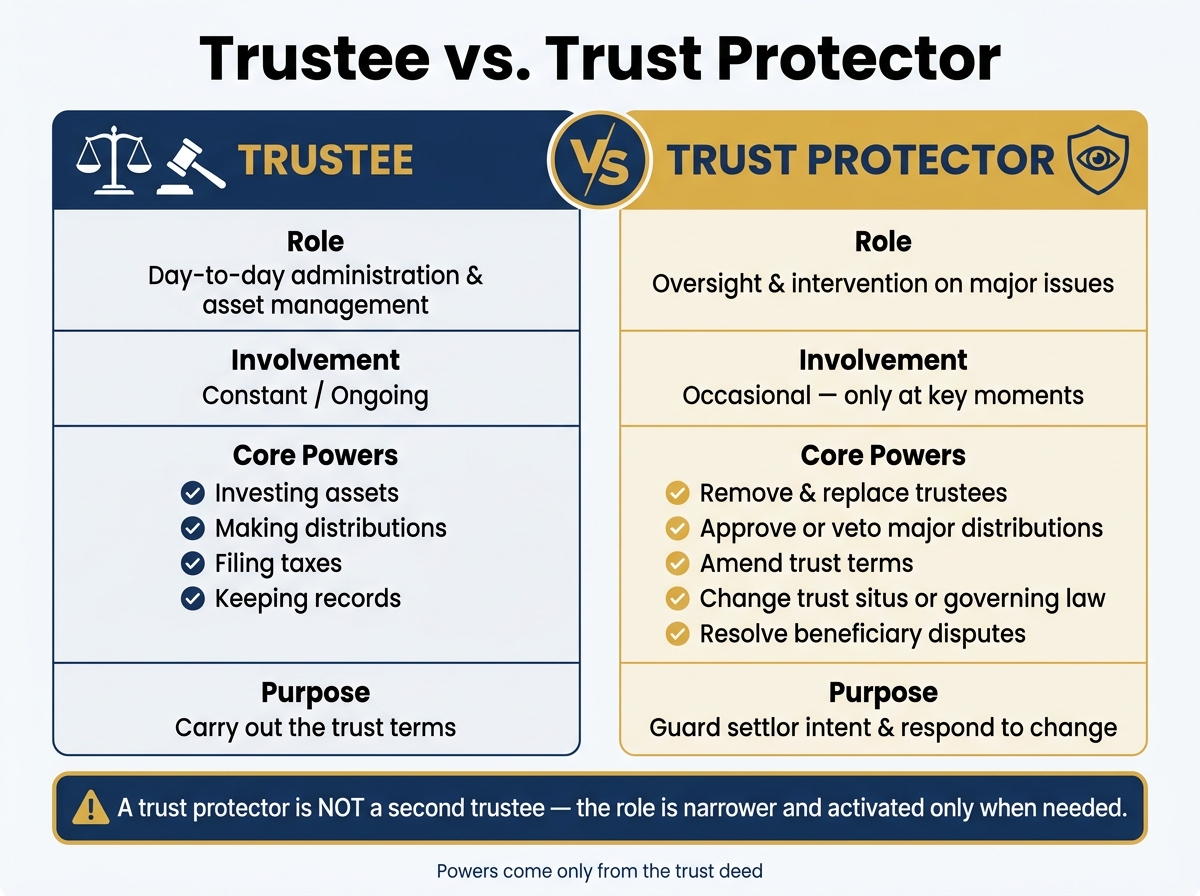
I’d keep one point front and center: a trust protector is not a second trustee. The role is narrower. The goal is to protect the settlor’s plan without giving one person open-ended power.
If you’re dealing with an structuring offshore trusts or international trusts, this role often matters even more. Distance, tax rules, and shifts in local law can make it harder to fix problems once they start.
That’s the main takeaway of the article: a trust protector helps keep a trust from getting stuck.
What is a trust protector?
A trust protector is a person or entity named in the trust deed to watch over major trustee decisions and help keep the settlor’s intent in place as life changes. Their authority goes only as far as the trust deed says it does.
That matters because a protector’s powers come only from the trust deed. In some trusts, the role is tight and limited. In others, it’s much broader. It all depends on how the trust is written.
You’ll often see trust protectors used in irrevocable, dynasty, and international trusts. The reason is pretty simple: the settlor wants oversight, but not direct control.
How a trust protector differs from a trustee
The trustee runs the trust day to day. That usually means managing investments, making distributions, filing taxes, and keeping records. A trust protector doesn’t handle the assets or the daily work. Instead, that person steps in when a major decision comes up or when the trust may need to change.
| Feature | Trustee | Trust Protector |
|---|---|---|
| Role | Day-to-day administration and asset management | Oversight and intervention on major issues |
| Involvement | Constant | Occasional, usually tied to specific events |
| Core Powers | Investing assets, making distributions, record-keeping | Removing trustees, amending trust terms, vetoing distributions |
| Purpose | Carry out the trust terms | Guard settlor intent and respond to change |
That line between the two roles is a big deal. If the protector’s powers are vague, problems can follow fast.
Who is usually appointed as trust protector
The usual pick is an independent attorney, accountant, professional fiduciary, or trusted advisor with experience in trusts and cross-border tax matters. You want someone independent, steady under pressure, and well versed in trust law and cross-border tax issues.
Naming a family member or beneficiary as protector can create real problems. It can also create tax risk, including the chance that the power is treated as a general power of appointment.
The trust deed should also spell out a clear process for naming a successor protector. If the protector dies or becomes incapacitated and no successor is named, the trust may end up in court. The next issue is what powers that person can actually exercise.
sbb-itb-39d39a6
What powers can a trust protector hold?
A trust protector’s powers come from the trust deed and the law that governs the trust. That means the role can be quite limited or fairly broad, depending on how the trust is written. These powers tend to matter most when a trust needs oversight, but not day-to-day management.
Removing and replacing trustees
One of the most common powers is the ability to remove and replace a trustee. This can matter a lot if a trustee has a conflict, stops acting, or just isn’t doing the job well. A clear removal power helps keep the trust on track without forcing the family into court. It can also help stop distribution fights from turning into bigger disputes.
Approving distributions and resolving beneficiary disputes
Many trust deeds give the protector veto or approval rights over major discretionary distributions. Put simply, the trustee may not be able to make a large distribution unless the protector signs off on it.
Protectors may also help settle disputes between beneficiaries before those disputes start to interfere with trust administration. In international trusts, that kind of flexibility can be just as important as control over distributions.
Changing trust situs, governing law, or trust terms
A trust protector may also have the power to move the trust’s legal home, change the law that applies to it, or allow limited changes to the trust terms. That can make a big difference when tax rules shift, beneficiaries move to a new place, or the current jurisdiction no longer offers the same level of protection.
In offshore planning, the ability to adjust the trust’s legal framework can help the trust keep working as laws and family circumstances change.
Why your trust needs a trust protector
A trust protector gives the trust a built-in check on trustee discretion. The trustee runs the trust’s administration. The protector steps in when big issues come up. That setup helps the trust keep its asset-protection purpose as life, laws, and family needs change.
Oversight without day-to-day management
The protector’s job is oversight, not day-to-day control.
This role matters most when a trust holds major assets, covers several beneficiaries across generations, or is meant to stay in place for decades. Tax laws change. Trustees retire. Some underperform. Without a protector, the trust may have no built-in way to adjust without going to court.
A protector can also help solve problems before they turn into lawsuits. If the trust document contains unclear language, or a drafting mistake leads to a result no one meant, the protector may be able to fix the issue through powers written into the deed. That’s a big deal in an irrevocable trust, where changes are often hard to make.
That kind of flexibility matters even more when the trust operates across borders.
Why offshore and international trusts use protectors more often
Oversight matters even more offshore, where distance and shifting jurisdictions can make trustee review harder. Offshore and international trusts face more jurisdiction and tax risk. When a family uses a professional trustee in another jurisdiction, the protector can serve as the main link between the family and the trustee.
A protector may also help move the trust’s situs or change its governing law if the original jurisdiction turns unfavorable because of political upheaval, new taxes, or exchange controls.
Without a protector, the trust can get stuck in place until someone asks a court to step in.
What happens when a trust has no trust protector?
Leaving out a trust protector can look harmless at the start. The trouble usually shows up later, when life changes, the trust needs to change too, and no one inside the structure has the power to act.
Common problems when no protector is named
The weak spot appears when the trust needs a fix, but nobody has the authority to make it happen fast. Without a protector, those fixes often need court approval. That means more delay, more legal work, and more cost.
In cross-border trusts, that delay can hit even harder. Assets, trustees, and beneficiaries may be spread across different jurisdictions, so even a simple issue can turn into a slow and expensive process.
If conflicts come up around jurisdiction or where assets are held, the trust may need court approval just to keep working the way it was meant to work.
A protector can also keep trustee disputes from snowballing into costly litigation. Without that role, small problems can sit and grow.
The same goes for tax-law changes. If no protector is in place, a trust can fall behind and become less efficient over time.
When a trust protector adds real value: key takeaways
A trust protector is a focused oversight role, not a co-trustee or a second manager. The point isn’t control for the sake of control. It’s a quick, limited way to deal with problems before they get bigger.
| Risk Without a Protector | What a Protector Can Do |
|---|---|
| Trustee misconduct or underperformance | Remove and replace the trustee without court involvement |
| Outdated terms after tax law changes | Modify distribution formulas or administrative provisions |
| Trust stuck in an unfavorable jurisdiction | Move the trust’s situs or change governing law |
| Beneficiary disputes with no neutral party | Resolve conflicts before they reach litigation |
One thing matters a lot here: draft the protector’s powers narrowly and clearly. If the language is too broad, you invite confusion and arguments.
For families, expats, and globally mobile investors, this choice needs attention when the trust is being drafted. Trying to add a protector after a problem appears is much harder, and it may require the same court process the protector was supposed to help avoid.
FAQs
Who should serve as a trust protector?
The ideal trust protector is an independent party, not the settlor, trustee, or a beneficiary.
In most cases, that means choosing a trusted adviser such as an attorney, accountant, or financial expert with experience in trust law and tax planning.
Appointing yourself can weaken the trust’s legal independence and asset protection. Choosing a family member can also create conflicts of interest, emotional decision-making, or tax issues.
Can a trust protector change an irrevocable trust?
Yes – but only if the trust deed clearly gives that power.
A trust protector can add some flexibility to an otherwise fixed irrevocable trust. The main idea is simple: help keep the trust in line with the grantor’s original intent, even when life or the law changes.
Depending on the wording of the trust, the protector may be allowed to:
- adjust terms in response to legal or tax changes
- fix drafting mistakes
- clear up vague or unclear language
- move the trust to a different jurisdiction
That said, there’s a hard limit here. A trust protector can’t go beyond the powers spelled out in the trust document.
When does a trust protector make the most sense?
A trust protector makes the most sense when a trust needs extra oversight, flexibility, and protection. That often comes up with an offshore trustee, a long-term multigenerational trust, or a family situation that isn’t exactly simple.
In plain English, a trust protector acts as an independent check if a trustee drags their feet, has a conflict, or mishandles the trust. They can also help settle disputes and give the trust room to adjust to legal, tax, or personal changes without dragging everyone into court.
