
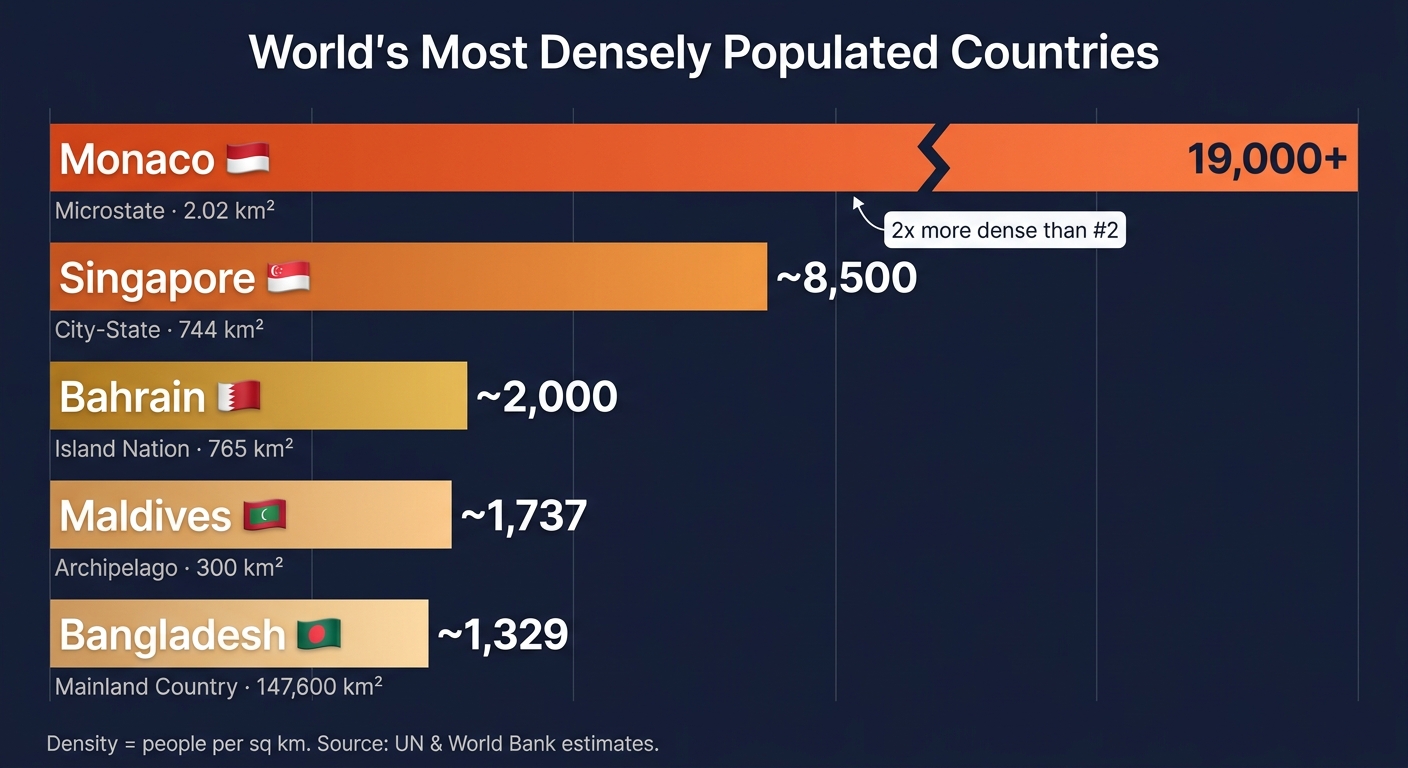
The short answer: Monaco ranks first, followed by Singapore, Bahrain, the Maldives, and Bangladesh.
If you want the clearest takeaway, it’s this:
- Monaco is in a class of its own at 19,000+ people per sq km
- Singapore is next at about 8,500 per sq km
- Bahrain, the Maldives, and Bangladesh round out the top five
- These countries get so crowded for different reasons: tiny land area, island limits, urban concentration, and heavy national settlement pressure
A large population alone doesn’t tell you much. I look at population density because it shows how many people share each piece of land. That gives you a better sense of crowding, housing pressure, transit demand, and day-to-day space limits.
Quick Comparison
| Rank | Country | Population | Land area | Density per sq km | Density per sq mi |
|---|---|---|---|---|---|
| 1 | Monaco | 38,367 | 2.02 sq km | 19,000+ | 49,188 |
| 2 | Singapore | 6,014,723 | 744 sq km | ~8,500 | ~22,000 |
| 3 | Bahrain | 1,485,509 | 765 sq km | ~2,000 | ~5,200 |
| 4 | Maldives | 521,021 | 300 sq km | ~1,737 | ~4,499 |
| 5 | Bangladesh | 172,954,319 | 147,600 sq km | ~1,329 | ~3,442 |
What stands out to me is that this list mixes microstates with a large mainland country. Monaco and Singapore show what happens when very little land meets strong demand. Bangladesh shows that a country can also rank near the top when dense settlement spreads across a much larger area.
So if you’re asking which countries feel the most packed on paper, this is the list – and the numbers make the answer plain.
sbb-itb-39d39a6
How Population Density Is Measured
Population density is simple math: total population divided by land area. It’s usually shown as people per square kilometer or people per square mile. That’s the metric used for the rankings below.
One detail matters more than it might seem: use land area, not total area. Total area can include lakes, rivers, and other water that people can’t settle on, which can make some countries look less crowded than they are. Canada is a good example. Its density appears low in part because its huge Arctic area is largely uninhabitable.
This standard formula is called arithmetic density. There’s also another way to look at crowding: density of arable land. That measure divides population by farmable land instead of all land. Egypt shows why that matters. Its arithmetic density looks modest, but most people live along the Nile.
These rankings use census data and estimates from the UN and World Bank. With that method in place, the list begins with Monaco.
1. Monaco
Monaco is the most densely populated sovereign state on Earth. 38,367 people live in just 2.02 square kilometers (0.78 square miles). That works out to more than 19,000 people per square kilometer and 49,188 per square mile. Put plainly, Monaco is far denser than any other country on this list.
The reason is simple: there’s almost nowhere to go. Monaco sits between France and the Mediterranean, so its footprint is tightly boxed in. Add a tax system that has long drawn wealthy residents, and pressure on space gets intense fast.
About 99% of Monaco is urban. To make more room, the country keeps pushing outward by reclaiming land from the sea. Mareterra (Portier) added 6 hectares in 2024, but even that hasn’t cooled the market. Prices still top €100,000 per square meter.
Monaco is a clear case of what happens when severe land limits meet strong demand for a tiny amount of space. Singapore faces some of that same pressure too, but on a much larger scale and with tighter state planning.
2. Singapore
Singapore is a city-state with about 6,014,723 people packed into just 744 square kilometers (287.4 square miles). That comes out to roughly 8,500 people per square kilometer (about 22,000 per square mile).
But Singapore’s crowding doesn’t work the same way as Monaco’s. Here, density is shaped by planning, not just by a lack of land. 100% of the population lives in urban areas, and about 80% of residents live in high-rise apartment buildings. There’s no rural zone sitting off to the side to take pressure off growth.
Instead, Singapore leans on national planning to keep dense living workable. Housing, transit, green space, and land reclamation are all coordinated as part of the same system. Since the 1960s, the country has increased its total land area by about 25% through land reclamation. That sets up the next case well: another land-limited country, but one with a very different density pattern.
3. Bahrain
Bahrain is a small island nation in the Persian Gulf with a population of about 1,485,509 people spread across roughly 765 square kilometers (about 295 square miles). That comes out to about 2,000 people per square kilometer (about 5,200 per square mile), which puts it fourth among the world’s most densely populated sovereign states.
Unlike Monaco and Singapore, Bahrain’s density comes from a mix of island geography and heavy urban concentration. Most people and much of the economy are packed into Manama and Al Muharraq, the main urban centers.
Expatriate workers add more pressure in those urban areas. Bahrain has also used land reclamation around its urban centers to create more developable land. Even so, the squeeze still shows up in transport, housing, and utilities.
The Maldives is even more constrained, but in a very different way.
4. Maldives
The Maldives is an archipelago in the north-central Indian Ocean with a population of 521,021 people spread across only 300 square kilometers (about 115.8 square miles) of land. That comes out to around 1,737 people per square kilometer (about 4,499 per square mile), which puts it among the most densely populated countries in the world. Still, density on paper doesn’t tell the whole story of what daily life feels like across a chain of islands.
Population pressure in the Maldives is uneven. Some islands feel that pressure far more than others, especially the main population centers where jobs, public services, and transport links are clustered. That’s where crowding hits hardest. And with so little land to work with, plus tight building space, adding new housing isn’t easy.
On top of that, climate risk and the plain logistics of moving people, materials, and services across islands make growth harder to manage over time.
Bangladesh shows how extreme density can also appear in a much larger country.
5. Bangladesh
Bangladesh changes the comparison quite a bit. Instead of a tiny island or city-state, you’re looking at a large mainland country. Even so, the numbers are striking: 172,954,319 people living in 147,600 square kilometers means a population density of about 1,329 people per square kilometer (around 3,442 people per square mile).
That level of density comes from two things working together: fertile land and heavy settlement pressure. Unlike Monaco and Singapore, which pack people into very small urban spaces, Bangladesh spreads that density across the country instead of concentrating it in just a handful of city centers.
Much of the land is arable, shaped by fertile river deltas and the Ganges Plain. Those conditions have long supported dense settlement and left little land undeveloped. On top of that, fast urbanization, especially in Dhaka, has made crowding even more intense. Dhaka adds another layer of pressure to a country that is already densely populated.
Quick Ranking Table
Here’s the ranking at a glance.
| Rank | Country | Density per km² | Density per sq mi |
|---|---|---|---|
| 1 | Monaco | 19,000+ | 49,188 |
| 2 | Singapore | ~8,500 | ~22,000 |
| 3 | Bahrain | ~2,000 | ~5,200 |
| 4 | Maldives | ~1,737 | ~4,499 |
| 5 | Bangladesh | ~1,329 | ~3,442 |
These places are very different from one another. But the same pressure points show up in each case.
Why These Countries Are So Densely Populated
The ranking comes from two very different density patterns. In plain terms, these countries land near the top for two main reasons: very little land in the smaller states and heavy settlement pressure in Bangladesh.
For the smaller countries, the math is pretty simple. A tiny land area, mixed with strong economic pull, leads to extreme density. Singapore is small, fully urbanized, and shaped around vertical living. Bahrain is an island archipelago, so its geography puts a hard cap on outward growth. The Maldives packs much of its population and services onto a small group of islands. When space runs tight, these places don’t have many options. They build upward, reclaim land, or both. Several of these countries use land reclamation or taller development to deal with space limits.
Bangladesh follows the same basic logic, but at a much bigger scale. The key difference is that its density is national, not just urban. Its population is spread across fertile delta land, and pressure rises even more around Dhaka, where some areas exceed 36,000 people per km². So this isn’t just a story about one crowded city. It’s a pattern that runs across the country.
What High Population Density Looks Like Day to Day
You usually feel population density first in housing, transit, and public space.
In dense places, cities grow upward and even underground. Monaco and Singapore rely on high-rise apartments and skyscrapers to use scarce land more efficiently. Singapore has also added vertical farms, while Monaco moved its railway station underground to open up space above ground
Housing prices show that pressure fast. In Monaco, luxury housing can top €100,000 per square meter When land is scarce, prices climb. It’s that simple.
Transit also shifts from convenience to daily need. Singapore supports more than 8,000 people per square kilometer, and its transport system leans heavily on public transit use Monaco, meanwhile, uses public elevators and escalators to help people get around its steep, tight layout In places like these, getting from point A to point B depends on shared systems.
Bangladesh shows a tougher side of density. There, density often means crowded roads, strained utilities, and long commutes, especially in Dhaka
Public space matters more too. When people live close together, parks and waterfronts do more than look nice; they give people room to breathe. Monaco’s Mareterra project, a 6-hectare neighborhood built entirely on reclaimed sea land, made a public park a core part of the plan
Conclusion
Monaco is the clear outlier, with roughly 19,000 people per square kilometer in a tiny coastal footprint.
Beyond Monaco, the ranking shows that density doesn’t come from just one cause. In the rest of the list, you can see three different forces at work: planned urban density, island constraint, and nationwide pressure on fertile land.
That’s the main takeaway from this ranking. Density makes more sense when you read it alongside geography, land limits, and settlement patterns.
FAQs
Why do tiny countries rank so high?
Tiny countries often sit near the top of population density rankings for a simple reason: they don’t have much land.
In places like Monaco, Singapore, and Vatican City, a small amount of territory packs people, infrastructure, and economic activity into a tight footprint. When the land area is tiny, the number of residents per square kilometer climbs fast.
Larger countries can have very dense cities, of course. But their national population density usually drops once you factor in big rural regions, open land, or places where few people live. Small states don’t have that kind of extra space, so their per-square-kilometer numbers end up much higher.
Why isn’t Bangladesh higher on the list?
Bangladesh ranks lower because it is a large country, which changes how its population density compares with tiny places at the top of the list.
Monaco and Singapore pack people into very small, heavily urban areas. Bangladesh, by contrast, has more than 170 million people spread across about 148,000 square kilometers. That larger land area keeps its density lower than those smaller territories.
Can these population density rankings change quickly?
Yes. Population density rankings can shift over time as populations grow, people move, and cities spread out.
Some microstates remain near the top because they have very little land to begin with. Other countries move up more slowly as their populations increase over the years.
These rankings can also change based on how a place is classified. For example, a list may include only sovereign nations, or it may also count dependent territories.
