
Yes, I can move assets offshore legally – but only if I report the account, income, entity, or trust the right way. For most U.S. taxpayers, the risk is not the transfer itself. The risk is missing a filing like the FBAR, Form 8938, Form 5471, Form 8865, or Form 3520.
Here’s the short version:
- I still owe U.S. tax on worldwide income
- A foreign account can trigger reporting once balances go above $10,000
- A foreign trust, company, or partnership can trigger extra IRS forms
- Penalties can start at $10,000 per form
- In some FBAR cases, penalties can reach 50% of the account value per year
The main rule is simple: disclosure keeps the move legal; hiding it creates the problem.
If I want to move money, securities, or ownership interests offshore, I need to match the asset move to the right filings before sending funds, keep a clear paper trail, and get U.S. international tax help when trusts or foreign entities are involved.
| Asset move | Usual tax issue | Main forms |
|---|---|---|
| Foreign bank or brokerage account | Account and asset reporting | FBAR, Form 8938 |
| Foreign corporation or partnership | Ownership and transfer reporting | Form 5471, Form 8865 |
| Foreign trust | Trust transfer, ownership, or distribution reporting | Form 3520, Form 3520-A |
So if I had to boil the whole article down to one point, it would be this: plan the reporting first, move the assets second.
Step 1: Choose the offshore asset move that matches your goals
Once you know the reporting rules, the next move is simple: pick the least complicated structure that still does the job.
Start small. Then add layers only if liability, ownership, business, or estate-planning needs call for them. That approach keeps costs down and makes compliance less of a headache.
Moving cash or securities to a foreign bank or brokerage account
For cash and securities, a personal foreign account is usually the simplest path.
You send funds abroad, keep them at a foreign bank or brokerage, and invest in assets such as foreign bonds, currencies, or U.S.-domiciled international ETFs. The big thing here isn’t the account itself. It’s making sure you report it the right way.
One thing to watch closely: PFIC rules. Foreign-domiciled funds can trigger PFIC reporting and harsh tax treatment.
Using an offshore LLC, corporation, partnership, or trust
A foreign entity should serve a clear purpose. Think liability, ownership, business activity, or estate planning.
If there’s no strong reason for the structure, it’s usually not worth the extra filings, upkeep, and cost. Foreign entities come with more paperwork, and foreign trusts sit at the top of that burden. They can help with asset protection and estate planning, but they also bring the most reporting.
Here’s a simple way to match the structure to its main IRS filing trigger:
| Structure | Best For | Complexity | Key IRS Form |
|---|---|---|---|
| Foreign bank/brokerage account | Diversification, multi-currency holding | Low | FBAR, Form 8938 |
| Offshore LLC, corporation, or partnership | Business operations, asset segregation | Medium to High | Form 5471 or 8865 |
| Foreign trust | Estate planning, asset protection | High | Forms 3520 and 3520-A |
Moving business ownership, operating capital, or investment positions
If you’re moving ownership stakes, operating capital, or investment positions offshore, clean records matter from the start.
That means clear ownership documents, payment records, and transfer records from day one. If you control a foreign corporation, CFC and Subpart F rules can speed up U.S. tax on certain passive income. And the structure you pick will decide which forms you need to file next.
sbb-itb-39d39a6
Step 2: Match each asset move to the required IRS and FinCEN filings
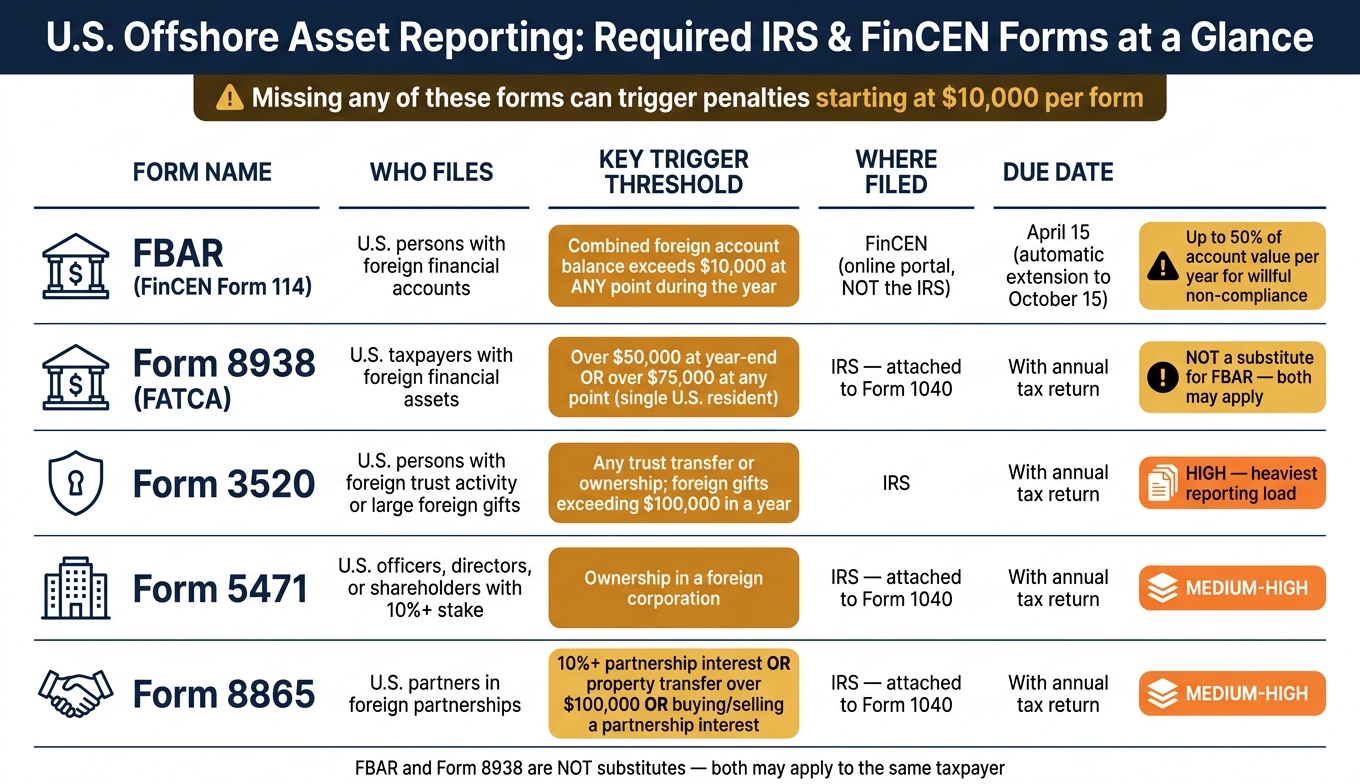
Once you’ve picked the offshore asset protection structure, the next step is simple in theory and a headache in practice: match each asset move to the forms it sets off before any money leaves the U.S.
That matters because the filing duty usually follows the type of asset and where it lands. Move cash to a foreign account? One set of forms may apply. Move assets into a foreign trust or foreign entity? That can trigger a different set of reports.
FBAR and Form 8938 for foreign financial accounts
If you move cash or securities to a foreign account, two forms often come into play.
FBAR (FinCEN Form 114) applies when the combined balance of your foreign financial accounts goes over $10,000 at any point during the calendar year.
Form 8938 (FATCA) uses higher thresholds. For a single U.S. resident, it applies if foreign financial assets are worth more than $50,000 on the last day of the year or more than $75,000 at any point during the year.
These two forms can both apply to the same person. They are not substitutes for each other.
Forms 3520 and 3520-A for foreign trusts and certain foreign transfers
Trusts usually bring the heaviest reporting load.
If you use a foreign trust, Form 3520 is required if you transfer assets to it, are treated as its owner, receive distributions from it, or receive more than $100,000 in gifts from foreign persons in a year.
If a foreign trust has a U.S. owner, it also files Form 3520-A each year.
Forms 5471 and 8865 for foreign companies and partnerships
Foreign corporations and partnerships add ownership reporting on top of account reporting.
If you move ownership into a foreign corporation or partnership, two more forms may apply.
Form 5471 covers U.S. officers, directors, or 10% shareholders of certain foreign corporations.
Form 8865 applies to foreign partnerships and can be triggered if you own a 10% or greater interest, transfer property worth more than $100,000 to a foreign partnership, or buy, sell, or transfer a partnership interest.
| Form | Who Files | Key Trigger | Filed With | Due Date |
|---|---|---|---|---|
| FBAR (FinCEN 114) | U.S. persons with foreign accounts | Combined balance exceeds $10,000 at any point | FinCEN (online) | April 15 (auto-ext to Oct. 15) |
| Form 8938 (FATCA) | U.S. taxpayers with foreign assets | Over $50,000 at year-end or $75,000 at any point (single resident) | IRS with Form 1040 | With tax return |
| Form 3520 | U.S. persons with foreign trust activity or large gifts | Any trust transfer/ownership; gifts over $100,000 | IRS | With tax return |
| Form 5471 | Officers, directors, 10%+ shareholders | Ownership in a foreign corporation | IRS with Form 1040 | With tax return |
| Form 8865 | U.S. partners in foreign partnerships | 10%+ interest; transfers over $100,000 | IRS with Form 1040 | With tax return |
Step 3: Execute the transfer with clean records and low audit risk
Once the structure and filings are set, document the transfer before the first wire goes out.
Keep source-of-funds, transfer, and ownership records from day one
Paperwork closes the gap. Every offshore transfer should answer three basic questions: Where did the money come from? Who owns it? What is it worth?
Keep pay stubs, prior-year tax returns, or sale-proceeds records that tie directly to the capital you’re moving. For ownership and valuation, hold on to government ID, recent proof of address, and your TIN, plus the purchase date, USD and local-currency amounts, exchange rate, foreign taxes withheld, and transaction costs.
If an entity is involved, keep the formation records, trust deeds, subscription agreements, cap tables, and board or manager resolutions too. Those records show the business or estate-planning reason behind the setup.
Retain all FBAR-related records for at least five years. The IRS can assess penalties retroactively for up to six years for some international issues, so a longer retention period is the safer move.
Use bank-to-bank wire transfers or SWIFT payments so there’s a clean, traceable trail. Then match those records to the forms listed in Step 2.
Transaction patterns that draw IRS scrutiny
Once your records are in order, the next risk is conduct that looks like concealment. The IRS is focused on concealment, not offshore ownership itself.
The biggest red flags are:
- Unreported foreign accounts
- Missing entity or trust forms, such as Form 5471, 8865, 3520, or 3520-A
- Offshore income that never shows up on Form 1040
- Nominee ownership setups where the beneficial owner isn’t clear
Each one points back to the same problem: a missing filing or a missing record from Steps 1 and 2. Full disclosure isn’t just the right call. It’s the only approach that holds up.
Get U.S. international tax advice before funds move
Offshore transfers involving trusts, controlled foreign corporations, or partnership interests can get messy fast. Even when someone’s trying to comply, mistakes happen.
Bring in a U.S. international tax CPA or attorney before any transfer tied to trusts, foreign entities, or partnership interests.
Have that team review the structure, filing duties, and transfer records before funds move. When the plan and the paperwork line up from the start, you’re far less likely to run into avoidable IRS problems.
Conclusion: Plan the reporting before the transfer
Once you’ve picked the structure and lined it up with the right filings, timing becomes the last piece. Offshore transfers are legal only when ownership, income, and transfers are fully disclosed. That’s the line that matters: disclosure, not destination.
The main trouble spots are missed forms and thin records. Foreign accounts, trusts, corporations, and partnerships can each set off their own reporting rules, and the type of asset shapes the filing load. Leave a foreign account off an FBAR, and the penalty can reach 50% of the account value per year of non-compliance.
So the transfer should come last. The reporting plan should come first. Figure out which filings apply before anything happens, get your documents in order, and have a qualified U.S. international tax advisor review the structure before any funds move.
FAQs
Does moving money offshore create tax by itself?
No. Moving money offshore does not, by itself, trigger tax.
If you’re a U.S. taxpayer, you still have to report your worldwide income to the IRS, no matter where the money sits.
The trouble usually starts with non-disclosure. If you fail to report foreign accounts, assets, or related income, you can face steep penalties. And some foreign investments, including passive foreign investment companies, can come with less favorable tax treatment.
Which offshore moves trigger the most IRS forms?
Moving assets into complex offshore structures triggers the heaviest IRS reporting.
A simple foreign bank account will often mean FBAR and Form 8938. Once you add entities, though, the compliance burden gets much heavier.
Common examples include:
- foreign corporations (Form 5471 or Form 926)
- foreign trusts (Form 3520)
- passive foreign investment companies (Form 8621)
Miss these filings, and the penalties can be severe.
What records should I keep before sending funds abroad?
Before you send money overseas, keep a clean paper trail that shows where the funds came from. That usually means documents like wage slips, sales contracts, tax returns, and bank statements from the past six to 12 months.
If you use offshore entities such as trusts or corporations, the recordkeeping needs to go deeper. Hold on to trust deeds, operating agreements, board minutes, management resolutions, and records for each transfer. Those documents help show ownership, the business purpose behind the setup, and support annual filings like FBAR and FATCA.
