
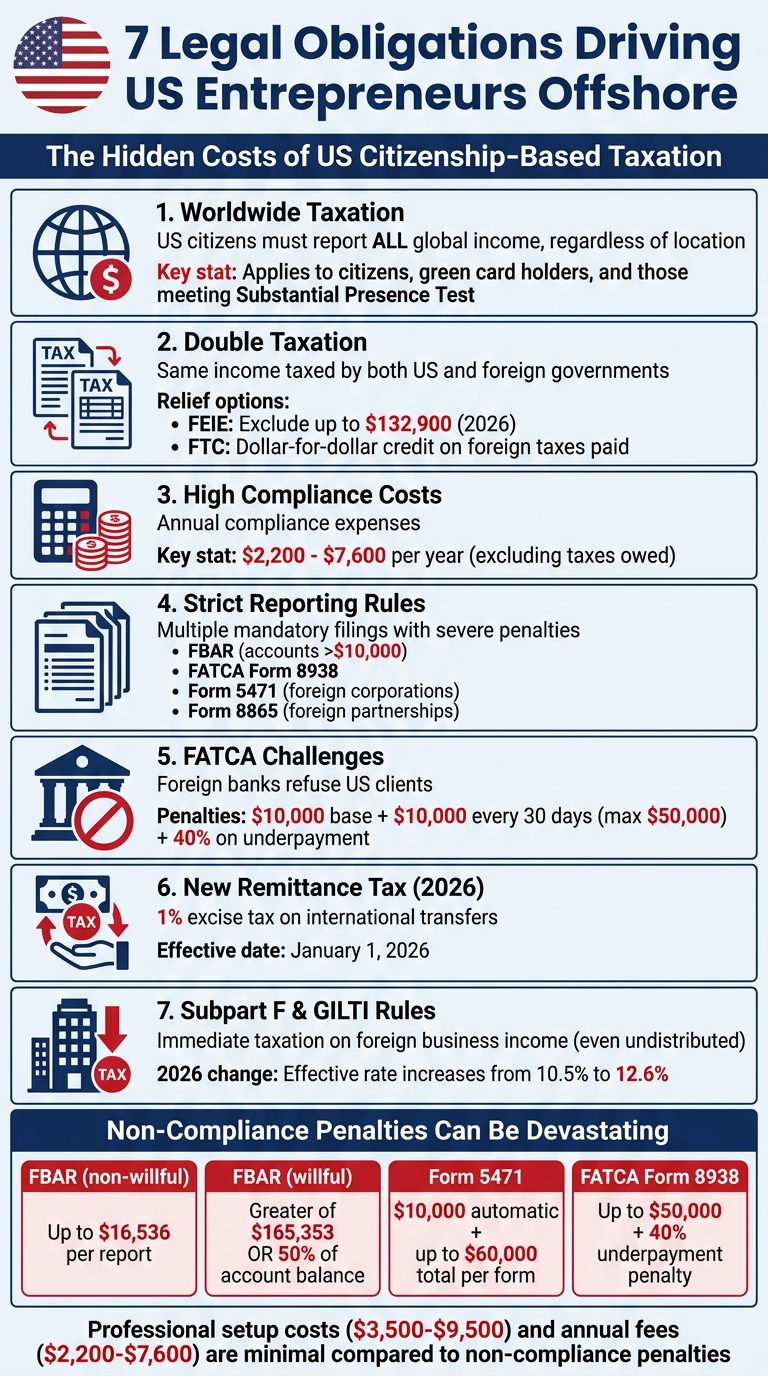
US entrepreneurs working internationally face a unique set of legal and financial challenges. Unlike most countries, the U.S. taxes its citizens on worldwide income, no matter where they live or earn. This creates a complex compliance burden that can be overwhelming and costly. Here’s a quick breakdown of the key reasons many entrepreneurs explore offshore strategies or even renounce their U.S. citizenship:
- Worldwide Taxation: U.S. citizens must report and potentially pay taxes on all income earned globally.
- Double Taxation: Even with tax treaties, many face overlapping taxes from the U.S. and foreign governments.
- High Compliance Costs: Annual compliance expenses can range from $2,200 to $7,600, excluding taxes owed.
- Strict Reporting Rules: Forms like FBAR, FATCA (Form 8938), and Form 5471 carry steep penalties for non-compliance.
- FATCA Challenges: Many foreign banks refuse U.S. clients due to FATCA regulations.
- New Taxes: Starting in 2026, a 1% excise tax applies to certain international remittance transfers.
- Subpart F and GILTI Rules: Immediate taxation on foreign business income, even if profits are not distributed.
With penalties for non-compliance reaching tens of thousands of dollars, staying compliant is both time-consuming and expensive. While offshore strategies can help manage these burdens legally, including why offshore asset protection is a primary driver for many, they require careful planning and expert guidance to avoid pitfalls.
Global Income Taxation: Paying Taxes on Worldwide Earnings
Navigating global tax obligations is a must for U.S. entrepreneurs working internationally. The U.S. operates under a citizenship-based taxation system, which means that holding a U.S. passport obligates you to report – and potentially pay taxes on – all income, no matter where it’s earned. Whether your income comes from a business in Singapore or consulting gigs in Dubai, the IRS expects you to account for it. This rule applies not just to U.S. citizens but also to green card holders and foreign nationals who meet the Substantial Presence Test. For entrepreneurs, this means juggling multiple reporting requirements. Every dollar – whether it’s from wages, business profits, investments, or even tips – must be reported in U.S. dollars, using Treasury-approved exchange rates. This level of reporting often exposes entrepreneurs to the challenge of double taxation.
The Problem of Double Taxation
Double taxation happens when both the U.S. and the country where the income is earned tax the same earnings. While the U.S. has tax treaties with many nations, these agreements don’t automatically exempt you from U.S. tax obligations. Filing a U.S. tax return is still mandatory, and you’ll need to explore relief options to mitigate the tax burden.
Two key relief mechanisms are the Foreign Earned Income Exclusion (FEIE) and the Foreign Tax Credit (FTC). The FEIE lets eligible individuals exclude up to $132,900 of foreign wages or self-employment income for the 2026 tax year. On the other hand, the FTC offers a direct dollar-for-dollar reduction in your U.S. tax bill based on taxes you’ve already paid to foreign governments. However, you can’t use both benefits on the same income – you have to pick one. Many entrepreneurs lean toward the FTC because it directly cuts the tax owed. For example, if you paid $15,000 in taxes to Germany but owe only $10,000 to the IRS on that income, you can claim a credit for up to $10,000.
The Cost of Staying Compliant
Tax compliance for international entrepreneurs goes far beyond filing a standard return. If you own a foreign corporation, you’ll need to file Form 5471. For foreign partnerships, it’s Form 8865. And if your combined foreign account balances exceed $10,000, you must submit an FBAR. Missing or incorrectly filing any of these forms can lead to hefty penalties. For instance, failing to file an FBAR – even unintentionally – can result in fines of $13,640 per unreported form or account.
Self-employed entrepreneurs face additional hurdles. If your net earnings from self-employment hit $400 or more, you’re required to file a U.S. return – even if your overall income falls below the typical filing threshold.
Starting January 1, 2026, a new 1% excise tax will apply to certain remittance transfers to foreign countries under the One Big Beautiful Bill Act. This adds yet another financial layer for entrepreneurs transferring money internationally. Between taxes, professional fees for specialized advisors, currency conversion costs, and the time spent managing compliance, the expenses can quickly climb into the thousands each year. These growing costs and complexities are why many entrepreneurs explore offshore strategies to better manage their resources and reduce the administrative burden. This often involves implementing asset protection for the entrepreneur to safeguard wealth from legal and tax liabilities.
sbb-itb-39d39a6
FATCA and FBAR: Reporting Requirements for Foreign Accounts
U.S. entrepreneurs with foreign accounts must navigate both FBAR and FATCA reporting rules, each with distinct requirements and penalties. Importantly, filing one does not exempt you from filing the other – even if no federal income tax is owed. Failing to comply with either can result in severe penalties. Below, we break down what FATCA and FBAR entail, including their specific reporting thresholds and potential consequences.
What FATCA Requires You to Report
FATCA mandates that U.S. taxpayers report "specified foreign financial assets" using IRS Form 8938, which is submitted alongside their annual tax return. The reporting thresholds depend on both your residency and filing status. For example:
- A single filer living abroad must report if assets exceed $200,000 on December 31 or $300,000 at any point during the year.
- Married couples filing jointly face higher thresholds: $400,000 on December 31 or $600,000 during the year.
FATCA goes beyond bank accounts – it includes stock certificates, partnership interests, and other financial assets. For those seeking to shield wealth, structuring offshore trusts for asset protection can provide an additional layer of security while maintaining compliance. To ensure compliance, foreign financial institutions now report U.S. account data directly to the IRS.
Penalties for failing to file Form 8938 start at $10,000, with additional $10,000 penalties imposed every 30 days (up to $50,000 total). Additionally, a 40% penalty may apply to any tax underpayment linked to undisclosed assets. These strict penalties highlight the importance of understanding FATCA’s intricate requirements.
FBAR Filing Requirements and Penalties
FBAR, on the other hand, focuses specifically on foreign account balances. It must be filed separately through FinCEN‘s BSA E-Filing System and is not part of your tax return. The filing requirement kicks in if the total value of your foreign accounts exceeds $10,000 at any point during the calendar year. Notably, this $10,000 threshold has remained unchanged since 1970; adjusted for inflation, it would equal about $82,000 today.
If you own more than 50% of a foreign corporation, you are responsible for reporting all of that corporation’s accounts on your personal FBAR. Exchange rate fluctuations can also push you over the $10,000 threshold – use the Treasury Bureau of the Fiscal Service‘s official exchange rate from December 31 to calculate account values.
Penalties for FBAR violations vary based on intent:
- Non-willful violations: Up to $16,536 per annual report (as of January 2025).
- Willful violations: The greater of $165,353 or 50% of the account balance. Criminal violations may also result in fines and up to five years in prison.
A notable case, Bittner v. United States (2023), involved Alexandru Bittner, a dual citizen penalized $2.72 million for failing to file FBARs for 272 accounts over five years. The Supreme Court ultimately reduced his penalty to $50,000, ruling that the $10,000 non-willful penalty applies per annual report, not per account.
To address late filings, the IRS offers amnesty programs like the Streamlined Foreign Offshore Procedures and the Delinquent FBAR Submission Procedures. These programs allow taxpayers to file up to three years of tax returns and six years of FBARs penalty-free, provided the failure was non-willful and all income was reported. Such options can help alleviate the stress of catching up on compliance.
IRS Form 5471: Reporting Foreign Business Ownership
If you’re a U.S. citizen holding 10% or more of a foreign corporation, you’re likely familiar with IRS Form 5471. This form is an informational return that tracks ownership and financial activity in foreign businesses. Unlike FBAR or FATCA, it demands detailed financial records, including income statements, balance sheets, and transaction documentation. The IRS places filers into five categories based on their ownership percentage and role. Those involved with Controlled Foreign Corporations (CFCs) – where U.S. shareholders collectively own more than 50% – face the most comprehensive reporting requirements.
Even if your foreign corporation has no income or business activity, you’re still required to file Form 5471. All financial data must be converted from the foreign currency to U.S. dollars using Treasury-approved exchange rates. Additionally, accounting entries must align with U.S. GAAP, meaning adjustments for depreciation, R&D, and other items may be necessary if the foreign company uses IFRS or local standards. Each foreign corporation you hold a reportable interest in requires a separate form, complete with all applicable schedules.
"Form 5471 is one of the most complex IRS forms. Errors or missing information can trigger audits and steep penalties." – Bright!Tax
Penalties for Missing Form 5471
Failing to file Form 5471 comes with steep consequences. The IRS imposes an automatic $10,000 penalty for each unreported foreign corporation per annual accounting period. This penalty applies even if no additional tax is owed. If you fail to comply within 90 days of receiving an IRS notice, an extra $10,000 is added every 30 days, up to a maximum of $50,000. That brings the total potential penalty to a staggering $60,000 per unfiled form.
Beyond monetary fines, non-compliance can also reduce foreign tax credits. Initially, there’s a 10% reduction in credits under sections 901, 902, and 960. If the failure continues beyond 90 days of notice, an additional 5% reduction is applied for every three-month period. Moreover, if Form 5471 is missing or incomplete, the statute of limitations for your entire tax return remains open indefinitely, leaving you vulnerable to future IRS audits.
These penalties highlight the importance of staying compliant and the need for strategies to manage the associated costs effectively.
The Time and Cost of Filing Form 5471
Filing Form 5471 isn’t just costly in terms of penalties – it also demands significant time and resources. Even in straightforward cases, completing the form can take over 30 hours. The form includes numerous schedules, such as Schedule C (Income Statement), Schedule F (Balance Sheet), Schedule M (related-party transactions), and Schedule J (Earnings and Profits tracking), depending on your filing category.
Professional preparation costs reflect this complexity. Basic filings typically cost between $1,500 and $2,500, while moderately complex cases range from $2,500 to $3,000. For highly intricate filings, fees can exceed $5,000. Many tax professionals avoid handling Form 5471 altogether, or they charge premium rates due to the form’s complexity. For entrepreneurs managing multiple foreign entities, these costs can quickly add up, creating a significant financial and administrative burden – even when the corporations in question generate little to no income.
This level of complexity often prompts business owners to look into offshore strategies as a way to reduce their compliance challenges. Managing the demands of Form 5471 is crucial for minimizing the financial and administrative pressures that come with owning foreign businesses.
Subpart F and GILTI: Immediate Taxation on Foreign Business Income
If you’re a U.S. citizen with foreign business interests, the tax challenges don’t stop at Form 5471 reporting. Enter Subpart F and GILTI (Global Intangible Low-Taxed Income) – two rules designed to prevent tax deferral through foreign corporations. Subpart F, dating back to 1962, targets income streams like dividends, interest, royalties, and rents that can easily be shifted between jurisdictions. GILTI, introduced in 2017, casts a wider net by taxing active income that exceeds a standard return on physical assets.
These rules mean immediate taxation. If you own at least 10% of a Controlled Foreign Corporation (CFC) – defined as a foreign company where U.S. shareholders collectively hold over 50% – you must include your share of certain earnings as gross income in the year they’re earned, regardless of whether you receive a distribution. This creates a tax liability even for undistributed income.
"Subpart F income and GILTI are taxed annually, irrespective of whether the profits are actually distributed." – 1040 Abroad
Starting in 2026, the rules get stricter. Under the One Big Beautiful Bill Act (OBBBA), GILTI will be renamed Net CFC Tested Income (NCTI), and the effective corporate tax rate on foreign earnings will rise from about 10.5% to 12.6%. Additionally, the Section 250 deduction will drop from 50% to 40%, though there’s a slight improvement in the foreign tax credit haircut, which increases from 80% to 90%.
How These Rules Target Passive Income and IP
Subpart F and GILTI rules divide income into categories, each with its own tax treatment. Subpart F zeroes in on passive income – think interest from loans, dividends, royalties from intellectual property, and rental income. It also applies to income from sales or services involving related parties outside the corporation’s home country.
GILTI, on the other hand, focuses on active business income, particularly from intangible assets like patents, trademarks, and software. By 2026, the exclusion for a 10% return on tangible assets (known as QBAI) will disappear, leaving businesses with fewer ways to shield income tied to physical investments.
There’s some relief through the high-tax exception. If your foreign business operates in a country with a tax rate exceeding 18.9% (set to rise to about 25.2% in 2026), you can elect to exclude that income from GILTI/NCTI. However, since this threshold is calculated at 90% of the U.S. corporate tax rate, many lower-tax jurisdictions won’t meet the criteria.
Effects on Digital and Service-Based Businesses
Digital entrepreneurs and service-based businesses often bear the brunt of these rules. Professionals like software developers, consultants, and online marketers typically operate with minimal physical assets. For instance, a web developer running a SaaS company abroad might own little more than a few laptops and servers – far from enough tangible property to benefit from the former QBAI exclusion.
Here’s an example: A U.S. owner of an Irish CFC with $1,000,000 in income and $2,000,000 in tangible assets would see their taxable inclusion jump from $550,000 under 2025 GILTI rules to $750,000 under 2026 NCTI. For a corporate shareholder, this change increases U.S. tax liability from $57,750 to $94,500 – a $36,750 hike.
"The elimination of QBAI increases taxable income for CFCs with significant tangible assets." – SDO CPA
For individuals, a Section 962 election can help. This allows you to be taxed at corporate rates (21%) instead of individual rates (up to 37%) on Subpart F and NCTI income. However, this strategy comes with a catch: when you eventually distribute the income to yourself, you’ll face a second layer of tax. Navigating this complex framework often requires careful planning and a solid understanding of international tax laws.
These challenges are why so many entrepreneurs explore offshore strategies , such as establishing a private family office for asset protection, to simplify compliance while staying within legal boundaries.
Offshore Strategies to Reduce Legal Burdens
Navigating U.S. tax obligations can feel overwhelming, but there are ways to ease the burden. Many entrepreneurs turn to offshore structures to manage compliance costs, safeguard assets, and maintain flexibility – all while staying within the law. Popular tools in this space include offshore companies, trusts, and private LLCs.
Using Offshore Companies to Lower Tax Burdens
Offshore companies can simplify international operations by offering access to local payment systems and credit facilities. This can help reduce currency risks and transfer costs, making transactions smoother and cutting operational expenses.
For U.S. citizens, tax relief options like the Foreign Earned Income Exclusion (FEIE) (via Form 2555) or the Foreign Tax Credit (FTC) (via Form 1116) can help avoid double taxation by excluding qualifying income or offsetting U.S. taxes with foreign taxes already paid. However, owning more than 50% of a foreign corporation turns it into a Controlled Foreign Corporation (CFC), which triggers the need to file Form 5471.
"The United States taxes its citizens on worldwide income regardless of where they live. Once a foreign company and a US entity are both involved, reporting complexity increases quickly." – Antravia Advisory
One effective approach is the merchant of record strategy. Here, a U.S. LLC handles invoicing while a foreign entity oversees service delivery. This setup maintains a professional U.S. presence while benefiting from offshore operations. However, compliance with transfer pricing rules under IRC §482 is a must to justify revenue sharing between entities.
Each of these tools – offshore companies, trusts, and LLCs – offers tailored solutions to address different aspects of U.S. tax challenges, from compliance to asset security.
Offshore Trusts for Protecting Assets
Offshore trusts go beyond tax relief by providing robust asset protection. By transferring assets to jurisdictions with strong legal systems like Switzerland or Liechtenstein, individuals can diversify their holdings. This isn’t about secrecy; it’s about strategic planning.
These trusts shield assets from public scrutiny, data brokers, and casual inquiries, though they remain fully visible to tax authorities. U.S. citizens are still taxed on worldwide income, no matter where their assets are located. Under IRC sections 671-679, transferring assets to a foreign trust generally means you’re taxed on the trust’s income as if you still own it.
The reporting obligations are strict. You’ll need to file Form 3520 annually to disclose the creation or funding of a foreign trust. The trust itself must submit Form 3520-A, or you’ll need to file a substitute if it fails to comply. Additionally, if foreign accounts exceed $10,000 at any point in the year, you’ll need to file an FBAR (FinCEN Form 114) and potentially Form 8938 for specified foreign financial assets.
"Offshore investing is transparent, fully documented, and fully reported to U.S. tax authorities. The goal is to diversify currency exposure, legal jurisdiction, and investment opportunities – not to hide assets." – WHVP
Private US LLCs for Privacy and Protection
Private U.S. LLCs are a simpler domestic option that complements offshore companies and trusts. For U.S. citizens, a single-member LLC is often treated as a "disregarded entity", meaning its income flows directly to Schedule C of Form 1040, avoiding complex corporate filings. This structure offers personal asset protection while keeping compliance manageable.
That said, there are limits to this simplicity. If your LLC has 25% or more foreign ownership or engages in transactions with foreign entities, you’ll need to file Form 5472, and failing to do so can result in a $25,000 penalty.
"Clarifying the entity structure early reduces future reporting headaches." – Antravia
Dual-entity strategies can spread operational risks, but they require careful management of intercompany payments to avoid double taxation. Be cautious about electing corporate tax treatment unless it’s advised by a professional. The key is finding a balance between privacy, protection, and manageable compliance without overcomplicating things.
Conclusion: Using Offshore Solutions While Staying Compliant
Meeting Legal Requirements While Protecting Your Wealth
U.S. citizens are taxed on their worldwide income unless they formally expatriate. This means any offshore strategy must be designed to protect assets while staying fully compliant with the law.
Offshore structures aren’t about hiding wealth – they’re tools for strategic diversification that adhere to legal requirements. The strategies discussed earlier, such as offshore companies, trusts, and private LLCs, aim to balance compliance with asset protection. However, strict adherence to reporting rules like FBAR and FATCA is non-negotiable. Regularly monitoring account balances can help avoid triggering reporting thresholds.
As regulations shift, staying informed is critical. For instance, new remittance transfer taxes will begin in 2026, and the IRS is set to receive nearly $80 billion in additional funding through 2032, significantly enhancing its enforcement capabilities. These developments make proactive planning even more essential.
The complexity of these requirements highlights the importance of having clear, expert-driven strategies to safeguard your wealth without running afoul of the law.
Why Professional Guidance Matters
With evolving regulations and enforcement measures, handling dual reporting requirements, entity classifications, and international tax treaties requires specialized knowledge. Consider this: failing to file an FBAR in 2026 could result in penalties of $12,921 per account, while FATCA non-compliance starts at $10,000 and can climb as high as $60,000. These potential risks underscore the necessity of expert advice.
"The international tax landscape is constantly evolving… The potential for inadvertent noncompliance and severe penalties underscores the importance of proactive planning and expert tax guidance." – The Tax Adviser
Professionals can ensure compliance by verifying bank policies, managing documentation, and aligning U.S. and foreign jurisdiction requirements. Typical setup costs for offshore arrangements range from $3,500 to $9,500, with annual fees between $2,200 and $7,600. While these costs may appear steep, they pale in comparison to the penalties or expenses involved in resolving non-compliance issues. By working with experts, you can ensure your offshore strategy aligns with your financial goals while staying within the bounds of U.S. law.
FAQs
Do I still owe U.S. taxes if I live abroad full-time?
Yes, if you’re a U.S. citizen living abroad full-time, you are still required to pay taxes on your worldwide income. It doesn’t matter where you live – whether it’s Paris, Tokyo, or a remote island – you must file U.S. tax returns and meet all related tax obligations. The U.S. operates on a citizenship-based taxation system, meaning your tax responsibilities follow you wherever you go.
When do I have to file both FBAR and Form 8938?
If your foreign financial assets cross $10,000 at any point during the year, you’ll need to file both FBAR (FinCEN Form 114) and Form 8938. However, Form 8938 has additional thresholds that vary depending on your filing status and whether you live in the U.S. or abroad. These thresholds are set under FATCA reporting requirements, so it’s important to review them closely to ensure you stay compliant.
How can I reduce Subpart F or GILTI tax legally?
Reducing Subpart F or GILTI tax obligations can be achieved through legal strategies such as setting up offshore structures, acquiring second citizenships, or enrolling in residency programs. These methods aim to improve your tax situation while staying compliant with IRS rules. It’s crucial to work with a qualified tax advisor to explore these options and ensure you adhere to legal requirements.
