
If you have multi-currency accounts outside your tax residence, you’re likely subject to CRS (Common Reporting Standard) rules. CRS is a global system where financial institutions report your account details to tax authorities, who then share this information internationally to prevent tax evasion.
Here’s what you need to know:
- CRS applies to 120+ countries (excluding the U.S., which uses FATCA).
- Multi-currency accounts are treated as one account, with all balances converted to a single currency (usually USD) for reporting.
- Financial institutions report details like your name, Tax Identification Number (TIN), account balance, and income annually.
- Errors in self-certification (e.g., incorrect tax residency or missing TIN) can lead to your account being flagged or misreported.
- Joint accounts are fully reported for each holder, meaning the entire balance is attributed to both.
To stay compliant:
- Keep your tax residency and documentation updated with your bank.
- Monitor year-end balances, as exchange rate fluctuations can push you into higher reporting thresholds.
- Seek professional advice for complex situations like dual tax residency or entity accounts. This is particularly important when considering offshore asset protection strategies.
Understanding CRS reporting ensures you avoid penalties and maintain compliance across jurisdictions.
CRS Basics for Multi-Currency Account Holders
Which Countries Participate in CRS?
Over 120 jurisdictions have signed on to the Common Reporting Standard (CRS), with 113 of them exchanging data between April 1, 2025, and March 31, 2026. Some of the most prominent financial hubs on this list include Switzerland, Singapore, Hong Kong, Luxembourg, and the United Arab Emirates.
Interestingly, the U.S. does not participate in CRS. Instead, it relies on its own system, FATCA (Foreign Account Tax Compliance Act). This can create a dual reporting scenario for U.S. account holders living abroad, as they may need to report based on both their tax residency and the location of their accounts. Knowing which countries participate in CRS helps clarify how it differs from FATCA.
How Is CRS Different from FATCA?
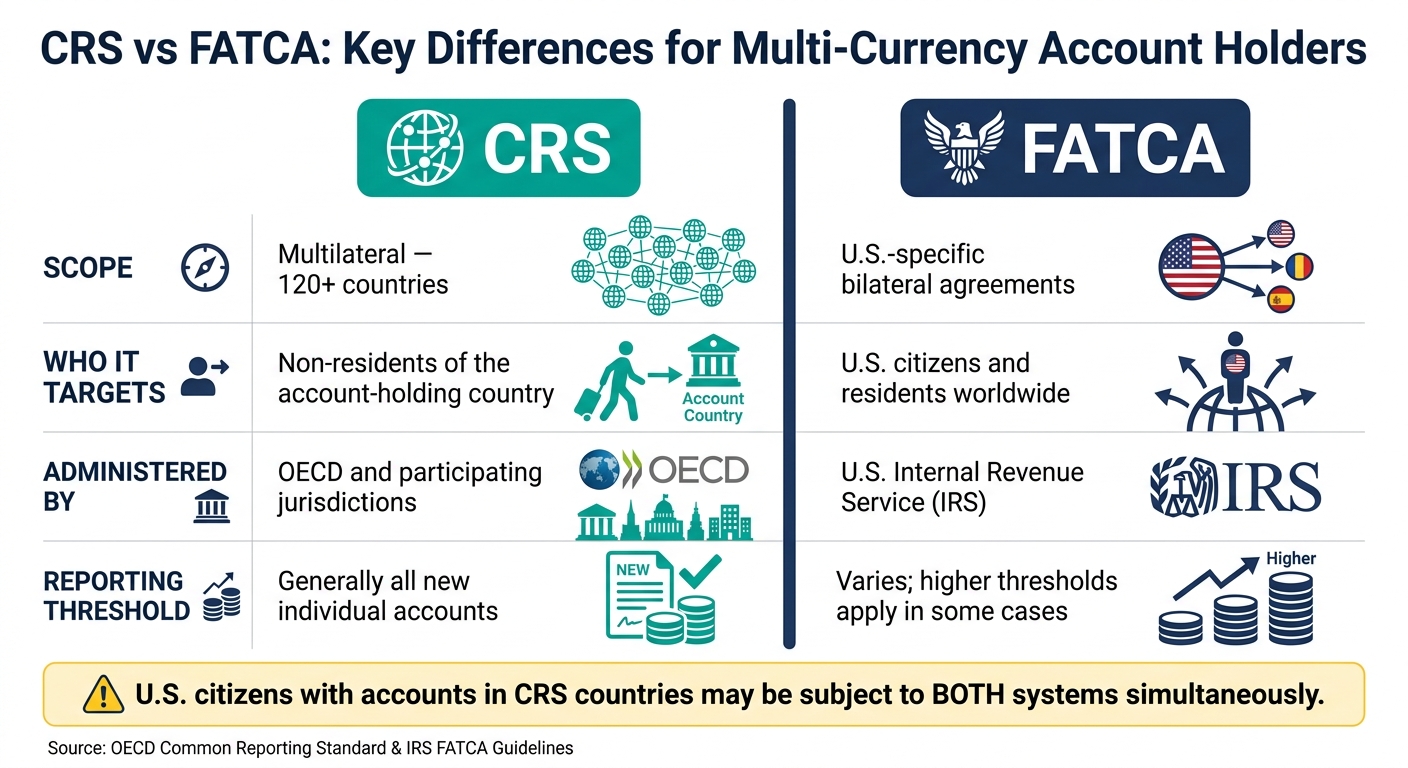
Although both CRS and FATCA aim to tackle offshore tax evasion, they operate under different frameworks. Here’s a quick comparison:
| Feature | CRS | FATCA |
|---|---|---|
| Scope | Multilateral – 120+ countries | U.S.-specific bilateral agreements |
| Who It Targets | Non-residents of the account-holding country | U.S. citizens and residents worldwide |
| Administered By | OECD and participating jurisdictions | U.S. Internal Revenue Service (IRS) |
| Reporting Threshold | Generally, all new individual accounts | Varies; higher thresholds apply in some cases |
For multi-currency account holders, this distinction matters. FATCA focuses on U.S. persons wherever they bank, while CRS applies based on the jurisdiction where an account is held. For example, a U.S. citizen with accounts in a CRS country may find themselves subject to both systems.
How Do Financial Institutions Handle CRS Reporting?
Financial institutions identify non-resident account holders through self-certification forms and by reviewing account records for signs of foreign residency, such as a non-local address or international wire transfers.
Once flagged, accounts are reported annually – often in XML format – to local tax authorities. These authorities then share the information with the account holder’s home jurisdiction. The reported details typically include:
- Full name and home address
- Tax Identification Number (TIN)
- Date of birth
- Account number
- Year-end balance
- Currency denomination for multi-currency accounts
Accuracy in self-certification is crucial. Institutions are required to ensure that your declared tax residency aligns with other records they hold. If there are inconsistencies, your account could face additional scrutiny or even be classified as undocumented, leading to further reporting complications.
sbb-itb-39d39a6
How CRS Applies to Multi-Currency Accounts
Are Multi-Currency Accounts Treated Differently Under CRS?
Under the Common Reporting Standard (CRS), a multi-currency account is considered a single financial account, regardless of how many currencies it holds. For instance, if your account includes balances in U.S. dollars, euros, and Swiss francs, the reporting institution doesn’t submit three separate reports. Instead, it files one report that covers the account as a whole.
This approach simplifies reporting but has an important implication: all currency sub-balances are combined into the total reported value. You can’t exclude one currency from being reported while keeping others visible within the same account.
Now, let’s look at the specific data financial institutions report for these accounts.
What Information Gets Reported for Multi-Currency Accounts?
Financial institutions are required to provide detailed information about the account holder, the account itself, and its financial activity. This ensures a comprehensive overview of the account’s status and transactions.
| Category | Data Fields Reported |
|---|---|
| Account Holder (Individual) | Name, address, jurisdiction(s) of tax residence, TIN(s), date of birth |
| Account Holder (Entity) | Name, address, TIN(s), entity type, controlling person details (for Passive NFEs) |
| Account Information | Account number, reporting institution name and ID |
| Financial Activity | Year-end balance or value, total gross interest/dividends/other income |
| Custodial Activity | Gross proceeds from the sale or redemption of financial assets |
One key point to note: joint accounts are fully reported for each account holder. If you share a multi-currency account with someone else – like a spouse or business partner – the entire balance is attributed to each individual in the report.
How Are Multi-Currency Balances Valued?
Financial institutions calculate the value of multi-currency accounts as of December 31 each year. They convert all sub-balances into U.S. dollars (or another applicable currency) using the published spot rate for that day. A sudden currency fluctuation on December 31 could push your account balance above critical thresholds, such as $250,000 for pre-existing entity accounts or $1,000,000 for individual High Value accounts. Crossing these limits can trigger enhanced due diligence.
"The Standard defines the account balance or value in the case of an Equity interest as the value calculated by the Financial Institution for the purpose that requires the most frequent determination of value." – OECD
To stay compliant and avoid unnecessary scrutiny, it’s essential to monitor your combined USD-equivalent year-end balance closely. This valuation method highlights the importance of keeping a vigilant eye on your account as the year ends.
How to Determine Your CRS Reporting Obligations
If you hold a multi-currency account, it’s essential to understand whether you’re subject to reporting under the Common Reporting Standard (CRS).
Who Is Considered a Reportable Person Under CRS?
A reportable person includes any individual or entity considered tax resident in a CRS-participating country, except for the account-holding country or the United States. This category covers individuals, corporations, trusts, and partnerships.
For entities classified as Passive Non-Financial Entities (Passive NFEs) – like holding companies or certain types of trusts – the obligation to report extends to their controlling persons (beneficial owners) if those individuals are tax residents in a CRS jurisdiction.
Tax residency under CRS is based on factors like where you live, where your family resides, and where your primary economic activities occur. It’s not determined solely by citizenship. If someone spends substantial time in multiple countries, tax treaty tie-breaker rules may help establish the primary jurisdiction for reporting. These classifications help banks identify accounts that need to be reported.
How Do Banks Classify Account Holders?
Banks use a thorough process to classify account holders. It starts with self-certification, where new account holders provide details like their tax residency, Taxpayer Identification Number (TIN), and date of birth when opening an account.
For existing accounts, banks look for signs of foreign residency. These could include a foreign mailing address, international phone numbers without a local counterpart, or instructions for international fund transfers. If such indicators are found, the account may be flagged for further review or updated documentation may be requested.
Banks also cross-check self-certifications with Anti-Money Laundering (AML) and Know Your Customer (KYC) records. Changes like updating a foreign address can trigger a reclassification. Account holders are generally required to notify their bank within 15 days if their tax residency changes or if they receive a new TIN.
How Do Account Types and Thresholds Affect CRS Reporting?
Once tax residency and classification are confirmed, the type of account and its balance influence reporting requirements. Certain accounts, such as tax-advantaged ones, are exempt from CRS reporting. Examples include RRSPs, TFSAs, and RESPs.
However, CRS covers a broad range of account types, including:
- Savings and checking accounts
- Brokerage and custodial accounts
- Mutual funds
- Cash-value life insurance or annuity contracts
In many countries, balance thresholds for new accounts have been removed. For instance, in Canada and New Zealand, accounts opened on or after July 1, 2017, require self-certification regardless of balance. This means even low-balance multi-currency accounts could be reportable if the holder is a foreign tax resident.
For pre-existing accounts, some thresholds may still apply. For example, entity accounts with balances under $250,000 might be exempt. However, these exemptions are becoming less common as CRS rules continue to evolve. It’s crucial to understand the specific rules in the jurisdiction where your account is held, as even small or inactive accounts might be subject to reporting.
Practical Steps for CRS Compliance
What Risks Do Account Holders Face Under CRS?
One of the biggest risks for multi-currency account holders under CRS is mismatched information between your declarations and what the bank reports. Errors in your self-certification – like an incorrect tax residency, an old address, or a missing Tax Identification Number (TIN) – can lead to your account being flagged as undocumented. When that happens, the bank reports your account to tax authorities based on whatever "indicia" they have on file, which could result in your information being sent to the wrong jurisdiction.
Another common issue is valuation discrepancies. Banks convert multi-currency balances into a single reporting currency using a published spot rate. This means the amount they report to your tax authority might not align with what you’ve declared. Even a small difference in exchange rates could push your account over a reporting threshold or raise red flags that lead to an audit.
"Financial institutions have to send to the CRA information on account holders who do not cooperate with requests for information." – Canada Revenue Agency
Non-cooperation with your bank’s requests for updated tax documentation has serious consequences. If you don’t respond, your account will still be reported, but you lose the chance to influence how it’s classified.
To avoid these pitfalls, it’s crucial to adopt strong recordkeeping habits and stay proactive about your account details.
Recordkeeping and Monitoring Best Practices
To reduce compliance risks, follow these key practices:
- Maintain thorough records: Keep copies of every self-certification form you’ve submitted, along with supporting documents like passports, certificates of residence, and government-issued IDs. These documents are essential if questions arise.
- Reconcile regularly: Compare your account statements with the currency conversion rates your bank uses and ensure they match your tax filings. For joint accounts, remember that the full balance is attributed to each account holder, as previously noted.
- Update promptly: Notify your bank as soon as your tax residency changes. For example, in Canada, account holders must report a new TIN within 15 days of receiving it.
By staying organized and keeping your bank informed, you can minimize the risk of errors or misreporting.
When to Get Professional Advice
Sometimes, the complexities of CRS compliance call for expert help. This is especially true if your accounts are held through structures like trusts, partnerships, or entities that operate across multiple jurisdictions. Determining whether your entity qualifies as a Passive NFE (Passive Non-Financial Entity) – which applies if more than 50% of its income comes from passive sources like dividends or interest – can be tricky. Misclassification here affects how controlling persons are reported and to which jurisdictions.
Dual residency is another area where professional advice is invaluable. If you’re considered a tax resident in two countries at the same time, treaty tie-breaker rules decide your primary jurisdiction for CRS purposes. Misapplying these rules and giving your bank the wrong jurisdiction can lead to significant compliance headaches. Similarly, U.S. citizens and green card holders face overlapping obligations under CRS and FATCA, which require specialized expertise to navigate.
If you’re planning a move to a new country or restructuring how your accounts are held, consult a professional before making changes. This ensures you have the best options available and reduces the risk of unintended consequences.
Conclusion: Managing CRS Reporting for Multi-Currency Accounts
The Common Reporting Standard (CRS) facilitates the automatic exchange of financial data across more than 120 jurisdictions. This means your bank is already sharing details like your account balances, currency conversions, and personal information with the relevant tax authorities.
For those holding multi-currency accounts, the challenges are even greater. Factors like exchange rate conversions, aggregation rules, and entity classifications can complicate compliance. Even small mistakes – such as errors in self-certification or missing Tax Identification Number (TIN) submissions – can lead to serious consequences.
"The rules are complicated. The consequences are real. And your best move? Getting ahead of all of it – before your inbox lights up with tax letters from three countries." – Bright!Tax
Staying compliant means ensuring accurate self-certification, submitting TINs on time, and updating your residency information promptly. It’s also crucial to regularly review the information being reported to ensure its accuracy.
If your situation involves more complex arrangements – like trusts, multi-entity structures, or overlapping obligations under FATCA – professional advice is essential. The Canada Revenue Agency frequently updates its CRS guidance, with the next major update scheduled for April 2026. Conducting an annual compliance review with a qualified tax professional is a smart way to stay ahead, especially for those managing accounts across multiple currencies and jurisdictions. For more intricate cases, consulting experts like Global Wealth Protection can provide tailored advice for investors navigating cross-border tax obligations.
FAQs
Will CRS report each currency separately or as one account?
When it comes to multi-currency accounts, the CRS (Common Reporting Standard) handles each currency as if it were a separate account. This means that instead of grouping all currencies into one report, each currency is reported individually.
Which exchange rate does my bank use for year-end CRS values?
Banks usually use the exchange rate effective at the close of the reporting period to determine CRS values. This is often either the spot rate or a rate set according to the bank’s internal policies for that particular date.
Can CRS reporting make my tax authority audit me?
CRS reporting doesn’t directly result in an audit by your tax authority. Instead, it enhances transparency, making it easier to spot undeclared foreign assets. If any inconsistencies are identified, this might prompt an audit. Ensuring compliance with your reporting obligations can help minimize these risks.
