
Protecting your privacy when buying real estate in the U.S. is becoming harder due to public records, data aggregation, and new regulations like the Corporate Transparency Act (CTA). However, there are still ways to reduce exposure by using specific ownership structures and strategies. Here’s what you need to know:
- Public Records: Property ownership is public, exposing names, addresses, and financial details.
- New Regulations: CTA requires LLCs and corporations to report beneficial owners to FinCEN, limiting federal anonymity.
- Ownership Structures: Options like land trusts, anonymous LLCs, and offshore entities can help shield your identity.
- Financial Privacy: Strategies include avoiding traditional mortgages, using entity-owned accounts, and minimizing paper trails.
The key is planning ahead, ensuring your name never appears on public records, and staying compliant with evolving laws. Below, we’ll explore practical methods to protect your privacy while maintaining legal compliance.
Privacy Challenges in Real Estate Ownership
Public Records and Data Aggregators
Every real estate transaction creates a trail of public records. When a deed is filed with the county recorder’s office, it becomes a public document. This record typically includes the owner’s full legal name, property details, transfer date, lender information, debt amount, and tax assessment history. The main concern here is how easily this information can be collected and redistributed. For example, platforms like Realtors Property Resource (RPR) compile data on 160 million properties across the U.S.. This makes it simple for various parties – whether marketers, litigants, or even malicious actors – to trace property ownership and examine its history.
To avoid this exposure, it’s crucial to plan purchases in a way that keeps your name off public records from the start. The sheer volume of accessible data highlights the need for privacy-conscious strategies, especially as new regulations further complicate the landscape.
Transparency Regulations and Beneficial Ownership
Privacy in real estate ownership has become even more complicated due to evolving regulations. The Corporate Transparency Act (CTA), which took effect on January 1, 2024, mandates that most LLCs and corporations disclose their beneficial owners to the Financial Crimes Enforcement Network (FinCEN). This includes providing each owner’s full legal name, date of birth, residential address, and a government-issued ID number. A "beneficial owner" refers to anyone with significant control or at least a 25% ownership stake. Noncompliance can lead to severe consequences, including civil penalties of up to $500 per day, criminal fines of up to $10,000, and even up to two years in prison.
Attorneys from Hunton Andrews Kurth emphasized the importance of this shift:
"Starting January 1, 2024, FinCEN reporting will need to be a checklist item for all new non-public entities… irrespective of funding sources."
Although CTA data is stored in a confidential database and isn’t publicly accessible, the requirement effectively ends federal anonymity for entity-based ownership structures. Proposed rules from February 2024 aim to go even further, requiring reporting for common-law trusts involved in non-financed residential transfers. This would close what some have called the "trust loophole". Navigating these changes demands careful planning to stay compliant while maintaining as much privacy as possible.
Banking and Financial Visibility
Financing a property brings another layer of privacy challenges. Most residential lenders won’t approve a mortgage for an LLC or trust, which often forces buyers to take title in their personal name – creating a public record. Even all-cash purchases aren’t entirely private. Banks must comply with Know Your Customer (KYC) and Customer Due Diligence (CDD) regulations, requiring them to identify the individuals behind any entity.
Here are some common financial exposure points and strategies to address them:
| Financial Element | Privacy Risk | Mitigation Strategy |
|---|---|---|
| Mortgage/Lien | Links owner name to property in public records | Opt for all-cash purchases or private loans |
| KYC/CDD Rules | Banks require identification of individuals | Use a FinCEN Identifier for reporting |
| Payment Records | Wire transfers and checks leave a trail | Use an account owned by an entity |
| Insurance/Utilities | Bills tie individuals to specific addresses | Use virtual mailboxes and entity-named accounts |
Understanding these risks is essential for anyone considering privacy-focused ownership structures. Each step, from financing to managing utilities, requires deliberate strategies to reduce visibility while staying within legal and regulatory boundaries.
sbb-itb-39d39a6
Key Strategies for Anonymous Real Estate Ownership
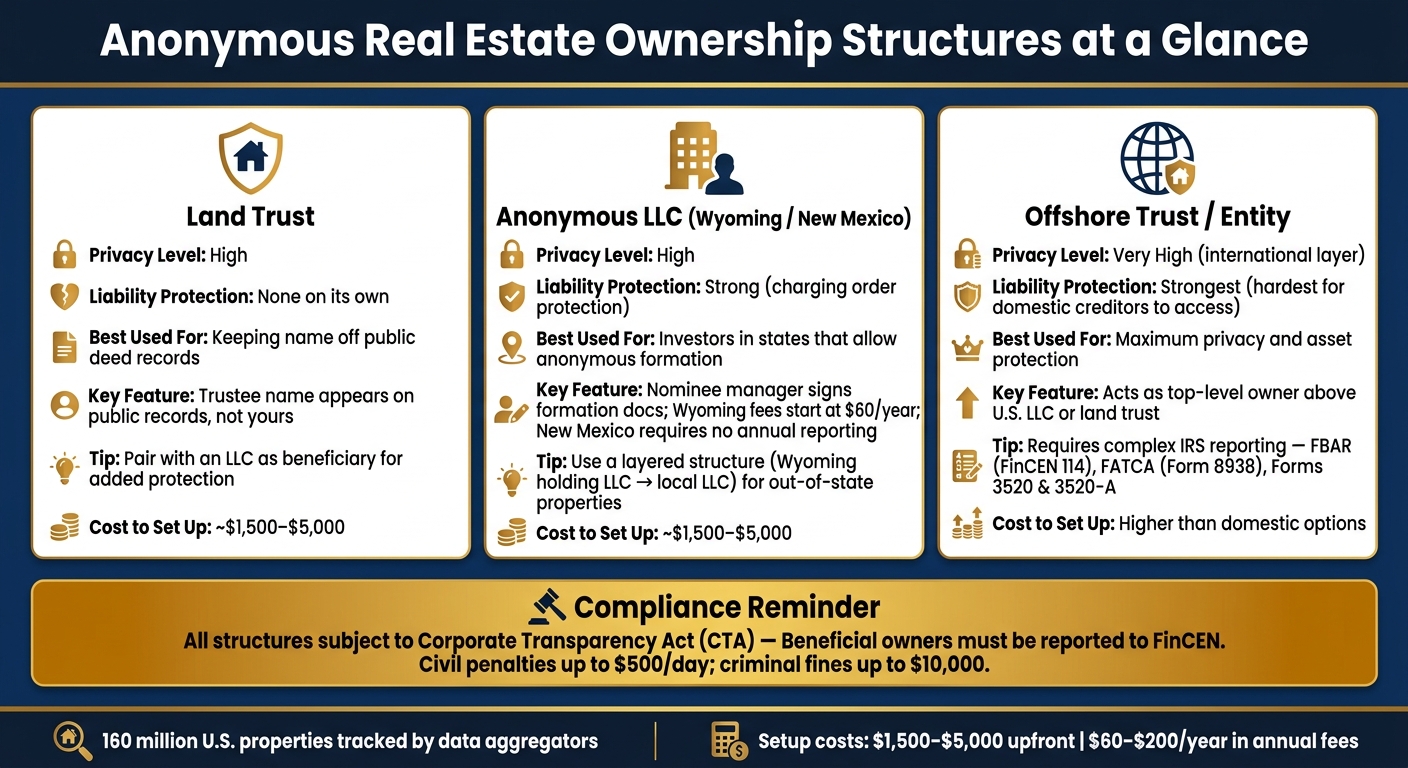
Creating an ownership structure that keeps your name out of public records requires careful planning. Three popular methods include land trusts, anonymous LLCs, and offshore entities.
Using Land Trusts for Privacy
A land trust allows you to transfer property into a trust, where a trustee holds the legal title, while you remain the beneficiary. The trustee’s name, not yours, appears in public records, and the trust agreement – which identifies the beneficiary – remains private. For example, naming a trust "Horizon Properties Trust" provides no clues about the actual owner.
However, land trusts alone don’t offer liability protection. If a lawsuit arises from an incident on the property, the trust won’t shield your personal assets. To enhance both privacy and protection, many experts suggest naming an LLC as the trust’s beneficiary. For added benefits, anonymous LLCs are another option worth considering.
How Anonymous LLC Structures Work
Anonymous LLCs provide a balance of privacy, asset protection, and compliance by limiting public disclosure of ownership. Only a few states – Delaware, Wyoming, New Mexico, and Nevada – allow for anonymous LLC formation. Wyoming and New Mexico are especially favored by real estate investors; Wyoming’s annual maintenance fees start at just $60, and New Mexico doesn’t require annual reporting.
To ensure your name stays off public documents, a nominee manager can sign the formation paperwork on your behalf.
If you’re investing in property located in a state that doesn’t permit anonymous LLCs, a layered structure can help. For instance, you could establish a Wyoming holding LLC that owns a second LLC registered in the state where the property is located. While the local LLC appears in public records, its ownership traces back to the private Wyoming LLC, preserving your anonymity. However, this strategy has limits. If the Wyoming LLC needs to register to operate in states like California, those states may require disclosure of member information, potentially undermining your privacy.
"Visibility equals vulnerability. The more your name appears on titles, cap tables, or beneficiary designations, the larger a target you present to opportunistic creditors and plaintiffs." – Estate Street Partners
Using Offshore Trusts and Entities
For those seeking maximum privacy, offshore trusts can add another layer of protection. These trusts can act as the top-level owner, either by holding a U.S.-based LLC or serving as the beneficiary of a land trust. This creates multiple barriers between you and the property in public records.
Here’s a quick comparison of domestic vs. offshore structures:
| Feature | Domestic LLC / Land Trust | Offshore Trust / Entity |
|---|---|---|
| Public Privacy | High (in states like Wyoming) | Very high (adds an international layer) |
| Asset Protection | Strong (charging order protection) | Strongest (harder for domestic creditors to access) |
| IRS Reporting | Standard (Forms 1040, 1065, 1041) | Complex (FBAR, FATCA, Forms 3520 & 3520-A) |
| Regulatory Oversight | Subject to CTA/BOI reporting | Subject to CTA/BOI and international disclosures |
While offshore trusts offer unmatched privacy, they come with stricter compliance responsibilities. Federal reporting requirements include FBAR (FinCEN Form 114) for foreign accounts, FATCA (Form 8938) for foreign financial assets, and Forms 3520 and 3520-A for transactions involving foreign trusts.
At Global Wealth Protection, we specialize in designing layered ownership structures, combining offshore trusts with private U.S. LLCs. This approach ensures your name stays off public records while remaining compliant with regulatory and tax requirements. These strategies are essential for maintaining your anonymity without stepping outside legal boundaries.
Balancing Privacy, Compliance, and Asset Protection
Staying Within Legal and Regulatory Limits
Maintaining privacy in real estate is possible, but it must align with legal requirements. For instance, the Corporate Transparency Act (CTA) mandates that beneficial ownership details be reported to FinCEN. While this information isn’t made public, it does mean complete federal anonymity is no longer an option. Additionally, transferring property to dodge creditors during ongoing litigation – known as fraudulent conveyance – is indefensible. However, structures created as part of standard operations are generally more defensible.
Legal compliance is just one piece of the puzzle. Smart tax planning can complement your ownership structure, providing both privacy and financial efficiency.
Aligning Privacy with Tax Efficiency
A well-thought-out ownership structure can reduce your tax liability without sacrificing privacy. For example, the IRS typically treats single-member LLCs as "disregarded entities", meaning the LLC’s income is reported directly on your personal tax return. This setup avoids the need for a separate corporate filing while still offering the liability protection of an LLC.
Another advantage comes with transfer costs. In Miami-Dade County, assigning the beneficial interest in a land trust instead of recording a new deed for a $1 million property could save you around $6,010 in documentary stamp taxes. These savings are achieved through proper structuring, not by engaging in risky tax practices.
As tax laws and regulations change, it’s crucial to revisit your ownership structure regularly to ensure it remains effective.
Reviewing Ownership Structures Over Time
Even with a solid legal and tax-efficient foundation, your ownership structure needs periodic reviews to stay relevant. Laws evolve, personal circumstances shift, and privacy measures that were once secure may no longer be effective. Conducting annual reviews is a key step for anyone holding real estate through trusts or LLCs.
Certain events should trigger an immediate reassessment. For example, foreign investors who spend considerable time in the U.S. may face U.S. tax residency if they meet the substantial presence test – spending 183 or more days over a weighted three-year period. This can significantly alter tax obligations. Similarly, estate planning rules are changing. By 2025, U.S. citizens will have a $13,990,000 federal estate tax exemption, while nonresident aliens will only receive $60,000. A structure designed for one tax status might not suit another.
Additionally, as county assessors move property records online, older structures like simple land trusts may become easier to trace. To maintain privacy, you might need to update your approach, such as combining a land trust with an anonymous LLC. Partnering with professionals who monitor regulatory changes – like the team at Global Wealth Protection – can help ensure your structure stays effective without requiring you to track every new development yourself.
Conclusion: How to Protect Your Privacy in Real Estate Ownership
Protecting your privacy when it comes to real estate requires careful planning and setting up the right structure from the very beginning. The key is to focus on timing, choose the right entities, and layer ownership effectively. For instance, creating an LLC or a land trust before you sign a purchase contract ensures your name stays out of public records. If your name ends up on a deed, reversing that exposure later can be both complicated and expensive.
As Hancock, McGill & Bleau explain:
"Achieving anonymity for a real estate investor is relative, not absolute."
Setting up a privacy-focused trust or LLC typically costs between $1,500 and $5,000 upfront, with annual fees ranging from $60 to $200 for registered agent services. While this may seem like a significant investment, it pays off by keeping your personal information secure.
Maintaining privacy requires more than just setting up the structure – it’s about ongoing diligence. Use your entity for property-related expenses, utilize professional mailing addresses, and regularly review your setup. This is especially important as laws like the Corporate Transparency Act continue to evolve. These steps will help ensure your structure remains effective and compliant over time.
For expert assistance in creating a privacy-focused structure, Global Wealth Protection offers services such as private US LLC formation, offshore trusts, and personalized consultations tailored to investors who prioritize privacy and asset protection.
FAQs
Will the Corporate Transparency Act eliminate real estate anonymity?
The Corporate Transparency Act is designed to enhance transparency around ownership, but it doesn’t entirely do away with anonymity. Tools like anonymous trusts and LLCs still offer ways to maintain a level of privacy in real estate ownership, even while complying with the Act’s stipulations.
What structure keeps my name off the deed from day one?
Using an LLC to hold property means your name doesn’t appear on the deed – only the LLC’s name does. This approach offers an extra layer of privacy and helps protect your assets.
How can I buy property privately if I need financing?
When buying property privately while requiring financing, one option is to use an LLC or a trust to hold the property. This approach can help maintain privacy. However, many lenders prefer working with individuals and might insist on personal guarantees, which could make staying anonymous more difficult.
Another route is exploring private or hard money lenders. These lenders often provide more flexible terms, but their loans typically come with higher interest rates. To navigate these options effectively and ensure they align with your privacy and financing goals, it’s wise to consult a legal or financial professional.
