
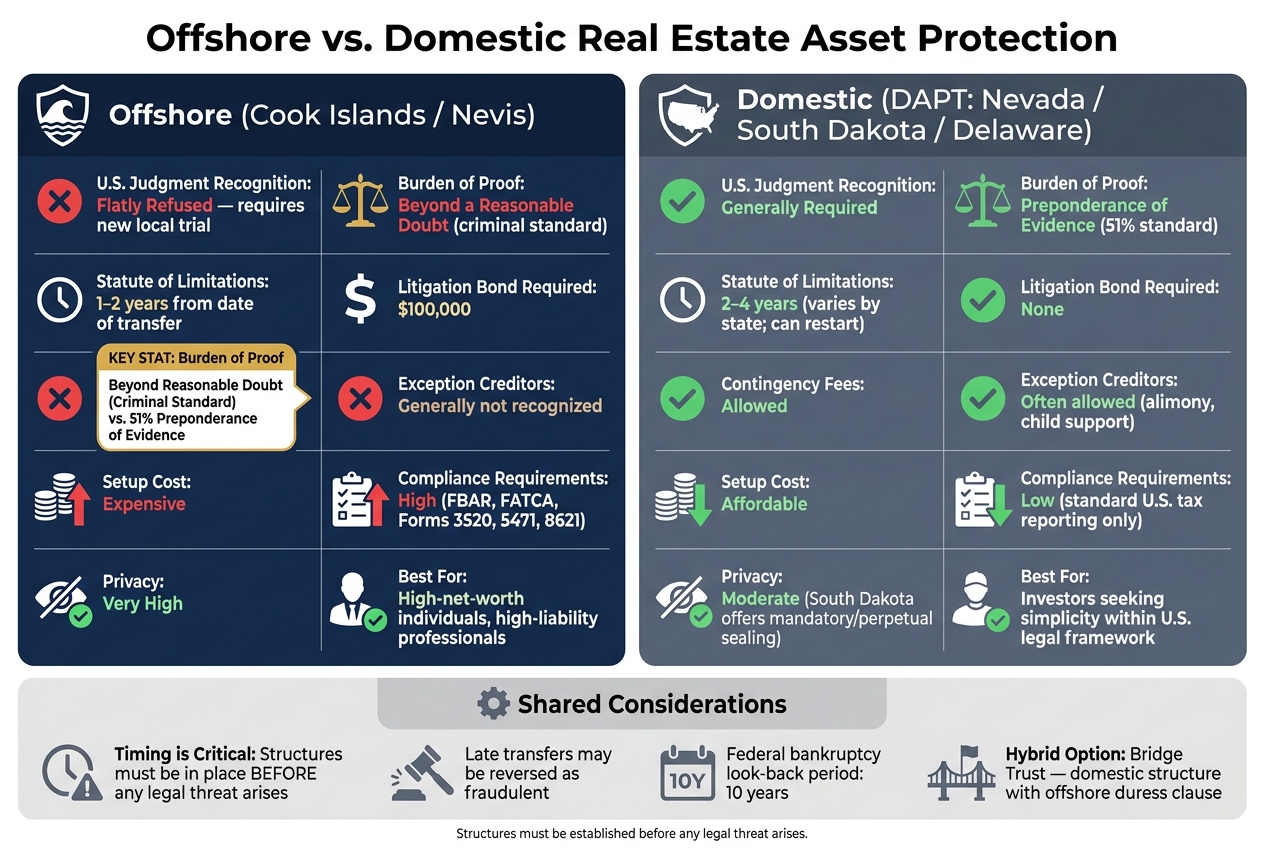
Protecting your real estate investments from creditors requires choosing the right strategy. Domestic and offshore methods each have strengths and weaknesses, depending on your goals, risk level, and willingness to manage complexity. Here’s what you need to know:
- Domestic Strategies: Use tools like LLCs and Domestic Asset Protection Trusts (DAPTs) under U.S. state law. They’re easier to manage but are still subject to U.S. court judgments and the Full Faith and Credit Clause.
- Offshore Strategies: Rely on foreign jurisdictions like the Cook Islands or Nevis that don’t recognize U.S. judgments. They offer stronger legal barriers but come with higher costs, compliance requirements, and complexity.
Key Differences:
- Judgment Recognition: Domestic trusts must honor U.S. court rulings, while offshore jurisdictions don’t.
- Burden of Proof: Offshore strategies require creditors to meet stricter legal standards.
- Cost: Offshore options are more expensive to set up and maintain.
- Compliance: Offshore structures involve complex U.S. tax reporting (e.g., FBAR, FATCA).
Quick Comparison:
| Feature | Domestic (DAPT) | Offshore (Cook Islands/Nevis) |
|---|---|---|
| U.S. Judgment Recognition | Required | Refused |
| Statute of Limitations | 2–4 years | 1–2 years |
| Compliance Requirements | Low | High |
| Setup Cost | Affordable | Expensive |
Timing is critical: Asset protection structures must be in place before any legal threats arise. Late transfers may be reversed as fraudulent.
For high-risk individuals or those managing significant assets, combining domestic and offshore strategies (e.g., Bridge Trusts) can offer enhanced protection while balancing simplicity and cost.
Domestic Real Estate Structures for Asset Protection
Common Domestic Structures and How They Work
When it comes to protecting assets in the U.S., investors often rely on three main tools: LLCs, Domestic Asset Protection Trusts (DAPTs), and Asset Management Limited Partnerships (AMLPs).
An LLC acts as a barrier between your personal finances and the property it owns. For instance, if a tenant sues over an injury on your property, the LLC takes the hit, keeping your personal bank accounts and other assets safe. This is known as inside liability protection. However, there’s a flip side: outside liability. If you face a personal lawsuit – like one resulting from a car accident – a creditor could potentially target your LLC membership interest.
To maximize protection, investors often combine these tools. You can achieve horizontal protection by holding property in an LLC and vertical protection by using a DAPT or AMLP to own the LLC. This layered approach strengthens your defenses.
One important note: revocable living trusts do not protect assets. Since you can cancel these trusts at any time, the law considers the assets within them as still being under your ownership.
"The revocable trust is the estate planning foundation, not the asset protection structure." – Brian T. Bradley, Esq., Bradley Legal Corp
Advantages of Domestic Real Estate Strategies
Domestic strategies offer several practical benefits, although they come with some vulnerabilities.
The biggest upside? Simplicity. Everything stays within familiar U.S. systems – courts, banks, and legal frameworks. There’s no need for foreign filings, trustees, or currency exchanges. These structures are also less expensive to set up and maintain compared to offshore strategies.
Some states provide robust protections. For example:
- Nevada: No exception creditors (even for alimony or child support claims) and a short two-year window for creditors to challenge trust transfers.
- South Dakota: Offers automatic, permanent sealing of court records in trust disputes, rivaling offshore privacy. Like Nevada, it also has a two-year statute of limitations.
- Delaware: While offering strong protections, it has a longer four-year statute of limitations and allows some exception creditors, such as for alimony or child support.
| Feature | Nevada DAPT | South Dakota DAPT | Delaware DAPT |
|---|---|---|---|
| Statute of Limitations | 2 years | 2 years | 4 years |
| Exception Creditors | None | Child support only | Alimony, child support, property division |
| Privacy | Judicial discretion | Mandatory/perpetual sealing | Judicial discretion |
| State Income Tax | 0% | 0% | 0% |
These advantages make domestic structures appealing, but they’re not without flaws.
Limitations of Domestic Structures
Domestic structures face vulnerabilities that investors often overlook.
The most significant risk is jurisdiction. Thanks to the Full Faith and Credit Clause, a creditor with a valid judgment in one state can ask courts in another state – including states with protective DAPT laws – to enforce it. Offshore jurisdictions, by contrast, refuse to recognize U.S. judgments altogether.
The situs rule adds another layer of risk. If your property is in a state that doesn’t honor self-settled spendthrift trusts, the protective structure you set up elsewhere could be disregarded entirely.
"A Nevada trust holding California real estate is not a Nevada trust when it matters." – Ipanema Partners
Single-member LLCs (SMLLCs) are particularly vulnerable. In the case of Olmstead v. FTC, Florida’s Supreme Court ruled that creditors could seize the entire membership interest of a debtor’s SMLLC – not just issue a charging order. This effectively hands over control of the property.
Timing also plays a crucial role. Under federal bankruptcy law, any transfers into self-settled trusts made within 10 years of a legal threat can be undone if there’s intent to defraud. If you fund these structures after a lawsuit or legal issue arises, the courts could reverse the transfer entirely.
sbb-itb-39d39a6
Offshore Real Estate for Asset Protection
Using Offshore Structures to Hold Foreign Real Estate
Owning foreign real estate through an offshore entity can effectively shield the asset from U.S. court judgments. Jurisdictions like the Cook Islands and Nevis are known for their refusal to recognize U.S. legal rulings. This means that even if a creditor wins a lawsuit in the U.S., they would need to start an entirely new legal process in these foreign jurisdictions, which are designed to make litigation difficult and expensive.
These legal barriers discourage creditors. For example, they must post a $100,000 litigation bond and meet a higher standard of proof – proving fraudulent transfers beyond a reasonable doubt, rather than the lower civil standard. On top of that, contingency fee arrangements aren’t allowed, so creditors need to pay attorneys upfront. For most creditors, the financial and logistical challenges simply aren’t worth it.
"The Cook Islands is the undisputed global gold standard… no Cook Islands trust that was properly structured and funded before any legal claim has ever been successfully penetrated by a U.S. creditor." – Ipanema Partners
The Cook Islands also enforces a strict one-to-two-year statute of limitations for fraudulent transfer claims, starting from the date the trust is funded – not from when a judgment is issued. This is a stark contrast to domestic cases like In re: Momentum Development, LLC, where courts allowed the four-year clock to reset after a final judgment was entered in 2018, even though the original property transfer occurred back in 2012.
This difference highlights the unique advantages of offshore strategies compared to domestic methods, particularly when it comes to protecting assets.
Protecting U.S.-Based Property With Offshore Structures
When it comes to U.S. real estate, the situs rule applies, meaning the property is governed by local law. This was clearly demonstrated in the United States v. Huckaby case in 2026. Here, a Nevada Spendthrift Trust holding property in California failed to protect the asset when the IRS pursued it, as California law doesn’t honor self-settled spendthrift trusts.
To counter this exposure, offshore strategies use creative methods to protect U.S.-based property. One such method is equity stripping, where a lien is placed on the property, payable to an offshore LLC owned by an offshore trust. This reduces the property’s visible equity, discouraging creditors from attempting to seize it. Another approach is the "bridge trust", which pairs an offshore trust (like a Nevis trust) with a domestic LLC holding the property. If a U.S. court tries to seize the asset, a duress clause allows control to shift to the foreign trustee, who is legally obligated to reject repatriation orders.
However, retaining too much control over an offshore structure can backfire. In cases like FTC v. Affordable Media and In re Lawrence, U.S. courts jailed individuals for contempt because they served as their own Trust Protectors. This invalidated their "impossibility defense." For offshore protection to work, an independent institutional trustee must manage the trust, ensuring the settlor genuinely cannot comply with court orders to return the assets.
Strengths and Limitations of Offshore Strategies
Offshore strategies offer a distinct advantage: legal distance. Offshore jurisdictions operate independently and are not bound by the U.S. Constitution’s Full Faith and Credit Clause, nor do they follow orders from U.S. courts. This level of protection is unmatched by domestic structures.
However, there are notable downsides. Offshore planning is expensive. Setup costs, trustee fees, hiring local counsel, and compliance with U.S. regulations all add up. Compliance is mandatory – U.S. persons must file FinCEN Form 114 (FBAR) if their foreign financial accounts exceed $10,000 during the year, as well as Form 8938 (FATCA) if their foreign assets surpass certain thresholds. Additionally, offshore corporate structures may trigger PFIC or CFC rules, leading to more reporting requirements and potential tax implications.
| Feature | Cook Islands Trust | Nevis LLC | Nevada DAPT |
|---|---|---|---|
| U.S. Judgment Recognition | Refused | Refused | Required |
| Burden of Proof | Beyond reasonable doubt | Beyond reasonable doubt | Preponderance of evidence |
| Litigation Bond | $100,000 | $100,000 | None |
| Statute of Limitations | 1–2 years from transfer date | 1–2 years from transfer date | 2 years (can restart) |
| Charging Order Expiry | N/A | 3 years, non-renewable | N/A |
Timing is critical for offshore protection. Transfers made after a legal threat arises are vulnerable to fraudulent conveyance claims. To ensure protection, these structures must be established well in advance – ideally years before any potential liability. If this route interests you, it’s crucial to work with seasoned professionals both in the U.S. and the chosen offshore jurisdiction. Services like Global Wealth Protection specialize in creating compliant and properly structured offshore frameworks tailored to your needs.
Offshore vs. Domestic Real Estate: A Direct Comparison
Legal Protections and Creditor Resistance
When it comes to legal protections, the difference between domestic and offshore strategies is stark. Domestic strategies operate under U.S. court jurisdiction, which means they’re subject to the Full Faith and Credit Clause. This clause ensures that a judgment in one state can typically be enforced in another. Even in states like Nevada, South Dakota, or Delaware – known for their protective laws – this clause limits the effectiveness of domestic asset protection trusts.
Offshore jurisdictions, such as the Cook Islands and Nevis, take a completely different approach. They flat-out refuse to recognize U.S. judgments. Creditors must re-litigate their claims in these jurisdictions, often under much stricter legal standards. For example, in the Cook Islands, the burden of proof is flipped. A creditor must prove beyond a reasonable doubt – the same standard used in criminal cases – that the trust was set up with the intent to defraud that specific creditor.
"The Cook Islands flips the burden of proof… the creditor must prove ‘beyond a reasonable doubt’ (the criminal standard) that the settlor established the trust with the specific intent to defraud that particular creditor." – Ipanema Partners
This is far tougher than the 51% preponderance of evidence standard used in U.S. civil courts. Additionally, the statute of limitations in offshore jurisdictions is often just one to two years from the date of transfer, which further deters creditors. Here’s how the two approaches compare:
| Feature | Domestic (DAPT) | Offshore (Cook Islands/Nevis) |
|---|---|---|
| U.S. Judgment Recognition | Generally recognized | Flatly refused; requires new local trial |
| Statute of Limitations | 2–4 years (varies by state) | 1–2 years from date of transfer |
| Burden of Proof | Preponderance of evidence (51%) | Beyond a reasonable doubt (criminal standard) |
| Litigation Costs | Standard U.S. legal fees | High; $100,000 bond; no contingency fees |
| Exception Creditors | Often allowed (alimony, child support) | Generally not recognized |
These legal differences highlight the stronger protections offered by offshore structures but also set the stage for the practical challenges involved in managing them.
Financing, Management, and Day-to-Day Operations
On the financing front, domestic real estate has a clear edge in simplicity. U.S. investors benefit from access to 30-year fixed-rate mortgages, which are a rarity in foreign markets. Offshore property purchases often require variable-rate loans, shorter loan terms, or even cash payments. For those who can’t secure traditional foreign financing, securities-backed loans in the U.S. are an option, but they come with increased risks tied to the value of the underlying collateral.
Managing offshore property also presents unique hurdles. You’ll need local experts – real estate attorneys, property managers, and tax advisors – who understand the intricacies of local laws and ownership regulations. This adds layers of complexity to your operations. On top of that, currency risk is a constant concern. Rental income in a foreign currency can swing widely against the U.S. dollar, impacting cash flow and the eventual resale value of the property.
In contrast, domestic real estate management is far more straightforward. Everything operates in U.S. dollars, within a familiar legal and regulatory framework. This simplicity often makes domestic real estate a more practical choice for day-to-day operations.
But the differences don’t stop there – tax rules further distinguish these strategies.
Tax Reporting and Compliance Requirements
Offshore strategies bring significant tax reporting obligations. U.S. taxpayers are required to report worldwide income, no matter where their assets are located. Owning foreign real estate – or holding it through an offshore entity – doesn’t change this obligation, but it does add a layer of complexity.
For example, if you hold foreign financial accounts exceeding $10,000 at any point during the year, you’ll need to file FinCEN Form 114 (FBAR). If your foreign assets meet certain thresholds, Form 8938 (FATCA) comes into play. Depending on the structure you use, additional forms like 3520/3520-A, 5471, or 8621 may also be required.
Domestic real estate, on the other hand, sticks to standard U.S. tax reporting with no foreign disclosure requirements. Both domestic and offshore asset protection trusts are typically classified as grantor trusts for U.S. tax purposes, meaning they’re tax-neutral when it comes to income. However, the heavy reporting burden associated with offshore strategies is a key trade-off for the higher level of protection they provide against U.S. judgments.
Conclusion: Choosing the Right Asset Protection Strategy
Asset protection strategies need to align with your specific risks, the location of your assets, privacy needs, and the level of complexity you’re comfortable managing. As ICLG wisely notes, "There is no universal solution suitable for everyone."
Key Takeaways
- Domestic structures: These are more affordable and easier to manage but remain under U.S. jurisdiction.
- Offshore structures: They offer stronger creditor resistance but come with higher costs and more complicated compliance requirements.
Understanding the situs rule is essential: the legal protections for property are governed by its location. To better safeguard your equity, consider having the trust hold the LLC membership interest instead of owning the deed directly.
Timing is another critical factor. Brian T. Bradley, Esq. emphasizes this point:
"The window for effective planning exists only before the threat appears. And once it closes, it rarely reopens." – Brian T. Bradley, Esq., Bradley Legal Corp
Late-stage transfers are often deemed fraudulent and can be reversed, especially given the 10-year bankruptcy look-back period. Reactive planning simply doesn’t work in these scenarios.
Next Steps for Asset Protection Planning
To strengthen your asset protection plan, start by evaluating your liability exposure. For instance, a physician, real estate developer, or high-net-worth investor faces risks that are vastly different from someone owning a single rental property. If your exposure is significant, a layered approach combining an LLC for internal liability with an offshore trust for external liability can be highly effective.
If a fully offshore solution feels out of reach, consider a Bridge Trust. This hybrid option operates as a domestic grantor trust for tax simplicity but includes a duress clause, allowing it to transition to an offshore jurisdiction if a legal threat arises.
Given the complexities of these structures, it’s crucial to work with seasoned professionals. For instance, Global Wealth Protection specializes in helping location-independent investors and entrepreneurs create tailored, legally sound asset protection plans, ranging from offshore trust setups to domestic LLC strategies.
FAQs
When does an offshore trust make more sense than a U.S. LLC or DAPT?
Offshore trusts can be an excellent option when the priority is strong asset protection beyond the reach of U.S. courts. Trusts established in places like the Cook Islands move assets out of U.S. jurisdiction, creating significant obstacles for creditors trying to claim them. These trusts are particularly useful in high-risk scenarios, as they rely on foreign trustees and local laws that offer far greater protection compared to U.S.-based LLCs or domestic asset protection trusts (DAPT).
How does the situs rule limit protection for out-of-state real estate?
The situs rule impacts the protection of out-of-state real estate because legal and tax protections are tied to the property’s physical location (its situs). Real estate is subject to the laws of the state where it resides. This means asset protection tools, such as LLCs or trusts, might not work as effectively if the property is in a state with stricter regulations or less favorable asset protection laws.
What tax forms might I have to file with offshore structures?
If you’re a non-resident, you might need to file U.S. income tax returns, such as Form 1040NR. Additionally, if you have offshore accounts or assets, you may need to submit forms like FBAR (Report of Foreign Bank and Financial Accounts) or FATCA (Foreign Account Tax Compliance Act) reports. The specific requirements vary based on your offshore structure and ownership setup. It’s a good idea to consult a tax professional to make sure you’re meeting all reporting obligations.
