
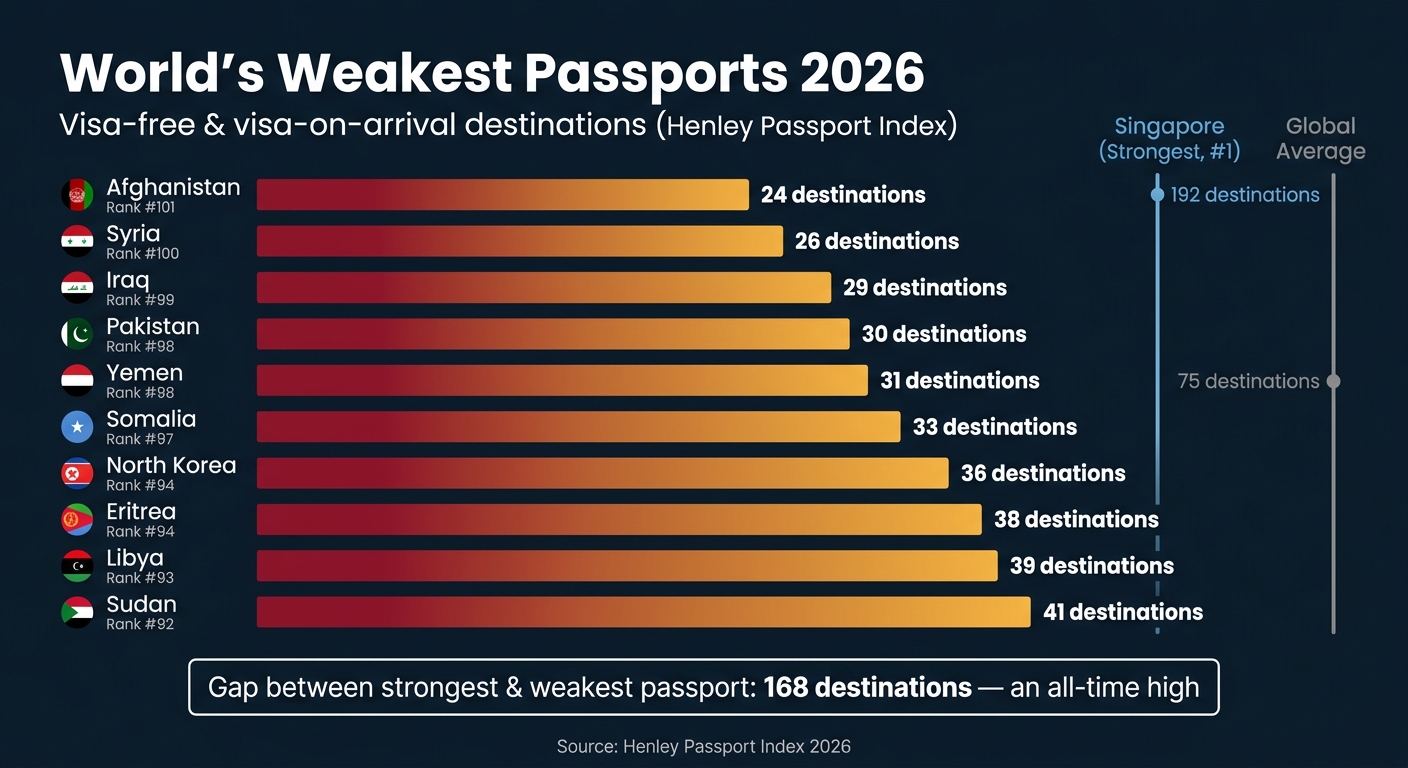
In 2026, the weakest passports in the world severely limit global mobility, with Afghanistan ranking the lowest, granting visa-free access to only 24 destinations. The gap between the strongest (Singapore, with 192 destinations) and weakest passports has widened to an all-time high of 168 destinations. This disparity highlights the influence of political instability, conflict, and limited diplomatic ties on passport strength.
Here’s a quick summary of the 10 weakest passports:
- Afghanistan: 24 destinations (lowest globally)
- Syria: 26 destinations
- Iraq: 29 destinations
- Pakistan: 30 destinations
- Yemen: 31 destinations
- Somalia: 33 destinations
- Libya: 39 destinations
- Sudan: 41 destinations
- Eritrea: 38 destinations
- North Korea: 36 destinations
These passports face challenges due to conflict, sanctions, and diplomatic isolation, affecting not just travel but access to education, jobs, and global opportunities. While some countries offer citizenship programs or Residency by Investment programs to overcome these barriers, the cost often remains out of reach for most individuals.
1. Afghanistan
Afghanistan’s passport exemplifies the struggles faced by individuals with highly restricted travel options. As of 2026, it ranks as the weakest passport globally, sitting at 101st place on the Henley Passport Index. Afghan passport holders can travel to just 24 destinations without needing a visa beforehand – the only passport with access to fewer than 25 destinations.
Here’s how those 24 destinations are categorized:
| Access Type | Destinations |
|---|---|
| Visa-free | Cook Islands, Dominica, Haiti, Micronesia |
| Visa-on-arrival | Bangladesh, Cambodia, Maldives, Rwanda, Macao (SAR China), and 12 others |
| ETA | Sri Lanka, Kenya, Seychelles |
| Total | 24 |
This limited access reflects Afghanistan’s lack of travel agreements, which significantly curtails mobility.
The situation is further complicated by Afghanistan’s diplomatic isolation. The Taliban-led administration’s absence of formal United Nations recognition has prevented the establishment of bilateral visa agreements. These restrictions extend beyond leisure travel, impacting vital aspects of life such as education, medical care, and family connections. For Afghan citizens, international travel often involves a lengthy and cumbersome process that includes visa applications, embassy visits, and extensive background checks.
"That gap may look like a number on paper, but in real life it shapes job opportunities, education prospects, business travel and family visits abroad." – ET Now
The disparity between Afghanistan’s passport and the world’s strongest has grown dramatically over the years. In 2006, the difference in accessible destinations was 118. By 2026, that gap has ballooned to 168 destinations. This stark contrast highlights the profound challenges faced by Afghan passport holders in a world where mobility often translates to opportunity.
sbb-itb-39d39a6
2. Syria
Syria ranks as the second weakest passport in terms of global travel freedom, just behind Afghanistan. According to the Henley Passport Index, Syrian passport holders can access only 26 visa-free destinations, while needing visas for 162 other countries. The Passport Index provides a slightly broader Mobility Score of 36, which includes visa-on-arrival and e-visa options:
| Access Type | Destinations |
|---|---|
| Visa-free | 9 |
| Visa-on-arrival / e-visa | 27 |
| Total | 36 (Mobility Score) |
Years of conflict have severely weakened Syria’s diplomatic relationships, making international travel increasingly difficult. Over a decade of war, combined with international sanctions and limited global recognition, has left the country with very few reciprocal visa agreements. This has drastically reduced the strength of the Syrian passport.
The impact of these restrictions goes far beyond tourism. Everyday activities such as studying abroad, accessing crucial medical care, or visiting family often require extensive background checks and long, complicated visa processes. As Despina Wilson, Business News Editor at CEOWORLD magazine, explains:
"For lower-ranked passports, including Pakistan, Iraq, Syria, and Afghanistan, routine business travel can become a structural barrier."
The disparity is stark when compared to other nations in the region. The UAE passport, for instance, ranks 2nd globally with access to 187 destinations, thanks to its extensive diplomatic efforts. Meanwhile, Singapore, which holds the world’s strongest passport, allows its citizens visa-free access to 192 destinations. In 2026, a Singaporean citizen can visit over seven times as many countries without a visa compared to someone from Syria. These differences in mobility highlight the ongoing challenges faced by conflict-affected nations like Syria.
3. Iraq
In 2026, Iraq holds the 99th spot on the Henley Passport Index, offering visa-free or visa-on-arrival access to just 29 destinations. This places it as the world’s third weakest passport. Similar to Syria and Afghanistan, Iraq’s limited travel access reflects years of instability and weakened diplomatic relations.
Here’s how Iraq’s passport ranks across major indexes:
| Index | Global Rank | Total Access |
|---|---|---|
| Henley Passport Index 2026 | 99th | 29 destinations |
| Global Passport Power Rank 2026 | 91st | 41 (Mobility Score) |
| PassportScope 2026 | 98th | 38 (Mobility Score) |
This trend highlights the challenges faced by countries with fragile international relationships.
Decades of armed conflict, political instability, and corruption have drastically reduced Iraq’s ability to establish visa agreements. For Iraqi citizens, traveling abroad often involves months of navigating bureaucratic hurdles. In stark contrast, passports from countries like the UAE and Singapore grant access to 184 and 192 destinations respectively, creating gaps of 155 and 163 destinations.
4. Pakistan
In 2026, Pakistan’s ranking on the Henley Passport Index showed some movement – starting at 97th place in February with access to 32 visa-free or visa-on-arrival destinations, and dropping to 100th place by May with access reduced to 30 destinations. Pakistani passport holders face some of the toughest travel restrictions worldwide.
Here’s how various mobility indices evaluate the Pakistani passport:
| Index | Global Rank | Destinations/Mobility Score |
|---|---|---|
| Henley Passport Index 2026 | 97th | 32 |
| CEOWORLD Global Mobility Index 2026 | 100th | 30 |
| Passport Index (Power Rank) | 90th | 42 |
| The Visa Index | 97th | 24 |
For Pakistani travelers, these rankings translate into significant barriers. Even for countries offering visa-free or visa-on-arrival access, additional documentation is often required – such as return tickets, proof of funds, confirmed accommodation, and vaccination records. For instance, South Africa mandates transit visas for layovers, further complicating travel within Africa. These obstacles highlight the broader difficulties faced by holders of the world’s least powerful passports in 2026.
Pakistan’s situation is particularly stark when compared to its neighbors. Only Iraq, Syria, and Afghanistan rank lower on the Henley Passport Index. Meanwhile, India is ranked 80th, granting its citizens access to 55 destinations. This 25-destination gap underscores the severe restrictions faced by Pakistani passport holders, especially when contrasted with the world’s top-ranking passports, which provide access to 192 destinations.
5. Yemen
Yemen’s passport ranks 98th globally on the 2026 Henley Passport Index, allowing access to just 31 destinations without a visa or with visa-on-arrival privileges. Similarly, the Global Passport Power Rank places Yemen at 88th, with a mobility score of 45 – broken down into 13 visa-free destinations and 32 visa-on-arrival options. These rankings highlight significant challenges beyond the numbers.
| Index | 2026 Global Rank | Accessible Destinations |
|---|---|---|
| Henley Passport Index | 98th | 31 |
| Global Passport Power Rank | 88th | 45 |
The root of these low rankings lies in Yemen’s prolonged conflict and instability. Years of political unrest have prompted many countries to impose strict entry requirements on Yemeni citizens. Additionally, international security advisories further limit their ability to travel freely. As Eshita Bhargava, Associate Editor at ET Now, explains:
"Ongoing political instability and years of conflict have significantly limited international mobility for Yemeni citizens."
For Yemeni travelers, planning a trip often involves months of preparation, extensive paperwork, and a high risk of visa refusals. These restrictions not only complicate travel but also hinder access to global job markets and educational opportunities, illustrating the broader consequences of a weak passport.
The gap becomes even more apparent when compared to top-ranking passports. For instance, Singapore’s passport, ranked 1st globally, grants access to 192 destinations, while the UAE passport, ranked 5th, allows entry to 184 destinations. This stark difference underscores the challenges Yemeni citizens face with their limited access to just 31 destinations.
6. Somalia
Somalia’s passport highlights significant hurdles when it comes to global mobility. Ranked 96th on the 2026 Henley Passport Index, it allows access to only 33 destinations. Similarly, the Global Passport Power Rank places Somalia at 89th, with a slightly higher mobility score of 43 destinations. This includes 15 visa-free countries and 28 destinations offering visas on arrival. However, Somali passport holders must secure pre-approved visas for 155 out of 198 destinations worldwide.
| Index | 2026 Global Rank | Accessible Destinations |
|---|---|---|
| Henley Passport Index | 96th | 33 |
| Global Passport Power Rank | 89th | 43 |
The restricted access tied to Somalia’s passport is largely due to ongoing security concerns, limited diplomatic relationships, and economic challenges. Many countries are hesitant to ease entry for Somali citizens, citing a lack of diplomatic agreements or leverage. As noted by Global Citizen Consultants:
"These figures reflect the impact of political, economic, and security instability on freedom of movement."
For Somali citizens, obtaining a visa often involves a lengthy and cumbersome process, including embassy visits, extensive paperwork, and prolonged waiting periods. These barriers affect more than just leisure travel – they limit opportunities for business, employment, and education, making it difficult for individuals to explore better prospects abroad. Somalia’s case underscores the broader challenges faced by citizens of conflict-affected and diplomatically isolated nations, a recurring theme throughout this discussion.
7. Libya
Libya’s passport ranks 93rd globally on the 2026 Henley Passport Index, offering visa-free or visa-on-arrival access to just 39 destinations. This places it behind regional neighbors like Tunisia and Morocco. Similarly, the Passport Index by Arton Capital assigns Libya a Power Rank of 83, with a mobility score allowing access to 52 destinations.
| Index | 2026 Global Rank | Accessible Destinations |
|---|---|---|
| Henley Passport Index | 93rd | 39 |
| Passport Index (Arton Capital) | 83rd | 52 |
While Libya’s ranking has slightly improved from its 2021 low of 108th, its passport still grants access to only about 17% of the 227 possible destinations, keeping it among the least powerful globally. This limited mobility sharply contrasts with neighboring countries and reflects Libya’s ongoing struggles to rebuild diplomatic relationships.
The primary reason behind these challenges lies in the political divisions that escalated after 2014, which fractured Libya’s international relations and left it increasingly isolated. For example, since June 9, 2025, the United States has restricted visa issuance for Libyan passport holders, while territories like Ascension Island have denied entry entirely since May 2015. Even in cases where entry is allowed, the conditions are often stringent. For instance, Lebanon requires Libyan travelers to carry $2,000 in cash and have a confirmed reservation at a 3- to 5-star hotel to qualify for a visa on arrival. These restrictions illustrate how political instability has a direct impact on global mobility.
As journalist Misha Glenny points out, the limited strength of Libya’s passport is a stark reflection of the country’s deep political divides and diminished diplomatic standing.
For Libyan citizens, these restrictions create significant barriers to education, employment, and business opportunities, further exacerbating the country’s economic struggles.
8. Sudan
Sudan’s passport ranks 92nd globally on the 2026 Henley Passport Index, granting access to just 41 destinations. Sharing this position with South Sudan, both nations fall into the lower ranks of global passport strength. Other metrics paint a similar picture: the Passport Index by Arton Capital places Sudan at 84th, offering access to 51 destinations, while The Visa Index ranks it 89th with only 27 destinations accessible.
| Index | Sudan’s Rank | Accessible Destinations |
|---|---|---|
| Henley Passport Index | 92nd | 41 |
| Passport Index (Arton Capital) | 84th | 51 |
| The Visa Index | 89th | 27 |
To put this into perspective, Sudanese passport holders face a stark difference compared to Singapore, whose passport provides access to 192 destinations – a gap of 151 destinations. The global average for visa-free travel in 2026 is 75 destinations, meaning Sudanese citizens can travel to little more than half of what the average traveler enjoys.
Sudan’s challenges extend far beyond passport rankings. Years of civil war between the SAF and RSF have plunged the country into what is now the world’s largest humanitarian crisis. The economy contracted by –20.3% in 2024, inflation surged past 240%, and the currency lost over 300% of its value since the conflict began. With unemployment projected to hit 61.3% in 2026, many Sudanese lack the financial resources to consider international travel.
On top of these economic hardships, international travel restrictions further limit mobility. The U.S. Department of State issued a Level 4 "Do Not Travel" advisory for Sudan on May 15, 2026, citing dangers such as armed conflict, terrorism, kidnapping, and landmines. Meanwhile, Schengen visa rejection rates for African applicants, including Sudanese, soared to 26.6% following EU visa policy reforms in 2024 and 2025.
Prof. Mehari Taddele Maru of the European University Institute and Johns Hopkins University SAIS commented on these policies:
"These policies do not simply regulate mobility – they institutionalize it… What we are witnessing is a form of conditional racial discrimination in visa policymaking, shaped by geopolitical power rather than individual risk."
For Sudanese citizens, the combination of internal conflict, economic devastation, and restrictive international visa policies creates barriers that effectively erase any meaningful opportunities for global mobility.
9. Eritrea
Eritrea’s passport ranks 94th on the 2026 Henley Passport Index, granting access to just 38 destinations – a position it shares with North Korea and the Palestinian Territory. Other rankings paint a similar picture. The Global Passport Power Rank places Eritrea at 85th with a score of 49, while PassportScope ranks it 96th with a score of 42.
| Index | Global Rank | Accessible Destinations |
|---|---|---|
| Henley Passport Index | 94th | 38 |
| Global Passport Power Rank | 85th | 49 |
| PassportScope | 96th | 42 |
This disparity is striking – Eritrean passport holders can access 154 fewer destinations compared to Singapore, the global leader in mobility.
The limited power of the Eritrean passport is largely tied to the country’s political isolation. Strict controls on emigration and a lack of extensive diplomatic ties – partly due to Eritrea’s relatively recent independence in 1993 – have made it difficult to establish reciprocal visa agreements.
For Eritrean citizens, international travel often involves navigating a lengthy and challenging process. As Eshita Bhargava, Associate Editor at ET Now, describes:
"For millions of people around the world, the journey begins long before the airport. It starts with visa forms, embassy appointments, background checks and sometimes weeks – even months – of waiting for approval."
These hurdles go beyond leisure travel, affecting crucial areas like education, job opportunities, and economic advancement. Eritrea’s restricted passport power not only limits mobility but also creates barriers to broader opportunities that could improve quality of life.
10. North Korea
North Korea’s passport ranks 94th on the 2026 Henley Passport Index, allowing visa-free or visa-on-arrival access to only 36 destinations. The situation isn’t much better on other major indexes.
| Index | Global Rank | Accessible Destinations |
|---|---|---|
| Henley Passport Index | 94th | 36 |
| PassportIndex.org | 86th | 48 |
| The Visa Index | 94th | 21 |
To put this into perspective, North Korean passport holders face a gap of about 156 destinations compared to Singapore, which offers access to 192 locations. Neighboring countries like South Korea and Japan also provide significantly greater mobility, with both granting access to 188 destinations. This stark difference not only limits North Koreans’ ability to travel abroad but also highlights the regime’s tight grip on inbound and outbound travel.
The government imposes strict restrictions on its citizens, barring them from traveling freely. Foreign visitors, meanwhile, are required to join government-approved guided tours, further emphasizing the regime’s control over movement.
For North Korean citizens, decades of international sanctions and political isolation have made it nearly impossible to establish the diplomatic ties needed for reciprocal visa agreements. As a result, most countries require a traditional visa, leaving North Koreans needing visas for roughly 150 destinations.
Pros and Cons
These 10 passports offer very limited advantages for international travel. As highlighted earlier, the gap between the most powerful and least powerful passports has reached a record 168 destinations by 2026. Below is a table summarizing each passport’s ranking along with the primary challenges they face.
| Country | Henley Rank | Visa-Free Destinations | Key Limitation |
|---|---|---|---|
| Afghanistan | 101 | 24 | Conflict, sanctions, and limited diplomacy |
| Syria | 100 | 26 | Geopolitical isolation and ongoing conflict |
| Iraq | 99 | 29 | Security concerns and regional instability |
| Pakistan | 98 | 31 | High refusal rates and stringent security checks |
| Yemen | 98 | 31 | Conflict-related travel restrictions |
| Somalia | 97 | 32 | Severe security concerns and limited global access |
| Libya | 96 | 40 | Conflict and governance issues |
| Sudan | 95 | 43 | Political instability |
| Eritrea | 94 | 38 | Strict governance and tight migration controls |
| North Korea | 94 | 36 | International isolation and sanctions |
The limited mobility associated with these passports doesn’t just hinder travel; it also restricts access to education, employment, and broader global opportunities.
These low rankings mean travelers face complicated visa requirements and high rejection rates. For many, the process involves embassy appointments, extensive background checks, and long waiting periods – often lasting weeks or even months. For instance, the Schengen visa refusal rate for African applicants rose from 18.6% in 2015 to 26.6% by 2024.
"For millions of people around the world, the journey begins long before the airport. It starts with visa forms, embassy appointments, background checks and sometimes weeks – even months – of waiting for approval." – Eshita Bhargava, Associate Editor, ET Now
There are, however, a few limited advantages to note. Passport rankings don’t influence eligibility for work visas, study permits, or employer-sponsored residency, which are assessed based on individual qualifications and financial resources. Additionally, some passports benefit from regional agreements. For example, the open border between Nepal and India allows citizens of both nations to live and work freely.
"What we are witnessing is a form of conditional racial discrimination in visa policymaking, shaped by geopolitical power rather than individual risk." – Prof. Mehari Taddele Maru, European University Institute
Despite these minor benefits, the structural challenges tied to these passports remain overwhelming. As a result, there has been a 28% annual increase in applications for alternative residence and citizenship programs, as individuals search for more dependable mobility options.
Conclusion
The 10 passports at the bottom of the 2026 Henley Index face shared challenges like geopolitical instability, international sanctions, and limited diplomatic ties. For those holding these passports, the impact extends far beyond just travel restrictions – it affects access to global job markets, prestigious universities, and international business opportunities. This creates daily hurdles for millions of people.
The numbers paint a stark picture. Over the past two decades, the gap in travel freedom has widened dramatically – from 118 destinations to 168. At the top of the list, Singapore offers access to 192 destinations, while Afghanistan lags far behind with only 24 destinations. This growing divide highlights how much global mobility hinges on one’s place of birth.
For individuals seeking to overcome these barriers, programs offering second citizenship or residency provide a viable solution. Citizenship by Investment (CBI) options, such as those in Dominica (starting at $200,000) and Saint Kitts and Nevis (starting at $250,000), can grant visa-free travel to Europe and other key regions. Similarly, Residency by Investment (RBI) programs, like those in Greece (starting at €250,000) or the UAE (starting at $545,000), pave the way to naturalization. These programs are designed to address the structural limitations discussed throughout this article.
Experts emphasize the growing importance of these strategies:
"In an era of geopolitical uncertainty and increasingly fragmented travel regimes, residence and citizenship planning has evolved into an essential strategy for building resilience, optionality, and mobility certainty across multiple jurisdictions." – Dr. Juerg Steffen, CEO of Henley & Partners
What was once a niche option for the ultra-wealthy has become a practical approach for individuals aiming to safeguard their access to global opportunities. If your passport restricts where you can go, it also limits what you can achieve – and tackling this issue proactively is more important than ever.
FAQs
Why do passport rankings differ across indexes?
Passport rankings differ because each index relies on unique methods to evaluate global mobility. Some emphasize factors like visa-free access, visa-on-arrival privileges, or electronic travel authorizations (eTAs). Others include additional elements, such as the importance of destinations. Variations also arise due to differences in data update schedules, shifts in diplomatic relations, and how entry requirements are classified.
What does “visa-free” vs “visa on arrival” vs “ETA” mean?
“Visa-free” travel means you can enter a country without needing to secure approval or extra paperwork beforehand. On the other hand, “Visa on arrival” lets you get the necessary entry documents when you reach the border. An Electronic Travel Authorization (eTA) is a pre-screening process for travelers who are exempt from visas, completed online before leaving for your trip. These options make travel easier by skipping long pre-trip visa applications.
How can someone legally improve travel access with a weak passport?
Obtaining additional citizenships or residencies is a legal way to expand travel options. Programs based on investment or ancestry can grant a new passport, often with broader visa-free access, which helps bypass travel restrictions. Beyond mobility, a second citizenship can open doors to international opportunities like access to global markets, education systems, and healthcare services. It also provides more dependable travel arrangements, ensuring greater freedom for personal and professional pursuits.
Related Blog Posts
- Passport Portfolio Strategy: How Many Citizenships Do You Actually Need?
- Worst Passports in the World: Why Citizenship Diversification Matters More Than Ever
- What are the strongest passports in the world in 2026? (Full ranking)
- How to build a bulletproof Plan B in 2026 (banking, residency, citizenship)
