
In 2026, financial and geopolitical risks are driving individuals to secure their futures with a diversified Plan B. This strategy relies on three key pillars: international banking, backup residency, and second citizenship. Together, these elements protect your assets, ensure mobility, and provide security against potential disruptions. Here’s a quick breakdown:
- International Banking: Open accounts in stable jurisdictions (e.g., Switzerland, Singapore) to safeguard funds and maintain access during crises.
- Backup Residency: Obtain residency in countries like Panama, Paraguay, or Portugal for legal options, tax benefits, and local access.
- Second Citizenship: Secure a second passport through descent, investment, or residency, offering mobility and long-term protection.
Start by assessing your risk exposure and setting clear financial, mobility, tax, and family goals. Build your Plan B step-by-step, beginning with banking, followed by residency, and then citizenship. Compliance with U.S. tax laws (e.g., FBAR and FATCA) is critical throughout the process.
Quick Tip: Fast-track options like Caribbean Citizenship by Investment (starting at $200,000) or Paraguay’s Investor Pass ($200,000 real estate) can help you establish a robust Plan B within months.
This guide explains how to execute each step effectively while staying compliant and organized.
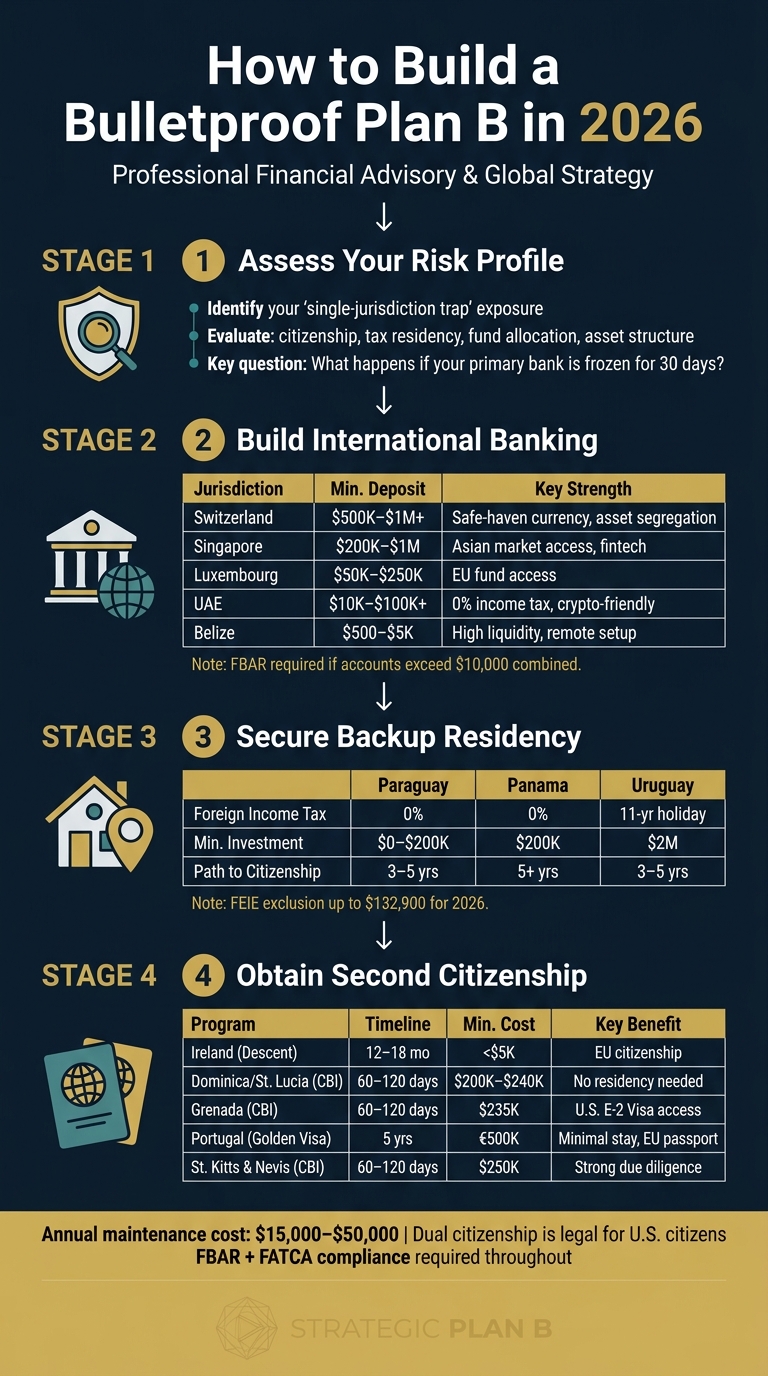
Assessing Your Risk Profile and Goals
How to Map Your Personal Risk Exposure
Creating a solid Plan B begins with a clear understanding of your current vulnerabilities. Many people don’t realize the extent of their exposure until a crisis hits. The main issue is often what experts call the "single-jurisdiction trap" – when your citizenship, residence, banking, business, and real estate are all tied to one government. If that government suddenly changes its policies, you could be left with no safety net.
To evaluate your exposure, focus on four key areas: citizenship, tax residency, fund allocation, and asset structure. A simple but critical question to ask yourself is: What would happen if my primary bank account were frozen for 30 days? If the answer involves significant financial distress, your exposure is high.
Risks like capital controls, currency devaluation, and abrupt tax reforms aren’t just hypothetical anymore – they’ve become real possibilities in 2026.
Once you’ve identified your risks, the next step is to outline specific Plan B goals.
Setting Clear Plan B Goals
Define your goals across four main categories:
| Goal | Key Consideration | Example Jurisdictions |
|---|---|---|
| Financial security | Political stability, strong institutions | Singapore, Switzerland, Panama |
| Global mobility | Visa-free access, regional settlement rights | Malta, St. Kitts & Nevis, Greece |
| Tax predictability | Territorial tax systems, economic substance | Panama, Cayman Islands |
| Family protection | Education, healthcare, multi-generational planning | UAE, Portugal, Antigua & Barbuda |
It’s important to remember that obtaining a second passport doesn’t automatically change your tax obligations as a U.S. citizen. Tax residency is determined by factors like physical presence and your "center of life", so your goals need to account for these rules from the outset.
"In 2026, wealth is no longer measured solely by net worth. It is measured by options." – Vicky Katsarova, High Net Worth Immigration
With your goals in place, the next step is to prioritize your actions.
What to Do First vs. What Can Wait
Your timeline should reflect your risk exposure and the goals you’ve set. Start by securing international banking. Having at least one bank account outside the U.S. provides immediate flexibility and serves as the foundation for your entire Plan B. As one expert succinctly put it:
"Everything else you build needs a functional financial backbone. Without it, you have a plan on paper." – Isha Sesay, Editor-in-Chief, Escape Artist
Once your banking is sorted, focus on residency, followed by citizenship. Residency is typically renewable and often requires physical presence, while citizenship is permanent, heritable, and comes with a passport. Programs in the Caribbean can process citizenship applications in two to six months, while European options like Malta take longer but grant access to 183 countries. If time is critical, fast-track programs like Vanuatu can deliver citizenship in as little as 30 to 60 days.
Planning ahead gives you the flexibility to establish a tax base, secure a lifestyle residency, and obtain a second passport on your own terms.
sbb-itb-39d39a6
How to Build a Solid International Banking Setup
International banking forms the backbone of a reliable Plan B. Having at least one fully operational bank account outside the U.S. ensures you maintain financial access if domestic systems encounter issues. The key is to select jurisdictions known for political stability, strong regulations, and independence from U.S. financial policies.
Which Banking Jurisdictions Are Worth Considering
Not every offshore banking destination is created equal. Switzerland continues to set the standard for wealth management. It holds about 25% of global cross-border assets, with foreign exchange reserves nearing $909 billion – nearly 100% of its GDP. The Swiss franc is widely regarded as a safe-haven currency, and securities in Swiss accounts are classified as segregated assets (Sondervermögen). This means they are separate from the bank’s balance sheet and protected even if the bank faces insolvency.
"Switzerland’s attraction rests on four reinforcing pillars: longstanding political neutrality, a strong rule of law, sophisticated private banking infrastructure, and safe-haven currency status." – Alexander Lindemann, Founder, LINDEMANNLAW
For those seeking access to Asian markets, Singapore is a top choice. Its government operates with virtually no net debt, and foreign reserves stand at approximately $365 billion. Leading banks like DBS, OCBC, and UOB are consistently ranked among the world’s safest. The city-state’s rapid growth in single-family offices – rising from 400 in 2020 to over 2,000 by the end of 2024 – highlights its appeal to high-net-worth individuals.
If you’re starting with a smaller capital base, Belize offers a practical option. With a legal requirement for banks to maintain a liquidity ratio of 24% – far above the 3–4% typical in U.S. banks – Belizean accounts can often be opened remotely with deposits ranging from $500 to $5,000. Luxembourg and Andorra are also solid European options, particularly for those seeking access to EU investment structures without direct ties to the European Central Bank.
| Jurisdiction | Typical Minimum Deposit | Primary Strength |
|---|---|---|
| Switzerland | $500,000 – $1M+ | Safe-haven currency, asset segregation |
| Singapore | $200,000 – $1M | Asian market access, fintech integration |
| Luxembourg | $50,000 – $250,000 | EU fund access, investor protection |
| UAE | $10,000 – $100,000+ | 0% income tax, crypto-friendly |
| Belize | $500 – $5,000 | High liquidity, remote setup |
The next step? Learning how to navigate the account opening process efficiently.
How to Open a Foreign Bank Account
Opening a foreign bank account in 2026 is more complex than it was just a few years ago. Heightened anti-money-laundering measures have led banks to demand more detailed documentation about the source of wealth (SoW) and source of funds (SoF).
"The era of simple access is over. Consequently, securing a non-resident account today demands strategic precision." – BMA Business Solutions
Here’s what you’ll need to prepare:
- A certified color copy of your passport
- Proof of address dated within the last three months
- A reference letter from your current bank
- Documentation explaining your wealth’s origin and how it was built
- Your U.S. Social Security Number for FATCA compliance
Some Swiss and Singaporean banks also require an in-person meeting or a video KYC (Know Your Customer) call before approval. To streamline the process, create a one-page financial summary detailing your business activities, income sources, and expected transaction volumes. This document can significantly cut down onboarding time. For high-end private banks, working with a professional introducer can reduce the approval process from months to as little as one to four weeks.
U.S. citizens should remember two key reporting requirements for foreign accounts. If the combined value of all your accounts exceeds $10,000 at any point during the year, you must file the FBAR (FinCEN Form 114). Additionally, FATCA (Form 8938) must be submitted with your annual tax return, though the thresholds vary based on your filing status. These are disclosure rules, not restrictions – offshore accounts are entirely legal.
Enhancing Protection with Offshore Entities
After setting up a personal account, you can add another layer of security with offshore structures. These entities create legal separation, ensuring your assets, liabilities, and income streams are held in distinct legal vehicles. This separation minimizes risks by isolating problems in one area from affecting your entire portfolio.
For example, pairing an offshore company – like a Nevis LLC – with a corporate bank account in a different jurisdiction, such as Panama, creates two independent layers of protection. Offshore trusts take this a step further, offering intergenerational asset protection and shielding wealth from future creditors. However, these trusts need to be established before any financial crisis to be effective.
In 2026, jurisdictions like the British Virgin Islands, Cayman Islands, and Jersey require "economic substance." This means entities must demonstrate genuine business activity, local decision-making, and physical presence. The introduction of CRS 2.0 and the Crypto-Asset Reporting Framework (CARF) has made transparency the new standard, eliminating the loopholes that older setups relied on.
"The 2024–2026 regulatory environment has changed which combinations work and which have ceased to provide their historical benefits. The current environment rewards substantive structure over nominal arrangement." – Sarah Mitchell, Senior Immigration Advisor, WorldPath AI
Maintaining compliance for these structures can cost anywhere from $13,000 to $165,000 annually, depending on their complexity. Firms like Global Wealth Protection specialize in offshore company formation and trust services, offering consultations to help tailor solutions to your specific needs.
Lastly, if your business activities or company structure changes, inform your bank immediately. Banks conduct routine compliance reviews, and discrepancies between your records and actual activities can result in temporary account restrictions. Staying proactive is much easier than addressing issues after they arise.
How to Get a Backup Residency
Once you’ve set up international banking, the next logical step is securing a backup residency. This move diversifies your legal options, protects your financial future, and can even lead to a second passport. It’s also a key to accessing foreign banking while reducing reliance on a single government. Fortunately, several countries have made this process straightforward for U.S. citizens.
Residency Options for U.S. Citizens
There are two main paths for U.S. citizens seeking residency abroad: residency by independent means or residency by investment.
- Residency by independent means involves proving you have a steady income. While this option is generally more affordable, it often requires extensive documentation to verify your financial stability.
- Residency by investment requires a financial commitment, such as purchasing real estate, making a bank deposit, or investing in a business. Though this route can be more expensive upfront, it usually has fewer bureaucratic hurdles and quicker processing times.
For many, the investment route offers a practical balance between cost and convenience. Others may prefer a low-cost option in a country with a territorial tax system.
Countries That Make Residency Easy
If you’re considering backup residency in 2026, three countries stand out: Paraguay, Panama, and Uruguay. Each offers different benefits, so your choice will depend on your priorities.
| Factor | Paraguay | Panama | Uruguay |
|---|---|---|---|
| Foreign Income Tax | 0% (Territorial) | 0% (Territorial) | 11-year holiday (Conditional) |
| Min. Investment | $0 to $200,000 | $200,000 | $2,000,000 (for tax holiday) |
| Physical Presence | 1 visit every 3 years (PR) | 1 visit every 2 years | 183 days (for tax holiday) |
| Path to Citizenship | 3 to 5 years | 5+ years | 3 to 5 years |
| Cost of Living | Very low | Moderate | High |
Paraguay is the most accessible option. The traditional route requires no minimum investment, with government fees ranging from $300 to $500 and legal counsel costing $1,500 to $3,500. In April 2026, Paraguay introduced the "Investor Pass", allowing for immediate permanent residency through a $200,000 real estate investment, skipping the usual two-year temporary phase.
"Paraguay is actively opening its doors to foreign investment… The government processed over 47,000 new residency applications in 2025 – up from 28,000 in 2024 – and is projecting over 80,000 in 2026." – Lincoln Global Partners
Panama, with its dollarized economy and modern infrastructure, offers the Friendly Nations Visa. However, as of 2026, applicants must invest $200,000 in real estate or a fixed-term bank deposit. This option is ideal for those seeking a more urban environment and are comfortable with a larger financial commitment.
Uruguay, known for its high quality of life, has stricter requirements for its tax holiday. As of January 1, 2026, under Law N° 20.446, new residents must either spend 183 days annually in the country or invest $2,000,000 in real estate to qualify for the 11-year foreign income exemption. While appealing, this option may pose challenges for those looking to keep costs low.
Steps to Apply for Residency
Once you’ve assessed your options and finalized your banking setup, follow these steps to secure residency:
- Gather Required Documents: You’ll need a certified copy of your passport, your original birth certificate, police clearances from every country you’ve lived in over the last three years, and proof of financial means (such as a bank statement or a deposit of around $5,000). Documents must include a Hague Apostille and, in most cases, a certified Spanish translation. If your documents are in a less common language, first translate them into English, then have the English version apostilled before translating into Spanish.
- Submit Your Application: Upon arrival, file your application, provide biometrics, and obtain local clearances.
- Obtain Your Residency Card: After approval, you’ll receive a national ID card (called a Cédula in Paraguay and Panama), which is essential for opening bank accounts and signing contracts. In Paraguay, it takes about 90 days to process the residency card, followed by another 90 days to issue the Cédula.
While obtaining foreign residency doesn’t eliminate your U.S. tax obligations, it does open the door to the Foreign Earned Income Exclusion (FEIE). For 2026, the FEIE allows you to exclude up to $132,900 of foreign-earned income from U.S. taxes. To establish tax residency in your new country, secure a local Tax ID (known as a RUC in Paraguay) and maintain active filings, even if they report zero local income.
How to Get a Second Citizenship
A second citizenship is a key part of any Plan B. It grants you the legal right to live, work, and travel under the protection of another government, offering security no matter what happens in your home country. Here’s a closer look at the four main ways to obtain this valuable asset.
The Main Paths to a Second Citizenship
There are four primary routes to explore, and your choice will depend on factors like budget, timeline, and family heritage.
Citizenship by descent is often the most affordable option, so it’s worth checking first. For example, around 33 million Americans have Irish ancestry, 17 million have Italian roots, and 9 million trace back to Poland. If you qualify, an Irish citizenship application costs about €278 and takes 12–18 months. Italy has recently tightened its rules, limiting claims to grandparents under Law 74/2025, so if you have an Italian-born grandparent, act quickly. Poland, on the other hand, allows claims dating back to 1918 without a generational cap. Costs for this route are typically under $5,000, covering fees and document preparation.
Citizenship by Investment (CBI) is the fastest option. In the Caribbean, countries like St. Kitts and Nevis, Dominica, Grenada, Antigua, and St. Lucia offer passports in exchange for donations or real estate investments, with no residency requirement. Processing usually takes 60–120 days. Grenada is especially appealing for U.S. citizens because its passport provides access to the U.S. E-2 Investor Visa, a benefit shared only with Turkey in the CBI category.
Naturalization through residency takes longer but builds stronger ties to the country. Paraguay and Argentina offer some of the fastest paths, with citizenship available in three and two years, respectively, for those who establish genuine residency.
For a hybrid approach, Golden Visas combine residency with investment. Portugal’s Golden Visa program requires a minimum €500,000 investment and only seven days of physical presence per year, leading to citizenship after five years. Greece offers a lower entry point (€250,000–€800,000 depending on the region), but requires 183 days of annual residency and seven years to qualify for citizenship.
Securing a second citizenship strengthens your Plan B, complementing strategies like international banking and backup residency.
How to Evaluate a Citizenship Program
Not all programs are equally beneficial, and some have recently lost their appeal. For instance, Vanuatu’s passport lost its Schengen visa-free access in 2024, significantly reducing its value despite its $130,000 price tag. Spain also closed its Golden Visa program to new applicants in April 2025.
When evaluating a citizenship program, consider factors like passport utility, processing time, total cost, and overall stability. Here’s a comparison of some of the most relevant options for U.S. citizens in 2026:
| Program | Timeline | Min. Cost | Key Benefit |
|---|---|---|---|
| Ireland (Descent) | 12–18 months | <$5,000 | EU citizenship; 185+ visa-free countries |
| Italy (Descent) | 12–60 months | <$5,000 | EU citizenship; grandparent limit applies |
| Dominica / St. Lucia (CBI) | 60–120 days | $200,000–$240,000 | Quick passport; no residency needed |
| St. Kitts & Nevis (CBI) | 60–120 days | $250,000 | Long track record; strong due diligence |
| Grenada (CBI) | 60–120 days | $235,000 | U.S. E-2 Visa eligibility |
| Turkey (CBI) | 3–6 months | $400,000 | Direct citizenship; U.S. E-2 Visa access |
| Portugal (Golden Visa) | 5 years to citizenship | €500,000 | Minimal stay requirement; EU citizenship |
Malta continues to lead the Global Citizenship Programs Index for the 11th year running in 2026. Its passport offers visa-free access to 183 countries, but recent changes now require a €600,000 investment following a 2025 EU court ruling.
"The programs still standing in ten years will not be the most affordable or the fastest; they will be the ones with rigorous due diligence, transparent governance, and strong international standing." – Patricia Casaburi, CEO, Global Citizen Solutions
What U.S. Citizens Need to Know
Dual citizenship is legal for U.S. citizens, but a second passport doesn’t change your tax obligations. The IRS taxes worldwide income, regardless of where you live or how many passports you hold. FATCA and FBAR reporting requirements remain fully applicable.
The only way to end U.S. tax liability is to renounce your citizenship, which requires holding a valid second passport. For most people, though, a second citizenship serves as a safety net rather than an exit strategy.
"Most of our U.S. clients are looking for a Plan B, almost like an insurance policy… they want to put in place options for themselves and their families to protect generational wealth." – Judi Galst, Managing Director, Henley & Partners
One important tax consideration: U.S. citizens investing in foreign mutual funds or ETFs through Golden Visa programs may trigger Passive Foreign Investment Company (PFIC) rules. These rules can lead to retroactive taxation at the highest federal rate of 37%, plus interest. Before committing to any investment-based program, consult a tax advisor with expertise in international compliance. Adding a second citizenship can enhance your overall strategy for protecting assets and expanding personal freedom.
Putting Banking, Residency, and Citizenship Together
Combining international banking, backup residency, and second citizenship creates a solid foundation for financial security. A second passport without a foreign bank account offers mobility but lacks the financial tools for smooth international transactions. On the flip side, a foreign bank account without residency leaves you without a legal or operational base. Integrating all three elements ensures they work together, reinforcing one another. Here’s how to weave these components into a cohesive strategy.
A Timeline for Building Your Plan B
Start with banking. Open an account in a stable jurisdiction like Singapore, Panama, or Switzerland. This account can serve as the financial backbone for your residency and citizenship plans.
Next, secure a second passport through Citizenship by Investment. These programs typically take 60–120 days and provide permanent mobility, giving you freedom to move internationally without restrictions.
After that, establish residency. This adds a local address, access to healthcare, and a legal presence. Programs like the Portugal Golden Visa require minimal physical presence while offering a pathway to EU citizenship. Residency acts as your operational base, while citizenship anchors your long-term freedom and security.
Finally, consider offshore asset protection. Trusts or foundations can help shield your wealth. As NTL Trust puts it:
"A passport gets you across the border. An offshore trust makes sure your wealth is waiting for you on the other side."
Remember, maintaining these structures comes with annual costs, typically ranging from $15,000 to $50,000 for legal and tax coordination. Each step not only strengthens your legal framework but also expands your financial flexibility across borders.
Staying Compliant and Keeping Good Records
Compliance is non-negotiable. Even a single missed filing or renewal can disrupt your entire Plan B. For U.S. citizens, this means filing an FBAR (FinCEN Form 114) if your foreign financial accounts exceed $10,000 at any point in the year. Additionally, FATCA (Form 8938) requires reporting of foreign financial assets above specific thresholds, regardless of your residency or number of passports.
Beyond U.S. obligations, over 100 countries participate in the Common Reporting Standard (CRS), which automatically shares financial account data based on your declared residence. Any mismatch between your declared fiscal residence and your actual physical presence could trigger a tax inquiry.
To avoid issues, log your days digitally to track where you spend your time. Many countries use a 183-day rule to determine tax residency, but others, like the UK, Canada, and Australia, consider economic ties and habitual residence. Accurate tracking is essential for staying compliant with these rules.
Adopt a "Family Offshore Office" approach. Use a single compliance calendar to manage passport expirations, residency renewals, corporate filings, and updates for offshore structures. This system simplifies the process and helps you stay organized.
When and How to Review Your Plan B
Even after building your Plan B, regular reviews are crucial. Regulations can change quickly, and a plan that works today might become outdated within a year or two. Review your strategy at least every two years, or sooner if you experience major life changes – such as shifts in income, marital status, or relocation – or if new regulatory updates affect your chosen jurisdictions. Collaborating with a cross-border tax attorney or accountant who tracks global regulatory changes can help you stay ahead of potential compliance gaps.
"Residence and citizenship rights are being integrated into the core architecture of wealth structuring, alongside trusts, holding companies, and asset allocation strategies." – Dominic Volek, Group Head of Private Clients, Henley & Partners
Ultimately, the best Plan B is not the most expensive one – it’s the plan that is legally sound, actively managed, and adaptable to changing circumstances and regulations.
Conclusion: Your Plan B Starts Now
After reviewing strategies for secure banking, residency, and citizenship, one thing is clear: diversification is key. Relying on a single jurisdiction for your assets, citizenship, and banking leaves you exposed to potential political or financial upheavals.
Each of the three pillars plays a crucial role in creating a safety net. International banking ensures access to funds outside your home system. Backup residency provides a legal foothold in another country. And second citizenship offers permanent mobility – a level of freedom that no residency permit can fully guarantee.
Patricia Casaburi, CEO of Global Citizen Solutions, explains it well:
"Citizenship is no longer pursued as an end goal. It has become one component within a broader risk-management architecture, considered alongside tax planning, asset structuring, and relocation options rather than after them."
This mindset is increasingly common among ultra-high-net-worth individuals. In fact, over 34% of them now hold or are pursuing a second citizenship. The investment migration industry itself generated nearly €20 billion in revenue in 2024, reflecting its growing importance. However, access to the best programs is becoming more difficult as governments raise thresholds and tighten eligibility requirements.
To protect your financial future in these unpredictable times, the best time to act is now. Open a foreign bank account, initiate your residency or citizenship process, and consult a cross-border tax advisor. As NTL Trust emphasizes, "The single most important rule of asset protection is that it must be established before you need it." Those who prepare during stable times are the ones best equipped to weather future disruptions.
FAQs
How much money do I need to start a Plan B?
The cost of setting up a Plan B can vary widely based on your objectives. For strategies focused solely on residency, you might spend less than $100,000. On the other hand, Caribbean citizenship-by-investment programs typically fall between $100,000 and $200,000. If you’re aiming for a comprehensive citizenship package, the expenses can climb beyond $1,000,000.
For those eligible, pursuing citizenship by descent is usually far more affordable, often costing less than $5,000 in fees. When it comes to international banking, the required initial capital depends largely on the specific jurisdiction you’re dealing with.
Which country is best for a backup residency for Americans?
When choosing the best backup residency, it ultimately depends on what you’re aiming for – whether that’s tax advantages, enhanced mobility, or minimal physical presence requirements. Some popular options include Portugal, which offers a low minimum stay requirement and a clear pathway to EU citizenship. Greece is another favorite, thanks to its relatively simple residency process.
If your focus is on territorial tax benefits, Costa Rica might be a strong contender. On the other hand, New Zealand stands out for those seeking long-term stability and security. Make sure to evaluate your choice based on factors like your assets and timeline, especially since residency rules can evolve over time.
What should I do first: banking, residency, or a second passport?
International banking is the backbone of any residency or citizenship planning strategy. It offers the financial infrastructure and flexibility necessary to manage assets, pay program fees, and navigate the complexities of global mobility. Without access to reliable banking solutions, handling these processes becomes far more challenging.
Once your banking arrangements are in place, think of residency and citizenship as interconnected parts of a larger plan. By diversifying across multiple jurisdictions, you can enhance financial and personal security. Strategically choosing where you bank, live, and hold citizenship helps minimize risks and prevents over-reliance on any single country.
