
Private jets in 2026 are no longer just a luxury – they’re a necessity for time, privacy, and global mobility. With over 713,000 ultra-high-net-worth individuals (UHNWIs) worldwide, private aviation is essential for managing cross-border responsibilities. Key trends include a rise in private jet charters, advanced privacy measures, and tax strategies that make jet ownership more practical.
Key Takeaways:
- Time-Saving: Private jets save 8–20 hours per trip by skipping layovers and crowded terminals.
- Privacy Concerns: Cybersecurity threats are up 131%, making flight data protection critical.
- Access Models: Options include full ownership, fractional shares, jet cards, and charters, tailored to different travel needs.
- Tax Benefits: The 2025 tax law allows 100% depreciation for business-use jets, but compliance is crucial.
- Privacy Tools: FAA programs like LADD and PIA help limit flight tracking, but international privacy requires additional steps.
- Ownership Structures: LLCs, trusts, and offshore entities protect assets and enhance privacy.
In 2026, private aviation is part of a broader wealth strategy – offering efficiency, security, and control for UHNWIs navigating a global lifestyle.
How Wealthy Travelers Access Private Jets in 2026
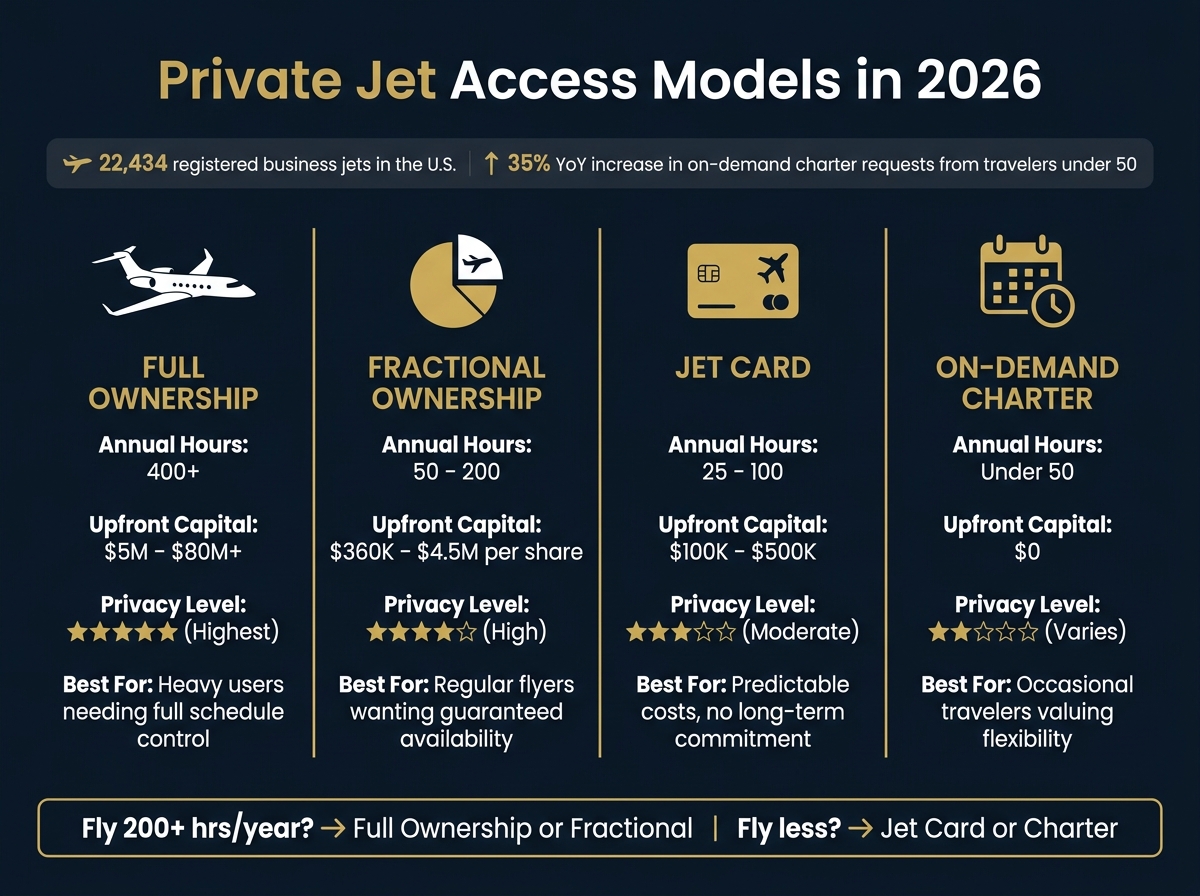
The way affluent individuals approach private aviation has changed significantly. By 2026, the United States boasts 22,434 registered business jets. Yet, instead of owning jets outright, many ultra-high-net-worth (UHNW) individuals are opting for fractional ownership, jet cards, or on-demand charters. This shift is largely driven by a desire for better capital allocation. Younger UHNW travelers, particularly Gen Xers and Millennials, are prioritizing investments in high-growth opportunities over tying up millions in a depreciating asset. This trend has fueled a 35% year-over-year increase in on-demand charter requests from travelers under 50.
Private Aviation Access Models: Full Ownership, Fractional, Jet Cards, and Charters
Different access models cater to varying travel needs. The right choice depends on how often you fly and how much control you want over your travel experience.
| Model | Annual Hours | Upfront Capital | Privacy Level | Best For |
|---|---|---|---|---|
| Full Ownership | 400+ | $5M – $80M+ | Highest | Heavy users who need full control over schedule and aircraft configuration |
| Fractional | 50 – 200 | $360K – $4.5M (per share) | High | Regular flyers who want guaranteed availability without full ownership responsibilities |
| Jet Card | 25 – 100 | $100K – $500K | Moderate | Flyers seeking predictable costs without long-term commitments |
| On-Demand Charter | Under 50 | $0 | Varies | Occasional travelers valuing flexibility over fixed arrangements |
A simple rule: if you fly more than 200 hours a year, full ownership or fractional shares often make more sense financially than chartering. For those flying less, jet cards and on-demand charters are usually more cost-effective.
Some fractional programs go beyond just providing access. Take Flexjet’s Red Label, for example. By early 2026, this program expanded to 12 European cities, including London, Paris, and Zurich. It offers shareholders a consistent experience by assigning both primary and secondary crews to specific aircraft. On the membership side, Wheels Up rebounded financially in late 2025 after a $100 million investment and operational restructuring by Delta Air Lines, stabilizing its King Air 350i fleet for mid-market travelers.
"A jet card does not make flying cheaper. It makes flying predictable. You trade the discount potential of open-market sourcing for the certainty that an aircraft will be there when you need it." – Brian Galvan, Founder, The Jet Finder
Before committing to any program, it’s essential to compare your most common routes against open charter market rates. If the membership doesn’t offer a clear cost advantage, the long-term commitment may not be worth it.
Aircraft Types and When to Use Each
Picking the right aircraft is just as important as choosing the right access model. Factors like passenger count, luggage needs, and route distances play a big role in this decision.
| Jet Category | Typical Range | Passenger Capacity | Best For |
|---|---|---|---|
| Light Jets (e.g., Phenom 300E, Citation CJ3) | 1 – 3 hours | Up to 7 | Short regional trips and smaller airports; ideal for 1–4 passengers |
| Midsize Jets (e.g., Citation Latitude, Challenger 350) | Up to 3,500 nm | 8 – 10 | Coast-to-coast travel with added comfort like stand-up cabins |
| Heavy Jets (e.g., Challenger 650) | 4,000 – 6,000 nm | 10 – 14 | Transatlantic flights, such as New York to London |
| Ultra-Long-Range (e.g., Gulfstream G700, Global 8000) | 6,500 – 7,700 nm | 14 – 19 | Non-stop global travel with flights exceeding 14 hours |
For international trips, ultra-long-range jets eliminate the need for refueling stops. The Bombardier Global 8000, which debuted in 2026, is the fastest civilian aircraft since Concorde, hitting speeds of up to Mach 0.95. Meanwhile, the Gulfstream G700 enhances passenger comfort with a cabin altitude of just 2,916 feet at cruising height, reducing fatigue on long-haul flights. Private jets also unlock access to over 5,000 airports across the U.S., compared to the roughly 500 served by commercial airlines. This flexibility allows travelers to bypass congested hubs and reach secondary destinations more efficiently.
sbb-itb-39d39a6
Privacy, Security, and Anonymity in Private Aviation
Having access to a private jet is only part of the equation – keeping your movements discreet is the other. By 2026, flight tracking technology has become both affordable and widely accessible. A commercial-grade ADS-B receiver costs less than $200 and can track aircraft in real time. Platforms like ADS-B Exchange gather data directly from ground receivers, bypassing FAA restrictions. This is a detail many travelers might overlook.
How to Limit Public Flight Tracking
The FAA offers two programs designed to protect flight information, and they work best when used together. The Limiting Aircraft Data Displayed (LADD) program prevents your flight data from being shared with commercial tracking platforms like FlightAware and Flightradar24. Meanwhile, the Privacy ICAO Address (PIA) program assigns your aircraft a temporary, rotating transponder address, unlinking your flights from your permanent registration. As of 2026, PIA addresses can be changed every 20 days. Both programs are free through the FAA.
However, PIA protections only apply domestically. When flying internationally, your aircraft reverts to its permanent ICAO address. For global travel, a brokered charter offers better privacy since the aircraft is registered to the operator, not the traveler.
| Privacy Method | How It Works | Key Limitation |
|---|---|---|
| FAA LADD | Blocks tail number from commercial tracking feeds | Doesn’t affect independent ADS-B receivers |
| FAA PIA | Rotates temporary ICAO address | U.S. airspace only; reverts to permanent ID internationally |
| Section 803 (2024 FAA Reauthorization Act) | Hides owner name and address from public FAA registry | Data still accessible to law enforcement |
| Brokered Charter | Aircraft registered under operator, not traveler | Requires a trustworthy broker |
For the best domestic privacy, enroll in both LADD and PIA. Additionally, using a third-party flight ID service like ForeFlight or FltPlan.com can help prevent temporary ICAO addresses from being tied back to your permanent registration.
Beyond technical measures, choosing the right airport and ground operations can further enhance privacy.
Discreet Airports, Routing, and Ground Operations
Where you land matters as much as how you fly. High-profile FBOs at airports like Teterboro (TEB) in New Jersey or Van Nuys (VNY) in California often attract plane spotters, paparazzi, and journalists. Opting for less conspicuous alternatives, such as Morristown (MMU) in New Jersey or Long Beach (LGB) in California, can significantly reduce attention without adding much travel time.
To maintain discretion, coordinate with your FBO manager ahead of time. Arrange for a vehicle to meet the aircraft directly on the tarmac, allowing passengers to board in under 90 seconds without stepping into a public lobby. To further obscure travel patterns, consider varying the aircraft and operators you use.
"Flying without being seen is not about the aircraft. It is about the system around it." – Hype Luxury
While physical measures protect your location, digital precautions are equally important.
Protecting Digital Privacy During Flights
Onboard Wi-Fi might be convenient, but it’s far from secure. Instead, rely on cellular data through an eSIM service like Airalo or Yesim. Pair this with end-to-end encrypted apps like Signal and use a hardware security key, such as YubiKey, for two-factor authentication.
The risks are real. In early 2025, a NetJets data breach exposed client names and Social Security numbers after a phishing attack. That same year, nearly 75% of North American family offices reported cyberattacks.
Before traveling internationally, completely power down your devices. Full-disk encryption only kicks in after a cold boot, and biometric unlocks like Face ID can sometimes be compelled at border crossings. A strong passcode offers better protection under the Fifth Amendment. Also, strip GPS metadata from photos and wait until after your trip to post on social media.
Tax, Regulatory, and Compliance Issues for Private Jet Owners
Owning or operating a private jet in the U.S. comes with a host of tax and compliance responsibilities. Beyond the luxury and convenience, private jet ownership is heavily influenced by regulatory and tax considerations.
Tax Treatment of Private Jet Use in the US
One of the biggest changes in recent years is the 100% bonus depreciation introduced under the One Big Beautiful Bill Act of 2025 (OBBBA). This allows for a full deduction of the purchase price for aircraft acquired and put into service on or after January 20, 2025, in the first year. This is a notable shift from the previous phase-down schedule, which had dropped to 60% in 2024.
To qualify for accelerated depreciation under MACRS, the aircraft must meet the 50% qualified business-use test. Falling below this threshold requires using the Alternative Depreciation System, which spreads deductions over 6 to 12 years depending on the aircraft type. Adding to the complexity, the IRS now requires aircraft owners to disclose ownership or leasing on Line 24c of Form 4562, reflecting increased audit scrutiny.
If a company aircraft is used for personal purposes, the IRS imputes income to the user, typically calculated using Standard Industry Fare Level (SIFL) rates. These rates, updated semiannually, are often more favorable than fair market charter rates, which tend to be much higher. However, flights for entertainment or commuting purposes are non-deductible under Section 274, even if the aircraft is owned by the business.
Another critical tax consideration arises when selling a depreciated aircraft. Any gain up to the original purchase price is taxed as ordinary income, not capital gains. As tax attorney Paul Jebely of Sterlington explains:
"The deduction is real. The exit is where the arithmetic reappears."
To avoid complications during an audit, owners should maintain detailed flight logs that record the date, destination, purpose, and passenger list for every trip.
International Travel Rules and Reporting for US Citizens
Flying internationally on a private jet involves strict customs and immigration compliance. For flights entering the U.S., operators must submit passenger and crew manifests through the Electronic Advance Passenger Information System (eAPIS) at least 60 minutes prior to arrival. Failing to meet this requirement can result in fines, delays, or additional inspections.
International flights must land at designated ports of entry, which include Landing Rights Airports with full-time CBP services or User Fee Airports where CBP services are arranged privately in advance. To bypass intermediate stops and fly directly to a preferred U.S. airport, a border overflight exemption is required, and obtaining one can take 30 to 60 days. As NBAA Director Laura Everington advises:
"Don’t wait until that trip to Mexico that you thought you would never have in your flight operation before you get something like a border overflight exemption."
Owners should also be aware of international tax obligations, such as the 50% increase in the UK Air Passenger Duty and departure taxes in France, which vary based on aircraft weight and flight distance. Additionally, under ReFuelEU Aviation regulations, flights departing EU airports in 2026 must include a minimum percentage of Sustainable Aviation Fuel (SAF).
When crossing U.S. borders, any cash or monetary instruments exceeding $10,000 must be declared. It’s also essential to ensure the aircraft has a current annual CBP Private Aircraft User Fee Decal and that passengers carry passports valid for at least six months beyond their return date, with two to four blank pages available.
Ownership Transparency Risks and How to Reduce Them
Another key issue for private jet owners is the structure of ownership and its impact on transparency. Between 2024 and 2026, unauthorized tracking increased by 22%, prompting the IRS to compare public flight data with the tax filings of high-income individuals.
Owning an aircraft under your personal name offers minimal privacy, as your name appears in public records. Using an LLC adds liability protection, shielding personal assets from aircraft-related claims, but the entity’s name remains publicly accessible. For more privacy, a registration trust places the legal title with a trustee, keeping the beneficial owner’s name off the FAA registry. Establishing a trust typically costs a few hundred to $2,000, with annual fees ranging from $500 to $2,000. As Shawn Holstein, CEO of Holstein Aviation, explains:
"An aircraft trust does not make ownership invisible to government agencies… The privacy benefit is specifically from the public FAA registry."
For owners with multiple aircraft or international operations, offshore Special Purpose Vehicles (SPVs) in jurisdictions like the Cayman Islands or British Virgin Islands can help limit liability exposure across a fleet. This prevents financial risks tied to one aircraft from affecting others. Many owners use hybrid structures, such as a trust-over-LLC arrangement, combining the liability protection of an LLC with the privacy benefits of a trust.
| Structure | Primary Benefit | Privacy Level |
|---|---|---|
| Individual Title | Simplicity | Low (public record) |
| LLC | Liability protection | Moderate (entity name public) |
| Registration Trust | FAA registry privacy | High (trustee name public) |
| Offshore SPV | Limits liability exposure | High (jurisdiction dependent) |
Corporations face additional compliance requirements. To maintain direct FAA registration, the CEO and at least two-thirds of the board must be U.S. citizens. If this condition isn’t met, a registration trust becomes a practical necessity.
Fitting Private Jets into a Global Asset Protection Plan
Owning a private jet is a hallmark of luxury and convenience, but it also comes with serious risks. Without the right planning, a jet can expose its owner to lawsuits or regulatory complications that could threaten their entire financial portfolio. That’s why savvy high-net-worth individuals make sure their aviation plans align with their overall asset protection strategy.
Ownership Structures That Limit Liability
How you structure ownership of your jet has a direct impact on your personal financial risk. Shawn Holstein, CEO of Holstein Aviation, emphasizes this point:
"The ownership structure decision is one of the least glamorous parts of an aircraft acquisition and one of the most consequential."
In the U.S., forming a Limited Liability Company (LLC) is a popular way to separate aircraft-related liabilities from personal assets. States like Delaware and Wyoming are especially appealing due to their favorable legal frameworks and potential tax advantages. For those managing international operations or multiple aircraft, offshore Special Purpose Vehicles (SPVs) in places like the Cayman Islands or British Virgin Islands offer another layer of protection. These entities isolate each jet’s liabilities, ensuring that problems with one aircraft don’t spill over into the rest of the owner’s assets. OVZA Legal Affairs explains:
"By isolating the aircraft within a dedicated entity, the owner may significantly reduce the risk that liabilities connected to the aircraft affect unrelated personal or corporate assets."
For maximum protection, many owners opt for a trust-over-LLC arrangement. This method not only shields assets but also provides privacy for FAA registrations.
However, owners should be cautious about falling into the "Flight Department Company Trap." If an entity exists solely to own an aircraft and charges for flights without proper FAA certification, it can lead to serious regulatory violations. To avoid this, every ownership structure should have a documented business purpose.
These strategies do more than protect assets – they also integrate seamlessly with a global lifestyle.
Using Private Jets to Support a Multi-Country Lifestyle
Once your jet is secured with the right ownership structure, it becomes a powerful tool for managing a multi-country lifestyle. Today’s ultra-high-net-worth families often split their time across several key locations: a tax-friendly city like Miami or Dubai, a business hub like New York or London, and a seasonal retreat such as Aspen or Lake Como. Private aviation makes this lifestyle possible.
In 2025, global business jet departures hit 3.88 million, a 34% increase from pre-pandemic levels in 2019. This surge is largely driven by wealthy families juggling residencies, banking relationships, and business interests across borders. For instance, 142,000 cross-border millionaire moves were recorded in 2025, with projections of 165,000 for 2026.
Kamal Hotchandani, CEO of Haute Jets, captures this trend:
"The New York-to-Miami corridor, the London-to-Dubai corridor… are the physical connective tissue of a global UHNW class now living across three or four residences."
Beyond convenience, private jets also serve as a strategic exit tool. When families have assets spread across multiple jurisdictions, the ability to move quickly and discreetly becomes essential for managing risks like geopolitical instability or sudden regulatory changes.
A common challenge in this lifestyle is siloed advice. Immigration lawyers, tax advisors, and aviation consultants often operate independently, which can lead to gaps in planning. The best strategies involve integrating these experts into a cohesive team to avoid unintended consequences.
How Global Wealth Protection Supports Aviation Planning

Incorporating private jet ownership into a broader asset protection plan requires expert coordination. Global Wealth Protection specializes in ensuring that every element – tax law, privacy, asset protection, and international compliance – works together seamlessly.
This includes helping clients choose the right holding structure before acquiring a jet. Whether it’s a U.S. LLC in a privacy-friendly state, an offshore SPV aligned with international operations, or a combination of both, the focus is on creating defensible ownership layers that support the client’s global strategy from the outset.
For those managing multi-country lifestyles, Global Wealth Protection offers more than just aviation solutions. Services like offshore company formation, offshore trusts, and private interest foundations in Anguilla provide the tools needed to handle wealth, residency, and mobility across borders. Through their GWP Insiders membership program, clients gain access to tailored advice that accounts for their unique tax situations, citizenship profiles, and travel needs. Private consultations are also available for those requiring a customized approach.
Conclusion: Private Jets as Part of a Wealth and Mobility Plan
By 2026, private aviation will be less about luxury and more about efficiency, privacy, and control. As Ian Moore, Chief Commercial Officer at VistaJet, explained:
"Seamless global connectivity [is] now essential, and private aviation [is] playing a central role in enabling multi-location living."
The numbers back this up. Executives lose an estimated 145 billable hours annually due to commercial airport congestion. Meanwhile, with 165,000 cross-border millionaire moves expected in 2026, the demand for fast, discreet, and adaptable travel options is set to rise. These shifts highlight the importance of integrating private aviation into a broader wealth and mobility strategy.
Owning a jet is just one piece of the puzzle. Its value lies in how well it fits into a larger plan – covering ownership structures, tax strategies, privacy safeguards, and the coordination of all these elements. Without a solid framework, a private jet could become more of a liability than an asset.
This is where Global Wealth Protection steps in. They specialize in creating comprehensive strategies that tie aviation seamlessly into broader wealth management plans. Whether it’s setting up offshore asset protection structures, forming private interest foundations in Anguilla, or leveraging the GWP Insiders membership program, their services ensure every detail is covered. These tools help clients manage wealth, residency, and mobility across multiple jurisdictions without leaving gaps in their planning.
For those seeking tailored advice, private consultations are available to address specific tax, citizenship, and travel needs. The ultimate aim? To ensure your aviation strategy complements and strengthens your financial strategy – not the other way around.
FAQs
How do I choose between owning, fractional, a jet card, or charter?
Choosing the right private aviation option comes down to how often you fly, your travel requirements, and how much control you want:
- Charter: Perfect if you fly less than 25 hours a year. It offers ultimate flexibility without any long-term commitment.
- Jet Cards: A smart choice for those flying between 25 and 100 hours annually. You’ll enjoy predictable pricing and guaranteed availability.
- Fractional Ownership: Tailored for those flying over 100 hours a year. It provides access to a fleet and potential tax advantages.
- Full Ownership: Best for those logging 400+ hours annually. You’ll have complete control over your aircraft, though it comes with significant financial obligations.
What actually stops people from tracking my private flights?
Private jets send real-time flight data through unencrypted ADS-B signals, making them accessible to ground receivers. To reduce visibility, consider enrolling in the FAA’s LADD program, which blocks your tail number from appearing on commercial tracking feeds. For even greater privacy, the PIA program can assign temporary identifiers to your aircraft. Another option is to use brokered charter flights, where the aircraft is registered under the operator’s name instead of yours.
What records do I need to keep to defend business-use and tax deductions?
To ensure compliance with IRS requirements for business use and tax deductions in private aviation, it’s crucial to keep detailed and timely records. The IRS mandates documentation of the expense amount, time and place of travel, business purpose, and relationships of passengers.
You should maintain a comprehensive flight log that includes details such as travel dates, origin and destination, flight hours, and mileage. Pair this with a passenger manifest and any supporting documents, like meeting agendas or receipts for associated expenses. Keeping these records well-organized and reviewing them periodically with your tax professional can help you stay on track and avoid potential issues.
