
Bitcoin is becoming a go-to financial backup for people navigating unstable financial systems or cross-border challenges. It offers direct control over your money, bypassing banks and governments, making it especially useful during crises like currency devaluation or account freezes. Here’s why it matters:
- Resilient Wealth Storage: With a fixed supply, Bitcoin protects against inflation and offers long-term value.
- Global Accessibility: It works anywhere, without reliance on banks or intermediaries.
- Cross-Border Payments: Faster and cheaper than traditional methods, especially with tools like the Lightning Network.
- Asset Protection: Offshore structures and multisignature wallets enhance security and safeguard assets from seizures.
- Privacy and Compliance: While Bitcoin transactions are traceable, proper planning ensures compliance with tax laws.
Bitcoin Basics for Asset Protection and Mobility
How Bitcoin Differs from Other Assets
Bitcoin operates on a fundamentally different principle compared to cash held in a bank. Bank deposits are essentially promises from the bank, leaving you exposed to counterparty risk – the risk that your funds could be frozen, withdrawals restricted, or lost entirely if the bank collapses. This makes bank-held cash a contractual asset.
In contrast, Bitcoin, when self-custodied, is a bearer asset, meaning you have direct control over it without relying on any third party. No bank, no government, no intermediary can interfere. As Dane Quincy aptly described:
"Bitcoin introduces something the modern world quietly forgot was possible: a decentralized monetary foundation that cannot be adjusted to rescue bad decisions or reward proximity to power."
Bitcoin’s scarcity is verifiable, offering a hedge against the gradual devaluation of fiat currencies. Over decades, inflation has eroded the purchasing power of traditional money, but Bitcoin stands apart. Unlike gold, Bitcoin can cross borders instantly – no physical weight, no customs checks, and no paperwork tied to its movement.
Key Crypto Categories for Everyday Use
Understanding Bitcoin’s unique role is just the beginning. To build a versatile financial strategy, it’s essential to recognize how different types of cryptocurrencies can serve specific purposes. For practical, everyday use, two categories stand out: Bitcoin and stablecoins.
- Bitcoin: Think of it as a long-term reserve. While its price can swing wildly in the short term, its decentralized foundation makes it an excellent option for preserving wealth over the long haul.
- Stablecoins: Cryptocurrencies like USDT (Tether) and USDC (USD Coin) serve as digital cash. Their value is pegged to fiat currencies like the US dollar, making them ideal for maintaining liquidity and ensuring financial stability during times of market volatility or banking issues.
A balanced approach involves using stablecoins for daily spending and liquidity while holding Bitcoin as a core reserve for long-term wealth preservation. Together, they provide both immediate financial flexibility and a reliable store of value for the future.
Managing Private Keys and Crypto Custody
The phrase "not your keys, not your coins", popularized by Andreas Antonopoulos, underscores a critical truth: if you don’t control your private keys, you don’t truly control your cryptocurrency. For example, funds held on exchanges are at risk of being frozen, seized, or lost if the exchange faces regulatory issues or insolvency.
To safeguard your Bitcoin, start with a hardware wallet like Ledger or CoolWallet Pro. These devices keep your private keys offline, reducing the risk of hacking. Protect your recovery seed phrase carefully – engraving it on a durable material like stainless steel is a smart way to ensure it survives disasters or device failure.
For larger holdings, consider a multi-signature (multisig) setup to enhance security. A 3-of-5 multisig wallet, for instance, requires three out of five keys to authorize a transaction. A simpler 2-of-3 setup is easier to manage and still provides strong protection. To further secure your assets, distribute the keys across multiple jurisdictions – think Switzerland, Singapore, and the UAE. This way, no single government can access the entire wallet.
For high-value holdings, combining multisig with additional measures like legal entities and geographic distribution eliminates single points of failure. Here’s a quick breakdown of custody options:
| Custody Type | Seizure Resistance | Best For |
|---|---|---|
| Single Exchange | Very Low | Small holdings (under $10,000) |
| Single Hardware Wallet | Medium | Beginners in self-custody |
| Multisig (Same Jurisdiction) | Medium-High | Advanced users |
| Geographically Distributed Multisig | Very High | High-net-worth individuals |
| Multisig + Legal Entity + Geo-Spread | Maximum | Ultra-high-net-worth / Politically exposed |
sbb-itb-39d39a6
Using Bitcoin for International Asset Protection
Holding Bitcoin Through Offshore Structures
When it comes to safeguarding Bitcoin, self-custody protects against exchange failures, while offshore legal structures shield assets from lawsuits, creditor claims, and even government orders.
For holdings exceeding $500,000, combining an offshore LLC with an offshore trust offers an added layer of protection. In this setup, the trust legally owns the LLC, and the LLC holds the Bitcoin. This separation between legal and beneficial ownership means a domestic court cannot simply order you to hand over the assets because, legally, they are not in your personal possession.
Asset protection attorney Jon Alper explains this concept well:
"The protection is legal, not informational – the creditor will know the cryptocurrency exists, but the trust prevents the creditor from reaching it through U.S. court processes."
Additionally, a well-crafted trust deed can include a duress clause. This clause automatically transfers management authority to a foreign trustee if you face legal pressure domestically. Jurisdictions like the Cook Islands are popular for such trusts because they operate entirely outside U.S. court jurisdiction. Setting up these structures typically costs between $3,000 and $15,000, with annual maintenance fees ranging from $500 to $2,000.
These offshore arrangements give individuals the ability to protect wealth across borders. For example, Global Wealth Protection offers services like offshore trusts and foundations in Anguilla, as well as private U.S. LLC formation, helping clients navigate the complexities of layered legal protection.
Beyond legal frameworks, distributing the physical and digital keys to Bitcoin across multiple locations is another key strategy for safeguarding assets.
Reducing Confiscation and Jurisdictional Risks
Between 2022 and 2025, global governments froze over $8 billion in crypto-related assets. Many of these freezes happened because the assets were stored on domestic exchanges or in single-signature wallets tied to one jurisdiction.
A striking example occurred in February 2023, when a Canadian trucker convoy supporter lost access to $150,000 in cryptocurrency held on a domestic exchange after their accounts were frozen. This highlights how concentrating assets in one jurisdiction creates a single point of failure.
To counter this risk, many are turning to multisignature wallets with keys distributed across multiple jurisdictions. This strategy ensures that no single government can unilaterally freeze or seize the assets. As Block Devs, Administrator at Decentralised News, put it:
"The question isn’t whether governments can seize crypto. It’s whether your crypto is structured to resist seizure."
A growing number of high-net-worth individuals now follow a simple rule: no single jurisdiction should hold more than 40% of their accessible wealth.
These structural defenses work hand-in-hand with privacy practices and compliance measures to secure financial independence.
Privacy Practices and Compliance Obligations
While Bitcoin transactions are pseudonymous, they are far from anonymous. Every transaction is logged permanently on the blockchain, making it possible for tax authorities to trace holdings through on-chain analytics, exchange data, and fiat on/off-ramp records.
The introduction of the Crypto Asset Reporting Framework (CARF) in over 50 countries at the start of 2026 further increases transparency. Under CARF, exchanges are required to automatically share account data with tax authorities. Colby Mangels, Head of Government Solutions at Taxbit, highlighted this shift:
"The era of ‘suitcase money’ is over… if you don’t report it, authorities will discover unreported activity, worsening your situation."
For U.S. citizens, the reporting requirements are particularly stringent. Foreign accounts exceeding $10,000 in total value must be reported under FBAR, while FATCA requires Form 8938 filings for accounts exceeding $200,000 at year-end – or $300,000 at any point during the year for single filers living abroad. Starting with 2025 transactions, digital asset brokers will also need to issue Form 1099-DA, with the first filings due in early 2026.
Practical Uses: Bitcoin for Cross-Border Freedom
Bitcoin for Cross-Border Payments
Bitcoin goes beyond secure storage and asset protection – it’s also an efficient option for cross-border payments, offering a low-cost alternative to traditional methods.
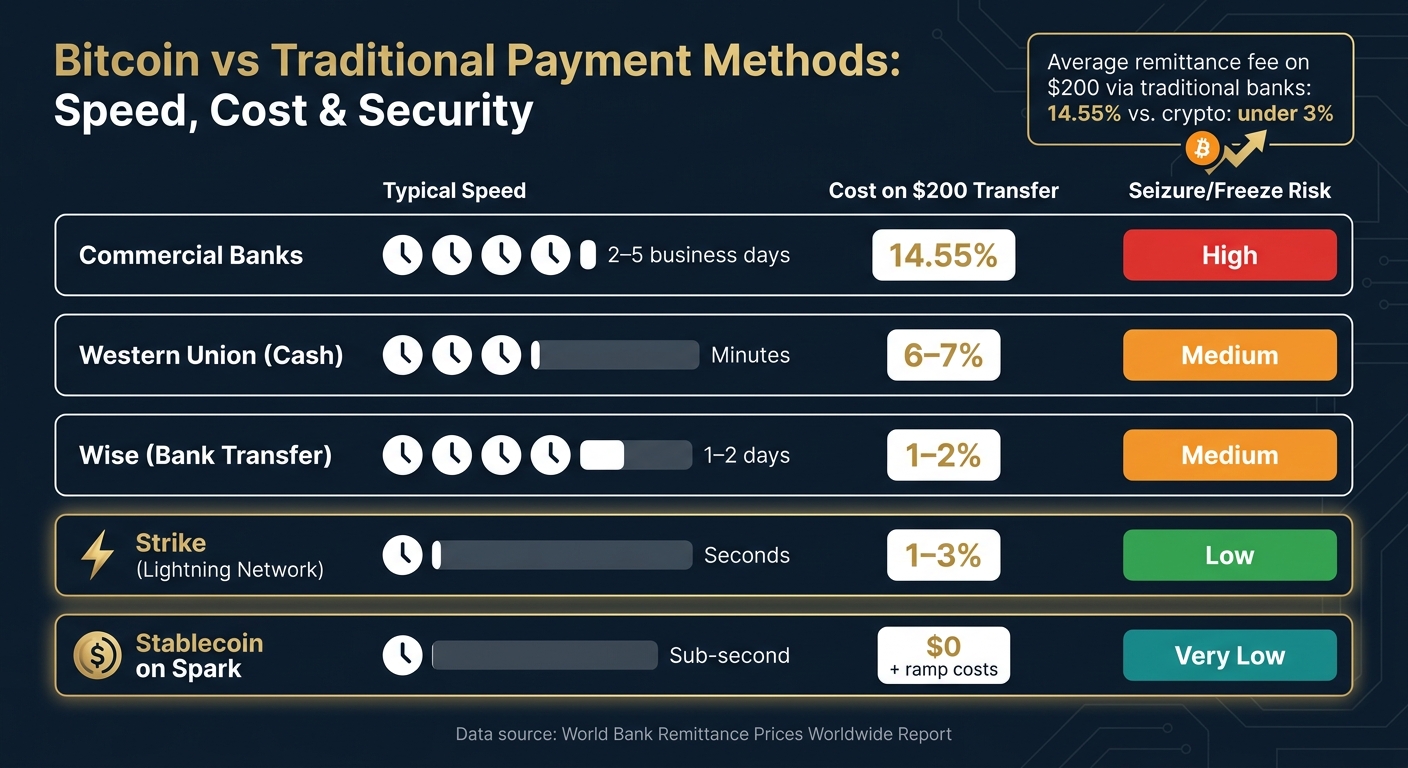
Consider this: standard wire transfers typically cost between $25 and $45 per transaction, and sending a $200 remittance comes with an average fee of 6.36%. For expats and digital nomads, these fees can pile up quickly. Bitcoin’s Lightning Network changes the game by slashing costs. For example, Strike, a platform using the Lightning Network, charges zero transaction fees for transfers from the U.S. to Africa or Mexico. With exchange rate spreads of just 1–3%, it’s far cheaper than what commercial banks usually charge.
"Bitcoin doesn’t care where you are. It doesn’t freeze when you cross borders. It doesn’t require a branch visit to prove your identity." – Kirubai, Lightning News
Stablecoins also play a key role in everyday transactions. Pegged to the U.S. dollar, they shield users from Bitcoin’s price volatility, making them ideal for covering expenses like rent or groceries. Some platforms even allow payments from self-custodial stablecoin wallets directly to local fiat bank accounts in over 170 countries – no local bank account required.
| Payment Method | Typical Speed | Cost on $200 Transfer |
|---|---|---|
| Commercial Banks | 2–5 business days | 14.55% |
| Western Union (Cash) | Minutes | 6–7% |
| Wise (Bank Transfer) | 1–2 days | 1–2% |
| Strike (Lightning) | Seconds | 1–3% |
| Stablecoin on Spark | Sub-second | $0 + ramp costs |
Data source: [13]
Bitcoin’s utility extends beyond remittances, offering opportunities to diversify and grow income streams across borders.
Earning and Diversifying Income with Bitcoin
Beyond saving on remittance fees, Bitcoin opens doors to new income strategies. For freelancers, invoicing in cryptocurrency can cut transaction costs by up to 60%. To avoid price volatility, it’s wise to convert incoming Bitcoin into stablecoins like USDC or USDT for short-term expenses. For savings, Bitcoin can serve as a long-term reserve, while stablecoins can be placed in yield-bearing accounts. For instance, Coinbase offers annual returns of 4.1%–10.8% on USDC, while platforms like YouHodler provide up to 18% APY on USDT.
A solid banking setup for expats might include:
- A U.S.-based anchor account (such as Charles Schwab International or Mercury) for stability.
- A regulated exchange like Kraken or Coinbase for converting funds.
- A local spending layer for daily expenses in local currency.
For U.S. citizens, Bitcoin can also be part of a Self-Directed IRA (SDIRA), enabling tax-deferred growth. The 2026 contribution limit is $7,000 annually (or $8,000 for those over 50). With major brokerages like Fidelity now offering Crypto IRAs, this option is more accessible than ever.
Bitcoin in High-Inflation or Restrictive Countries
In countries experiencing runaway inflation or strict financial controls, Bitcoin and stablecoins offer a lifeline. For example, Argentina faced inflation exceeding 211% in 2023. Many residents turned to USDT and Bitcoin to protect their savings from the peso’s collapse. Between July 2023 and June 2024, Argentinians moved $91.1 billion in crypto, surpassing Brazil’s volume. Stablecoins now make up 61.8% of all crypto transactions in the country.
Similarly, in Nigeria, the naira lost over 60% of its value, prompting traders to adopt USDT on the Tron network (TRC-20) for cross-border commerce. Even with fees under $1, this method proved far more reliable than traditional banking. Interestingly, Nigeria’s Central Bank reversed its 2021 crypto ban in 2023, acknowledging the role digital assets play in facilitating legitimate remittances.
"Bitcoin is best thought of as crisis sovereignty, not crisis convenience." – Decentralised News
For individuals in restrictive or unstable environments, a tiered financial approach works well:
- Keep local cash for immediate needs (1–4 weeks).
- Use stablecoins for medium-term flexibility.
- Hold Bitcoin as a long-term reserve, allowing it to cross borders without interference from customs or banks.
When traditional banking systems fail, peer-to-peer markets provide a direct and reputation-based way to exchange value.
These examples highlight how Bitcoin serves as a financial backup plan, offering global citizens a way to navigate economic and regulatory challenges with greater flexibility and independence.
Managing Risks in a Bitcoin Plan B Strategy
When it comes to safeguarding your international assets while maintaining financial control, managing risks effectively is absolutely crucial.
Handling Volatility and Portfolio Allocation
Bitcoin’s price swings are intense – about three to five times more volatile than stocks or gold. This makes it an unreliable choice for short-term needs, like next month’s rent. However, as a long-term reserve, it has shown resilience.
Financial advisors often suggest allocating 1% to 5% of a diversified portfolio to Bitcoin. Why? A 5% allocation, rebalanced yearly, boosted a standard equity portfolio’s annual returns by about 3–4 percentage points between 2015 and 2026. Additionally, a disciplined dollar-cost averaging (DCA) strategy – investing $100 monthly from 2014 to 2026 – delivered a staggering 6,712% return. That said, using funds earmarked for short-term expenses to buy Bitcoin is a bad idea. This ties back to the three-tier liquidity strategy mentioned earlier.
Beyond allocation, strong security measures are necessary to counter Bitcoin’s unpredictable nature.
Security and Custody Best Practices
Here’s the golden rule: if you don’t control your private keys, you don’t control your Bitcoin. Storing Bitcoin on centralized exchanges exposes you to risks like platform failures, regulatory freezes, and mandatory data sharing under the Travel Rule. This rule requires exchanges to share sender and receiver details for transactions above $1,000 to $3,000.
For better security, use a hardware wallet to store your keys offline. Back up your seed phrase on a durable metal plate that can withstand disasters like fire or flooding. And don’t just assume your backup works – test your recovery process first.
"If you have never tested recovery, you do not actually have a backup – you have a hope." – D-Central Technologies
For additional safety, consider a multisig setup where multiple keys are required to access funds. Spread these keys across different jurisdictions. For example, in March 2022, a Russian tech executive safeguarded $5 million in Bitcoin using a 3-of-5 multisig setup with keys distributed across Switzerland, Singapore, and the UAE. Since the assets were held by a Cayman Islands legal entity, they remained accessible despite international freezes.
Security aside, understanding tax and regulatory obligations is another key piece of a Bitcoin Plan B.
Tax and Regulatory Considerations
Taxes and regulations are unavoidable when managing global assets. Bitcoin’s tax treatment varies significantly by country. Take India, for instance: in 2022, the government imposed a flat 30% tax on crypto gains and a 1% tax deducted at source for every transaction. This led to a 90% collapse in exchange volumes.
In the U.S., the IRS classifies Bitcoin as property, meaning every sale, trade, or conversion is a taxable event. New reporting requirements like CARF, DAC8, and the 1099-DA form are tightening the screws, leaving little room for mistakes.
Even with geographic diversification, U.S. citizens are taxed on worldwide income, no matter where their assets are stored. Before making significant moves, consult a tax professional with crypto expertise. Setting up an offshore legal entity could cost between $2,000 and $10,000, with annual maintenance fees ranging from $500 to $2,000. While not cheap, these costs pale in comparison to the financial risks of non-compliance.
Conclusion: Bitcoin as a Pillar of Financial Sovereignty
Bitcoin’s significance goes far beyond its dollar valuation. As Katie Mestre aptly stated:
"Measuring Bitcoin’s value in dollars is like measuring a building’s height with a ruler that shrinks a little each time you use it."
This perspective becomes even more striking when you consider that the U.S. dollar has lost over 96% of its purchasing power since 1913. In this context, Bitcoin’s price fluctuations seem less like instability and more like the natural adjustments of a durable asset in a rapidly evolving monetary system.
What truly sets Bitcoin apart isn’t its market price – it’s the freedom and control it offers. Designed to operate independently of traditional financial systems, Bitcoin empowers individuals to retain control even in situations where those systems falter. By 2025, approximately 145,100 Bitcoin millionaires exist worldwide, accounting for 60% of all crypto millionaires. This trend highlights a growing recognition of Bitcoin as a foundational financial tool rather than just a speculative asset.
The real power of Bitcoin lies in its ability to integrate with diverse strategies for wealth protection. By combining offshore trusts or LLCs with robust self-custody practices and disciplined key management across jurisdictions, individuals can move beyond fragile, centralized setups. This approach ensures ownership, portability, censorship resistance, and the ability to exit oppressive systems – the core attributes of true financial sovereignty.
FAQs
How do I start self-custodying Bitcoin safely?
To take control of your Bitcoin, transfer it from exchanges to your own private keys. A hardware wallet like Trezor or Ledger is a solid option for storing larger amounts. Always purchase these devices directly from official sources to avoid tampering risks.
Keep your 12- or 24-word seed phrase safe by writing it down on paper or engraving it on metal – never store it digitally to prevent hacking. When making transactions, double-check wallet addresses carefully and consider testing with a small amount first to ensure everything is set up correctly. Remember, your seed phrase is your ultimate safeguard – protect it as if your Bitcoin depends on it, because it does.
What’s the simplest way to move money internationally with crypto?
Using stablecoins from a self-custodial wallet is one of the easiest ways to handle fiat payments. Platforms that offer crypto-to-fiat settlements allow you to convert stablecoins like USDT or USDC into local currency and send the funds straight to the recipient’s bank account. This approach is available in over 170 countries, bypassing the long delays and hefty fees often associated with traditional wire transfers.
How do U.S. taxes and reporting work for crypto held abroad?
As a U.S. citizen or green card holder, you’re taxed on your worldwide income – and that includes cryptocurrency. The IRS classifies crypto as property, meaning every sale, trade, or purchase is treated as a taxable event. These transactions result in either a capital gain or loss, which must be reported on Form 8949 and Schedule D.
If you’re earning crypto through staking, mining, or as payment, it’s considered ordinary income and taxed accordingly.
