
Offshore business legal protection helps shield assets and operations from creditors, lawsuits, and tax complications. By creating legal entities in favorable jurisdictions, you can separate personal and business liabilities, reduce tax burdens, and enhance privacy. Key strategies include structuring offshore trusts, LLCs, and combined structures like trusts owning LLCs. Popular jurisdictions like Nevis and the Cook Islands offer strong legal defenses, such as high barriers for creditors and short statutes of limitations on claims.
However, compliance is critical. U.S. citizens must report offshore accounts exceeding $10,000 via FBAR and adhere to FATCA regulations. Non-compliance can lead to severe penalties. Setting up these structures during stable times, maintaining proper documentation, and adhering to local and international laws are essential for effective protection.
Key Takeaways:
- Offshore structures like trusts and LLCs offer asset protection and tax efficiency.
- Jurisdictions like Nevis and the Cook Islands provide strong safeguards.
- U.S. compliance includes FBAR, FATCA, and other reporting obligations.
- Proper governance and separation of personal and business finances are crucial.
This guide breaks down the options, costs, and compliance steps to help you protect your assets while managing risks effectively.
Understanding Offshore Legal Protection
What Is Offshore Business Legal Protection?
Offshore business legal protection involves setting up legal entities in foreign jurisdictions to safeguard assets and operations from domestic creditors and courts. By taking advantage of jurisdictional separation, these structures ensure that U.S. court authority doesn’t extend to foreign fiduciaries or assets governed by foreign laws. Importantly, this approach relies on legal frameworks rather than secrecy. While these entities must still be reported to the IRS under FATCA and FBAR regulations, their protection is rooted in the statutory safeguards of the host jurisdiction. As attorney Jon Alper explains:
"The value of offshore asset protection lies in legal architecture, not concealment."
This setup creates significant obstacles for creditors, requiring them to relitigate claims in foreign courts, post substantial bonds, and meet a higher burden of proof – often "beyond a reasonable doubt" instead of the U.S. civil standard of "preponderance of evidence".
Key Offshore Structures for Legal Protection
Offshore legal protection typically relies on four main structures, each suited to different needs and risk levels:
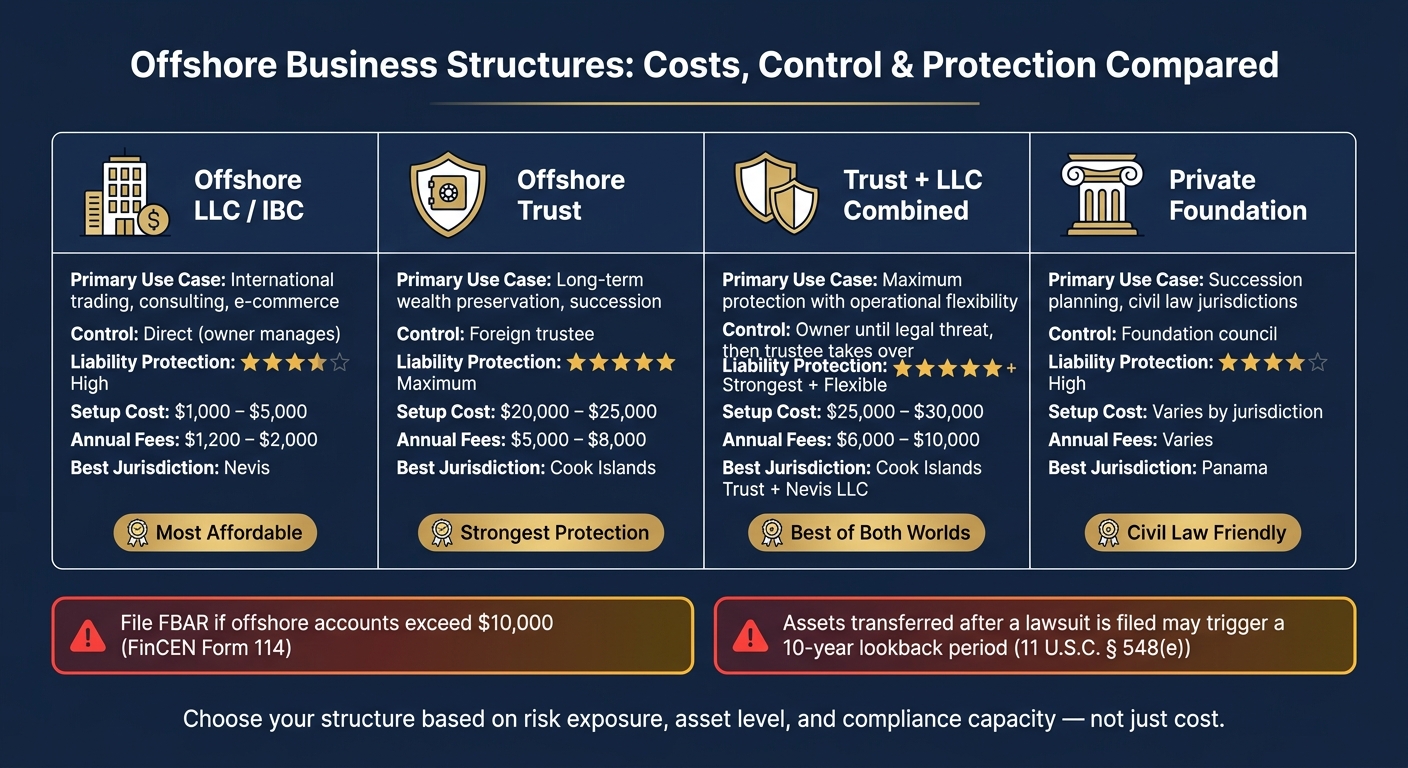
- Offshore Trusts: By transferring assets to a foreign trustee, these trusts remove assets from the reach of domestic courts. For example, the Cook Islands has a 40-year history of successfully protecting assets, with no creditor ever recovering them through local litigation. Setting up a trust here costs between $20,000 and $25,000, with annual fees ranging from $5,000 to $8,000.
- Offshore LLCs: An offshore LLC allows you to retain control over day-to-day management while benefiting from "charging order" rules. These rules limit creditors to placing a lien on distributions rather than seizing assets or gaining management control. A Nevis LLC costs $3,000 to $5,000 to establish, with annual fees of $1,200 to $2,000.
- Combined Trust and LLC Structure: This layered approach involves a Cook Islands trust owning 100% of a Nevis LLC. In normal circumstances, you manage the LLC. However, if a legal threat arises, the trustee can take over management, activating full protection. This setup costs $25,000 to $30,000, with annual expenses between $6,000 and $10,000.
- Private Foundations: Common in Panama, private foundations operate under civil law systems and offer similar liability-separation benefits.
| Structure | Control | Protection Level | Setup Cost |
|---|---|---|---|
| Offshore Trust | Foreign Trustee | Strongest | $20,000–$25,000 |
| Offshore LLC | Owner (as Manager) | Moderate | $3,000–$5,000 |
| Trust + LLC Combined | Owner until threat arises | Strongest + Flexible | $25,000–$30,000 |
| Private Foundation | Foundation Council | Strong | Varies by jurisdiction |
These structures are vital components of a comprehensive offshore risk management strategy, emphasizing the importance of maintaining separation between legal entities.
Why Legal Entity Separation Matters
Keeping personal affairs distinct from offshore entities is a cornerstone of asset protection. One key advantage is the impossibility defense: if a domestic court orders the return of offshore assets controlled by a foreign trustee, you can show that you lack the authority to comply. However, this defense collapses if you maintain informal control over the assets.
Legal entity separation also creates a protective barrier around core assets. By placing strategic assets – like intellectual property, subsidiary shares, or investments – into a holding entity, you shield them from risks tied to lawsuits or disputes at the operational level. As Rifa S. Laskar from Arnifi explains:
"Asset protection works best when it is tied to real ownership logic and disciplined governance."
Additionally, this separation strengthens your negotiating position. Creditors pursuing an offshore entity face challenges like high legal fees, bond requirements, and tougher evidentiary standards. These hurdles often lead to settlements rather than lengthy litigation. However, the success of this approach depends on maintaining a clear, well-documented, and consistently enforced separation.
sbb-itb-39d39a6
Selecting the Right Offshore Structure
Building on the basics of offshore legal protection, picking the right structure is key to balancing control and managing risk effectively.
Offshore Structures Compared
Choosing the wrong offshore structure can be an expensive mistake. The table below outlines the four main options, comparing their use cases, control levels, liability protection, and typical setup costs:
| Structure | Primary Use Case | Control | Liability Protection | Typical Setup Cost |
|---|---|---|---|---|
| Offshore LLC / IBC | International trading, consulting, e-commerce | Direct (owner manages) | High | $1,000–$5,000 |
| Offshore Trust | Long-term wealth preservation, succession | Foreign trustee | Maximum | $20,000–$25,000 |
| Holding Company | IP management, subsidiary ownership | Direct (centralized) | High | Varies by jurisdiction |
| Private Foundation | Succession planning, civil law jurisdictions | Foundation council | High | Varies by jurisdiction |
As attorney Todd M. Villarrubia explains, offshore planning is all about strategy and tailoring the structure to fit specific goals and risk profiles.
Understanding these differences is essential when evaluating which structure aligns best with your needs.
Factors That Influence Structure Selection
Beyond comparing structures, several factors play a major role in determining the best fit for your situation. It’s important to base your choice on your actual risk exposure, not just the jurisdiction or type of entity. Rifa S. Laskar of Arnifi emphasizes this point:
"Offshore asset protection works best when it follows a clear understanding of exposure. Legal risk, creditor risk, operational risk, and even geopolitical risk all sit in different buckets."
Timing is critical. Establishing offshore structures during stable times ensures maximum protection. If assets are transferred after a lawsuit is filed, you could face fraudulent transfer claims. Under federal law (11 U.S.C. § 548(e)), there’s a 10-year lookback period for such transfers.
Asset thresholds should guide your planning. For instance, creating a complex offshore trust typically makes sense for individuals with at least $1 million in total assets or $500,000 in liquid assets. Lower asset levels may not justify annual maintenance costs, which can range from $5,000 to $8,000.
Compliance obligations are another major consideration. U.S. reporting requirements, like filing FBAR (FinCEN Form 114) for offshore accounts exceeding $10,000, Form 3520 for foreign trust transactions, and FATCA disclosures, must be factored in. The penalties for non-compliance can be steep – Form 3520 violations, for example, can result in penalties starting at 35% of the gross value of transferred assets. Choose a structure you can maintain properly, not just one that looks appealing on paper.
Lastly, banking access is often overlooked but crucial. Jurisdictions with strong reputations among international banks – like Singapore, the Cayman Islands, and the BVI – make it easier to open accounts, handle payments, and access multicurrency IBANs. A structure that works legally but causes banking challenges can disrupt operations in ways that are hard to fix later.
Jurisdictional Considerations and Formation Requirements
How to Choose the Right Jurisdiction
The jurisdiction you choose for incorporation can influence everything from how courts handle creditor claims to whether banks will agree to open an account for you. It’s a decision that carries weight, especially when it comes to enforcing asset protection and managing liability.
Start by aligning the jurisdiction with your main goal. For instance, if asset protection is your priority, Nevis and the Cook Islands are strong contenders. Nevis requires creditors to post a bond of up to $100,000 with the local court before filing a claim against an international trust. This discourages frivolous lawsuits. Additionally, these jurisdictions don’t enforce foreign court judgments. So, even if a creditor wins a case in the U.S., they’d need to start fresh in Nevis or the Cook Islands. Plus, the statute of limitations for fraudulent transfer claims is short – just one to two years – making assets in a properly structured trust hard to reach.
On the other hand, if your focus is on trading, banking, or expanding into Asian markets, Hong Kong and Singapore are excellent choices. Both have stable legal systems and are well-regarded by international financial institutions. For a more general option, the British Virgin Islands (BVI) is a favorite, with over 400,000 active companies.
Economic substance is another factor to consider. Jurisdictions like the BVI, Cayman Islands, and UAE now require companies engaged in specific activities – such as intellectual property holding or fund management – to have a real local presence, including employees and active management. Without this, tax benefits may be at risk. As Dharmesh Naik of Acclime explains:
"The offshore advantage has evolved from a tax-driven decision to a strategic compliance imperative. In 2026, the successful international structure is one that is transparent, has verifiable substance and is fully compliant."
Lastly, avoid jurisdictions listed on the EU Council’s non-cooperative list or the OECD blacklist. Such listings can complicate banking and trade.
Standard Formation Requirements
Once you’ve chosen your jurisdiction, understanding its formation requirements is key. The process typically begins with Know Your Customer (KYC) checks. This involves submitting certified copies of your passport, a recent proof of address, and a brief professional summary.
You’ll also need to outline your intended business activities clearly. Increasingly, registries and banks ask for proof of funds, such as sale agreements, dividend records, or payroll documentation.
Most jurisdictions require the following:
- A licensed registered agent
- A local registered office address
- Registers of directors, shareholders, and Ultimate Beneficial Owners (UBOs) – kept private but accessible to regulators
Timelines for incorporation vary widely. For example:
- BVI and Seychelles: 1–3 days
- UAE Free Zones: 7–10 days
- Singapore: 2–3 weeks
Costs also differ depending on the jurisdiction:
| Jurisdiction | Setup Cost (Year 1) | Annual Renewal |
|---|---|---|
| Seychelles | $595 – $1,500 | $500 – $1,000 |
| Belize | $1,200 – $1,800 | $800 – $1,200 |
| BVI | $1,500 – $3,000 | $1,000 – $1,500 |
| UAE (Free Zone) | $3,000 – $8,000+ | $2,000 – $5,000+ |
| Singapore (with substance) | $20,000+ | $30,000 – $80,000+ |
Banking is another critical step. Before filing for incorporation, prepare a detailed KYC package that includes an ownership chart, certified UBO documents, and a memo outlining expected monthly transaction volumes. Without a functioning bank account, even a legally formed company cannot operate effectively.
Staying Compliant in Your Chosen Jurisdiction
After setting up your entity, staying compliant is essential to preserve its benefits. This includes paying annual government and registered agent fees on time. Delays can lead to deregistration and expensive reinstatement processes. Typical annual renewal fees range from $500 to $2,000 – a small price compared to the cost of restructuring or restoring a company.
Transparency is now a global standard. Over 100 jurisdictions participate in the Common Reporting Standard (CRS), which automatically shares financial account details with tax authorities in your home country. Anonymous ownership is no longer viable, as beneficial ownership registers – while private – are accessible to regulators. Failing to disclose this information can result in penalties or even dissolution of the entity.
If your structure includes a trust or foundation, strict adherence to local laws is non-negotiable. Deviations could expose you to legal challenges. For U.S. persons, additional federal reporting obligations – like FBAR and FATCA filings – apply, regardless of the offshore jurisdiction.
To navigate these complexities, consider consulting experts like Global Wealth Protection. They offer private consultations to help business owners understand and meet their compliance requirements before issues arise.
Managing Risks and Staying Compliant
Common Legal Risks for Offshore Businesses
Even the best-planned offshore business can face real legal challenges if not properly managed. These risks can lead to serious financial and legal consequences.
One major concern is veil-piercing. If a court determines that your offshore entity is just an extension of your personal finances – due to mixing personal and business funds, neglecting corporate formalities, or treating the entity as a personal bank account – you could be held personally responsible for business debts. As Michael Schmitt points out:
"Overreliance on the corporate veil and offshore secrecy leads directors to assume they are immune from personal claims."
Another common issue is fraudulent transfer claims. Moving assets into an offshore structure after a lawsuit has been filed or a creditor claim arises can result in a court reversing the transfer.
For U.S. residents, domestic enforcement problems add another layer of risk. In Wells Fargo Bank v. Barber, a federal court in Florida ruled that a Nevis LLC membership interest is considered intangible personal property located at the debtor’s Florida residence. This means creditors may not need to litigate offshore to access those assets.
Lastly, IRS reporting failures can lead to severe penalties. For instance, failing to file Form 3520 or 3520-A for offshore trusts can result in fines starting at $10,000 per form annually, with penalties reaching up to 5% of the trust’s total assets.
By addressing these risks proactively, you can protect your offshore structure and avoid unnecessary complications.
Compliance Steps to Reduce Legal Risk
Here are steps you can take to minimize potential legal risks:
- Maintain strict separation between personal and business finances. Keeping separate bank accounts for your offshore entity and documenting board decisions with detailed minutes are critical steps to prevent veil-piercing claims.
- Fund your offshore structure during stable times. This helps avoid fraudulent transfer claims. For example, the Cook Islands enforces a one-year statute of limitations on such claims, which only applies if the transfer occurred well before any legal issues arose.
- Use a layered structure. Combining an offshore LLC with an offshore trust removes the LLC membership interest from your personal property. As Gideon Alper of Alper Law explains:
"The offshore trust vs. domestic trust distinction is structural: a U.S. judge can compel a domestic trustee but cannot compel an offshore one."
- Appoint a successor manager to address repatriation orders. Include a clause in your operating agreement that automatically replaces the U.S.-based manager with a foreign successor if a "legal duress" event occurs. This creates an "impossibility defense", ensuring you no longer control the assets in the event of a repatriation order.
- Stay up to date with IRS filings. U.S. persons with offshore structures must file forms like FinCEN Form 114 (FBAR), IRS Form 8938 (FATCA), Forms 3520 or 3520-A for trusts, and Form 8832 for LLC tax elections. Missing deadlines can lead to hefty penalties, so consult professionals like Global Wealth Protection to ensure timely filing.
Legal Risks vs. Compliance Steps: A Reference Table
Here’s a quick look at common risks and how to address them:
| Legal Risk | Potential Impact | Compliance Action |
|---|---|---|
| Veil-Piercing (Alter Ego) | Personal liability for business debts | Keep separate bank accounts and detailed corporate records. |
| Fraudulent Transfer Claim | Court may reverse asset transfers | Fund structures early and include a "Jones Clause" in agreements. |
| Creditor Charging Order | Lien on distributions; loss of income | Choose jurisdictions with favorable charging order statutes (e.g., Nevis: 3 years; Cook Islands: 5 years). |
| U.S. Court Repatriation Order | Civil contempt and potential imprisonment | Appoint a foreign trustee with an anti-duress clause and remove the U.S. manager automatically. |
| IRS Reporting Penalties | Fines starting at $10,000 per form or 5% of trust assets | File all required forms (3520, 3520-A, 8938, 8832, and FBAR) on time. |
| Banking Friction | Account closure or frozen funds | Provide clear KYC documentation and a transparent business rationale. |
Running an Offshore Business Safely
Once you’ve set up and structured your offshore entity, keeping it secure requires careful attention to operational details. These steps help maintain the protections you’ve worked to establish.
Cross-Border Operational Best Practices
How you handle daily operations plays a big role in safeguarding your offshore legal protections. As of 2026, the "place of management" – where key decisions are made – determines business residency. For instance, if you’re running a Nevis LLC from your home office in Miami, you could unintentionally create U.S. tax obligations.
To avoid this, document where contracts are signed, meetings are held, and major business decisions take place. Conduct annual compliance audits to ensure your entity remains in good standing. If your jurisdiction requires "economic substance" (proof of local operations), include these compliance costs in your budget.
These operational strategies work hand-in-hand with the structural protections discussed earlier, creating a strong foundation for asset security.
Avoiding Alter Ego Risks
Even with solid operations, maintaining strict governance is critical to avoid "alter ego" risks. Using your offshore entity for personal expenses can strip away its legal protections. A recent review found that many offshore directors leave gaps in governance, making entities vulnerable to creditors and regulators.
To steer clear of this, always keep your personal and business finances separate. As Kelly Diamond from Global Wealth Protection warns:
"The era of ‘set up an LLC anywhere and you’re fine’ is over."
One way to strengthen your setup is by layering your structure. For example, placing an offshore trust above your LLC removes membership interests from your personal property, reducing the risks associated with standalone offshore LLCs.
Working with Expert Guidance
With international standards constantly evolving, having expert oversight is crucial. Bobby Casey, a well-known offshore expert, emphasizes:
"An evolving legal landscape necessitates expert guidance… it takes more than just someone willing to rubber stamp a few papers on your behalf."
Experts can help you navigate the complexities of formation, banking, tax compliance, and asset protection, ensuring your offshore setup meets regulatory requirements. Firms like Global Wealth Protection specialize in these services, offering support with offshore formations, trust structures, U.S. private LLCs, and personalized consultations. Expect annual maintenance costs for offshore entities to range from $500 to $2,000 – a necessary investment in keeping your protections intact.
Conclusion: Building Stronger Offshore Legal Protection
Creating effective offshore legal protection comes down to three key elements: selecting the right structure, staying fully compliant, and treating your offshore arrangement as an ongoing, proactive strategy.
One reliable approach is layering trusts over LLCs. This method helps separate personal liability from business risks. As attorney Gideon Alper explains:
"The entrepreneur’s liability exposure increases at the exact moment the wealth becomes real."
Timing plays a critical role here. Offshore trusts and layered structures work best when established during calm periods, long before any legal disputes or business exits come into play. This proactive timing underscores the importance of strict compliance to maintain long-term protection.
Compliance is non-negotiable. For instance, U.S. persons must file an FBAR if their offshore accounts exceed $10,000, and failing to submit IRS Form 5471 can lead to hefty penalties. Regular upkeep and administration are equally vital to sustaining the integrity of your legal shield.
The costs for setting up offshore structures typically range from $1,000 to $5,000, with annual fees falling between $500 and $2,000. As Global Wealth Protection aptly states: "Offshore isn’t shady. It’s smart. It’s about control. You control where your company is based, where your money lives, and how much you pay in tax." With a relatively modest investment and professional guidance, you can turn this control into a lasting layer of legal protection. These points highlight the strategies covered in this guide, ensuring your offshore endeavors remain secure and compliant.
FAQs
Do I need an offshore trust or is an offshore LLC enough?
The decision to use an offshore trust or an offshore LLC largely depends on your objectives and how much risk you’re willing to take on. An LLC is ideal for protecting against liabilities related to business operations. On the other hand, a trust offers a higher level of asset protection by transferring ownership to a foreign trustee in a jurisdiction that doesn’t acknowledge U.S. court rulings. For those seeking both operational flexibility and legal protection, a layered approach – where a trust owns an LLC – can provide the benefits of easier asset management alongside stronger legal defenses.
What U.S. tax forms must I file for offshore accounts or entities?
If you’re a U.S. person holding foreign financial accounts or involved with offshore entities, there are specific reporting obligations you need to follow with the IRS and the Treasury Department.
- FBAR (FinCEN Form 114): If the total value of your foreign accounts exceeds $10,000 at any point during the year, you must file an FBAR. This form is submitted separately from your tax return.
- Form 8938: For broader asset reporting, you may need to file this form with your tax return, provided you meet certain thresholds based on your filing status and the value of your foreign assets.
- Other Forms: Depending on your involvement with foreign entities, you might also need to file additional forms like Forms 5471, 8865, or 8858.
Failing to comply with these requirements can result in penalties, so it’s important to stay informed and ensure all necessary filings are completed.
When is it too late to move assets offshore without it being a fraudulent transfer?
It’s important to act early when it comes to safeguarding your assets. Once a legal claim is made or a lawsuit is filed, it’s often too late to make protective moves. Courts have the authority to undo transfers that appear to be made with the intent to hinder, delay, or defraud creditors. While there might be limited options for liquid assets after a judgment, the best defense is to take proactive measures well before any legal trouble arises. Attempting to transfer assets after being sued is typically viewed as fraudulent and can lead to intense legal examination.
