
Offshore hedge funds are often set up in tax-neutral jurisdictions to minimize tax burdens and meet investor needs. Popular locations like the Cayman Islands, British Virgin Islands (BVI), Bermuda, Luxembourg, Singapore, and Mauritius each offer distinct advantages and cost structures. Here’s a quick summary:
- Cayman Islands: The leading choice for institutional investors, but high setup and operational costs make it best for larger funds with global ambitions. This structure is often integrated into a private family office for comprehensive wealth management.
- BVI: A more affordable option for emerging managers, offering flexibility and lower regulatory fees.
- Bermuda: A niche option for funds in sectors like insurance-linked securities, with moderate costs.
- Luxembourg: Ideal for accessing EU investors, but high compliance expenses mean it suits funds with significant EU-based capital.
- Singapore: Known for its Variable Capital Company (VCC) structure, it’s a strong choice for Asia-Pacific-focused funds but comes with higher regulatory demands.
- Mauritius: Cost-effective for funds targeting African and Indian markets, leveraging its extensive tax treaty network.
Each jurisdiction has unique costs for fund formation, regulatory compliance, taxation, and ongoing operations. Selecting the right one depends on your fund’s size, investor location, and strategic goals.
1. Cayman Islands
The Cayman Islands stands out as a premier destination for institutional-grade hedge funds, hosting around 80% of all new offshore fund formations worldwide. Its well-developed legal system, reliable regulatory framework, and straightforward tax policies make it a magnet for institutional investors. Beyond tax efficiency, many managers prioritize these jurisdictions for offshore asset protection and legal stability.
Formation and Structuring Legal Costs
Setting up a fund in the Cayman Islands comes with varied legal costs. Attorney-led packages for single-class funds typically range from $25,900 to over $100,000, depending on the fund’s complexity. Additional fees include a CIMA registration fee of $4,268 to $6,098 and an incorporation fee of $1,500 to $3,000. When factoring in operational costs, total first-year expenses generally land between $60,000 and $130,000.
Most funds are structured as Registered Mutual Funds under Section 4(3) of the Mutual Funds Act, which requires a minimum investor subscription of $100,000. The setup process, including CIMA registration, usually takes 8–12 weeks, with CIMA registration alone requiring 2–4 weeks.
Regulatory Registration and Supervisory Fees
Funds register under different acts depending on their structure – open-ended funds under the Mutual Funds Act and closed-ended funds under the Private Funds Act. The current annual fees, which are set to be revised starting January 1, 2026, are as follows:
| Fee Category | Amount (USD) |
|---|---|
| Registered Mutual Fund Annual Fee | $5,030.49 |
| Master Fund Annual Fee | $3,750.00 |
| Registered Mutual Fund Sub-fund Fee | $914.63 per sub-fund |
| Registered Private Fund Sub-fund/AIV Fee | $640.24 per sub-fund |
These fees are due by January 15 each year, with any remaining balances from the 2026 fee revision payable by February 15, 2026. Non-compliance can lead to fines ranging from $5,000 for minor infractions to as much as $1,000,000 for severe violations.
Taxation and Tax-Related Legal Costs
The Cayman Islands offers a tax-neutral environment with no corporate income tax, capital gains tax, or withholding tax at the fund level. Funds can secure a 20-year Tax Exemption Certificate for $300 to $500, ensuring their tax-neutral status remains intact. This is particularly beneficial as investors are taxed according to their home country’s rules.
Starting January 1, 2025, private funds must maintain a beneficial ownership register or appoint a local contact person, adding a minor administrative requirement. Annual filings for Economic Substance and UBO requirements cost about $900 combined.
Ongoing Compliance, Governance, and Reporting Costs
Regulatory compliance forms a significant portion of annual operating expenses. Funds must submit audited financial statements and a Fund Annual Return (FAR) to CIMA within six months of the financial year-end. Audits, conducted by CIMA-approved local auditors, typically cost $15,000 to $50,000+ per year.
Funds are also required to appoint an AML Compliance Officer, a Money Laundering Reporting Officer, and a Deputy MLRO. Independent director fees generally range from $15,000 to $35,000 per director, with most funds appointing two. Administration services add another $30,000 to $100,000+, depending on the fund’s complexity and assets under management.
"The standalone fund’s annual overhead is a fixed cost that exists from the first day of operation regardless of AUM. For an emerging manager building their institutional track record, this overhead is not merely a financial consideration. It is a constraint on how long they can sustain operations." – CV5 Capital
Emerging managers with smaller assets under management face unique challenges. A standalone Cayman fund typically requires $15 million to $25 million in AUM just to cover fixed operating costs. Managers below this threshold often turn to Segregated Portfolio Companies (SPCs) or regulated fund platforms, which allow cost-sharing across directors, auditors, and compliance officers, easing the financial burden.
sbb-itb-39d39a6
2. British Virgin Islands (BVI)
The British Virgin Islands (BVI) is a budget-friendly option for hedge fund managers seeking institutional credibility without the hefty costs associated with the Cayman Islands. By the end of 2024, the BVI had 2,139 active mutual funds, including 866 Professional Funds. Its regulatory framework offers flexibility with fund types like Professional, Private, Incubator, and Approved funds, allowing managers to tailor their structure to match their investor base and fund size. While the Cayman Islands is often seen as the leader, the BVI provides a cost-efficient alternative while maintaining regulatory integrity.
Formation and Structuring Legal Costs
Setting up a fund in the BVI involves legal fees ranging from $15,000 to $50,000, with total first-year setup costs between $18,000 and $55,000. This is 30%–50% lower than the costs in the Cayman Islands. Government and Financial Services Commission (FSC) registration fees add about $7,775, covering incorporation and the registered office. The setup process usually takes 2 to 4 weeks, from incorporation to FSC approval.
"BVI is generally 30-50% less expensive than Cayman on a total-cost basis, making it attractive for smaller funds and emerging managers." – Adi Sharma, Trainee, Fundtec
Regulatory Registration and Supervisory Fees
The FSC charges an initial registration fee of $2,000 for Incubator Funds and $2,500 for Approved Funds. Incorporating a BVI Business Company costs $550 for entities authorized to issue up to 50,000 shares, or $1,350 for those authorized to issue more. Funds must appoint a BVI-licensed authorized representative to liaise with the FSC. Additionally, the BVI’s "four eyes" policy requires a minimum of two directors, at least one of whom must be an individual. Missing these requirements before FSC notification deadlines can lead to compliance issues. The BVI’s approach highlights its focus on keeping costs manageable while meeting regulatory standards.
Taxation and Tax-Related Legal Costs
The BVI’s tax-neutral status is a key draw. There’s no corporate income tax, no capital gains tax, and no withholding taxes on distributions to investors. Hedge funds are exempt from physical substance requirements, with only an annual self-certification filing required, costing around $350. FATCA and CRS reporting must be submitted to the International Tax Authority by May 31.
Ongoing Compliance, Governance, and Reporting Costs
Annual operating costs for a BVI fund fall between $12,000 and $30,000. The FSC annual recognition fee is $1,200, due by March 31. Audit fees range from $10,000 to $30,000 per year, and ongoing legal fees add another $3,000 to $15,000. Below is a summary of key annual deadlines:
| Obligation | Deadline | Authority |
|---|---|---|
| FSC Annual Fee | March 31 | BVI FSC |
| FATCA/CRS Reporting | May 31 | International Tax Authority |
| Registry Fee | May 31 or Nov 30 | BVI Registry |
| Mutual Fund Annual Return (MFAR) | June 30 | BVI FSC |
| Audited Financial Statements | 6 months after year-end | BVI FSC |
These deadlines reflect the BVI’s structured yet efficient regulatory setup compared to other jurisdictions. Starting in Q2 2026, the FSC plans to increase inspection frequency, particularly for higher-risk funds, moving them to an annual review cycle. Managers who establish their funds and complete compliance documentation ahead of this shift will be better prepared for the heightened regulatory scrutiny.
3. Bermuda
Bermuda provides a high-end yet competitive option for institutional hedge funds, building on the cost-efficient model seen in the BVI. The Bermuda Monetary Authority (BMA) regulates all fund activities under the Investment Funds Act, requiring funds to be classified as either Authorised or Registered before they can launch.
The majority of hedge funds in Bermuda are set up as Mutual Fund Companies. However, depending on their investor base, managers also have options like Unit Trusts, Partnership Funds, or LLC Funds. Within the hedge fund space, two main fund classes dominate: Professional Class A funds and Professional Class B funds. Class A funds require managers to either be licensed by a recognized regulator (such as the SEC or FCA) or manage assets worth at least $100,000,000. Class B funds, on the other hand, cater to qualified, high-net-worth individuals. Additionally, Bermuda offers specialized structures like Segregated Accounts Companies (SAC) and Incorporated Segregated Accounts Companies (ISAC), which allow for the separation of assets within a single legal entity.
Formation and Structuring Legal Costs
Legal fees in Bermuda reflect the jurisdiction’s advanced legal framework, so managers should expect higher costs. These fees typically cover detailed fund documentation and the appointment of required service providers, including an investment manager, administrator, registrar, auditor, and custodian/prime broker. For an Exempted 129A or Exempted LLC 25 structure, the government license application fee is $2,100, with an additional one-time license issuance fee of $1,000 upon approval.
Regulatory Registration and Supervisory Fees
Bermuda’s regulatory system balances its premium positioning with relatively low ongoing fees. The annual government license fee is $1,000, payable every January. This is notably competitive when compared to other offshore jurisdictions. Professional Class B funds are also required to appoint a local officer or trustee who holds authority over the fund’s records, as mandated by BMA regulations.
Taxation and Tax-Related Legal Costs
Bermuda offers complete tax neutrality for hedge funds – there are no income taxes, capital gains taxes, or withholding taxes on distributions. Funds registered as exempted companies are not subject to the 60% Bermudian ownership requirement, allowing for full foreign ownership. Since April 2026, oversight of Bermuda’s economic substance regime has shifted to the Corporate Income Tax Agency, following amendments to the Economic Substance Act 2018. Compliance with these regulations is essential to maintain tax-neutral status.
"Bermuda’s welcoming environment and risk-based approach has contributed globally to the growth of investment funds, catastrophe bond funds, hedge funds, private equity funds as well as insurance-linked securities (ILS) funds." – Conyers
Ongoing Compliance, Governance, and Reporting Costs
All BMA-registered funds must submit audited financial statements in accordance with IFRS or GAAP standards, which may include Bermuda, Canadian, UK, or US frameworks. Funds are also required to adhere to the Proceeds of Crime (AML/ATF) Regulations 2008. This involves appointing both a Compliance Officer and a Money Laundering Reporting Officer (MLRO). These roles can be handled internally or outsourced to third-party providers, which adds to the fund’s ongoing operational expenses.
Here’s a quick look at Bermuda’s key regulatory fees:
| Fee Type | Amount | Timing |
|---|---|---|
| License Application Fee | $2,100 | At application |
| License Issuance Fee | $1,000 | Upon license grant |
| Annual License Fee | $1,000 | Every January |
4. Luxembourg
Luxembourg stands as the world’s second-largest fund center, boasting over EUR 7.6 trillion in assets under management (AUM) as of August 2025. However, operating here comes at a premium – annual costs are two to four times higher than offshore alternatives due to the rigorous EU regulations.
The Reserved Alternative Investment Fund (RAIF) is the go-to structure for hedge funds in Luxembourg, with a setup time ranging from 4 to 12 weeks. By 2026, over 2,300 RAIFs were registered. Most managers lean towards the SCSp (Special Limited Partnership) for its flexibility and resemblance to Delaware or Cayman limited partnerships.
Formation and Structuring Legal Costs
Setting up a Luxembourg RAIF with a third-party Alternative Investment Fund Manager (AIFM) involves one-time costs between EUR 150,000 and EUR 400,000. Legal and structuring fees alone make up EUR 40,000 to EUR 100,000 of this total, broken down as follows:
- AIFM setup: EUR 20,000 to EUR 50,000
- Depositary setup: EUR 20,000 to EUR 50,000
- Fund administration setup: EUR 40,000 to EUR 80,000
- Initial audit: EUR 5,000 to EUR 15,000
- Registration and corporate services: EUR 5,000 to EUR 15,000
Additionally, there’s a EUR 75 registration duty payable during incorporation or any amendments to the articles of association. To justify the fixed cost structure, a minimum first close of EUR 30 million to EUR 50 million is typically required.
Regulatory Registration and Supervisory Fees
Every Luxembourg hedge fund must engage an authorized external AIFM, which ensures compliance with CSSF (Commission de Surveillance du Secteur Financier) reporting requirements. This is often the most significant cost factor. CSSF examination fees are EUR 4,650 for a standalone fund and EUR 9,250 for an umbrella fund.
For managers launching their first or second fund, working with a third-party "host" AIFM is the practical choice. Building an in-house AIFM demands a 4 to 6 month CSSF authorization process and substantial capital investment, which is better allocated to the fund itself.
"The CSSF authorisation timeline is months you do not have. The capital requirements are money that should be in your fund, not your management company. Build your own AIFM for Fund III, once the carry has started flowing." For personalized guidance on jurisdictional selection, consider private consultations. – Piotr Luberda, Head of Legal Ops, Infra One
Taxation and Tax-Related Legal Costs
Luxembourg offers tax efficiency rather than full neutrality. While SIFs and RAIFs are exempt from corporate, municipal, and net worth taxes, they are subject to an annual subscription tax of 0.01% of NAV. Compliance with EU frameworks such as AIFMD, SFDR, ATAD, and DAC6 is also mandatory.
"If more than 30–40% of your target LP capital is from EU institutions, Luxembourg is likely the better choice." – Adi Sharma, Trainee, Fundtec
Ongoing Compliance, Governance, and Reporting Costs
Annual operational costs for emerging funds in Luxembourg range from EUR 150,000 to EUR 300,000+. Key components include:
- Depositary fees: $20,000 to $80,000+ per year
- Fund administration: $50,000 to $150,000 annually
- Audit fees: $25,000 to $75,000 annually
- Third-party AIFM fees: Typically 0.25% to 0.75% of AUM
Compliance obligations are extensive. Funds must submit Annex IV transparency reports, quarterly CSSF financial reports (G2.1), an annual self-assessment questionnaire within four months of year-end, an AML summary report (SRRC) within five months, and audited financial statements within six months. Partnering with a single integrated provider for AIFM, administration, and depositary services can reduce costs by 10 to 20%.
| Cost Component | One-Time | Annual |
|---|---|---|
| Legal and Structuring | EUR 40,000 – EUR 100,000 | – |
| AIFM Setup / Ongoing | EUR 20,000 – EUR 50,000 | 0.25%–0.75% of AUM |
| Depositary | EUR 20,000 – EUR 50,000 | $20,000 – $80,000+ |
| Fund Administration | EUR 40,000 – EUR 80,000 | $50,000 – $150,000 |
| Audit | EUR 5,000 – EUR 15,000 | $25,000 – $75,000 |
| Registration and Corporate Services | EUR 5,000 – EUR 15,000 | – |
| Subscription Tax | – | 0.01% of NAV |
5. Singapore
Singapore stands out as an appealing option for fund managers, thanks to its Variable Capital Company (VCC) framework. With over 1,100 registered VCCs as of Q1 2026, it has become a noteworthy alternative to traditional offshore jurisdictions. The VCC serves as the primary fund vehicle, offering flexibility as either a standalone entity or an umbrella structure with segregated sub-funds. However, fund managers must secure a Monetary Authority of Singapore (MAS) fund management license before incorporating a VCC, as the Accounting and Corporate Regulatory Authority (ACRA) requires confirmation of the manager’s licensing status upfront. Below, we break down the associated costs in Singapore, highlighting both one-time and recurring expenses.
Formation and Structuring Legal Costs
Setting up a VCC in Singapore involves considerable initial costs, primarily for legal and structuring work. This includes drafting the VCC constitution, Information Memorandum, and investment management agreements, with fees typically ranging from S$26,000 to S$75,000+, depending on the complexity of the strategy. ACRA charges S$8,015 for incorporation (including a S$15 name registration fee), with an additional S$400 for each sub-fund. Fund administration setup adds another S$5,000 to S$20,000.
One notable advantage of the umbrella structure is cost efficiency for fund managers running multiple strategies. Sub-funds under the same structure share resources like a Board of Directors, company secretary, and auditor, reducing overhead per fund.
For a small-to-mid-sized VCC, the total one-time setup costs generally fall between S$51,000 and S$116,000.
Regulatory Registration and Supervisory Fees
Once the VCC is established, regulatory compliance introduces additional costs. MAS oversight requires a CMS/LFMC license, with an application fee of S$1,000 per regulated activity. Annual license fees range from S$4,000 to S$8,000 for Accredited/Institutional LFMCs.
Since the Registered Fund Management Company (RFMC) regime was abolished in August 2024, all new fund managers must now obtain a full Licensed Fund Management Company (LFMC) status. The approval process for a CMS license typically takes 6 to 9 months, so planning ahead is crucial.
To manage compliance, many fund managers opt to outsource these functions, which costs between S$15,000 and S$40,000 per year. This approach can save on the expense of hiring full-time compliance staff.
Taxation and Tax-Related Legal Costs
Singapore offers tax neutrality through its Section 13O and Section 13U incentive schemes under the Income Tax Act. These provide full tax exemptions on income from designated investments, creating an effective zero-tax outcome. Additionally, Singapore has access to over 80 double tax agreements (DTAs).
Applying for these incentives involves legal and tax advisory fees of approximately S$5,000 to S$15,000. Funds must meet specific criteria, including a minimum AUM of S$20 million for Section 13O and S$50 million for Section 13U, along with employing at least 2 and 3 local investment professionals, respectively. It’s important to delay the application until the AUM thresholds are met, as the requirements must be satisfied from the start of the incentive period.
Ongoing Compliance, Governance, and Reporting Costs
After the initial setup, annual operating costs for a fund with an AUM under S$50 million are estimated to range between S$83,000 and S$218,000. Key recurring expenses include:
- Fund administration: S$40,000 to S$100,000 per year
- Annual audit: S$8,000 to S$20,000 for a standalone VCC
- Corporate secretarial services: S$3,500 to S$9,500 per year
- Annual tax compliance: S$5,000 to S$15,000 per year
| Cost Component | One-Time (S$) | Annual (S$) |
|---|---|---|
| ACRA Registration (Umbrella + 3 Sub-funds) | 9,215 | |
| Legal & Structuring | 26,000 – 75,000+ | |
| Fund Administration | 5,000 – 20,000 | 40,000 – 100,000 |
| Audit Fees | 8,000 – 20,000 | |
| Corporate Secretarial | 3,500 – 9,500 | |
| Regulatory Compliance (LFMC, outsourced) | 1,000 | 15,000 – 40,000 |
| Tax Incentive Application (13O/13U) | 5,000 – 15,000 | |
| Annual Tax Compliance | 5,000 – 15,000 |
The MAS VCC Grant, extended through 2028 in the 2026 Budget, provides co-funding of up to S$150,000 for eligible setup expenses, including legal and tax advisory fees. This grant helps offset the higher upfront costs compared to simpler offshore structures. When evaluating Singapore as a jurisdiction, these ongoing and one-time expenses should be considered alongside those in other regions.
6. Mauritius
Mauritius has steadily gained recognition as a cost-efficient and well-regulated option for fund domiciliation, especially for managers focusing on African and Asian markets. Like other key jurisdictions such as the Cayman Islands, BVI, Bermuda, Luxembourg, and Singapore, Mauritius balances affordability with robust regulatory standards tailored to specific investor needs. By June 2025, the country housed 949 global funds, all under the supervision of the Financial Services Commission (FSC). Hedge funds in Mauritius commonly take the form of either an Expert Fund (requiring a minimum investor commitment of $100,000) or a Professional Collective Investment Scheme (minimum $200,000), both of which require a Global Business Licence (GBL) issued through a licensed Management Company (MC).
"Unlike traditional onshore hubs that impose 12-month licensing delays and prohibitive operational costs, Mauritius offers a regulated pathway to market within a streamlined 16-week implementation lifecycle." – Strategix International
Formation and Structuring Legal Costs
Setting up a fund in Mauritius is more economical compared to many other jurisdictions. Drafting essential legal documents like the Limited Partnership Agreement (LPA), Articles of Association, and fund constitution costs between $4,000 and $15,000, while preparing a Private Placement Memorandum (PPM) adds $3,000 to $12,000. Government incorporation fees range from $500 to $1,950, and fund administrator setup costs fall between $2,000 and $8,000.
Since all GBL applications must go through a licensed MC, engaging one early is critical. Total one-time setup costs range from $20,000 to $40,000 for a standard fund, while more complex structures like a Variable Capital Company (VCC) can cost between $35,000 and $60,000.
Regulatory Registration and Supervisory Fees
A single fund incurs a $1,000 one-time FSC registration fee, along with $3,000 annually. The GBL itself requires a $500 processing fee and an annual fee of $1,950. For managers with multiple strategies, a VCC umbrella structure can significantly reduce costs. Additional sub-funds under a VCC structure cost just $500 to register and $1,000 annually in FSC fees, compared to full licensing costs for separate entities.
| Fee Type | One-Time | Annual |
|---|---|---|
| FSC Fund Authorization (Single Fund) | $1,000 | $3,000 |
| Global Business Licence (GBL) | $500 | $1,950 |
| VCC Additional Sub-Fund | $500 | $1,000 |
| Fund Manager License | $1,000 | $2,500 |
| Registrar of Companies (Private GBL) | ~$65 | ~$195–$390 |
Management Company fees vary widely among the 160+ licensed MCs in Mauritius, typically ranging from $5,000 to $15,000 per year. Comparing providers before committing is strongly recommended.
Taxation and Tax-Related Legal Costs
Mauritius operates under a Partial Exemption Regime, granting Collective Investment Schemes (CIS) and GBL funds an 80% exemption on foreign-source income, effectively lowering the corporate tax rate to 3%. The jurisdiction also has no capital gains tax and no withholding tax on dividends, interest, or royalties paid to non-residents.
With access to 46 Double Taxation Avoidance Agreements (DTAAs), funds can reduce withholding taxes by 15–20% compared to non-treaty arrangements. To leverage these benefits, funds must obtain a Tax Residency Certificate (TRC) from the Mauritius Revenue Authority, which costs approximately $1,000 and requires proof that strategic decisions are made within Mauritius.
A newer development is the 2% Corporate Climate Responsibility (CCR) Levy, which applies to companies with chargeable income exceeding MUR 50 million. This increases the effective tax rate for affected funds to about 3.4%.
Ongoing Compliance, Governance, and Reporting Costs
Running a fund in Mauritius involves annual operating costs averaging $80,000, which cover administration, audits, directors, and regulatory filings. To maintain GBL status and access tax treaties, funds must meet substance requirements, including having two resident directors, a local bank account, and core activities based in Mauritius.
Key recurring costs include:
- Fund administration: $18,000 to $42,000 per year
- External audit: $3,000 to $10,000
- Resident directors: $2,000 to $5,000 per director
- Company secretarial services: $1,500 to $3,000
Resident directors must hold genuine decision-making authority, not just serve nominally, to satisfy FSC substance audits.
Pros and Cons by Jurisdiction
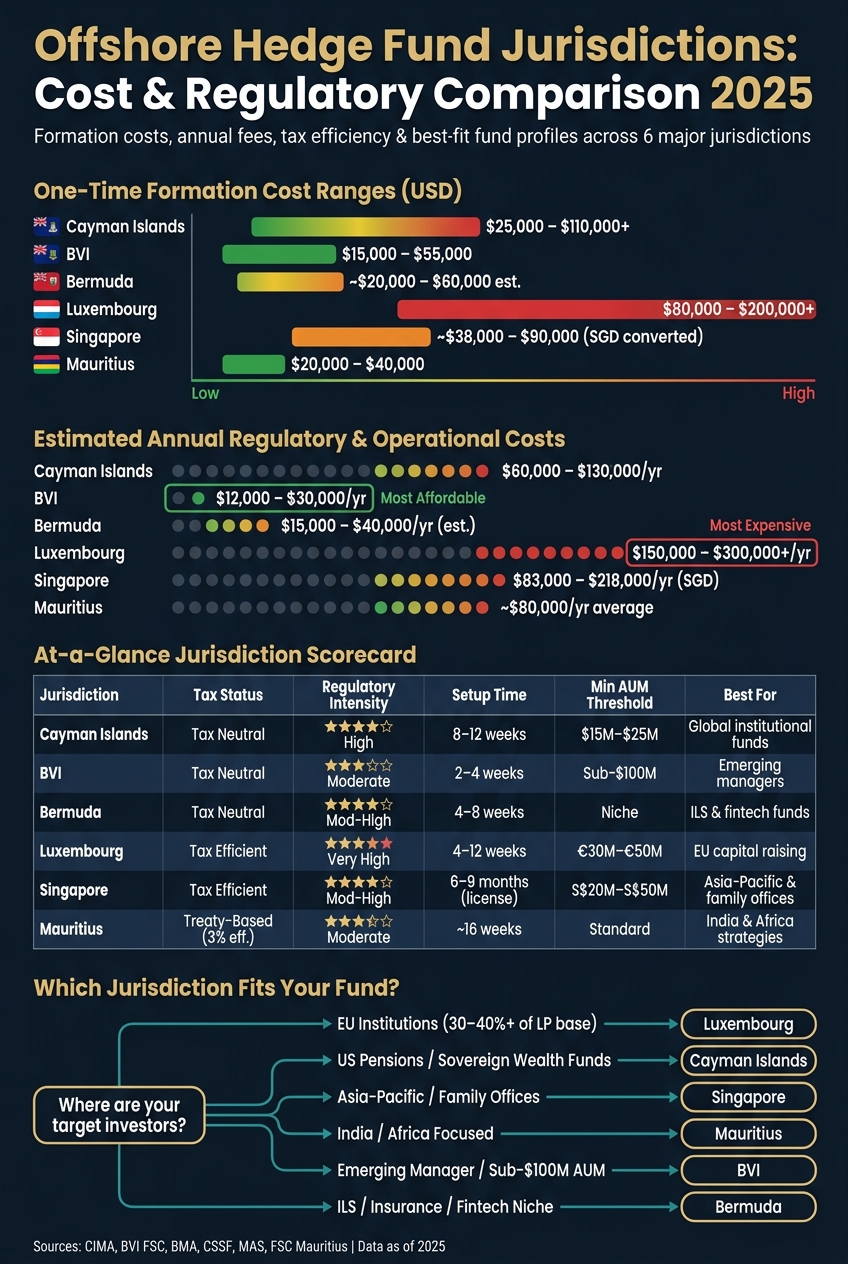
This section dives into how jurisdictions compare across key factors, building on the cost breakdowns provided earlier. There’s no one-size-fits-all solution – your choice will depend on fund size, target investors, and overall strategy.
| Jurisdiction | Formation Cost | Annual Regulatory Fee | Tax Efficiency | Regulatory Intensity | Best For |
|---|---|---|---|---|---|
| Cayman Islands | $25,000 – $110,000+ | ~$4,268 – $4,482 | Tax neutral | High | Global institutional funds |
| BVI | $15,000 – $55,000 | ~$1,500 – $2,500 | Tax neutral | Moderate (tiered) | Emerging managers; sub‑$100M funds |
| Bermuda | Moderate | ~$2,000 – $4,000 | Tax neutral | Moderate‑High | Ideal for niche funds in fintech and insurance-linked sectors |
| Luxembourg | $80,000 – $200,000+ | $100,000 – $300,000+ (AIFM) | Tax efficient | Very High (EU) | EU distribution; UCITS |
| Singapore | Medium‑High | Medium‑High | Tax efficient | Moderate‑High | Asia‑Pacific hub; family offices |
| Mauritius | $20,000 – $40,000 | ~$1,500 – $3,000 | Treaty‑based | Moderate | India and Africa‑focused strategies |
Each jurisdiction has its own strengths and weaknesses, so understanding their trade-offs is crucial. Factors like formation cost, regulatory fees, tax efficiency, and compliance requirements all play into the decision, making fund strategy and investor profile key drivers.
The Cayman Islands stands out for its institutional reputation but comes with a hefty price tag. It’s a favorite for global funds, especially when pitching to sovereign wealth funds or large U.S. pension allocators. However, smaller funds may find these costs prohibitive.
BVI is a more budget-friendly option, especially for emerging managers. Its total costs can be 30–50% lower than those in Cayman, making it a solid choice for sub-$100M funds targeting family offices or investors in regions like Asia and the Middle East. Its tiered compliance models, such as the Incubator and Approved fund structures, further ease the burden for newer managers.
Luxembourg, on the other hand, is at the high end of the cost spectrum. It’s the go-to jurisdiction for managers needing EU distribution via the AIFMD passport, but the steep annual costs – sometimes exceeding $300,000 – make it viable only if a significant portion (30–40%) of the capital comes from EU institutions.
"Luxembourg structures are 2–4x more expensive than Cayman on an annual basis. However, for managers raising substantial capital from EU institutions, the cost is justified by the distribution advantages." – Adi Sharma, Trainee, Fundtec
Bermuda shines in niche sectors like insurance-linked securities and fintech. While it’s a strong contender for these specialized funds, it doesn’t offer much advantage over Cayman or BVI for standard fund strategies like long/short equity or macro funds.
Mauritius carves out its niche with a wide network of double taxation treaties, making it especially appealing for funds targeting Indian or African markets. However, its local substance requirements can add operational complexity compared to Caribbean jurisdictions.
Conclusion
After examining the costs across major jurisdictions, it’s evident that selecting the right one depends on where your investors are based, the tax treatment you need, and how much compliance work you’re willing to manage. As one industry expert aptly notes:
"The cost differential is meaningful at small scale and irrelevant at large scale. Model the investor base first, then choose the structure that matches it."
This highlights the importance of tailoring your choice to your fund’s size and investor demographics.
For newer managers with less than $100M in assets under management (AUM), the British Virgin Islands (BVI) offers a budget-friendly option. Its flexible Approved Manager regime keeps operating and regulatory costs manageable, making it an attractive starting point.
If your target investors include large U.S. pension funds, endowments, or sovereign wealth funds, the Cayman Islands stand out. Its global reputation among institutional investors justifies its higher costs, which become less significant as your fund scales. Luxembourg, on the other hand, is a natural fit for raising capital from EU-based institutions. However, with annual costs often exceeding $300,000, it only makes sense if a significant portion of your limited partners are European. For managers focusing on the Asia-Pacific region or managing family office capital, Singapore is a strong contender, though it comes with higher regulatory demands.
Ultimately, no single jurisdiction is perfect across the board. The best strategy is to align your fund’s structure with your investor base and growth stage – and be prepared to adjust as your AUM increases.
FAQs
How do I choose the right jurisdiction for my investor base?
Selecting the right jurisdiction means considering where your investors are located and the regulatory requirements they must meet. For example, investors from the EU might need a structure in Luxembourg or Ireland to comply with AIFMD regulations, while U.S. pension funds often favor the Cayman Islands.
When making your choice, focus on institutional acceptance and legal predictability rather than just aiming for lower setup costs. This approach can help you avoid complications with fundraising down the line. Global Wealth Protection provides consultations to help tailor your structure to suit your investors’ profiles and long-term objectives.
What are the biggest ongoing annual costs after launch?
The largest recurring expenses for an offshore hedge fund generally involve regulatory filings, fund administration, and independent audits. For a streamlined setup in the Cayman Islands, annual costs typically fall between $40,000 and $80,000. Here’s a breakdown of the key expenses:
- CIMA fees: Required for regulatory compliance.
- Audits: Costs range from $15,000 to $30,000.
- Administration: Typically between $15,000 and $50,000.
- Office fees: These add an additional $5,000 to $10,000.
Global Wealth Protection supports clients in managing these expenses by leveraging tax strategies and internationalization approaches.
When is a Cayman fund too small to be cost-effective?
A Cayman Islands structure often proves too costly for smaller funds raising less than $50,000,000. With annual operating expenses landing between $40,000 and $80,000, these costs can significantly eat into the assets under management. For funds raising under $30,000,000, U.S.-based alternatives like Regulation D 506(b) or 506(c) offerings present a more economical route, potentially saving over $300,000 over a five-year period.
