
No one knows for sure who holds the most citizenships. There’s no global system tracking multiple nationalities, as citizenship laws vary by country, and individuals aren’t required to disclose all their passports. However, some reports suggest an anonymous individual holds eight citizenships (Canada, UK, Ireland, Belize, Grenada, Dominica, Saint Kitts, and Cape Verde).
For most people, having multiple citizenships isn’t about breaking records but creating flexibility. Wealthy individuals often pursue 2–4 citizenships to improve global mobility, secure financial options, and plan for emergencies. Popular methods include ancestry, naturalization, or the simplest citizenship programs involving investment, with costs ranging from $5,000 for ancestry-based routes to over $250,000 for investment citizenship.
Key points:
- Citizenship by Investment (CBI) programs in the Caribbean start at $100,000.
- Ancestry-based citizenships (e.g., Ireland, Italy) are cost-effective under $5,000.
- U.S. citizens face unique tax obligations, even with multiple passports.
The focus isn’t on holding the most passports but on selecting the right ones to meet personal and financial goals.
Who Holds the Most Citizenships? Facts vs. Claims
Why No Official Record Exists
There’s no global system tracking how many passports a person holds. Citizenship is regulated at the national level, and most countries don’t require their citizens to disclose additional nationalities. As Peter Spiro, a law professor at Temple University, explains:
"There’s no way to know the precise numbers… because most countries don’t require citizens to declare whether they hold multiple nationalities."
This reflects the principle of national sovereignty – countries only enforce their own citizenship laws, leaving no room for a centralized global record.
Known Cases: People Who Hold Many Citizenships
One widely discussed example in citizenship circles involves an anonymous individual with eight citizenships: Canada, the UK, Ireland, Belize, Grenada, Dominica, Saint Kitts, and Cape Verde. These were acquired through a mix of birthright, ancestry, and citizenship-by-investment programs.
Another example highlights actor George Clooney and his family, who, in late 2025, received French citizenship under a "distinguished citizen" provision. This case illustrates how unique opportunities, beyond conventional methods, can also grant citizenship.
These examples show that the paths to multiple citizenships are diverse, as are the reasons for pursuing them.
What This Means for You
The takeaway here isn’t about chasing records. Instead, holding multiple citizenships is often a strategic decision tailored to individual needs. For most high-net-worth individuals, the goal is not amassing as many passports as possible but creating a "passport portfolio" of two to four citizenships. This approach helps optimize mobility, reduce tax exposure, and provide security for their families.
Alexander Kosovskiy, Senior Citizenship & Residency Advisor at Astons, sums it up well:
"The practical limit is therefore not numerical. It is legal compatibility."
The real challenge isn’t how many passports you can hold but which combinations serve your goals. Whether it’s visa-free travel, access to stable financial systems, or an emergency exit plan, the focus is on solving specific problems. By carefully selecting a few key citizenships, individuals can achieve flexibility, security, and peace of mind for themselves and their families.
sbb-itb-39d39a6
How Multiple Citizenship Works Within the Law
Multiple citizenship is a legal status recognized under international law, but each country defines its own rules for managing it. These domestic laws are the backbone of creating a multi-citizenship plan, especially for asset protection. According to the 1930 Convention on Certain Questions Relating to the Conflict of Nationality Law, nations agree to respect each other’s nationality laws. However, a country can treat a dual national as solely its citizen while they are on its territory.
How Countries Differ on Multiple Citizenship
The global stance on multiple citizenship has evolved significantly. By 2026, about 75% of UN member states – more than 140 countries – permit some form of dual or multiple citizenship. This marks a sharp departure from the 20th century, when nations often discouraged "double nationality" to uphold singular loyalty.
Recent shifts highlight this change. In June 2024, Germany updated its "Modernisation of Nationality Law", removing long-standing restrictions to attract skilled workers and connect with long-term residents. Similar moves have occurred in Norway and Ukraine.
However, some nations remain strict. China, India, Japan, and Singapore prohibit dual citizenship outright, often revoking original citizenship if another nationality is acquired. For instance, India’s Overseas Citizen of India (OCI) card can cause confusion. While it offers lifelong visa privileges, it does not equate to citizenship and excludes voting rights. Spain, on the other hand, only allows dual citizenship with specific treaty countries, mainly former colonies and Portugal, requiring others to renounce their original nationality.
| Region | General Stance |
|---|---|
| Western Hemisphere | Largely open (e.g., U.S., Canada, Latin America) |
| Europe | Mostly permitted; moving toward broader acceptance |
| Asia | Largely restricted or outright banned |
| Middle East | Often restricted, with high renunciation barriers |
Main Routes to Gaining Citizenship
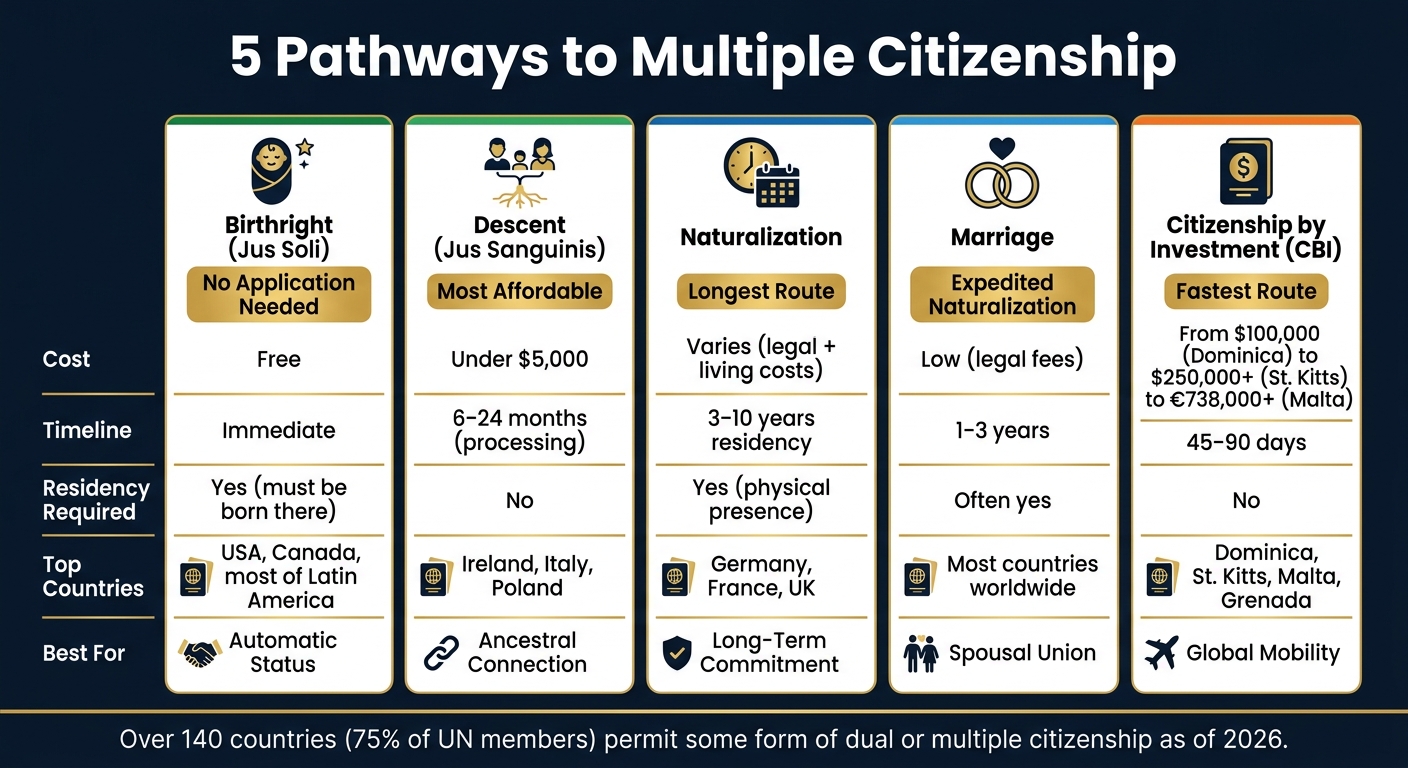
There are five key pathways to citizenship, each varying in complexity, cost, and time.
- Birthright (Jus Soli): Citizenship is granted based on birthplace. This applies in the U.S. and most of the Americas.
- Descent (Jus Sanguinis): Citizenship is based on ancestry, with no residency needed. Countries like Ireland, Italy, and Poland offer this option, often extending eligibility across generations. Costs usually stay under $5,000.
- Naturalization: This involves physical residency, typically lasting 3 to 10 years, alongside language and integration requirements.
- Marriage: Many countries expedite naturalization for spouses, reducing the timeline to 1 to 3 years.
- Citizenship by Investment (CBI): This route bypasses residency requirements entirely. Caribbean programs like Dominica start at $100,000, while St. Kitts requires $250,000. Malta’s program begins at €738,000 or more. European Golden Visa programs, such as those in Greece and Portugal, offer residency-to-citizenship paths starting around €250,000 with minimal physical presence requirements.
"Residency and citizenship rights are assembled rather than inherited, with families creating structured portfolios of access rights to build resilience over generations." – Dominic Volek, Group Head of Private Clients at Henley & Partners
Practical Limits Most People Face
Financial and logistical hurdles are the biggest barriers. CBI programs demand significant investment, while naturalization often requires years of physical presence – something many high-net-worth individuals struggle to commit to. On top of that, language requirements in countries like France and Hungary add another layer of difficulty.
Legal pitfalls also complicate matters. Some nations enforce "automatic citizenship forfeiture" laws, revoking original citizenship when another is acquired – often without formal notice. In May 2025, South Africa’s Constitutional Court struck down such a rule, declaring it unconstitutional. The court reinstated citizenship for individuals affected by the provision since October 1995, treating them as if they had never lost it. This case underscores the importance of staying updated on changing laws.
Before pursuing naturalization, check whether your home country is among the 38 nations that prohibit or heavily restrict renunciation. If renunciation is required by your target country, exceptions might apply. Missteps here could leave you stateless or caught in a legal gray area.
Navigating these legal and logistical challenges is crucial for making the most of the opportunities multiple citizenship can offer.
Key Benefits of Holding Multiple Citizenships
Holding multiple citizenships offers far more than just legal advantages. It opens up opportunities for financial security, expanded travel, and family protection – making it a strategic move for those looking to diversify their personal and financial options.
Reducing Exposure to a Single Government
Relying solely on one government for your identity, banking, and tax obligations can make you vulnerable. Political shifts, sudden capital controls, or new reporting requirements can arise without warning. By holding multiple citizenships, you can spread these risks across different legal systems and geopolitical regions.
Interestingly, over 34% of ultra-high-net-worth individuals actively pursue second citizenships. The investment migration industry itself has grown to generate nearly $20 billion in revenue as of 2024. This isn’t just about novelty – it’s about treating citizenship as a key part of wealth management.
For U.S. citizens, a second citizenship can unlock access to banking and asset management in financial hubs like Switzerland, Singapore, and Dubai – places that might otherwise be difficult to navigate. It also opens avenues for tax planning in countries with territorial tax systems, such as Panama or the UAE. However, keep in mind that U.S. citizens are still subject to FATCA and FBAR reporting requirements unless they formally renounce their U.S. citizenship.
While diversifying citizenship helps secure financial freedom, it also comes with the added benefit of expanding your global mobility.
Expanding Your Travel and Residency Options
Not all passports are created equal. The strength of a passport can vary greatly depending on your country of origin. For instance, the U.S. passport dropped to 10th place on the Henley Passport Index in 2026, marking its lowest position in over a decade. A second citizenship can bridge these gaps, granting access to regions like the Schengen Area, Singapore, Hong Kong, or even the right to live and work across all 27 EU member states and EEA countries.
Unlike residency permits, citizenship is permanent, can be passed down to future generations, and is immune to sudden policy changes. Malta, for example, offers merit-based citizenship with visa-free access to 183 countries. Additionally, Ireland’s Foreign Births Registration program has facilitated over 100,000 successful applications since its inception. For those with qualifying ancestry, the process is often affordable, with costs typically under $5,000 for documentation and fees.
Building Exit Options and Protecting Your Family
A second citizenship guarantees a legal right to entry and residence that cannot be revoked by foreign governments. This becomes crucial during crises – whether it’s economic instability, travel restrictions, or political upheaval.
Between 2024 and 2025, applications for residence and citizenship planning from U.S. nationals surged by 77%. Meanwhile, projections estimate that a record 165,000 millionaires will relocate globally by 2026. For families, the benefits extend across generations. Citizenship options based on ancestry – such as those offered by Ireland, Italy, or Poland – can be passed down, providing children with access to education, settlement rights, and enhanced mobility for years to come.
This kind of strategic planning not only creates an exit strategy but also reinforces a long-term asset protection plan – something that residency programs alone simply can’t match.
How to Build a Multi-Citizenship Plan That Works for You
Assessing Where You Stand Today
Before diving into any citizenship program, take a step back and analyze your current situation. Start by exploring your family tree. Citizenship based on ancestry is often the most affordable and straightforward option. For example, countries like Ireland, Italy, and Poland offer ancestry-based citizenship programs, with costs typically under $5,000 for filing and legal fees. If you have a grandparent from one of these nations, this could be your easiest and most cost-effective route.
Next, think about your resources, timeline, and goals. Are you looking for visa-free travel, a tax-friendly base, or a secure backup plan for your family? Your answers will guide you toward the right programs and help you prioritize your options.
Once you’ve mapped out your current assets and objectives, you’ll be ready to identify the countries that align with your long-term strategy.
Choosing the Right Countries
Think of citizenship as a portfolio – diversification is key. A well-rounded plan often involves three main pillars:
| Phase | Action | Purpose | Timeline |
|---|---|---|---|
| Pillar 1 | Caribbean CBI (e.g., St. Kitts at $250,000) | Quick mobility and diversification | 45–90 days |
| Pillar 2 | European Golden Visa (e.g., Greece from €250,000) | Begin the path to EU citizenship | 5–10 years |
| Pillar 3 | Strategic residency (e.g., UAE) | Tax-friendly base and banking access | 6–12 months |
This approach spreads your exposure across different legal systems and regions, reducing risks tied to any single geopolitical area. For instance, combining a Caribbean passport, a European residency, and a Middle Eastern base provides better protection than holding multiple passports from the same region.
If you’re a U.S. investor interested in the E-2 Treaty Investor Visa, Grenada is worth considering. It’s the only Caribbean CBI country that qualifies for this visa, making it a strategic choice for those seeking U.S. business opportunities.
Avoid clustering your citizenships within a single region. A mix of passports from Europe, the Americas, and regions like the Pacific or Middle East offers more security and flexibility.
Staying Compliant Across Multiple Jurisdictions
Having multiple passports doesn’t mean you’ll owe taxes in every country. Tax obligations depend on where you’re considered a tax resident, which is usually determined by the 183-day rule in most nations. However, U.S. citizens are an exception – they’re taxed on their worldwide income, no matter where they live or how many passports they hold.
If you’re a U.S. citizen, you’ll also need to file an FBAR (FinCEN Form 114) for any foreign accounts exceeding $10,000, along with FATCA reporting requirements. This applies even if the account was opened using a non-U.S. passport. Compliance with U.S. tax laws remains mandatory, regardless of your other citizenships.
"Citizenship and residence decisions must be coordinated with cross-border tax exposure, family governance, and succession planning." – CCLEX Global
Additionally, keep track of any physical presence requirements tied to your citizenships. For example, Antigua and Barbuda require you to spend at least 5 days in the country over 5 years. Failing to meet such requirements could jeopardize your citizenship status.
To avoid costly mistakes, work with a team of professionals – including an immigration attorney, tax advisor, and wealth manager – who can provide coordinated advice. Disjointed guidance is one of the most common pitfalls in this process. By aligning legal compliance with your broader asset protection strategy, you can ensure your plan remains stable and effective for the long haul.
Conclusion: Focus on the Right Number, Not the Highest Number
The idea of collecting multiple passports might sound appealing, but it often leads to unnecessary complications. Instead, a more thoughtful and strategic approach can yield far better results than simply chasing numbers.
Citizenship choices should complement broader goals like managing risks, optimizing taxes, and structuring assets effectively. A well-designed plan typically includes one primary citizenship, a backup option, and one or two strategic residencies. This approach offers flexibility for travel, a reliable safety net, and better tax management – all without creating an overwhelming compliance burden.
"A second citizenship is not a trophy asset. It’s part of a broader mobility structure that should fit your investment footprint, banking relationships, succession planning, and access to top-tier private healthcare." – David Eline, Riviera Expat
The growing interest in global citizenship reflects a shift in priorities around freedom and security. However, more passports don’t always translate to better outcomes. The most successful investors are those who carefully coordinate their plans. Start by considering your ancestry, evaluating your tax exposure, and selecting programs with rigorous due-diligence standards. The goal isn’t to rack up the highest passport count – it’s to build a portfolio that enhances security, simplifies your life, and aligns with your long-term objectives.
FAQs
How can someone legally hold multiple citizenships?
Legally holding multiple citizenships depends on the specific laws of each country, as there’s no universal rule governing this. You can acquire citizenship through various means, such as birth, descent, marriage, naturalization, or even investment – but only if all the countries involved permit dual or multiple citizenships.
It’s crucial to confirm whether your current country allows this, as some nations require you to renounce your existing citizenship before obtaining another. Additionally, consulting with legal and tax advisors is essential to ensure you comply with international obligations, like FATCA or CRS, which can affect individuals with ties to multiple nations.
Which countries might force you to renounce your original citizenship?
Whether you need to give up your original citizenship depends on the laws of the country where you’re seeking a new nationality. For example, countries like China, India, Japan, and Singapore often don’t permit dual citizenship and may require you to renounce your original one. However, some of these countries enforce this rule only in certain situations. On the other hand, many nations – around 140 globally – allow dual citizenship, letting you keep your original nationality while acquiring a new one.
What are the biggest tax and reporting risks for U.S. dual citizens?
U.S. dual citizens face complex tax and reporting requirements due to the U.S.’s citizenship-based taxation system. This system mandates that all U.S. citizens, regardless of where they live, must report their worldwide income annually using Form 1040.
Key obligations include:
- FBAR (Foreign Bank Account Report): Required if the total value of foreign accounts exceeds $10,000 at any point during the year.
- Form 8938: Necessary for reporting foreign financial assets above certain thresholds.
Failing to meet these requirements can result in hefty penalties, making compliance critical. For those considering renouncing U.S. citizenship, it’s important to note that doing so might trigger an expatriation tax on global assets, adding another layer of financial complexity.
