
When forming an LLC, many overlook the importance of a registered agent. A registered agent acts as the official contact for your LLC, handling legal and government documents, ensuring compliance, and protecting your privacy. Here’s why they matter:
- Legal Compliance: They help your LLC stay in good standing by managing deadlines for filings, taxes, and legal responses. Missing these can lead to penalties, lawsuits, or even the dissolution of your LLC.
- Privacy Protection: By using their address on public records, registered agents keep your personal address private, shielding you from unwanted exposure.
- Critical Role in Asset Protection: They ensure your LLC maintains its legal separation from personal assets, preventing liability issues.
Whether you’re managing a single LLC, a complex multi-entity structure, or a foreign-owned LLC, a professional registered agent simplifies compliance and safeguards your assets. But choosing the right one is key – look for reliability, nationwide coverage, and features like same-day document alerts.
How Registered Agents Keep LLCs Legally Compliant
Acting as the Official Contact for State Authorities
A registered agent is your LLC’s go-to contact for any official communication from state authorities, including reminders for annual reports and tax notices. To meet legal requirements, professional registered agents must provide a physical street address and ensure staff availability during standard business hours (usually 9 a.m. to 5 p.m., Monday through Friday). All state documents are delivered to this address, initiating important deadlines.
"Almost all entities on record with the Secretary of State must have a registered agent listed with a Colorado address, even if their business is located in a different state. Failing to appoint and maintain a registered agent can result in severe penalties for the entity and, sometimes, its owners." – Colorado Secretary of State
This setup not only satisfies legal obligations but also helps avoid missed deadlines or overlooked correspondence.
Preventing Legal and Administrative Problems
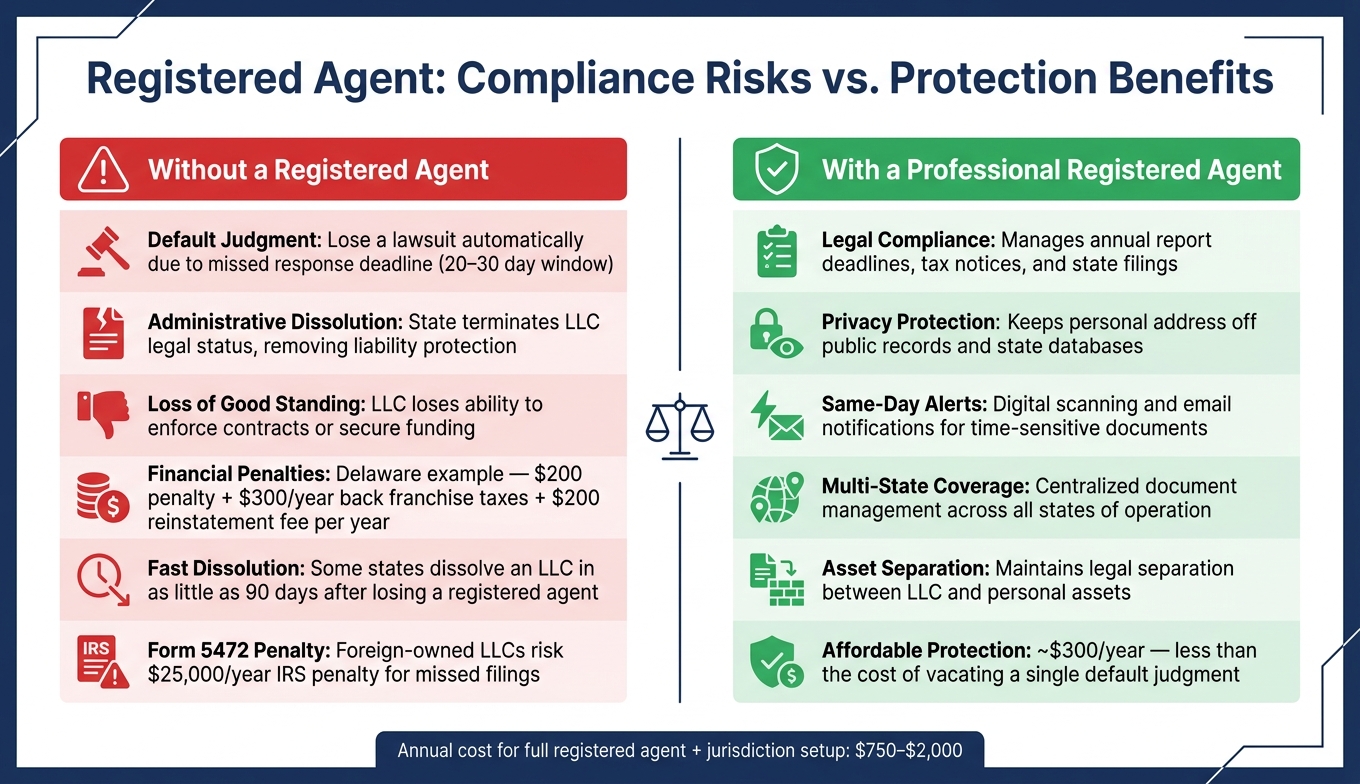
When lawsuits arise, deadlines to respond are often tight – typically within 20 to 30 days. If your registered agent doesn’t promptly forward a summons, you might miss that critical window without even knowing legal action has started. Professional registered agent services address this by providing same-day digital scanning and alerts, ensuring you’re notified of urgent matters right away.
Failing to stay compliant can lead to serious consequences for your LLC, such as:
| Consequence | What It Means for Your LLC |
|---|---|
| Default Judgment | Losing a lawsuit automatically because no response was filed in time. |
| Administrative Dissolution | The state terminates your LLC’s legal status, removing its liability protection. |
| Loss of Good Standing | Your LLC may lose the ability to enforce contracts or secure business funding. |
| Financial Penalties | Late fees, unpaid franchise taxes, and reinstatement costs can quickly add up. |
Take Delaware as an example: if your LLC loses good standing, it could face a $200 penalty, $300 per year in back franchise taxes, and a $200 reinstatement fee for each year of non-compliance. Some states move fast – an LLC can go from losing its registered agent to full administrative dissolution in as little as 90 days.
Using a professional registered agent service ensures your LLC stays compliant and retains its liability protections.
sbb-itb-39d39a6
How Registered Agents Protect Your Privacy
Keeping Owner Information Off Public Records
When setting up an LLC, you’re required to include a physical address in your Articles of Organization. Unfortunately, this information becomes part of a public database, making it easily searchable. Listing your personal address can put your privacy at risk, especially for home-based businesses.
A registered agent solves this issue by using their address on your formation documents instead of yours. This keeps your personal address off public records – a crucial safeguard for protecting your privacy. Without this option, your residential address could end up exposed in state registries.
Public business records are often scraped by data brokers, marketers, and solicitors. Once your address is in their databases, removing it can be a nightmare. Appointing a registered agent before filing your Articles of Organization is a simple yet effective way to keep your personal address private.
In addition to shielding your address, registered agents also act as a filter for official communications, adding another layer of privacy protection.
Filtering Legal and Government Correspondence
Registered agents act as a go-between for all the official correspondence your LLC receives. This includes legal documents like service of process (lawsuits), state compliance notifications, franchise tax bills, wage garnishment orders, and regulatory notices. Instead of being sent to your personal address, these documents go directly to the registered agent’s office.
For example, if your LLC is served with a lawsuit summons, it will be delivered to the registered agent’s address. This keeps sensitive legal proceedings away from your home or business location, reducing the risk of exposing private matters to neighbors or clients. Similarly, wage garnishment orders – affecting between 1% and 3% of U.S. employees – often start with documents served to the registered agent. Without this buffer, such personal legal documents could end up at your doorstep, compromising your privacy.
| Correspondence Type | Risks of Receiving at Your Home |
|---|---|
| Lawsuit summons | Legal documents delivered in plain view |
| Wage garnishment order | Reveals sensitive financial details |
| State delinquency notice | Risk of missing compliance deadlines |
| Regulatory violation notice | Potential legal trouble if ignored |
Many registered agent services offer same-day digital scanning and email notifications, ensuring you receive time-sensitive documents securely and without delay. This is particularly important since legal response deadlines are usually 20 to 30 days from the date of service. Quick, private notifications can make all the difference.
That said, it’s important to avoid using your registered agent’s address for banking, IRS filings, or general business mail. Banks often associate registered agent addresses with shell entities, which can lead to account rejections. For operational correspondence, consider using a virtual mailbox while reserving your registered agent’s address for legal and government communications.
Registered Agents in Complex Asset Protection Structures
Registered agents play a crucial role in simplifying compliance and ensuring privacy within complex asset protection frameworks. These services are particularly valuable in advanced setups where maintaining legal separation and adhering to regulations is critical.
Supporting Multi-Entity and Layered LLC Setups
Single-entity LLCs provide basic protection, but multi-layered LLC structures take asset safeguarding to another level. A common arrangement involves a holding LLC that owns one or more operating LLCs. The holding company secures valuable assets, while the operating LLC manages daily business activities. This separation ensures that if the operating LLC faces legal challenges, the assets in the holding entity remain shielded.
Each entity in such a structure must appoint its own registered agent in the state where it is formed. A national registered agent service simplifies this process by centralizing document management across multiple states. For example, if a Wyoming holding LLC owns property or operates in California, it must foreign qualify in California and designate a registered agent there. This centralized approach helps non-resident entrepreneurs navigate the complexities of multi-state compliance.
Facilitating US LLC Formation for Non-Residents
For non-US owners, registered agents are essential to meet the physical presence requirement in the United States. Non-residents also face significantly lower US estate tax thresholds for US-situs assets. To address this, many use a layered "blocker" structure – NRA → Foreign Corporation → Wyoming LLC – which converts US-situs assets into non-US-situs shares, reducing estate tax exposure. The registered agent ensures the Wyoming LLC maintains its legal standing by providing a physical nexus and handling compliance.
Timely communication is critical in these setups. Missing deadlines can lead to default judgments, which is why same-day digital forwarding of documents is indispensable for international owners. A registered agent offering immediate forwarding ensures that critical notices are received and acted upon promptly, mitigating risks.
Additionally, foreign-owned US LLCs face significant tax filing requirements. For instance, failing to file Form 5472 can result in penalties starting at $25,000 annually. While registered agents do not handle tax filings, they receive IRS correspondence and forward it promptly, giving owners the chance to address issues before penalties escalate.
"Privacy is one of our core values and it is represented in everything we do. When we form LLC’s, this is our primary focus." – Bobby Casey, Founder of Global Wealth Protection
How to Choose the Right Registered Agent
What to Look for in a Registered Agent
Selecting the right registered agent is crucial for keeping your LLC compliant and protecting your personal information. A poor choice can jeopardize an otherwise solid asset protection plan.
Your agent should have a physical address and be available during standard business hours, Monday through Friday, 9 AM to 5 PM. This availability is critical because lawsuits often require a response within 20 to 30 days. Features like same-day digital alerts can help ensure you respond in time.
A professional registered agent uses their own business address on public records instead of your home or office address. This keeps your personal contact details private and out of public databases. As Bobby Casey, Managing Director of Global Wealth Protection, notes:
"Wyoming, Delaware, and Nevada LLC’s are the most common tools for US domestic Asset Protection Planning. This is a must-have tool to manage your real estate, business, or liquid investments."
For businesses operating in multiple states, it’s wise to choose a provider with nationwide coverage. This allows you to centralize document management, streamline billing, and avoid the risk of missing deadlines. A secure online portal for accessing and tracking documents is especially helpful for international operators.
Additionally, automated reminders for annual reports, franchise taxes, and other state filing deadlines can save you from late fees or, worse, administrative dissolution. These features help ensure your LLC remains in good standing.
With these points in mind, it’s equally important to recognize and avoid common mistakes.
Mistakes to Avoid When Using a Registered Agent
Understanding what to look for in a registered agent can help you sidestep common errors that could undermine your asset protection efforts.
One major mistake is listing your personal address as the registered office. Doing so exposes your address on public records and requires you to be physically available during business hours.
Avoid using a P.O. Box, as state requirements mandate a physical street address.
Another misstep is using your registered agent’s address as your primary business mailing address. Banks and payment processors often flag registered agent addresses, which can lead to additional scrutiny or even rejection of your applications. Instead, consider using a virtual mailbox for general business correspondence, IRS notices, and bank statements. Reserve the registered agent’s address strictly for legal and state documents.
Finally, failing to act on forwarded documents can have serious consequences. For example, in In re Andover Senior Care LLC (2024), a Kansas LLC faced a $785,000 default judgment because its registered office wasn’t properly staffed to receive legal service. The court held the LLC accountable for the oversight. While a professional agent can reliably handle document delivery, it’s your responsibility to respond promptly when you receive forwarded documents.
"The cost [of a professional agent] is roughly $300 per year, which is less than the filing fee to vacate a single default judgment." – Justin Abdilla, Esq., Managing Attorney, Abdilla & Associates
Conclusion: Getting the Most Out of Your Registered Agent
A registered agent plays a crucial role in protecting your assets – helping your LLC stay compliant, keeping your address confidential, and ensuring you meet important deadlines.
That said, relying solely on a registered agent isn’t enough for full protection. Surprisingly, less than 5% of individuals seeking asset protection reviews have taken essential steps to safeguard themselves before consulting a professional. Without a well-structured operating agreement, the right jurisdiction, considering why offshore asset protection might be necessary, and a clear ownership framework, even the best registered agent can leave gaps in your protection. While the registered agent is key for compliance and privacy, it needs to be part of a larger, well-thought-out plan.
At Global Wealth Protection, privacy is at the heart of our strategy. Combining a registered agent with a carefully chosen state, a strong operating agreement, and expert advice creates a solid foundation to protect your assets. The annual cost for such a setup usually ranges from $750 to $2,000, depending on the jurisdiction – a small investment compared to the potential cost of a single legal mistake.
FAQs
Can I be my own registered agent?
Yes, you can act as your own registered agent in any U.S. state, provided you meet a few conditions: you must be at least 18 years old, have a physical street address (not a P.O. box) in the state, and be available at that address during normal business hours to receive legal documents. Keep in mind, though, this choice means your personal address will be publicly accessible, and there’s a chance you could miss important legal notices if you’re not consistently available.
Do I need a registered agent in every state I register in?
Yes, every state where your business is registered requires you to have a registered agent. This applies to both your state of formation and any states where your business is foreign-qualified. The registered agent must have a physical address in that specific state to receive legal documents on your behalf. If you fail to maintain a registered agent in each required state, you risk facing penalties or losing your good standing.
Will a registered agent keep my home address off public records?
When you form an LLC, a registered agent can help protect your privacy by using their address instead of your home address on state formation documents. This means their address will appear in public records, offering an extra layer of privacy. However, keep in mind that a registered agent’s address is strictly for official state correspondence. For everyday business mail, you’ll likely need another solution, such as a P.O. box or a mail-drop service.
