
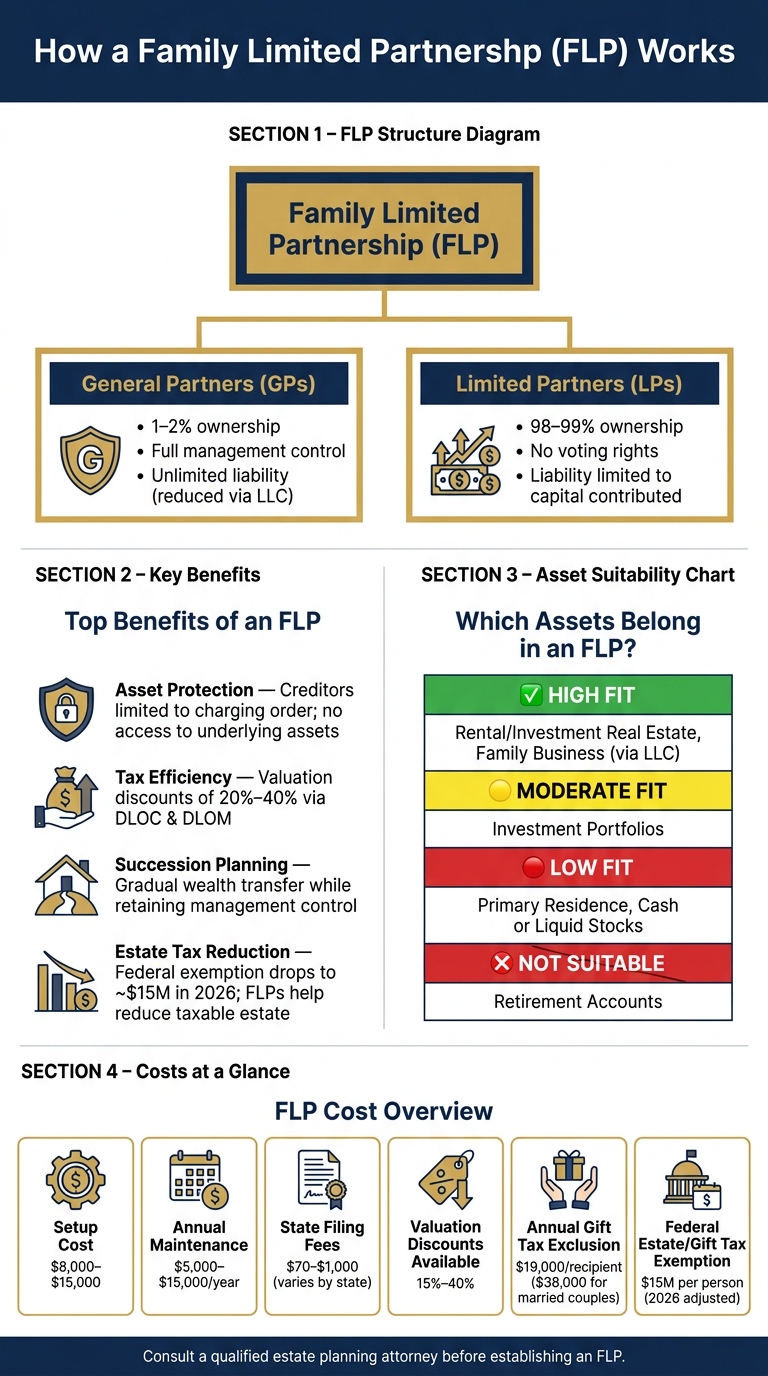
Family Limited Partnerships (FLPs) are legal tools designed to protect family wealth from creditors, lawsuits, and other risks while maintaining control within the family. They consolidate assets like real estate, investments, or business interests into a private family office structure with two roles: General Partners (GPs), who manage the partnership, and Limited Partners (LPs), who hold ownership without control. Key benefits include:
- Asset Protection: Creditors can only access distributions, not underlying assets, via a charging order. For those seeking even stronger safeguards, offshore asset protection offers additional layers of security against domestic legal reach.
- Tax Efficiency: FLPs allow discounted wealth transfers (up to 40%) due to lack of control and marketability.
- Succession Planning: Enables gradual transfer of wealth while keeping management control with senior family members.
- Estate Tax Reduction: Especially relevant as the federal estate tax exemption drops to $15M in 2026.
However, FLPs require careful setup and management. Costs range from $8,000 to $15,000 upfront, with annual maintenance between $5,000 and $15,000. Proper formalities, such as separate accounts, annual meetings, and strict adherence to legal guidelines, are critical to avoid IRS scrutiny or legal challenges. Missteps like using FLP funds for personal expenses or including unsuitable assets (e.g., primary residences) can undermine its legitimacy.
FLPs are ideal for families with substantial, income-generating assets or businesses, but they aren’t suitable for all situations. Families with unresolved conflicts, smaller estates, or timing issues (e.g., transferring assets during legal disputes) may find other strategies more appropriate. Ultimately, FLPs are a powerful option for safeguarding wealth and ensuring smooth generational transfers, provided they are structured and managed correctly.
Assessing Whether an FLP Fits Your Situation
Which Assets Belong in an FLP?
Not all assets are suitable for a Family Limited Partnership (FLP). The most fitting candidates are income-generating and investment assets. These include rental or investment real estate, marketable securities like stocks and bonds, diversified portfolios, and oil and gas interests. These types of assets benefit from centralized management and generate returns over time, making them ideal for an FLP structure.
However, operating businesses require a different approach. Instead of placing an operating business directly into an FLP, it’s better for the FLP to own the membership interest in an LLC that operates the business. This setup helps protect the partnership’s other assets by isolating liability within the LLC.
| Asset Type | FLP Suitability | Key Reason |
|---|---|---|
| Rental/Investment Real Estate | High | Illiquid, income-generating, and benefits from centralized management |
| Family Business (via LLC) | High | Allows gradual succession and potential valuation discounts |
| Investment Portfolios | Moderate | Useful for consolidation but may attract IRS scrutiny without a clear purpose |
| Primary Residence | Low | Treated as personal-use; invites IRS scrutiny and complicates estate planning |
| Cash or Liquid Stocks | Low | Hard to justify a legitimate business purpose for valuation discounts |
| Retirement Accounts | Not Suitable | Cannot legally be transferred into an FLP |
Certain assets, like motor vehicles and primary residences, should be avoided. For example, motor vehicles can expose all FLP assets to liability in case of an accident. Similarly, including a primary residence might make the FLP appear less legitimate for asset protection purposes.
With asset suitability in mind, it’s also crucial to consider family structure and legal exposure when deciding if an FLP is the right fit.
Evaluating Family Dynamics and Legal Exposure
Once you’ve identified appropriate assets, the next step is to evaluate family dynamics and legal risks. An FLP thrives when there’s a clear family hierarchy and unified goals. Maintaining formalities – such as holding annual meetings, keeping a separate bank account, and filing Form 1065 – is essential to preserve the FLP’s legitimacy.
Another advantage of FLPs is their potential to protect assets during divorce proceedings. Limited Partnership (LP) interests gifted to family members are typically classified as separate property, making them less likely to be divided in a divorce. Additionally, the Partnership Agreement can include clauses that allow the repurchase of LP interests, preventing them from leaving the family through involuntary transfers.
However, it’s important to follow strict guidelines. As Brillant Law warns:
"If you start using the FLP as a personal piggy bank – paying for groceries, family vacations, or personal bills from its account – you’re basically handing tax authorities a signed confession that the FLP is a sham."
When an FLP Is Not the Right Choice
While FLPs offer many benefits, they’re not suitable for every situation. Financial and timing considerations play a significant role in determining whether this structure makes sense. Initial setup costs range between $8,000 and $15,000, with annual maintenance expenses of $5,000 to $15,000. For smaller estates, these costs may outweigh potential tax savings.
Timing is another critical factor. If assets are transferred into an FLP after legal action has been initiated or while debts are outstanding, the transfer could be deemed fraudulent. In such cases, a judge may reverse the arrangement entirely. To avoid this, the FLP must be established well before any legal issues arise. For those seeking even higher levels of security, structuring offshore trusts for asset protection can provide an additional layer of defense against future claims.
Lastly, families dealing with significant internal conflicts might struggle with an FLP. If partners can’t agree on basic decisions, the voting requirements outlined in the Partnership Agreement could lead to operational gridlock, making the FLP difficult to manage effectively.
sbb-itb-39d39a6
How to Set Up a Family Limited Partnership
Picking the Right State and Advisors
When setting up a Family Limited Partnership (FLP), the state you choose plays a significant role in its success. States like Delaware, Nevada, and Wyoming are popular choices due to their strong limited partnership laws and creditor protections. Filing fees in these states vary widely, ranging from $70 to $1,000, depending on the jurisdiction you select.
You’ll also need to assemble a team of professionals to ensure everything is set up correctly. This includes an estate planning attorney to draft the partnership agreement, a CPA to manage tax structuring and annual filings, and a qualified appraiser to value the assets being transferred. Skimping on qualified professionals can lead to IRS scrutiny, so it’s crucial to hire experienced experts. The total cost for setting up an FLP typically falls between $8,000 and $15,000.
Setting Up Ownership and Control
One of the main advantages of an FLP is that it allows senior family members to transfer wealth while keeping management control. A typical FLP structure involves senior family members holding a small General Partner (GP) interest – usually 1% to 2% – while the remaining 98% to 99% is owned by children or trusts as Limited Partners (LPs). This arrangement lets senior family members retain control over management decisions, such as distributions, while gradually shifting the economic benefits to the next generation.
The GP has full authority over management, while LPs benefit financially but do not participate in daily operations. To limit personal liability as a GP, it’s advisable to form a separate LLC to act as the GP. Once the LLC is in place, you’ll need to apply for a Federal Employer Identification Number (EIN) from the IRS for tax purposes.
| Role | Control | Liability | Typical Ownership |
|---|---|---|---|
| General Partner (GP) | Full management authority | Unlimited (reduced by using an LLC) | 1–2% |
| Limited Partner (LP) | Passive; no voting rights | Limited to the capital contributed | 98–99% |
Transferring Assets into the FLP
Once ownership and control are established, the next step is to transfer assets into the FLP’s name. This process involves formally retitling assets to ensure they are protected. For real estate, you’ll need a new deed. Business interests require assignment agreements, while securities accounts must be transferred using the appropriate forms. Keeping assets in your personal name can lead to IRS scrutiny, so make sure everything is properly retitled.
If you’re transferring mortgaged real estate, review the loan covenants to avoid triggering due-on-sale clauses. It’s also essential to have a qualified appraiser document the value of transferred assets, especially if you plan to claim valuation discounts of 15% to 40%.
The Estate of Fields case (TC Memo 2024-90, July 2024) highlights the importance of timing. In this case, $17 million in Texas oil business assets transferred into an FLP were included in the taxable estate at full value because the FLP was formed less than a month before the owner’s death, and partnership funds were used for personal expenses. To avoid similar issues, establish your FLP well in advance of any health or legal concerns, and ensure partnership finances are kept entirely separate from personal accounts from the start.
Once assets are successfully retitled, the focus shifts to maintaining proper partnership operations and compliance.
Running and Maintaining an FLP
Keeping Up with Partnership Formalities
To keep an FLP running smoothly and avoid potential challenges from the IRS or creditors, it’s critical to stick to proper operational practices.
The cornerstone of this is financial separation. The FLP must have its own bank and brokerage accounts, and personal expenses should never be paid from these accounts. Partners are also expected to hold annual meetings and keep detailed records of key decisions, such as changes in strategy, asset sales, or distributions. These meeting minutes are essential – they demonstrate that the FLP is a legitimate business entity and not just a shell. Additionally, the FLP must file its own federal tax return (Form 1065) and issue Schedule K-1s to each partner. The cost of maintaining compliance – covering accounting, tax filings, and legal requirements – typically ranges from $5,000 to $15,000 annually.
One common pitfall involves the personal use of FLP assets, like a family vacation home. Under IRC Section 2036, such use can lead to those assets being pulled back into the taxable estate, potentially resulting in unexpected tax consequences. To avoid this, any personal use should be documented with a lease agreement, and fair market rent must be paid to the partnership.
Once these formalities are in place, the next step is to establish distribution policies that enhance creditor protections.
Distribution Policies and Creditor Protections
Carefully crafted distribution policies work hand-in-hand with proper formalities to protect FLP assets from creditor claims. As discussed earlier, the General Partner (GP) holds significant control over distributions, which can be a powerful shield.
If a Limited Partner is targeted by a lawsuit or judgment, creditors are often limited to obtaining a charging order. This legal remedy allows the creditor to claim any distributions that would have gone to the debtor partner, but it doesn’t grant access to the FLP’s underlying assets or force a sale of the partnership.
Here’s where the GP’s discretion comes into play: they can simply stop making distributions to the debtor partner, effectively cutting off the creditor’s access to cash. Adding to this, IRS Revenue Ruling 77-137 creates a unique tax angle. A creditor with a charging order may still owe taxes on the debtor’s share of FLP profits – even if no cash distributions are made. The American Society for Asset Protection explains:
"The result is that the plaintiff does not obtain any assets or income, but is liable for taxes on the income they will never receive."
Certain states, including Nevada, Alaska, South Dakota, and Texas, go even further by law. They make the charging order the sole remedy for creditors, eliminating the possibility of foreclosure or receivership.
Common Mistakes That Undermine an FLP
The majority of FLPs don’t fail during their formation – they fail during day-to-day operation. A common pattern emerges: the FLP is set up correctly but then treated informally, which erodes its credibility over time.
KHA Accountants puts it succinctly:
"An FLP that is carefully established but then left to operate informally can lose its defensibility over time just as surely as one that was poorly structured from the start."
A recent case illustrates this point: misuse of FLP funds led to the arrangement being disregarded entirely. As a result, the assets were included in the taxable estate at full value, and all planned valuation discounts were eliminated.
Other frequent missteps include placing a primary residence in the FLP, which raises red flags. Additionally, failing to outline a legitimate business purpose – such as streamlining asset management or planning for succession – can invite scrutiny from the IRS. Lastly, the senior generation must ensure they retain enough personal assets outside the FLP to cover their living expenses. Otherwise, the FLP may appear to be a vehicle for transferring assets while continuing to live off partnership funds, which undermines its legitimacy.
Using FLPs for Multi-Generational Wealth Planning
Family Limited Partnerships (FLPs) not only protect assets but also make it easier to transfer wealth across generations. This structure allows families to pass down wealth while maintaining control and reducing tax burdens.
Gifting FLP Interests and Reducing Tax Exposure
In an FLP, senior family members typically serve as General Partners (GPs), keeping full management control. Over time, they can gift Limited Partner (LP) interests to children or grandchildren. These LP interests, which come without management rights or resale value, are often appraised at a 20%–40% discount due to a lack of control (DLOC) and lack of marketability (DLOM).
This discount means families can transfer more wealth while using less of their lifetime gift tax exemption. Currently, the federal estate and gift tax exemption is $15 million per person (set to adjust in 2026), and the annual gift tax exclusion is $19,000 per recipient (or $38,000 for married couples gifting together). By gifting discounted LP interests each year, families can reduce the size of their estate without triggering gift taxes.
As Daniel Roccanti from James Moore & Company explains:
"I want to start shifting the economics without giving away the steering wheel."
It’s crucial to use a qualified, independent appraiser for each gift of LP units. The IRS often scrutinizes valuation discounts, and a professional appraisal is your strongest defense. This approach not only minimizes tax exposure but also ensures the family retains control over its wealth.
Enhancing FLP Benefits Through Strategic Trust and Entity Combinations
Combining an FLP with other legal tools can amplify its benefits. For example, gifting LP interests to an irrevocable trust keeps assets out of an heir’s taxable estate while shielding them from creditors or potential divorce claims. Spendthrift provisions can also be included to protect beneficiaries who may struggle with financial responsibility.
For families with multiple properties or businesses, a tiered entity structure can be particularly effective. In this setup, the FLP acts as a holding company for property-level LLCs. This isolates liability at the individual asset level while centralizing management within the FLP. As a result, a lawsuit tied to one property cannot jeopardize the others.
Families with substantial illiquid assets, such as real estate or private businesses, might also benefit from pairing the FLP with an Irrevocable Life Insurance Trust (ILIT). The ILIT provides liquidity to cover estate taxes and administrative expenses, reducing the risk of having to sell FLP assets under unfavorable conditions.
Planning for Leadership Changes in the FLP
Smooth leadership transitions are essential to maintaining the FLP’s integrity over time. Planning for General Partner (GP) succession early can prevent disruptions. One option is to use a separate LLC as the GP. This LLC’s operating agreement can outline successor managers, ensuring automatic transitions without involving probate or courts. Alternatively, a revocable living trust can hold the GP interest, with successor trustees named in the trust document.
KHA Accountants highlights the importance of this process:
"The FLP creates a structure within which the succession transition can happen gradually and deliberately, with governance rules already established and agreed upon before the transition begins."
The partnership agreement should also address key scenarios like a partner’s death, disability, or exit. Buy-sell provisions can give the family the first right to repurchase a departing partner’s interest, preventing outsiders from gaining ownership. Additionally, transfer restrictions – requiring unanimous or super-majority consent to admit new partners – help maintain control.
A well-designed GP structure and partnership agreement form the foundation of long-term family governance. By addressing these details from the outset, families can ensure the FLP operates smoothly for generations, without constant legal hurdles.
Conclusion: Key Takeaways on FLPs for Asset Protection
This guide has walked through how the proper structuring and management of a Family Limited Partnership (FLP) can help safeguard family wealth and business assets. An FLP serves as a reliable tool for protecting assets, minimizing tax exposure, and maintaining control over your holdings. When set up correctly, it creates a legal shield between your assets and potential creditors, allows for discounted wealth transfers, and ensures a smooth transition of ownership to the next generation without prematurely giving up control.
The advantages of an FLP go beyond theory – they can be measured. Valuation discounts tied to FLPs make tax-efficient wealth transfers possible. However, these benefits only hold up when the partnership operates as a legitimate business. The Estate of Fields case from June 2024 is a cautionary tale: the U.S. Tax Court ruled that $17 million in FLP-transferred assets had to be included in the taxable estate at full value because the partnership lacked a valid business purpose. To avoid such pitfalls, maintaining separate accounts, documenting decisions, and adhering to formalities is non-negotiable.
As noted by industry professionals:
"Establishing and maintaining an FLP requires legal and tax expertise, ongoing administrative oversight and strict adherence to partnership formalities to withstand IRS scrutiny."
- Leny Balute, Fenner Melstrom & Dooling, PLC
Getting your FLP set up the right way is critical. Global Wealth Protection specializes in helping high-net-worth families design strong asset protection strategies. If you’re considering an FLP, scheduling a private consultation is a smart first move.
FAQs
How does a charging order protect FLP assets from creditors?
A charging order acts as a protective measure for Family Limited Partnership (FLP) assets by restricting creditors from directly seizing partnership property. Instead, it limits their recovery to the debtor-partner’s share of distributions. Importantly, creditors do not gain any management rights, voting authority, or the ability to liquidate partnership assets.
The general partner remains in control, with the ability to reinvest profits back into the partnership. This can leave creditors empty-handed in terms of payouts, while still holding them responsible for taxes on the partnership’s income.
What assets should I avoid putting into an FLP?
Avoid mixing personal assets with those in a Family Limited Partnership (FLP), as this can jeopardize potential tax advantages and create unnecessary complications. Specifically, keep these practices in mind:
- Avoid commingling funds or treating the partnership as a personal bank account.
- Refrain from including assets tied to highly leveraged businesses or those requiring regular personal use.
To preserve the legal and financial structure of the FLP, it’s crucial to maintain clear financial boundaries and adhere to all partnership rules and procedures.
How do valuation discounts on LP interests work?
Valuation discounts allow you to transfer limited partnership (LP) interests at a lower taxable value compared to their proportional share of the partnership’s assets. This happens because limited partners don’t have management control and often face restrictions when trying to sell their shares.
These discounts are typically calculated using two key methods: Discount for Lack of Control (DLOC), which accounts for the limited control over management decisions, and Discount for Lack of Marketability (DLOM), which reflects the challenges of selling or liquidating the interest due to restricted liquidity.
