
Dual citizens often face the challenge of being taxed twice on the same income by two countries. This issue, known as double taxation, can be financially overwhelming. Tax treaties, however, provide relief by outlining which country has the primary right to tax specific income types and offering mechanisms like tax credits and exemptions.
Key takeaways from this guide:
- Double Taxation Explained: Dual citizens may encounter two types – juridical (same income taxed by two countries) and economic (same income taxed at corporate and individual levels).
- Tax Treaty Benefits: Treaties reduce withholding rates, prevent double taxation, and clarify taxing rights. However, U.S. treaties often include a "saving clause", allowing the U.S. to tax its citizens regardless of the treaty.
- Tools for U.S. Citizens: Combine treaty provisions with U.S. tax tools like the Foreign Tax Credit (FTC) and Foreign Earned Income Exclusion (FEIE) to manage obligations effectively.
- Practical Steps: Identify applicable treaties, confirm residency, file required forms (e.g., Form 8833, W-8BEN), and maintain thorough documentation.
For dual citizens, understanding and applying tax treaties is essential to avoid paying more than necessary. For personalized guidance, you may consider private consultations. Below, we break down the process and strategies to make the most of these agreements.
Double Taxation and Its Impact on Dual Citizens
Navigating taxes as a dual citizen can feel like walking a financial tightrope. Double taxation arises when two countries both claim the right to tax the same income. While this might sound like a theoretical issue for most, for dual citizens, it’s a very real – and often costly – problem. Here’s a closer look at the types of double taxation and how they affect dual citizens.
Juridical vs. Economic Double Taxation
Double taxation comes in two forms that are important to understand. Juridical double taxation happens when the same individual is taxed by two different countries on the same income. For instance, a U.S.-German dual citizen might find themselves paying income tax on their salary to both the U.S. and Germany.
Economic double taxation, on the other hand, involves the same income being taxed in the hands of two different taxpayers. A common example is corporate dividends: a company pays tax on its profits at the corporate level (21% federal rate in the U.S.), and then shareholders pay tax again when those profits are distributed as dividends. On $100,000 of profit, this means $21,000 goes to corporate tax, and shareholders are taxed again – $11,850 on the remaining $79,000 dividend – leaving just $67,150 after both layers of tax.
Common Double Taxation Scenarios for Dual Citizens
Dual citizens often face double taxation on income types like wages, dividends, interest, rental income, and pensions. The clash stems from differing tax systems: one country taxes based on residency (where you live), while the other taxes based on source (where the income was earned).
How Tax Treaties Reduce Double Taxation
Tax treaties offer a way to ease the burden of double taxation. These agreements clarify which country has the primary right to tax specific income types. Instead of both countries taxing the same income at full rates, treaties outline which country takes precedence and require the other to either exempt the income or provide a tax credit. Treaties also lower withholding taxes on cross-border payments. For example, the U.S.’s standard 30% withholding rate on dividends for non-residents can drop to 15%, 10%, or even 0%, depending on the treaty.
However, U.S. dual citizens face an added challenge: most U.S. tax treaties include a "saving clause" that allows the U.S. to tax its citizens as if the treaty didn’t exist. Mike Wallace, CEO of Greenback Expat Tax Services, explains:
"Nearly every U.S. tax treaty contains a ‘saving clause’ that preserves the United States’ right to tax its own citizens and residents as if the treaty didn’t exist."
This means U.S. citizens often need to combine treaty benefits with domestic tax tools to fully manage their obligations – a topic explored further later in this discussion.
How to Find and Read Tax Treaties That Apply to You
Once you understand the concept of double taxation, the next step is figuring out which tax treaties apply to your situation and how to interpret their provisions. This knowledge is crucial for dual citizens who want to take advantage of treaty benefits and avoid paying taxes twice on the same income.
How to Confirm Your Tax Residencies
Countries use different criteria to determine tax residency, often relying on physical presence, domicile, or a combination of both. A common benchmark is the 183-day rule, where spending at least 183 days in a country during a tax year makes you a resident for tax purposes.
The U.S., however, takes a unique approach. U.S. citizens are taxed on their worldwide income, no matter where they live – even if they haven’t been on U.S. soil for years. For example, a U.S.-French dual citizen living in Paris is still considered a U.S. tax resident. If France also claims them as a resident, they face a dual-residency scenario that requires applying treaty tie-breaker rules.
To confirm your U.S. tax residency for treaty purposes, you’ll need to file Form 8802 with the IRS to obtain Form 6166. This document serves as proof of your U.S. tax residency and is often required by foreign tax authorities. Verifying your residency is a critical step to ensure you apply treaty benefits correctly and avoid double taxation.
Once your residency is confirmed, you can move on to finding and analyzing the relevant U.S. tax treaties.
How to Locate and Review U.S. Tax Treaties
The IRS provides access to all current U.S. income tax treaties on its website under the "United States Income Tax Treaties – A to Z" section. Each treaty is listed with its full text, and you’ll also find Technical Explanations that help clarify the often dense legal language.
"The Technical Explanation provides more detail on the intent of the treaty language." – Internal Revenue Service
Don’t forget to check for protocols, which are amendments to the original treaty. These can modify specific provisions, so relying solely on the treaty text might give you outdated information.
Another helpful resource is IRS Publication 901 (U.S. Tax Treaties), which offers summaries of how treaty provisions apply to various types of income. This can make the information easier to digest if you’re just getting started.
Key Provisions to Look for in a Tax Treaty
Once you’ve located the tax treaty that applies to you, focus on these critical provisions:
- The Saving Clause: This clause allows the U.S. to tax its citizens as if the treaty didn’t exist. Pay attention to the exceptions, as these outline specific treaty benefits available to U.S. citizens.
- Residency Tie-Breaker Rules: These rules resolve conflicts when both countries claim you as a resident. Factors such as where your permanent home is, the strength of your personal and economic ties, and your habitual place of living are usually considered.
- Income-Specific Articles: Treaties divide taxing rights based on income type – like dividends, interest, royalties, pensions, and wages. For example, the table below highlights treaty-based withholding rates for some countries:
| Country | Dividends (General) | Dividends (Direct Investment) | Interest |
|---|---|---|---|
| United Kingdom | 15% | 5% | 0% |
| Germany | 15% | 5% | 0% |
| Japan | 10% | 5% | 10% |
| Spain | 15% | 5% | 0% |
| Italy | 15% | 5% | 10% |
| China | 10% | 10% | 10% |
- Relief Article: This provision explains whether the other country offers a tax credit or exemption for U.S. taxes you’ve already paid.
If you decide to take a treaty position that lowers your U.S. tax liability, you’ll need to disclose it by attaching Form 8833 (Treaty-Based Return Position Disclosure) to your tax return. Failing to file this form can result in a $1,000 penalty for each occurrence.
How to Use Tax Treaties to Avoid Double Taxation
Understanding where to locate a tax treaty is just the beginning. The real challenge lies in applying it correctly in both the country where your income originates and the one where you reside. This section walks you through how to apply treaty provisions effectively to avoid being taxed twice on the same income.
Claiming Treaty Benefits in the Source Country
To reduce withholding taxes at the source, you need to notify your withholding agent and submit the correct form based on the type of income you’re receiving:
| Income Type | Standard U.S. Withholding | Common Treaty Rate | Required Form |
|---|---|---|---|
| Dividends | 30% | 15% | W-8BEN |
| Interest | 30% | 0%–10% | W-8BEN |
| Royalties | 30% | 0%–15% | W-8BEN |
| Independent Services | Variable | 0% (if under 183 days) | 8233 |
Note: Rates depend on the specific treaty partner [10].
For passive income like dividends, interest, or royalties, use Form W-8BEN. For personal services, use Form 8233. Both forms require you to certify your residency and provide a Taxpayer Identification Number (TIN). Keep in mind that Form W-8BEN is valid for three years or until your circumstances change.
If the full 30% withholding rate was applied, you can recover the excess by filing Form 1040-NR and attaching Form 8833 to disclose your treaty position and claim a refund.
Once source withholding is reduced, the next step is addressing double taxation in your country of residence.
Claiming Relief in Your Country of Residence
Most treaties prevent double taxation through either a credit or exemption method:
- Credit Method: Your country of residence taxes your worldwide income but gives you credit for foreign taxes already paid. This ensures you only pay the higher of the two tax rates.
- Exemption Method: The foreign income is entirely excluded from taxation in your country of residence.
Which method applies depends on the treaty and the type of income involved.
Because U.S. tax treaties include a saving clause that preserves U.S. taxing rights, you may need additional tools like the Foreign Tax Credit (Form 1116). However, note that you cannot use the Foreign Tax Credit and the Foreign Earned Income Exclusion on the same income.
Also, keep in mind that differing tax year periods between countries might complicate how tax credits align.
Keeping Records and Staying Compliant
Once you claim treaty benefits in both the source and residence countries, maintaining thorough records is critical. This is especially true when managing complex structures like an asset protection private family office. Both the IRS and foreign tax authorities expect complete documentation. Without it, you risk losing treaty benefits and facing penalties.
"Foreign taxing authorities sometimes require certification from the United States that an applicant filed an income tax return as a U.S. resident, as part of the proof of entitlement to the treaty benefits." – Internal Revenue Service
Keep copies of all forms you file – W-8BEN, 8233, and 8833 – along with foreign tax returns, receipts for taxes paid abroad, and travel records that establish your residency. If you need to use tie-breaker rules under a treaty, maintain documents like utility bills, lease agreements, or bank statements to prove where your permanent home is located.
Whenever a treaty position reduces your U.S. tax liability or overrides Internal Revenue Code provisions, you must file Form 8833. Failing to disclose this can result in a $1,000 penalty per omission.
"If the payee is required to report the treaty benefits but does not, the payee is subject to a penalty of $1,000 for each failure." – Internal Revenue Service
If treaty provisions and domestic tax relief measures still leave unresolved issues, you can request Competent Authority Assistance. This process involves tax authorities from both countries working together to resolve disputes.
sbb-itb-39d39a6
U.S.-Specific Rules: Combining Treaties with Domestic Tax Tools
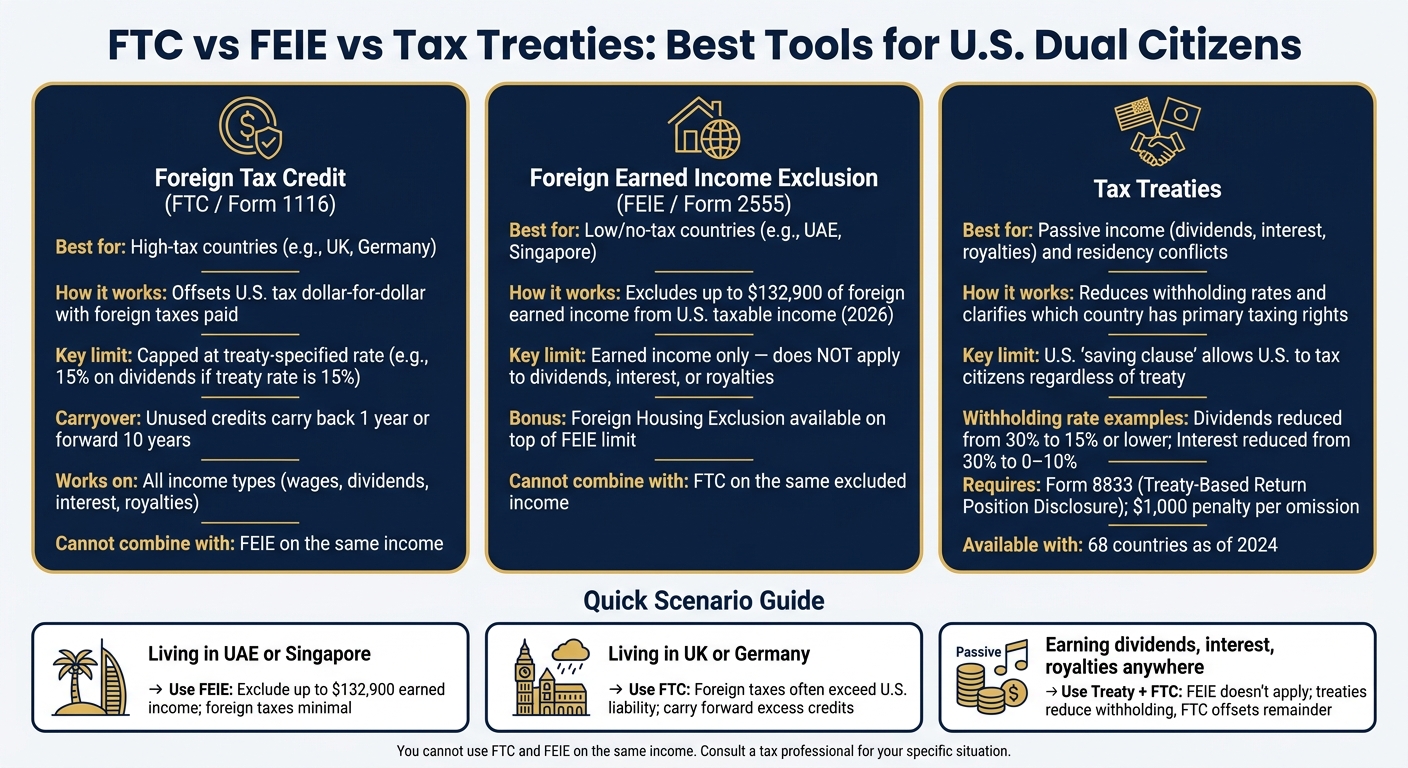
For U.S. citizens, tax treaties work hand-in-hand with two major IRS provisions: the Foreign Tax Credit (FTC) and the Foreign Earned Income Exclusion (FEIE). Understanding how to use these tools alongside treaty provisions can help you craft a solid tax strategy and avoid unnecessary penalties. For personalized guidance, you may consider private tax consultations to optimize your specific situation.
Using the Foreign Tax Credit Alongside Treaties
The FTC allows you to offset your U.S. tax liability with foreign taxes you’ve already paid to another country. To claim it, you’ll need to file Form 1116. However, when a tax treaty is in play, the credit you can claim is capped at the treaty-specified rate. For instance, if a foreign country withholds 30% on dividends but the treaty reduces the rate to 15%, you can only claim a credit for the 15% rate.
Another useful feature is income re-sourcing, which lets you reclassify certain U.S.-source income as foreign-source. This can expand your FTC limitation and help minimize double taxation. Additionally, any unused credits can be carried back one year or forward for up to 10 years.
It’s worth noting that FTCs are calculated by income categories or "baskets", meaning credits from one category (e.g., wages) can’t offset taxes in another (e.g., dividends). Also, state taxes – like those in California – may apply separately and are not covered by the FTC.
While the FTC is a powerful tool, the FEIE provides another way to reduce your U.S. tax burden.
Combining the Foreign Earned Income Exclusion with Treaty Benefits
The FEIE, filed using Form 2555, allows U.S. citizens working abroad to exclude up to $132,900 of foreign earned income from their U.S. taxable income for the 2026 tax year. This exclusion only applies to earned income, such as wages or self-employment income, and doesn’t extend to passive income like dividends or royalties.
One important limitation: you can’t claim the FTC on income excluded under the FEIE. For example, if you exclude $100,000 of earned income, the foreign taxes paid on that amount won’t qualify for the FTC. However, treaty benefits can still help. For instance, treaty-reduced withholding rates on passive income can lower your foreign tax burden, allowing you to use the FTC on any remaining taxes.
Here’s a quick comparison of which tool works best in different scenarios:
| Scenario | Best Tool | Why |
|---|---|---|
| Living in a low-tax country (e.g., UAE, Singapore) | FEIE (Form 2555) | Allows exclusion of up to $132,900 of earned income; foreign taxes are minimal or nonexistent |
| Living in a high-tax country (e.g., UK, Germany) | FTC (Form 1116) | Foreign taxes often exceed U.S. liability, enabling you to carry forward excess credits |
| Passive income (dividends, interest, royalties) | Treaty + FTC | FEIE doesn’t apply; treaties may reduce withholding, and FTC can offset remaining taxes |
For those living in high-cost cities abroad, the Foreign Housing Exclusion offers an additional benefit. This provision lets you exclude housing costs above a base amount, on top of the FEIE limit. If you’re paying steep rent, this can significantly lower your taxable income.
What to Do When No Tax Treaty Exists
As of 2024, the U.S. has tax treaties with 68 countries. However, several nations – like Brazil, Argentina, Saudi Arabia, and the UAE – don’t have treaties with the U.S.. Without a treaty, you lose access to reduced withholding rates and tie-breaker provisions, but the FTC and FEIE remain available.
In non-treaty situations, the FTC becomes your primary tool for avoiding double taxation. To qualify, the foreign tax must meet four IRS criteria: it must be imposed on you, you must have paid or accrued it, it must be a legal liability, and it must qualify as an income tax or a tax in lieu of income tax. In high-tax, non-treaty countries, the FTC can often eliminate your U.S. tax liability and even generate excess credits for future use. On the other hand, in low- or no-tax countries like the UAE, the FEIE is typically the better choice for reducing earned income taxes up to the exclusion limit.
Alternatively, you can deduct foreign taxes on Schedule A, but keep in mind that credits generally provide a dollar-for-dollar reduction in liability, making them more advantageous.
Working with Tax Professionals to Build a Treaty-Based Plan
Navigating tax treaties isn’t a set-it-and-forget-it task. Successfully claiming benefits, avoiding penalties, and managing the required filings demands expertise and a proactive approach.
Why Dual Citizens Need Specialized Tax Expertise
As mentioned earlier, filing Form 8833 is a critical step in claiming treaty benefits, but it’s often misunderstood or overlooked. A common myth is that tax treaties automatically apply. In reality, they don’t. As Berk Tüzel of Corpenza explains:
"Double Taxation Agreements (DTAs) do not work automatically; in most cases, they require correct declarations and proper documentation."
To claim treaty benefits, you typically need to file Form 8833 (Treaty-Based Return Position Disclosure) with the IRS. Forgetting or skipping this form can lead to hefty penalties – $1,000 per instance for individuals and $10,000 for entities. Beyond the paperwork, the process involves complex analysis. Determining which country has taxing rights often hinges on a tie-breaker test that examines factors like your permanent home, the center of your vital interests, and your habitual abode.
Tax professionals also help navigate the "saving clause", which allows the U.S. to impose taxes even when treaty benefits apply. They can pinpoint exceptions that genuinely reduce your tax burden. On top of this, handling special filing statuses, coordinating income tax treaties with totalization agreements, and balancing tools like the Foreign Tax Credit (FTC) and Foreign Earned Income Exclusion (FEIE) requires a level of expertise that generalist tax preparers often lack.
Given the many layers of complexity, working with a specialist is essential for dual citizens looking to create an effective tax strategy.
How Global Wealth Protection Can Help

Global Wealth Protection specializes in assisting entrepreneurs and investors facing tax challenges across multiple jurisdictions. Through private consultations, their team helps clients evaluate their tax residency, identify relevant treaty provisions, and develop filing strategies that can withstand scrutiny.
For those seeking more in-depth solutions, Global Wealth Protection offers services like offshore company formation, offshore trusts, and private interest foundations – primarily in Anguilla. These structures are particularly useful for managing passive income streams, such as dividends or royalties, across multiple countries. Additionally, their GWP Insiders membership program provides ongoing access to tools, strategies, and resources for individuals seeking a long-term approach to international tax planning.
Reviewing and Updating Your Tax Plan Over Time
Once you’ve built a tax plan with expert guidance, regular reviews are crucial. Tax treaties can change, personal circumstances evolve, and income structures shift – all of which can impact your filing obligations. For example, dual citizens who move mid-year, acquire foreign assets, or change jobs may need to reassess their use of tools like the FTC, FEIE, or specific treaty provisions.
An annual review is a practical standard. This includes checking for updates to treaty protocols, ensuring residency documentation is accurate, and verifying that your Form 8833 filings align with your current circumstances. As Skybound Wealth notes:
"Residence determinations rely heavily on factual support. Consistency strengthens defensibility."
Keeping thorough records – such as lease agreements, utility bills, and travel logs – can provide the consistency needed to defend your position if the IRS conducts an audit. Regular updates to your plan ensure you stay compliant and maximize treaty benefits.
Conclusion: Key Points on Using Tax Treaties Effectively
Tax treaties can be a game-changer for dual citizens, but they require careful attention and planning. The IRS emphasizes that the "saving clause" allows the U.S. to tax its citizens "as if no tax treaty were in effect". This makes it crucial to understand which treaty provisions are exceptions to this rule.
The cornerstone of a solid treaty strategy is proper documentation. Confirm your tax residency early and file important forms like Form W-8BEN and Form 8833 promptly. These steps not only help you claim treaty benefits but also protect you from penalties. Addressing potential withholding issues ahead of time can save you from dealing with complicated and delayed refunds later.
For those taking a treaty position that overrides U.S. tax law, filing Form 8833 is non-negotiable. Missing this requirement comes with a hefty $1,000 penalty for each instance. Another critical aspect of tax planning is balancing the Foreign Tax Credit (FTC) and the Foreign Earned Income Exclusion (FEIE) – which is capped at $132,900 for the 2026 tax year. Properly aligning these options with treaty benefits can lead to significant tax savings.
George Dimov, CPA and Managing Owner at Dimov Tax, highlights the importance of understanding these treaties:
"Most dual residents leave thousands of dollars on the table every year because they don’t understand how this treaty actually works."
It’s also worth noting that U.S. federal tax treaties don’t address state income taxes. Dual citizens must analyze state-level tax rules separately. And since treaties can change over time, a strategy that worked last year might need to be revisited to stay effective.
FAQs
Do I still benefit from a tax treaty if I’m a U.S. citizen?
U.S. citizens can take advantage of tax treaties, though these agreements mainly align tax rules between countries rather than eliminating taxes altogether. Thanks to the saving clause included in most treaties, the U.S. continues to tax its citizens on their worldwide income. However, treaties can still provide perks, such as lower withholding rates on dividends, interest, or royalties, as well as tie-breaker provisions for dual residents. To claim these benefits, filing Form 8833 is typically required.
Which IRS forms do I need to claim treaty benefits and avoid penalties?
To make sure you claim treaty benefits correctly and steer clear of penalties, it’s important to use the right IRS forms based on your specific situation:
- Form 1116: Use this to claim a foreign tax credit.
- Form 8833: Attach this to your tax return if you’re claiming a treaty position that changes how the tax code applies.
- Form W-8BEN or Form 8233: These forms are used for withholding purposes.
Be aware that failing to disclose treaty positions can lead to a penalty of $1,000.
Should I use the Foreign Tax Credit or the Foreign Earned Income Exclusion?
The choice hinges on how your host country’s tax rate compares to the U.S. rate. The Foreign Earned Income Exclusion (FEIE) is a good option for those living in countries with low or no taxes. It lets you exclude up to $126,500 of foreign earned income from U.S. taxation. On the other hand, the Foreign Tax Credit (FTC) is better suited for high-tax countries, as it provides a dollar-for-dollar credit for the taxes you’ve paid abroad. However, keep in mind that you can’t apply both to the same income.
