
There’s no universal limit on how many citizenships a person can hold – it depends on the laws of each country involved. Some nations, like the U.S., Canada, and the U.K., allow unlimited citizenships, while others, such as India and China, prohibit dual citizenship entirely. About 75% of UN member states permit some form of dual or multiple citizenship, but the rules vary widely.
Key takeaways:
- Unlimited Citizenship: Countries like the U.S. and Germany (since 2024) allow multiple citizenships without restrictions.
- Strict Limits: Nations like India, China, and Singapore automatically revoke citizenship if another is acquired.
- Conditional Rules: Countries such as Spain, South Korea, and Austria impose specific conditions for dual citizenship.
- Military, Taxes, and Laws: Multiple citizenships come with obligations like taxes, military service, and legal responsibilities in each country.
Your citizenship portfolio depends on the compatibility of laws across countries. While no global rule caps the number of citizenships, managing obligations and staying updated on legal changes is crucial.
The Legal Basics of Dual and Multiple Citizenship
There’s no universal rule or international treaty that limits how many citizenships a person can have. Each country sets its own policies, and the practical limit depends on how the laws of those countries interact.
Citizenship, Nationality, and Passport: What’s the Difference?
Though people often mix up the terms "citizenship", "nationality", and "passport", they refer to different things – especially when crafting a citizenship portfolio.
- Citizenship is a legal status granted by a country. It gives you rights like voting or running for office, but it also comes with responsibilities, such as jury duty.
- Nationality is a broader term that reflects your legal connection to a state. It doesn’t always include full citizenship rights. For instance, residents of American Samoa are U.S. nationals, but they can’t vote in federal elections.
- A passport is a travel document that proves your citizenship or nationality. However, it’s not the same as citizenship itself. You could be a citizen of a country without ever holding its passport, but you’d still be subject to its laws, including obligations like taxes or military service.
Chief Justice John Rutledge once explained:
"A man may, at the same time, enjoy the rights of citizenship under two governments."
Dual Citizenship vs. Multiple Citizenship
"Dual citizenship" means holding citizenship in two countries, while "multiple citizenship" refers to having three or more. The terminology can vary by country – some laws only mention "dual citizenship", even if someone holds more than two. What matters is whether each country in your citizenship portfolio recognizes the others and if gaining a new citizenship might cause you to lose an existing one.
How U.S. Law Treats Multiple Citizenship
The U.S. takes a relatively flexible approach to multiple citizenships. According to the U.S. Department of State:
"U.S. law does not mention dual nationality or require a person to choose one nationality or another."
There’s no cap on how many additional citizenships a U.S. citizen can hold. If you naturalize in another country, U.S. law assumes you’ll keep your American citizenship unless you explicitly renounce it. Even the naturalization oath, which includes a pledge of allegiance to the U.S., doesn’t legally force you to give up any other citizenships.
However, multiple citizenships come with responsibilities. For example, U.S. citizens must pay taxes on their worldwide income, no matter where they live or how many passports they have. And when entering or leaving the U.S., they’re required to use their U.S. passport, even if they hold another country’s passport.
There’s also a potential shakeup on the horizon. The "Exclusive Citizenship Act" (S.3283), introduced in December 2025, proposes banning dual citizenship for Americans entirely. If passed, it would force current dual nationals to choose one nationality within a year. That said, current projections put the likelihood of this bill passing at just 3% as of mid-2026.
sbb-itb-39d39a6
How Different Countries Handle Multiple Citizenship
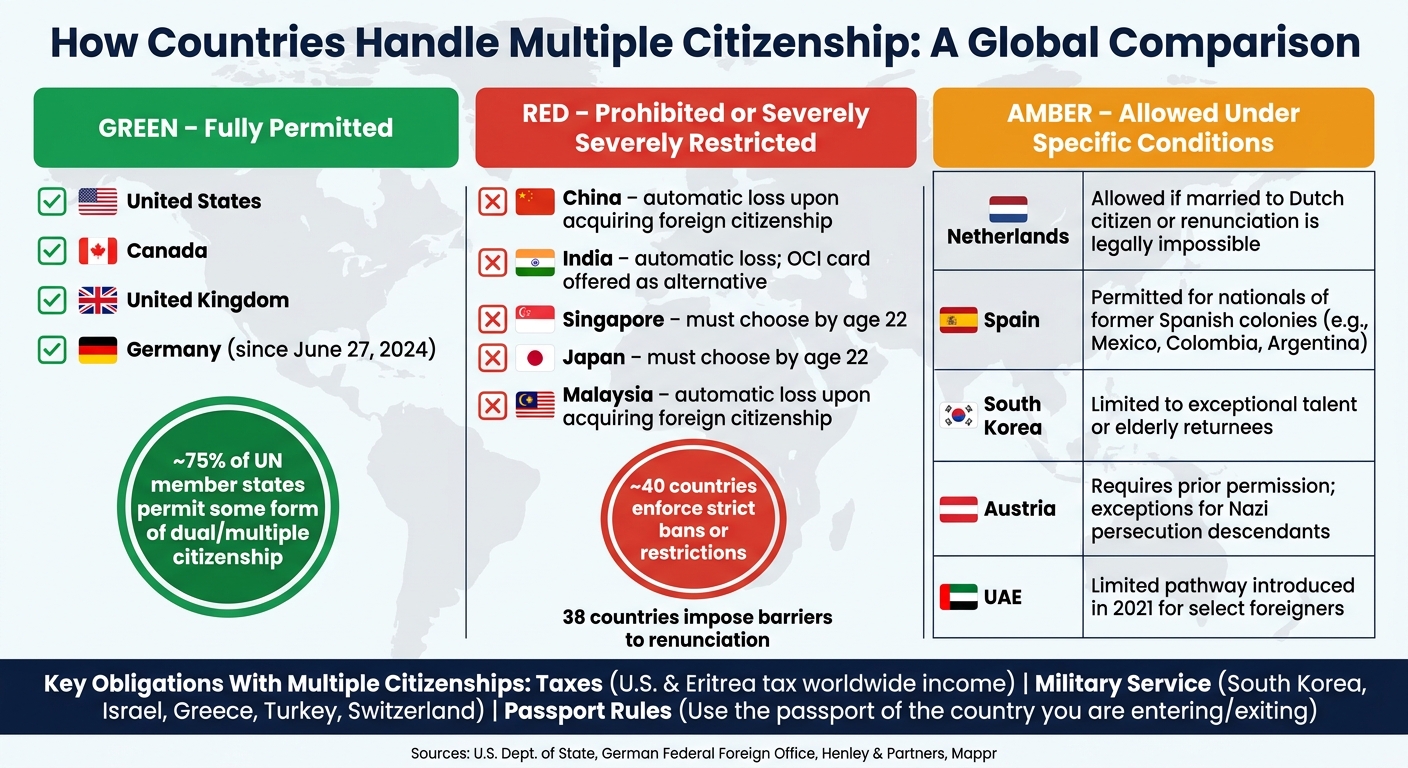
Countries take varied stances on multiple citizenship. While some embrace it without restrictions, others impose outright bans, with many adopting policies that fall somewhere in the middle. Your ability to hold multiple citizenships depends on the specific laws of each nation. Let’s dive into how different countries approach this issue.
Countries That Allow Multiple Citizenship Without Restrictions
The United States, Canada, and the United Kingdom are among the most welcoming nations when it comes to multiple citizenship. In these countries, naturalizing as a citizen does not require you to give up your existing nationality, and there’s no limit to the number of citizenships you can hold.
Germany joined this group on June 27, 2024, when it eliminated its long-standing rule requiring individuals to renounce prior citizenships upon naturalization. The country also shortened the residency requirement for naturalization from eight years to five. The German Federal Foreign Office confirmed:
"Since 27 June 2024, applying for and receiving citizenship of a foreign country no longer means losing German citizenship."
This change reflects a growing global trend. As Mappr notes, "The long-term trend is firmly toward acceptance: country after country has quietly dropped the rule that naturalizing elsewhere costs you your original nationality". This shift suggests that holding multiple citizenships may become even more accessible in the future.
Countries That Restrict or Ban Dual Citizenship
Roughly 40 countries still enforce strict bans or restrictions on dual citizenship. In nations such as China, India, Singapore, and Malaysia, obtaining foreign citizenship results in the automatic and immediate loss of your original nationality. There’s no grace period or alternative option, which can complicate international travel and asset management.
Japan and Singapore have a "choice rule" for individuals born with dual citizenship. They are allowed to retain both nationalities until adulthood but must choose one by the age of 22. For example, Singapore’s passport provides visa-free access to about 193 destinations, making the decision particularly impactful.
India does not permit dual citizenship but offers the Overseas Citizen of India (OCI) card as an alternative. The OCI card acts as a lifelong multi-entry visa and provides residency and work rights, but it excludes voting privileges and eligibility for public office.
Some countries have what are effectively practical bans. While nations like Iran, Syria, and Afghanistan technically allow citizens to renounce their nationality, administrative hurdles often make it nearly impossible. In fact, around 38 countries either prohibit or severely obstruct renunciation of citizenship, leaving individuals tied to legal obligations despite holding other passports.
Countries With Conditional Dual Citizenship Rules
Several nations permit dual citizenship under specific conditions, which vary widely:
| Country | Condition for Dual Citizenship |
|---|---|
| Netherlands | Allowed if married to a Dutch citizen or if renouncing the original nationality is legally impossible |
| Spain | Permitted for nationals of treaty countries, primarily former Spanish colonies |
| South Korea | Limited to individuals with exceptional talent or elderly returnees |
| Austria | Requires prior permission to naturalize abroad; exceptions exist for descendants of Nazi persecution victims |
| UAE | Introduced a limited dual citizenship pathway in 2021 for select foreigners and specific cases involving Emirati nationals |
Spain’s policies are particularly relevant to those with Latin American ties. The country allows dual citizenship with nationals of most former Spanish colonies, such as Mexico, Colombia, and Argentina, without requiring renunciation.
Austria, on the other hand, enforces strict rules. Without prior approval, Austrian citizens who naturalize abroad lose their Austrian nationality. However, descendants of Nazi persecution victims can reclaim Austrian citizenship without giving up their current nationality.
These conditional policies underscore how varied and complex dual citizenship rules can be, with each country tailoring its approach to fit its specific legal and historical context.
How to Plan and Build Your Citizenship Portfolio
Understanding how different countries handle multiple citizenships is just one piece of the puzzle. The other part is figuring out your personal situation and the options available to you.
Taking Stock of Your Current and Possible Citizenship Paths
Start by reviewing the citizenships and residencies you already hold. This inventory should align with your goals, whether they involve global mobility, protecting assets, or optimizing taxes. Look into your ancestry – countries like Italy, Ireland, Poland, and Hungary often allow citizenship to pass through parents, grandparents, or even great-grandparents under jus sanguinis rules.
If ancestral ties don’t apply, consider other routes like residency-based naturalization or citizenship by investment (CBI). Naturalization timelines vary widely, from as little as three years in Paraguay to up to ten years in countries like Italy or Spain. The simplest citizenship programs, such as CBI, offer faster options, but the required investments and processing times differ greatly.
Immigration consultant Anastasia Richman of Expalys emphasizes:
"The best second passport is not just the one ranked No. 1 on a list, but the one that combines travel freedom with a realistic route to obtain it."
Once you’ve explored potential citizenship paths, think about how these additions would fit with your current situation.
Checking Compatibility Between Citizenship Combinations
After identifying potential new citizenships, it’s crucial to ensure they align with your existing status. Each country has its own rules, so confirm that acquiring another citizenship won’t cause you to lose your current one.
The method of acquisition makes a difference. For instance, many countries treat voluntary naturalization differently from citizenship gained by birth or descent. Spain, for example, requires citizens who naturalize in most non-treaty countries to submit a "retention declaration" within three years to avoid losing their Spanish nationality. Similarly, Turkey allows dual citizenship but requires formal notification when a citizen naturalizes abroad.
Keep in mind that while one country may fully recognize your dual status, another might not officially acknowledge it.
Estimating Your Maximum Citizenship Count
Once you’ve confirmed compatibility, figure out the practical limit for your citizenship portfolio. While no international law restricts the number of citizenships you can hold, national laws set the boundaries. As attorney Peter D. Chu, founder of the Law Offices of Peter D. Chu, explains:
"The real question isn’t how many citizenships the world allows you to have, but rather, how many citizenships each specific country you’re connected to will permit you to hold simultaneously."
Lay out all the citizenships you currently hold or plan to acquire, making sure none will result in the automatic loss of another. For example, U.S. and U.K. citizens face no restrictions on acquiring additional nationalities, giving them greater flexibility. Many Americans take advantage of this by combining a Caribbean CBI passport (like Dominica or Grenada) with an ancestry-based European citizenship.
However, managing multiple passports comes with added responsibilities, so staying organized is key. A carefully planned portfolio can open doors to global opportunities while protecting your assets.
Why Multiple Citizenship Matters: Asset Protection, Tax Planning, and Travel
Building a diverse citizenship portfolio isn’t just about securing your status – it opens doors to better asset protection, smarter tax strategies, and expanded travel opportunities. A single passport simply can’t match the perks that come with multiple citizenships.
Using Citizenship for Asset Protection
Think of a second citizenship as a form of political and financial insurance. It guarantees a permanent legal right to enter and reside in a country – something no government can take away. This can be a lifesaver if your home country faces capital controls, asset freezes, or political unrest. For instance, Monaco offers strong banking privacy and asset protection, while financial hubs like Singapore, Switzerland, and Dubai are known for their creditor protections and regulatory stability.
"In tomorrow’s world, mobility and jurisdictional access rights will increasingly determine personal and financial freedom." – Henley & Partners
It’s no surprise that over 34% of ultra-high-net-worth individuals – those with $30 million or more in investable assets – either hold or are pursuing second citizenship. Beyond safeguarding assets, having multiple citizenships can also unlock tax advantages.
Tax Planning With Multiple Citizenship
Holding a second passport doesn’t automatically change your tax residency. Tax liability is typically based on where you live or have personal ties, often determined by the 183-day rule or your "center of vital interests". However, the U.S. and Eritrea are exceptions, as they tax citizens on worldwide income no matter where they reside.
For Americans, the Foreign Earned Income Exclusion (FEIE) offers some relief – up to $132,900 in 2026 – but it doesn’t eliminate all tax obligations. The real tax benefits of multiple citizenships come into play when you establish residency in countries with territorial tax systems like Panama, Paraguay, or the UAE. In these jurisdictions, income earned outside their borders is not taxed.
Expanding Your Travel and Residency Options
The benefits of multiple citizenships extend beyond finances – they also enhance global mobility and residency opportunities. Passport strength can vary significantly. For example, as of 2026, the U.S. passport ranks 10th on the Henley Passport Index, offering visa-free access to 186 destinations. By comparison, a Portuguese or French passport allows access to 194 destinations. A well-planned "three-pillar" passport strategy – combining passports from the Americas, Europe, and the Pacific – can grant visa-free travel to over 190 destinations.
European Union (EU) citizenship is especially powerful. Citizenship in countries like Ireland, Italy, or Portugal provides the right to live, work, and retire freely across all 27 EU member states. It also comes with perks like access to top-notch healthcare and reduced tuition fees at European universities. In the Caribbean, Grenada stands out as the only citizenship-by-investment option tied to the U.S. E-2 Treaty, allowing its citizens to apply for a U.S. investor visa. Other Caribbean nations like St. Kitts, Dominica, and Antigua also offer passports that include visa-free travel to the Schengen Area and the United Kingdom.
The rising interest in multiple citizenships is evident. Henley & Partners noted a 77% increase in investment migration applications from U.S. nationals between 2025 and 2026, showing that more Americans are proactively expanding their options rather than waiting for crises to strike.
Managing Obligations and Risks Across Multiple Citizenships
Holding multiple citizenships is not just about enjoying the perks – it also comes with a set of legal responsibilities that can’t be ignored. Overlooking these obligations can lead to serious complications.
Handling Overlapping Legal Duties
One of the most common challenges for those with multiple citizenships is taxation. The U.S., for instance, taxes its citizens on their worldwide income, no matter where they live. In fact, it’s one of only two countries globally (along with Eritrea) that does this. To avoid being taxed twice on the same income, tools like Foreign Tax Credits (FTCs) and bilateral tax treaties are crucial. These mechanisms are designed to ease the financial burden, but you’ll need to navigate them carefully.
Another often-overlooked duty is military service. Countries such as South Korea, Israel, Greece, Switzerland, and Turkey require male citizens to serve in the military within specific age ranges. In some cases, this obligation can be triggered simply by entering the country or attempting to leave. Before traveling to a country where you hold citizenship, it’s essential to check whether you or your children fall into the conscription age bracket.
For U.S. citizens, there’s an additional requirement: you must use your U.S. passport when entering or leaving the country. Using a foreign passport instead could lead to legal complications and might even limit your access to consular protection. As the U.S. Department of State explains:
"Dual nationality means you are a national of 2 countries. A dual national generally has legal rights and obligations in both countries."
If detained in a country where you hold citizenship, that nation may deny intervention from the embassy of your other nationality. These situations highlight the importance of staying informed about the legal responsibilities tied to your multiple citizenships.
Keeping Up With Changes in Nationality Laws
Nationality laws are not static – they evolve over time. Staying informed about these changes is crucial for managing your citizenships responsibly. For example, Germany updated its rules in June 2024, allowing dual nationality after years of restrictions. Similarly, Norway and Ukraine have recently made adjustments to their laws. What’s permitted today might not be tomorrow, and vice versa.
If you hold citizenship in a country that currently tolerates dual or multiple nationalities, a sudden change in the law could force you to choose between them. To stay ahead of these shifts, consider subscribing to legal updates from immigration attorneys or monitoring announcements in each country where you hold citizenship.
When and How to Give Up a Citizenship
In some cases, reducing the number of citizenships you hold can be a smart move. Simplifying your citizenship portfolio can make tax planning more straightforward and help protect your assets. Whether it’s to comply with a country’s laws or to avoid risks associated with a specific citizenship, renouncing one can sometimes be the best choice.
For U.S. citizens, renunciation is a formal process that must be done in person at a U.S. embassy or consulate abroad. It costs $2,350 and could trigger an "exit tax" on unrealized gains for high-net-worth individuals. However, if the IRS determines that your renunciation was primarily to avoid taxes, you could face continued taxation for up to 10 years and might even be barred from re-entering the U.S..
Globally, about 38 countries impose legal or administrative barriers to renunciation. For instance, while countries like Iran and Syria technically allow it, the process is rarely completed. Morocco presents a stark example: approximately 5 million Moroccan citizens living abroad have no legal pathway to renounce their citizenship. Before pursuing a new citizenship, ensure that your current country allows you to exit cleanly.
"Whereas denationalization emphasizes the power of the state vis-à-vis the citizen, renunciation empowers the citizen vis-à-vis the state. Yet some states prohibit this possibility, legally or in administrative practice." – Abbey Steele, International Migration Review
One golden rule to follow: never renounce a citizenship unless you have definitive proof of another nationality. Being stateless – without any citizenship – leaves you vulnerable, without a passport, consular protection, or basic legal rights in most parts of the world.
Conclusion: Key Points for Building and Managing a Citizenship Portfolio
Creating and maintaining a citizenship portfolio is a continuous effort that demands legal insight, careful planning, and regular updates. As Patricia Casaburi, CEO of Global Citizen Solutions, explains:
"Citizenship is no longer pursued as an end goal. It has become one component within a broader risk-management architecture."
The first step is ensuring that dual or multiple citizenships are legally permissible. Both your home country and the country you aim to add must allow for this arrangement. If either prohibits it, you could face the risk of losing one citizenship or being forced to renounce it. This reinforces the importance of understanding and navigating the legal frameworks of each nation. Whether you’re pursuing citizenship through descent, investment, or residency, each path comes with its own costs, timelines, and requirements.
After securing multiple citizenships, compliance becomes critical. For instance, U.S. citizens are subject to global taxation and must fulfill FBAR/FATCA reporting obligations, no matter where they reside. Similarly, some countries, like Israel, South Korea, and Turkey, may impose military service requirements even on citizens living abroad. Travel rules are another key aspect – always use the passport of the country you’re entering or exiting. Following these guidelines ensures you can fully enjoy the advantages discussed earlier, such as asset protection and tax planning.
It’s also important to stay vigilant about changes in nationality laws. What’s allowed today may not be tomorrow, so keeping up with legislative developments in each country where you hold citizenship is a vital part of managing your portfolio effectively.
FAQs
How can I check if adding a new citizenship will cancel one I already have?
To determine whether obtaining a new citizenship will affect your current one, you’ll need to look into the nationality laws of both countries involved. Some nations permit dual citizenship, while others enforce automatic renunciation of your original nationality. Since rules differ greatly and might vary based on how the new citizenship is acquired, it’s best to consult official government sources for accurate and up-to-date information.
What obligations can apply to dual citizens besides taxes?
Dual citizens often encounter unique responsibilities tied to their dual status. For instance, some countries impose mandatory military service or civic duties, with penalties for failing to comply. Others enforce compulsory voting laws, which dual citizens must follow to avoid consequences.
There can also be restrictions on holding certain public offices or positions requiring security clearance, depending on the policies of each nation. Beyond these obligations, managing multiple passports, registrations, and navigating different legal systems – such as those governing inheritance or family matters – can make life more complicated for dual citizens.
Can I lose a citizenship automatically without renouncing it?
Yes, some countries can automatically revoke your citizenship under specific legal conditions. This might occur if you acquire a second nationality or participate in activities considered disloyal or incompatible with your citizenship status. In nations with strict policies against dual citizenship, your original citizenship may be revoked when you naturalize in another country. These situations are distinct from voluntarily giving up citizenship and depend entirely on the laws of the countries involved.
