
A second passport through investment is a fast-track way to gain citizenship by financially contributing to a country’s economy. This legal process, known as Citizenship by Investment (CBI), offers full citizenship, allowing visa-free travel to 130–150 destinations, financial security, and a safeguard against political or economic instability. Unlike residency programs, CBI requires no physical presence and delivers results in as little as 1–6 months.
Key Points:
- Investment Options: Non-refundable donations, real estate purchases, government bonds, or business investments.
- Costs: Start at $130,000 (Vanuatu) and go up to €600,000+ (Malta).
- Top Programs: Caribbean nations like St. Kitts and Nevis, Dominica, and Antigua & Barbuda offer some of the simplest citizenship programs in the world for those seeking affordable and quick options.
- Eligibility: Clean criminal record, proof of lawful funds, and good health are mandatory.
- Risks: Visa-free access changes, stricter regulations, and potential revocation of citizenship.
If you’re looking for speed, Vanuatu processes applications in 30–60 days. For broader travel access, Malta provides EU citizenship but at a higher cost and longer timeline. Before applying, ensure you meet eligibility criteria and work with a licensed agent to avoid common pitfalls.
Next Steps: Define your goals, explore investment options, and consult with a professional to navigate the process effectively.
Citizenship by Investment (CBI) Explained
Citizenship by Investment (CBI) allows individuals to secure full citizenship and a second passport by making a qualifying financial contribution to a country’s economy. The key distinction here is that CBI grants the same legal status as a natural-born citizen.
This differs from Residency by Investment programs, often called Golden Visas, which provide a residency permit – the right to live in a country – but not citizenship. Residency programs often require 5 to 10 years of physical presence before naturalization is possible. CBI programs bypass this entirely. Most have no residency requirements, meaning you aren’t obligated to live in or even visit the country to qualify.
The speed of CBI programs is another major advantage. For example, Caribbean programs can process applications in as little as 60 to 120 days. Vanuatu boasts the fastest processing times globally, with approvals possible within 30 to 60 days. By contrast, standard naturalization processes in most countries take 2 to 10 years. For those in need of a second passport quickly, CBI is the only option that delivers results in months rather than years.
| Feature | Citizenship by Investment (CBI) | Residency by Investment (Golden Visa) |
|---|---|---|
| Status Granted | Full citizenship and passport | Residency permit only |
| Processing Time | 1 to 6 months | 3 to 12 months for permit; 5 to 10 years for citizenship |
| Residency Required | Usually none | Often requires physical presence |
| Global Mobility | Immediate via new passport | Limited to specific zones (e.g., Schengen Area) |
"Citizenship is no longer pursued as an end goal. It has become one component within a broader risk-management architecture, considered alongside tax planning, asset structuring, and relocation options." – Patricia Casaburi, CEO, Global Citizen Solutions
Common Ways to Qualify for a CBI Program
Governments offering CBI programs provide multiple investment options to qualify, catering to different budgets, risk levels, and goals. There’s no universal investment type, so the best choice depends on individual circumstances.
A government fund contribution involves a non-refundable donation to a national development fund, with no ongoing responsibilities. Real estate investments require purchasing government-approved properties, which must typically be held for 3 to 7 years before resale. Government bonds are state-backed securities, where your capital is returned after a holding period of 5 to 7 years. Lastly, the business investment route requires injecting capital into local enterprises or job-creating projects, though this option tends to have higher minimums and added complexity.
| Investment Method | Description | Typical Cost |
|---|---|---|
| Government Fund Donation | Non-refundable contribution to a national development fund | $200,000–$250,000 (Caribbean) |
| Real Estate Purchase | Approved property, resale allowed after 3–7 years | $200,000–$400,000+ |
| Government Bonds | State-backed securities; capital returned after holding period | $300,000 (St. Lucia) |
| Business Investment | Capital into job-creating local enterprises | $350,000–$1.5M+ |
Before committing to a CBI program, it’s worth checking if you qualify for citizenship by descent. Options like Irish, Italian, or Polish ancestry could provide a second passport for under $5,000 – a fraction of the cost of most CBI programs. This could be a more affordable and straightforward alternative to consider. For personalized guidance on which path fits your financial goals, you can book a private consultation.
sbb-itb-39d39a6
Countries That Offer Citizenship by Investment
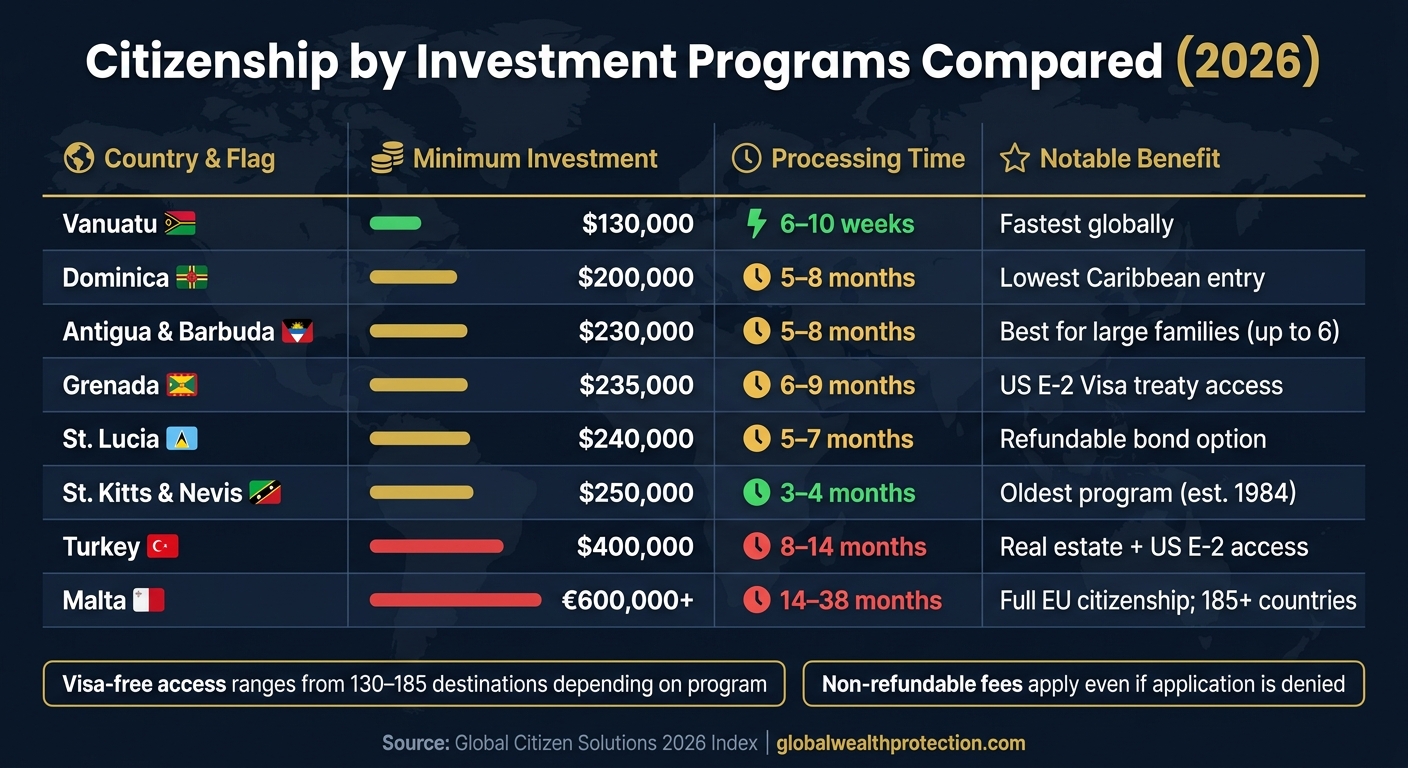
Citizenship by Investment (CBI) programs are a popular option for individuals seeking a second passport. These programs differ in terms of processing speed, travel privileges, family inclusion, and potential for recovering invested capital. Broadly, they can be grouped into four categories: the Caribbean Big 5, Pacific programs, Middle Eastern options, and European pathways.
The Caribbean Big 5
The Caribbean Big 5 – Antigua and Barbuda, Dominica, Grenada, St. Kitts and Nevis, and St. Lucia – are among the most sought-after CBI programs. These programs usually process applications within 3 to 6 months and grant visa-free travel to over 140 destinations, including the UK and the Schengen Zone. St. Kitts and Nevis, the first-ever CBI program established in 1984, is often considered a benchmark for others. Grenada and Turkey stand out for offering access to the US through the E-2 Treaty Investor Visa, making them appealing to those targeting US residency options.
Pacific Options
For those focused on speed, Vanuatu is a standout, with processing times as short as 6 to 10 weeks. However, the EU’s permanent revocation of Vanuatu’s Schengen visa-free access in 2024 has made it less appealing for frequent European travelers. Meanwhile, Nauru recently introduced its Economic and Climate Resilience Citizenship Program, starting at $95,000 for applications submitted before June 30, 2026.
European Pathways
At the higher end of the spectrum, Malta offers full EU citizenship, granting access to 185+ countries. This premium program requires a significant investment – starting at €600,000 – plus real estate commitments and a residency period, resulting in a timeline of 14 to 38 months for completion.
"St. Kitts and Nevis ranks first overall in the GCS 2026 Index… reflecting its forty-year track record, robust due diligence, and strong passport mobility." – Global Citizen Solutions
CBI Program Comparison Table
| Country | Minimum Investment | Processing Time | Notable Benefit |
|---|---|---|---|
| Vanuatu | $130,000 | 6–10 weeks | Fastest globally; no Schengen access |
| Dominica | $200,000 | 5–8 months | Lowest Caribbean entry point |
| Antigua & Barbuda | $230,000 | 5–8 months | Best value for large families (up to 6 members) |
| Grenada | $235,000 | 6–9 months | US E-2 Visa treaty access |
| St. Lucia | $240,000 | 5–7 months | Only Caribbean program with a refundable bond option |
| St. Kitts & Nevis | $250,000 | 3–4 months | Oldest, most established program |
| Turkey | $400,000 | 8–14 months | Real estate based; US E-2 Visa access |
| Malta | €600,000+ | 14–38 months | Full EU citizenship; highest global mobility |
This table provides a snapshot of the main features across leading CBI programs, helping you align options with your priorities. For instance, Antigua and Barbuda stands out for requiring only a 5-day visit within the first 5 years, unlike most programs that have no physical presence requirements. However, some programs restrict applicants from specific countries, including Iran, North Korea, Russia, and Belarus, so it’s crucial to confirm eligibility before proceeding.
The next step is to review the eligibility criteria and required documentation for your selected program.
Eligibility Requirements and Documents Needed
Before diving into a program, it’s crucial to confirm that you meet the basic eligibility criteria. Most Citizenship by Investment (CBI) programs follow similar requirements, so a quick self-check can save you valuable time and effort.
Eligibility Standards
To qualify, applicants need to meet these universal standards: be at least 18 years old, have a clean criminal record, provide proof of lawful funds, and demonstrate good health.
Criminal record: A spotless criminal record is non-negotiable. Applicants must have no convictions, pending charges, or ties to activities like money laundering, terrorism, or organized crime.
"Applicants who have a criminal history, have been subject to sanction, have links to financial crimes, or unexplained wealth are usually refused."
Source of funds: You’ll need to prove that your investment capital comes from legitimate sources. This can include audited financial statements, tax returns, or sale agreements that clearly link your earnings to the funds being invested.
Health: A recent medical exam is mandatory, typically covering blood, urine, and HIV tests conducted within the last three months. This ensures you don’t carry any communicable diseases that could pose a public health risk.
Due diligence screening: Programs conduct detailed background checks using Interpol databases, international sanctions lists, and Politically Exposed Person (PEP) screenings. While PEPs aren’t automatically disqualified, they face stricter scrutiny and must provide more extensive financial documentation. Additionally, some programs disqualify individuals who have been denied visas to countries where the host nation offers visa-free access.
A recent update worth noting: Starting in Q1 2026, St. Kitts and Nevis now requires mandatory biometrics for all applicants. Many Caribbean programs are also moving toward mandatory in-person or virtual interviews for applicants aged 16 and older as part of enhanced due diligence measures.
These eligibility rules set the stage for gathering the required documents outlined below.
Required Documents
The documents needed are fairly consistent across most programs. Here’s a breakdown of the key categories:
| Document Category | What’s Required |
|---|---|
| Identity | Certified copies of passports, birth certificates, marriage/divorce certificates, and recent passport-sized photos |
| Security | Police clearance certificates from your country of birth and any country where you’ve lived for 6+ months in the past 10 years |
| Financial | Bank reference letters, 6–12 months of bank statements, and proof of the source of funds (e.g., employment contracts, business licenses) |
| Wealth | Ownership records for businesses, audited financial statements, property sale agreements, and investment portfolio statements |
| Health | Medical exam results, including blood, urine, and HIV tests conducted within the last three months |
| Professional | CV and professional reference letters from lawyers, bankers, or employers |
| Residency | Proof of address, such as utility bills or a lease agreement |
| Dependents | University enrollment letters for adult children and custody papers for stepchildren |
Keep in mind: Any non-English documents must be translated by a certified professional and include an apostille or notarization. Double-check that names match across all documents, as inconsistencies can cause delays.
To avoid last-minute hiccups, start gathering key documents like police certificates and apostilled birth records at least three months before your intended submission date, as these often take longer to secure than expected.
How to Apply: Step-by-Step Process
Getting your documents ready is just the beginning. Understanding how the application process unfolds – from your initial submission to government approval – can save you from unnecessary headaches. The process is more structured than many assume, and knowing each step in advance can help you steer clear of costly mistakes.
Steps in the Application Process
Important Note: Always work with a licensed authorized agent. Before sharing any financial documents, confirm that your agent is listed on the official government-published registry.
The application process is divided into six key stages:
- Engage an authorized agent and complete initial KYC Your agent will start with a preliminary Know-Your-Client (KYC) screening. This is where you’ll need to provide a complete and transparent background. Keep in mind, failing to disclose information at this stage is one of the top reasons for application denials or even revocations later on.
- Compile and certify required documents This stage can be time-consuming. You’ll need to gather and certify documents like apostilled identity papers, police clearances, medical reports, and a detailed source-of-funds dossier. For Grenada applicants, there’s an additional step where certified IDs and source-of-wealth forms must pass scrutiny by a local bank before the government application can proceed.
- Submit your application and pay associated fees Once your agent submits your application to the Citizenship by Investment Unit (CIU), they’ll issue invoices for processing fees. For example, St. Kitts and Nevis charges US$10,000 for the main applicant’s due diligence, while Dominica’s fee is US$7,500. The CIU will also engage third-party firms to conduct background checks.
- Complete the mandatory interview Applicants aged 16 and older are now required to attend an interview, either virtually or in person.
- Receive Approval in Principle and complete the investment This is a critical step. Only transfer funds after you receive the Approval in Principle letter.
- Receive your Certificate of Naturalization and passport After payment is confirmed, the government will issue your Certificate of Naturalization. Depending on the program, you may also need to take an Oath of Allegiance – either in person before a notary or via a virtual session – before receiving your certificate and passport.
Below is a breakdown of typical processing times and what might cause delays.
Application Timeline and Common Delays
The processing times advertised by agents and brochures often differ from real-world experiences. Nagy Szabolcs from IMI explains:
"The brochures and most agent websites still quote three to six months… The IMI Processing Times Tool, which surveys actual approval timelines reported by working agents each quarter, tells a different story."
Here’s a snapshot of average processing times in 2026:
| Country | Average Timeline | Observed Range |
|---|---|---|
| St. Kitts and Nevis | 5 months | 3–8 months |
| Grenada | 7 months | 4–9 months |
| Dominica | 9 months | 4–18 months |
| Antigua and Barbuda | 14 months | 10–18 months |
| Saint Lucia | 18 months | 12–26 months |
Saint Lucia’s extended timeline can be attributed to a massive 424% increase in applications during fiscal year 2024, which led to significant backlogs. If speed is a priority, St. Kitts and Nevis offers an Accelerated Application Process (AAP) that guarantees approval within 45 to 60 days for an extra fee of US$25,000.
Common delays are often caused by incomplete or inconsistent documentation, expired clearances, or unclear evidence of financial sources. If the CIU requests additional information about your financials, responding promptly through your agent can help avoid unnecessary delays.
Costs, Timelines, and Risks of CBI Programs
Getting a second passport comes with a lot more than just the headline investment. Let’s break down the full picture.
Full Cost Breakdown
The donation or real estate investment is just one part of the overall expense. You’ll also need to account for government processing fees, due diligence costs, legal representation, and passport issuance fees. And here’s the kicker: none of these fees are refundable if your application is denied.
Family size plays a big role in determining the total cost. Adding a spouse or child can increase expenses by $25,000 to $50,000 per person. Including dependent parents or siblings? That could add $50,000 to $100,000 each. For larger families, Antigua and Barbuda stands out with its $230,000 donation covering a family of four, making it one of the more budget-friendly options in the Caribbean.
Some nationalities face higher fees. For instance, Iranian nationals applying to Dominica pay $25,000 for due diligence instead of the standard $7,500. If you’re considering the real estate route, you’ll need to budget for additional expenses like property taxes, registration fees, legal closing costs, and mandatory government administrative fees. For example, in St. Kitts and Nevis, the administrative fee alone is $35,000 for the main applicant.
Legal and agent fees can range between $10,000 and $50,000, and don’t forget about smaller costs like document translation, courier services, and bank transfer fees, which can add up to a few thousand dollars.
| Country | Min. Donation (Single) | Real Estate Min. | Due Diligence Fees |
|---|---|---|---|
| Dominica | $200,000 | $200,000 | $7,500–$10,000 |
| Grenada | $235,000 | $270,000 | $5,000–$10,000 |
| Antigua & Barbuda | $230,000 (family of 4) | $300,000 | $7,500+ |
| St. Kitts & Nevis | $250,000 | $400,000 | $7,500–$10,000 |
| Saint Lucia | $240,000 | $200,000+ | $7,500+ |
| Vanuatu | $130,000 | N/A | $5,000+ |
| Malta | €600,000+ | €700,000+ (or lease) | €7,500–€15,000 |
Once you’ve wrapped your head around the costs, the next step is to look at how long the process might take.
Typical Processing Timelines
While earlier sections detailed Caribbean-specific timelines, looking at the broader picture reveals that actual processing times often exceed advertised estimates. Vanuatu is the fastest, with some cases completed in as little as 45 days. On the other hand, Malta takes much longer, with timelines ranging from 12 to 36 months. Turkey typically processes applications within 3 to 6 months.
Before you even submit your application, expect to spend 1 to 3 months gathering documents, especially if you’ve lived in multiple countries over the last decade.
Risks and Limitations to Know
Costs and timelines are important, but so are the risks.
One of the biggest risks is mobility degradation. Visa-free access can be revoked without warning. For example, Vanuatu lost permanent EU Schengen access in December 2024, causing its CBI revenue to drop by 50%. Saint Lucia faced a similar situation, losing UK visa-free access in March 2026. These changes don’t just affect new applicants – they impact current passport holders too.
Regulatory changes are another concern. Starting mid-2026, the Eastern Caribbean Citizenship by Investment Regulatory Authority (ECCIRA) will require a 30-day physical presence over five years for Caribbean programs. Additionally, if one Caribbean nation rejects your application, you’ll be barred from applying to others in the region. Switching jurisdictions after a denial will no longer be an option.
Even after approval, citizenship can be revoked. Between June 2024 and May 2026, Dominica revoked 68 CBI passports due to fraud or misrepresentation. Other reasons for revocation include criminal convictions or violations of sanctions.
For those opting for the real estate route, risks extend beyond the purchase itself. Most programs require you to hold the property for 5 to 7 years, and off-plan developments come with the risk of non-completion. Before investing, confirm if the developer offers a buyback guarantee.
"The programs still standing in ten years will not be the most affordable or the fastest; they will be the ones with rigorous due diligence, transparent governance, and strong international standing." – Patricia Casaburi, CEO, Global Citizen Solutions
The bottom line: your source-of-funds documentation is critical. Anti-Money Laundering and Counter-Financing of Terrorism (AML/CFT) compliance is now the cornerstone of maintaining a program’s international credibility, which directly affects the value of your investment.
Understanding these factors is crucial as you plan your next steps toward securing a second passport through investment.
Conclusion: Next Steps for Getting a Second Passport
Obtaining a second passport through investment can be a powerful way to secure your mobility, diversify your financial options, and create a reliable Plan B for the future.
Start by defining your objectives. Are you seeking visa-free travel, greater tax flexibility, or a backup jurisdiction for your family? Your goals will determine which program suits you best. As Patricia Casaburi, CEO of Global Citizen Solutions, explains, citizenship is now part of a larger strategy that includes tax planning, asset structuring, and relocation choices – not just an isolated decision.
Before exploring investment options, check if your ancestry could qualify you for citizenship by descent. For instance, around 33 million Americans have Irish roots, 17 million trace their ancestry to Italy, and 9 million to Poland. Many could access citizenship this way for significantly less than the cost of investment programs, with fees typically ranging from $500 to $5,000.
If investment is your chosen path, working with a licensed advisor is crucial. Most Citizenship by Investment programs don’t accept direct applications, so an experienced professional can help you navigate the process. They’ll also ensure your new passport aligns with your tax residency, banking needs, and corporate structures. For those looking to protect their wealth internationally, Global Wealth Protection offers tailored consultations and offshore structuring services for entrepreneurs and location-independent individuals. This strategic alignment is essential as regulations continue to shift.
The investment migration industry, which generated roughly €20 billion in 2024, is evolving quickly. Programs with strong governance and thorough due diligence are likely to retain their value, offering reliable visa access and international credibility. Take the time to choose wisely, plan strategically, and build the right team to guide you through the process. By following these steps, you can streamline your journey to securing a second passport through investment.
FAQs
Which CBI program fits my travel goals (EU, UK, US options)?
Choosing the right program comes down to your priorities – whether you’re after quick travel benefits or a long-term citizenship solution.
If speed is your goal, Caribbean Citizenship by Investment (CBI) programs are a solid choice. They can provide a passport in just 3–6 months, offering visa-free travel to the Schengen Area and the UK. Grenada stands out with an additional perk: access to U.S. business visas through its E-2 treaty. On the other hand, if you’re aiming for European Union citizenship, Residency by Investment programs in countries like Portugal, Greece, or Italy are worth exploring. These programs pave the way to naturalization within 5–10 years.
What documents best prove my source of funds and wealth?
To confirm your source of funds and wealth, you’ll need to present a clear and chronological record that demonstrates how your assets were acquired and increased over time. Typically, this involves providing the following documents:
- Salary or Business Income: Include tax returns from the past 3–5 years, payslips, or audited financial statements.
- Asset Sales: Provide property sale agreements and corresponding bank transaction records.
- Investments: Share brokerage account statements and dividend payment records.
- Inheritance or Gifts: Submit copies of wills or probate grants.
- Bank Statements: Supply sequential bank records covering 6–12 months.
These documents help establish transparency and provide the necessary proof of your financial history.
How can I reduce the risk of denial or citizenship revocation?
To reduce the chances of application denial or citizenship revocation, it’s crucial to maintain complete transparency and consistency throughout the process. Be upfront about any past visa refusals, legal troubles, or citizenship denials. Clearly document your source of funds, and steer clear of any unapproved investment structures. Once approved, ensure ongoing compliance to avoid issues stemming from omissions or misrepresentation. Partnering with a licensed professional can help ensure your documentation meets the necessary standards.
