
Yes – in 2026, many people can still get citizenship through a parent, grandparent, and sometimes a more distant ancestor. But the short answer is this: your claim usually stands or falls on three things – how close the ancestor is, whether citizenship passed down without a break, and whether you can prove the line with records.
If I were checking my own family tree, I’d start here:
- Ireland, Italy, Portugal, Romania, Lithuania, and Latvia can work through grandparents or beyond in some cases
- Poland, Hungary, Germany, and Canada may reach farther, but each has strict rule checks
- The UK, Argentina, and Brazil are much more limited for direct descent
- Spain’s broad exile-based route is closed for new filings in 2026
- Naturalization dates, old gender rules, border changes, and missing records are the main reasons claims fail
- U.S. citizens usually can keep U.S. citizenship, but U.S. tax filing still follows you
A few 2026 updates matter right away:
- Italy now limits standard claims to the grandparent level after its March 2025 change
- Canada expanded descent citizenship in December 2025
- Romania now asks many applicants for B1 Romanian
- Germany allows dual citizenship more freely after its June 27, 2024 update
If you want the fast version, here it is: find your nearest qualifying ancestor, check whether they naturalized before the next birth in the line, and confirm you can get birth, marriage, and death records for every step. That one check can save you months and often $1,000s in record requests, translations, and legal fees.
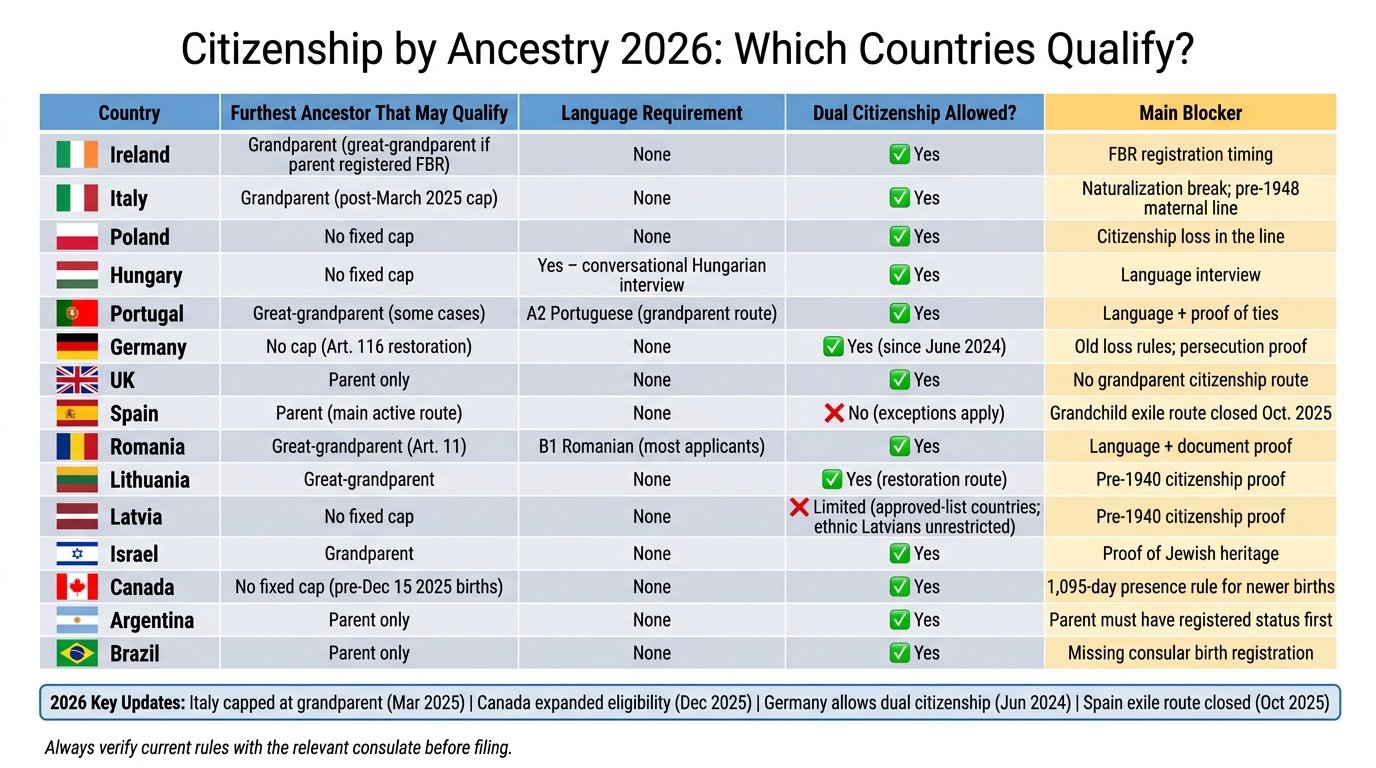
Quick comparison
| Country | Furthest ancestor that may work | Main blocker |
|---|---|---|
| Ireland | Grandparent, sometimes great-grandparent | FBR timing |
| Italy | Grandparent | Naturalization break; pre-1948 maternal cases |
| Poland | No fixed cap | Loss of citizenship in the line |
| Hungary | No fixed cap | Hungarian language interview |
| Portugal | Great-grandparent in some cases | Language/ties for some routes |
| Germany | Parent in standard cases; no cap for some restoration cases | Old loss rules; proof burden |
| UK | Parent | No broad grandparent citizenship route |
| Spain | Parent in main active route | Grandchild exile route closed |
| Romania | Great-grandparent in some Article 11 cases | Language and proof rules |
| Lithuania | Great-grandparent | Pre-1940 citizenship proof |
| Latvia | No fixed cap | Pre-1940 citizenship proof |
| Israel | Grandparent | Proof of Jewish line |
| Canada | No fixed cap in many cases | Date-based descent rules |
| Argentina | Parent | Parent had to pass status properly |
| Brazil | Parent | Missing registration |
So before I spent money on apostilles, translations, or lawyers, I’d treat this like a screening job, not a filing job. The countries are different, but the pattern is the same: lineage first, dates second, documents third.
sbb-itb-39d39a6
Citizenship by Ancestry: The Basics
Citizenship by ancestry usually follows jus sanguinis, or “right of blood.” That means you inherit citizenship through a parent or ancestor, not through where you were born.
So the first step is simple: find the family line, then find the country.
How far that line can go depends on the country. Some only allow claims through a parent. Others allow descent through many generations, as long as you can prove the chain with records. Start by checking for an unbroken citizenship line. Then look at whether that line stayed legally intact over time.
A claim often fails when an ancestor naturalized in another country before the next person in the line was born. In many cases, that one date changes everything. If the naturalization happened too early, the chain may have ended there.
Maternal lines can also get messy. In some countries, old gender-based restrictions still affect claims when the line passes through a woman before a certain cutoff date. That can push applicants away from the standard consular route and into court-based filing instead.
Paperwork is a huge part of this process. Most claims need certified birth, marriage, divorce, and death records for every person in the line. You may also need apostilles, certified translations, and proof that an ancestor did not naturalize, when that matters. For U.S. records, that often means requests to USCIS or the National Archives (NARA).
The takeaway is pretty practical: check the line before you spend money. Then use the country list below to match your ancestor’s country, generation depth, and proof rules.
How to Use This 2026 Country List
Each entry shows four things: eligibility, generation limit, required records, and the main blockers.
Start with the ancestor’s naturalization date. That’s the first thing to check. If the line broke before the next birth in your chain, you can stop there.
The next part gets a little messy. Statutes and consular practice don’t always match. A country’s law may look open on paper, but the process at the consulate can be a different story. Some Italian consulates have 10-plus-year backlogs. Hungary is another good example. Its statute does not set a generational cap, but applicants still face a mandatory language interview that works as a screening step. That gap between the written law and what happens in practice is noted in each entry.
Historic borders matter too, and sometimes they matter a lot. For Polish and Hungarian claims, eligibility depends on whether your ancestor was a citizen under a specific past regime or law, such as Poland’s 1920 Citizenship Act or the pre-1920 Kingdom of Hungary, no matter where those places fall on today’s map. Irish claims have their own twist: births in Northern Ireland can also count under the Good Friday Agreement. That detail shapes eligibility in Poland, Hungary, and similar cases.
This list reflects the rules as of 2026. Italy capped its program at the grandparent generation in March 2025, and Canada expanded eligibility in December 2025 under Bill C-71, bringing back eligibility for some descendants beyond the first generation born abroad. Use the list below to screen your line, then verify the current rules with the relevant consulate before you start collecting records.
1. Ireland
Ireland allows citizenship through a parent, grandparent, and, in some cases, a great-grandparent line.
If your parent was born on the island of Ireland and was an Irish citizen when you were born, you are already an Irish citizen. In that case, you can apply straight for an Irish passport. This also covers births in Northern Ireland, which count under the same rules as births in the Republic.
If your grandparent was born in Ireland, you can qualify for citizenship, but only after you register in the Foreign Births Register (FBR). Your citizenship begins on the date of registration, not on your birth date. The adult registration fee is €278.
Great-grandparent claims only work if the parent in between was registered in the FBR before you were born. If that did not happen, the line stops there.
A couple of details matter before you apply. The FBR has a backlog of about 12 to 18 months as of early 2026, and some reports put delays as high as 30 months. There is no official fast-track option, so timing matters. Apply as early as you can.
You’ll also need original or certified copies of birth and marriage certificates for each generation in the line. And this part trips people up all the time: names need to match exactly across the records, or your case can slow down.
| Generation | Irish-born ancestor | FBR Required? | Key Condition |
|---|---|---|---|
| Parent | Yes | No | Automatic if parent was an Irish citizen at your birth |
| Grandparent | Yes | Yes | Must register in the FBR |
| Great-grandparent | Yes | Yes | Parent must have registered in the FBR before applicant’s birth |
If your Irish line stops here, Italy is the next place to check, where eligibility leans hard on paperwork and the 2025 rule change.
2. Italy
Italy follows jus sanguinis. For standard 2026 claims, the line now stops at a grandparent born in Italy. If your last Italy-born ancestor was a great-grandparent, that path no longer works through the standard process.
Italy’s Constitutional Court upheld the cap in Sentenza n. 63, upholding the cap for new claims under Law 74/2025.
The first thing to check is when your ancestor naturalized in another country. This matters a lot. If that person naturalized before the next person in your line was born, the line broke. If naturalization happened later, citizenship likely passed down. The next step is usually pulling records from USCIS or NARA to confirm whether the line stayed intact.
There’s another common snag. If your Italian line goes through a woman who gave birth before January 1, 1948, you can’t use a consular filing. You need a 1948 court case instead. Legal fees usually start around €3,000 to €5,000.
Applying through a comune in Italy can move much faster, often 3 to 6 months. But there’s a catch: municipalities now look more closely at people who set up residency just to get around consular wait times. Total costs usually fall between $2,000 and $10,000+, once you add documents, apostilles, and translations.
| Route | Timeline | Legal Rep Required | Typical Cost |
|---|---|---|---|
| Consular application | 2 to 10+ years | No | $2,000 to $10,000+ |
| comune (residency in Italy) | 3 to 6 months | No | $2,000 to $10,000+ |
| 1948 court case | 12 to 24 months | Yes | €3,000 to €5,000 (legal fees only) |
One more thing: name mismatches can stall a file. Even small differences across birth, marriage, and naturalization records can cause delays, so it’s smart to fix those before filing.
If your Italian line ends at a great-grandparent or runs into a pre-1948 maternal break, Poland is the next country to screen.
3. Poland
Poland is a proof-based case. The big question is simple: did citizenship stay intact all the way down the line? Poland doesn’t use a set generation limit, but the chain can’t break, and your ancestor must have been a Polish citizen on or after January 31, 1920. In most cases, Poland is confirming that citizenship already exists, not issuing it from scratch.
The first thing to check is whether your ancestor became a citizen of another country. If they naturalized abroad between 1920 and 1951, that usually ended Polish citizenship. After 1951, citizenship loss usually required a formal renunciation. For Americans with Polish ancestry, USCIS or NARA naturalization records are often the first place to look.
There are also two historic exceptions that can trip people up. Before 1951, a male ancestor who served in a foreign military may have lost Polish citizenship because of that service. And under the 1920 Act, a Polish woman who married a foreign citizen before 1951 generally lost Polish citizenship as well.
The paper trail usually includes birth, marriage, and death records for each generation, along with proof that the ancestor held Polish citizenship. That proof can be a Polish passport, military ID, or an entry in a population register (księgi ludności). Older records from the partition period may appear in Russian, German, or Yiddish, and they need translation by a sworn Polish translator.
Costs are fairly modest at the government level. Fees are about PLN 219–360 ($55–$85), while total costs usually land between $500 and $3,000. Processing often takes 3–12 months.
If the Polish line doesn’t work because citizenship was lost, Hungary is usually the next country to check.
4. Hungary
Hungary has one of the more open ancestry paths, but there’s a catch: the interview is the hard part. Under Simplified Naturalization, there’s no fixed generational cutoff. If you can document descent from a Hungarian citizen, your claim may go back to a great-grandparent or even a more distant ancestor.
The embassy requires intermediate Hungarian for the in-person interview. For most people, that means setting aside 6 to 18 months of steady study before they’re ready.
There’s another point many people miss. Ancestors from the former Kingdom of Hungary may still count, even if those places are now in Romania, Slovakia, Serbia, Ukraine, or Croatia. That usually applies if the ancestor was a Hungarian citizen before 1920 or between 1941 and 1945.
You’ll need a full paper trail for each generation:
- Birth records
- Marriage records
- Death records
- Proof that the original ancestor held Hungarian citizenship
Older records can help too. Hungarian military booklets, school records, and passports may help prove the line. Any non-Hungarian records must be translated into Hungarian with certified translations.
One area needs extra care. For children born before October 1, 1957, to a Hungarian mother and a non-Hungarian father, citizenship did not always pass automatically. So if your case runs through the maternal line during that period, expect added review.
| Feature | Detail |
|---|---|
| Generational Limit | None |
| Language Requirement | Yes, intermediate conversational Hungarian interview |
| Residency Required | No |
| Government Fee | Free |
| Total Estimated Cost | $1,500 to $5,000 |
| Processing Time | 3 to 9 months after the interview |
If Hungary doesn’t match your family line, Portugal is the next ancestry route to check.
5. Portugal
Portugal is one of the cleaner EU ancestry routes, but your result still depends on which generation you claim through, whether each event was properly registered, and how strong your document trail is.
If your parent was Portuguese when you were born, you can qualify by having your birth transcribed into the Portuguese civil registry. In plain English, that means Portugal records your birth in its own system. To do that, you’ll need a certified paper trail for each generation, along with apostilled and translated foreign records. Once the case is approved, your birth is added to the Portuguese civil registry, and only then can you move on to a passport application.
For grandchildren, the bar is higher. You must show ties to Portugal and prove A2-level Portuguese. Great-grandchildren may still qualify, but only if every link in the family line stays valid from one generation to the next.
Proof of ties can include:
- Travel to Portugal
- Property ownership in Portugal
- Membership in a Portuguese cultural community
A new nationality law, Organic Law No. 1/2026, took effect on May 19, 2026. It tightened integration criteria and extended the general naturalization residency period to 10 years for most nationalities, or 7 years for EU and Portuguese-speaking countries. That change applies to naturalization, not direct descent claims.
About 6 million people outside Europe are eligible for Portuguese citizenship by descent, and around 5 million of them live in Brazil.
| Route | Ancestor | Key Requirements |
|---|---|---|
| 1st Generation | Parent | Birth transcription into the Portuguese registry |
| 2nd Generation | Grandparent | A2 language proficiency; proof of ties to the Portuguese community |
| 3rd Generation | Great-grandparent | Unbroken lineage |
Portuguese nationality applications are taking an estimated 24 to 48 months at the civil registry. The fee is €250.
If your line breaks under Portugal’s rules, Germany is the next country to screen.
6. Germany
Germany’s citizenship-by-descent rules break into one main descent path and two special fix-up paths for families harmed by Nazi-era persecution or old sex-based rules.
The standard descent route (Section 4 StAG) is pretty direct. If at least one parent was a German citizen when you were born, you got German citizenship at birth. There’s one big date to watch: for children born before January 1, 1975, citizenship usually passed only through the father. For children born on or after January 1, 1975, it could pass through either parent.
Restoration claims under Article 116 of the Basic Law are for people whose ancestor lost citizenship between January 30, 1933, and May 8, 1945, on political, racial, or religious grounds. Article 116 and Section 15 claims do not have a generational cap. That can make a huge difference if your family line goes back several generations. In these cases, you should expect to collect birth records, marriage records, naturalization records, and, for restoration claims, proof of deprivation or persecution.
There’s also a separate declaration path for families shut out by old maternal-line rules. Section 5 StAG covers descendants excluded under past gender-discrimination rules, including children of German mothers born before 1975. The filing deadline is August 20, 2031. If your case fits that rule, this is time-sensitive.
Another big update: as of June 27, 2024, Germany allows dual citizenship for all naturalizing citizens and people getting citizenship by descent. That means you can keep your current nationality.
| Pathway | Who It Covers | Key Requirement | Fee |
|---|---|---|---|
| Section 4 StAG (Standard) | Children of German citizens | Parent was German at time of birth | Approx. €51 |
| Article 116 (Restoration) | Nazi persecution descendants | Ancestor deprived of citizenship 1933–1945 | Free |
| Section 5 StAG (Declaration) | Gender-discrimination cases | German mother, born before 1975; declaration by August 20, 2031 | Varies |
The most common problem on the standard path is simple, but easy to miss: an ancestor naturalized in another country before the next generation was born. If that happened, the line may have been cut. In older family lines, there’s another trap. Spending more than 10 years abroad before 1914 could also end citizenship unless the ancestor registered with a German consulate.
Processing usually takes 12 to 36 months, and if you apply from outside Germany, the case goes through the Federal Office of Administration in Cologne.
7. United Kingdom
British citizenship by descent usually stops with a UK-born parent. So if your link is only through a grandparent, the UK doesn’t offer a broad citizenship-by-ancestry route from abroad.
That trips up a lot of people. On paper, a UK-born grandparent sounds like it should be enough. In most cases, it isn’t.
The UK Ancestry Visa is often part of the conversation, but it is not citizenship. It’s a work-and-residence option for Commonwealth citizens who have a UK-born grandparent.
If you’re putting a case together, your paperwork needs to line up cleanly. Submit apostilled birth, marriage, and death records for each link in the line, and make sure names, dates, and birthplaces match exactly.
There’s also a practical point here: a British passport no longer gives you EU free movement. That makes it less useful for Europe-wide mobility than an Irish, Italian, or Polish passport.
If you were born in Northern Ireland, you may also qualify for Irish citizenship.
If your UK line stops at a grandparent, the next country to screen is Spain.
8. Spain
Spain’s main ancestry route in 2026 is nationality by option under Article 20 of the Civil Code. If your mother or father was Spanish and born in Spain, this path is still open and has no deadline. That’s the key point here.
Spain does not offer a broad great-grandparent-by-descent route in 2026. So compared with Ireland, Italy, or Portugal, Spain is much more limited. For many families, that shifts attention to the older exile-based route.
The Democratic Memory Law, also called Law 20/2022, expanded access for grandchildren and descendants of exiles, but that window closed on October 22, 2025. As of 2026, Spain is not accepting new applications under that law. If your plan depended on a grandparent claim through the Democratic Memory Law, that filing period is over.
That said, a closed ancestry route doesn’t always mean the door is shut. Spain may still offer a residence-based path. Descendants born outside Spain to a Spanish father, mother, or grandparent may still qualify for the one-year residency naturalization track. The normal rule is 10 years of residence, so this shorter path can make a big difference.
Spain also usually requires applicants to renounce their prior nationality at the oath ceremony, with some exceptions. Those exceptions apply to nationals of Ibero-American countries, Andorra, the Philippines, Equatorial Guinea, and Portugal.
For paperwork, expect to build the case one document at a time. You’ll usually need:
- Birth and marriage certificates for each generation in the line
- The Spanish ancestor’s civil registry birth record
- Apostilles for foreign documents in most cases
- A sworn translation for foreign-language records
Pre-October 22, 2025 Democratic Memory Law filings are still moving through the system. If the consulate or registry asks for missing records, the response window is usually 30 days.
| Route | 2026 Status | Generational Reach | Residency Required |
|---|---|---|---|
| Nationality by Option (Civil Code Art. 20) | Active | Parent born in Spain | No |
| Democratic Memory Law | Expired Oct. 2025 | Grandchildren and descendants of exiles | No |
| Residency-based naturalization | Active | Children/grandchildren of Spanish-born ancestor | 1 year |
Romania is next.
9. Romania
Romania has two ancestry paths: Article 10 and Article 11. The right one depends on your family line, and that choice shapes the whole case.
Article 10 is for children and grandchildren of former Romanian citizens who later lost citizenship, often after emigrating or becoming citizens elsewhere.
Article 11 goes a bit further. It covers descendants up to the great-grandchild level when the ancestor was born in former Romanian territory between 1918 and 1940. Those territories are:
- Bessarabia
- Northern Bukovina
- the Herta region
- Cadrilater (Southern Dobrogea)
- Northern Transylvania
As of March 15, 2025, most applicants must show B1-level Romanian. There are a few carve-outs. Exemptions apply to applicants over 65, minors, former Romanian citizens reacquiring citizenship under Article 10, and applicants whose parent remained a Romanian citizen. If you don’t qualify for an exemption, plan on about four to six months of steady study to get to B1. The good news: Romania does not require residence in the country at any stage of the process.
The paperwork is pretty document-heavy, which is normal for citizenship-by-descent cases. You’ll need birth, marriage, and death records for each generation. You also need the ancestor’s Romanian birth certificate and proof that the ancestor held Romanian citizenship, such as an old passport, military records, or voter registration. Foreign records must be apostilled and translated.
Police certificates are another big piece. Romania asks for certificates from:
- every country of citizenship
- every country where you lived for more than 180 days during the last 15 years
Each police certificate must be less than six months old when submitted.
Where you file can change the wait time in a big way. Filing straight with the National Authority for Citizenship (ANC) in Bucharest is usually six to twelve months faster than filing through an embassy or consulate abroad. And if the ANC hasn’t ruled on a case within six months, applicants can petition the Bucharest Tribunal to force a decision.
After approval, there’s one last step: the oath. Applicants must read the oath of allegiance in Romanian and do it in person, either in Bucharest or at a consulate. Romania allows dual citizenship, so you do not have to give up your U.S. passport.
| Feature | Article 10 (Reacquisition) | Article 11 (Former Territories) |
|---|---|---|
| Generational Reach | Up to 2nd degree (children and grandchildren) | Up to 3rd degree (children, grandchildren, and great-grandchildren) |
| Ancestor Requirement | Former citizen who lost citizenship | Ancestor born in a Romanian territory, 1918–1940 |
| Language Requirement | Usually exempt for former citizens | B1 required for most applicants |
| Typical Timeline | 12–24 months | 2–5 years |
| Government Fee | €200 | €200 |
If your case runs through a Romanian ancestor, these rules tell you pretty fast whether you have a clean path forward or a much tougher file.
Lithuania is next.
10. Lithuania
Lithuania handles ancestry-based cases as citizenship restoration, not a standard descent claim.
The two big checks are simple on paper: your ancestor must have held Lithuanian citizenship before June 15, 1940, and your family line must show that the person left Lithuania before March 11, 1990.
To qualify, at least one parent, grandparent, or great-grandparent must have held Lithuanian citizenship sometime between February 16, 1918, and June 15, 1940. You also need records showing that the family line traces back to an ancestor who left Lithuania before March 11, 1990. There is no language test.
Dual citizenship is often kept, which is a big deal for many applicants. In most cases, that works if the ancestor left for a non-Soviet country or was deported, exiled, or forced to flee during the Soviet occupation. If the ancestor moved by choice to a former Soviet Union country after June 15, 1940, restoration can still happen, but you may have to give up your current citizenship.
What makes Lithuania stand out is the proof standard. The focus is on showing pre-1940 citizenship, and when old family papers are gone, archive records can do a lot of the heavy lifting. The main records to look for include a pre-1940 Lithuanian passport or ID, military service records, and school or work records from the interwar period. If you don’t have original documents, the Lithuanian State Historical Archives and the Lithuanian Central State Archives are the main places to search. Foreign documents must be apostilled and translated into Lithuanian. Passports are the main exception.
Applications are filed through MIGRIS. The restoration fee is €50. The Migration Department has up to 12 months to decide, although most cases finish in about 6 to 12 months.
Fast screen:
| Feature | Detail |
|---|---|
| Ancestor depth | Parent, grandparent, or great-grandparent |
| Citizenship window | Ancestor held citizenship before June 15, 1940 |
| Exit cutoff | Ancestor left Lithuania before March 11, 1990 |
| Dual citizenship | Allowed if ancestor left for a non-Soviet country or was exiled |
| Language requirement | None |
| Government fee | €50 |
| Timeline | 6 to 12 months |
If your family line falls outside Lithuania’s pre-1940 restoration rules, Latvia is the next country to check.
11. Latvia
Latvia’s citizenship-by-descent rules hinge on one date: June 17, 1940, the start of the Soviet occupation. There’s no set generation limit. What matters is an unbroken family line to a person who was a Latvian citizen on or before that date. If your ancestor left before 1918, the claim usually doesn’t work, because that person would not have been a citizen of the Republic of Latvia.
Latvia also gives families two other ways in when the usual pre-1940 paper trail is thin or missing. One path covers people of Latvian or Liv ethnic origin whose ancestry ties back to Latvian territory from 1881 onward. The other is an exile path for citizens who fled between June 17, 1940, and May 4, 1990, plus descendants born by October 1, 2014.
Dual citizenship is a bit narrower for most people. Latvia allows it only with an approved group of countries: EU, EEA, and NATO member states, along with Australia, Brazil, and New Zealand. There’s one big exception. Ethnic Latvians and Livs can keep dual citizenship with any country if they can prove their Latvian or Liv ethnic origin. For Americans, that means no need to give up U.S. citizenship.
At that point, the whole case comes down to documents. You’ll need birth, marriage, and any needed divorce records for every link in the chain, along with proof that the ancestor held Latvian citizenship before June 17, 1940. All foreign records, other than passports, must be apostilled and translated into Latvian.
If documents are missing, Latvia does give you a place to look. The Latvian State Historical Archives can help with birth, marriage, and 1935 census records, while the National State Archives handles older material. You can file by mail with the Office of Citizenship and Migration Affairs in Riga or through a Latvian mission. The government application fee is about €50, and passport issuance usually runs €60 to €100. Total processing time is usually 12 to 18 months.
Fast screen:
| Feature | Detail |
|---|---|
| Ancestor depth | Parent, grandparent, great-grandparent, or beyond |
| Citizenship cutoff | Ancestor held citizenship on or before June 17, 1940 |
| Ethnic Latvian/Liv path | Latvian or Liv ethnic origin; ancestor lived in Latvia in 1881 or later |
| Dual citizenship | Approved-list countries for most applicants; ethnic Latvians/Livs can hold dual citizenship with any country |
| Language requirement | None |
| Government fee | ~€50 application; ~€60–€100 for passport |
| Timeline | 12 to 18 months total |
If Latvia doesn’t match your family history, Israel uses a different ancestry rule set.
12. Israel
Israel’s ancestry route goes through the Law of Return, an immigration path known as Aliyah. In practice, it can work a lot like a citizenship-by-descent claim, which is why it still belongs on any family shortlist of ancestry-based options.
The law applies to people born Jewish or recognized as Jewish through conversion. It also covers children and grandchildren of a Jewish parent or grandparent. Great-grandchildren usually don’t qualify unless their parent is a qualifying applicant.
To apply, you’ll need civil records that show the Jewish line, or a recognized conversion certificate. There’s no language requirement.
| Feature | Detail |
|---|---|
| Eligibility basis | Jewish by birth, recognized conversion, child of a Jewish parent, or grandchild of a Jewish grandparent |
| Generational limit | Grandchild of a Jewish person |
| Spouse eligibility | Yes |
| Language requirement | None |
| Processing time | 3 to 12 months |
| Typical total costs | $300 to $2,500 |
| Dual citizenship | Generally allowed |
If Israel doesn’t match your family line, Canada is the next 2026 ancestry route to screen.
13. Canada
Canada has the biggest 2026 rule change on this list. Bill C-3 removed the first-generation limit on Dec. 15, 2025, and that change may apply retroactively to people born before that date.
If you can trace an unbroken line to a Canadian citizen, you may already qualify. That line has to connect to someone who held Canadian citizenship on or after Jan. 1, 1947, when modern Canadian citizenship began.
The main dividing line is the birth date. For births on or after Dec. 15, 2025, a Canadian parent born abroad must show 1,095 days of physical presence in Canada before the child’s birth.
To apply, you file for proof of citizenship with Form CIT 0001. You’ll need long-form birth certificates for each link in the chain, marriage certificates for any name changes, and older records like census or military files when the paper trail needs backup.
The government fee is CAD $75 per applicant. Processing times now run 10 to 18 months because of a jump in applications.
| Feature | Detail |
|---|---|
| Eligibility basis | Unbroken line of descent from a Canadian citizen who held citizenship on or after Jan. 1, 1947 |
| Generational limit | No generational cap for births before Dec. 15, 2025; 1,095-day rule for births on or after that date |
| Application type | Proof of Citizenship (not a grant) |
| Government fee | CAD $75 per applicant |
| Processing time | 10 to 18 months (as of June 2026) |
| Dual citizenship | Fully recognized; no need to renounce U.S. citizenship |
One more thing that makes Canada stand out: it taxes based on residency, not citizenship. So if you hold a Canadian passport while living in the U.S., that usually does not create Canadian tax obligations. If Canada doesn’t match your family line, move to Argentina.
14. Argentina
Argentina is a more limited path than Canada. In most cases, direct claims stop with a citizen parent. The process is called Nationality by Option under Ley 346, and you’re registering an existing right, not filing as a new citizen. If at least one of your parents was an Argentine citizen when you were born, you likely qualify.
Grandchildren can qualify, but only if the Argentine parent completed the option process before the applicant was born. If that step never happened, the line is treated as broken. There’s no residency rule, and you can handle the process through the Argentine consulate that serves your place of residence or in Argentina.
Once the family line is clear, the case mostly comes down to records. The main documents usually include:
- Your apostilled birth certificate, translated into Spanish by a certified traductor público
- The Argentine parent’s original partida de nacimiento from the Civil Registry
- The parent’s DNI card and a copy
You may also need a marriage certificate if your name changed through marriage, or a certified death certificate if the Argentine parent has died. If the name on your foreign birth certificate doesn’t match the name on the parent’s DNI, the consulate will usually require a legal rectification before it will accept the case.
Most applicants send digital copies first and then attend an in-person appointment to sign the consular notarial act. That deadline matters. If you don’t sign the act by Dec. 31 of the filing year, the application becomes void and must be started again.
Total consular fees are about $135 USD: $40 for birth record registration, $80 for the consular notarial act, and $15 for the DNI. You should also plan for about $500 to $1,500 USD for translations and apostilles, depending on how many records you need.
After citizenship registration is complete, the physical DNI card usually takes about 6 to 8 weeks to reach the consulate. After that, you can apply for an Argentine passport. Argentina also allows dual citizenship, so you can keep your original nationality.
| Feature | Detail |
|---|---|
| Eligibility basis | At least one Argentine citizen parent at time of birth |
| Generational limit | Children only; grandchildren need parent to have registered first |
| Residency required | No |
| Process location | Argentine consulate for your residence or in Argentina |
| Government fees | ~$135 USD total |
| Translation/apostille costs | ~$500 to $1,500 USD |
| DNI processing time | 6 to 8 weeks after consular notarial act |
| Dual citizenship | Permitted |
If Argentina doesn’t fit, Brazil is next.
15. Brazil
Brazil’s ancestry route usually applies to a child born outside Brazil to a Brazilian citizen parent.
The big issue here isn’t ancestry alone. It’s whether that citizenship connection was formally recognized. In plain English: before you go too far, check if the Brazilian parent’s status is clear and whether the birth was registered through a consulate. If it wasn’t, the case may need to go through Brazil’s civil registry instead.
This is why Brazil is often a record-check case. A family line may look fine on paper, but the claim can still stall if the legal link was never recorded the right way.
You’ll usually need birth, marriage, and identity records, along with the Brazilian parent’s documents. Small name differences across records can slow things down or stop the process altogether.
The most common point of failure is simple: there’s no recorded citizenship link between the Brazilian parent and the applicant.
| Feature | Detail |
|---|---|
| Eligibility basis | Child born abroad to a Brazilian citizen parent |
| Main pathways | Consular birth registration; or in-Brazil recognition through the civil registry |
| Key documents | Birth, marriage, and identity records, plus the Brazilian parent’s documents |
| Main blocker | A missing registration or broken parent-child citizenship line can end the claim |
Use the self-screening guide below to check whether your Brazilian line is still intact.
A Quick Self-Screening Guide for Americans
Before you spend money pulling records, do a quick check first. The point is simple: see if your family line still fits the rules of the country you’re looking at. If your line clears these four checks, the comparison tables below will help you narrow down which countries still make sense.
Step 1: Find your nearest qualifying ancestor. Write down their full name, country of birth, and approximate birth year. Then compare that person against the country’s generational limit listed above.
Step 2: Check for a naturalization break. This is one of the biggest reasons claims get denied. If an ancestor became a U.S. citizen before the next person in the line was born, that often breaks the chain. Get the exact naturalization date from USCIS or NARA. If there is no naturalization record, ask USCIS for a certificate confirming that.
Step 3: Map every document in the chain. Gather each birth, marriage, death, and any needed church record tied to that line.
Step 4: Understand the authentication rules. Most U.S. civil records need state apostilles and certified translations. Germany is a common exception. If names do not match across records, fix those issues before you file.
If the paper trail looks solid, move to the comparison tables for a fast side-by-side review.
| Step | What to Check | Where to Look |
|---|---|---|
| Nearest ancestor | Birth country, birth year, generational limit | Family records |
| Naturalization date | Did they naturalize before the next generation was born? | USCIS or NARA |
| Document chain | Every birth, marriage, death, and church record in the line | State vital records offices, foreign municipal offices, church archives |
| Authentication | Apostilles on U.S. documents, certified translations | Secretary of State (state-level), certified translators |
Comparison Tables
These three tables make it easier to compare the countries above on the points that usually matter most: how far back a claim can go, what you need to qualify, and how messy the paperwork can get.
Start with Table 1 and rule out claims that don’t work on ancestor distance alone. After that, use Tables 2 and 3 to size up the trade-offs around language, residency, dual citizenship, and document load.
Table 1: Longest Reachable Ancestor
| Country | Longest Reachable Ancestor | Key Condition |
|---|---|---|
| Poland | Unlimited | Ancestor must have held citizenship after 1918/1920 |
| Hungary | Unlimited | Requires conversational Hungarian language |
| Germany | Unlimited (Art. 116 restoration) | Descendants of victims of Nazi-era persecution, 1933–1945 |
| Lithuania | Pre-1940 ancestry | Ancestor must have left before June 15, 1940 |
| Ireland | Grandparent | Great-grandchildren only qualify if their parent registered on the Foreign Births Register before the applicant’s birth |
| Italy | Grandparent | Restricted to applicants with at least one grandparent born in Italy as of March 2025 |
| Canada | No fixed cap for births before Dec. 15, 2025; 1,095-day rule for newer births | Bill C-71 expanded eligibility beyond the first generation born abroad in December 2025 |
| UK | Parent only for citizenship; the Ancestry Visa is separate | First generation only; grandparent route is a work visa, not citizenship |
Table 2: Language, Residency, and Dual Citizenship
| Country | Language Requirement | Residency Required? | Dual Citizenship Permitted? |
|---|---|---|---|
| Ireland | None | No | Yes |
| Italy | None (for descent) | No | Yes |
| Poland | None (for confirmation) | No | Yes (since 2009) |
| Germany | None (for Art. 116) | No | Yes (since June 2024) |
| Hungary | Yes, conversational Hungarian | No | Yes |
| Romania | Basic Romanian (oath only) | No | Yes |
| Portugal | A2 Portuguese (grandparent route) | No residency for descent; residency applies only to naturalization | Yes |
| Lithuania | None (for restoration) | No | Yes (restoration route only) |
| Canada | No | No | Yes |
| UK | No | No direct residency-based descent route | Yes |
Table 3: Documentation Burden and Historical Caveats
| Country | Documentation Burden | Major Caveats and Fail Points |
|---|---|---|
| Italy | Very High | 1948 Rule: Maternal-line claims before 1948 require a court process. Minor Issue: Parent naturalized while child was still a minor may trigger denial under 2024 Ministry of Interior guidance |
| Poland | High | Border Changes: Records may be in Russian, German, or Yiddish depending on partition-era territory. Citizenship lost if ancestor served in a foreign military before 1951 |
| Germany | Moderate | Persecution Proof: Must document citizenship lost due to political, racial, or religious grounds between 1933 and 1945 |
| Hungary | Moderate | Treaty of Trianon: Ancestors from former Hungarian territories (now Slovakia, Romania, etc.) may qualify if they held Hungarian citizenship before 1920 |
| Lithuania | Moderate | 1940 Cutoff: Must prove ancestor departed before Soviet occupation on June 15, 1940 |
| Ireland | Low | Northern Ireland: Births in Northern Ireland qualify under the Good Friday Agreement. FBR timing is critical for passing citizenship to the next generation |
| Israel | Moderate | Law of Return: Requires proof of Jewish heritage |
| UK | Moderate | Ancestry Visa is a work route, not a citizenship grant. No direct citizenship-by-descent path beyond a UK-born parent |
The toughest cases usually stack several problems at once: shifting borders, a broken citizenship chain after naturalization, and missing birth, marriage, or death records.
How a Second Passport Fits Into a Broader Mobility and Asset Protection Plan
Once you confirm eligibility, the next step is simple: what does the passport change in day-to-day life?
An EU passport can open the door to broad rights to live, work, and travel across Europe. But the main point isn’t the document itself. The main point is what it lets you do across borders: move, bank, invest, and plan in more than one jurisdiction.
A second passport on its own does not protect assets or cut tax exposure. What it does is give you the jurisdictional flexibility that can make those moves possible.
A second nationality can also make it easier to:
- Open foreign bank accounts
- Buy property abroad
- Plan around tax residency and reporting
- Set up offshore entity structures
- Handle cross-border estate planning
That’s why citizenship, banking, tax residency, and estate planning need to be looked at together. If you treat them as separate issues, you can miss the whole point.
There’s also one big limit that matters for U.S. citizens: a second passport does not change U.S. worldwide income tax filing rules.
So if a citizenship plan ignores tax residency, entity structuring, and estate planning, it’s incomplete. A second passport creates options. Tax residency, banking, and estate planning are what decide whether those options turn into actual protection.
Use ancestry-based citizenship as one layer of a broader mobility, banking, and estate plan.
Conclusion
Start with the family tree, not legal fees.
If the line is there, go straight to the rules that decide whether it still holds up. Find the nearest qualifying ancestor, then check each country’s cutoff and filing rules. Cutoff dates and registration deadlines decide eligibility before you spend time pulling records.
If the cutoff still works, move to proof. Gather certified civil records for each link in the line. Check USCIS or NARA for naturalization dates that may break the line. Records prove the claim; they don’t create it. Screen first, document second, file last.
FAQs
How do I know which ancestor qualifies?
Identify the ancestor in your direct, unbroken line – such as a parent, grandparent, or great-grandparent – who was a citizen of that country. Then make sure that citizenship stayed in place and wasn’t lost, renounced, or broken before the next person in the line was born.
In most cases, you’ll need birth, marriage, and death records for each person in that chain. Some countries also have special rules about whether the line runs through the mother or father, or whether naturalization happened before a certain date.
What records do I need before I apply?
Before you apply for citizenship through ancestry, collect certified copies of the key records for every person in your family line, starting with your ancestor and ending with you. That usually means birth, marriage, and death certificates. In some cases, you’ll also need naturalization records or proof that an ancestor never naturalized.
A lot of countries ask for more than the documents themselves. They may want each record apostilled and translated by a certified translator. Some also ask for extra proof tied to your case, like an ancestor’s naturalization status or records from a Foreign Births Register.
Can I keep my U.S. citizenship if I qualify?
Yes. If you qualify for citizenship through ancestry, you can usually keep your U.S. citizenship.
The United States allows dual citizenship. So if you get another country’s citizenship by descent, you do not have to give up your U.S. nationality.
Related Blog Posts
- Which Countries Allow Dual Citizenship? The 2026 Global List
- EU Citizenship by Descent: How to Claim an Ancestral Passport You Didn’t Know You Had
- The World’s Easiest Citizenships: Passports You Can Get Without Major Investment
- Citizenship by Investment vs. Citizenship by Descent: Which Path Makes More Sense?
