
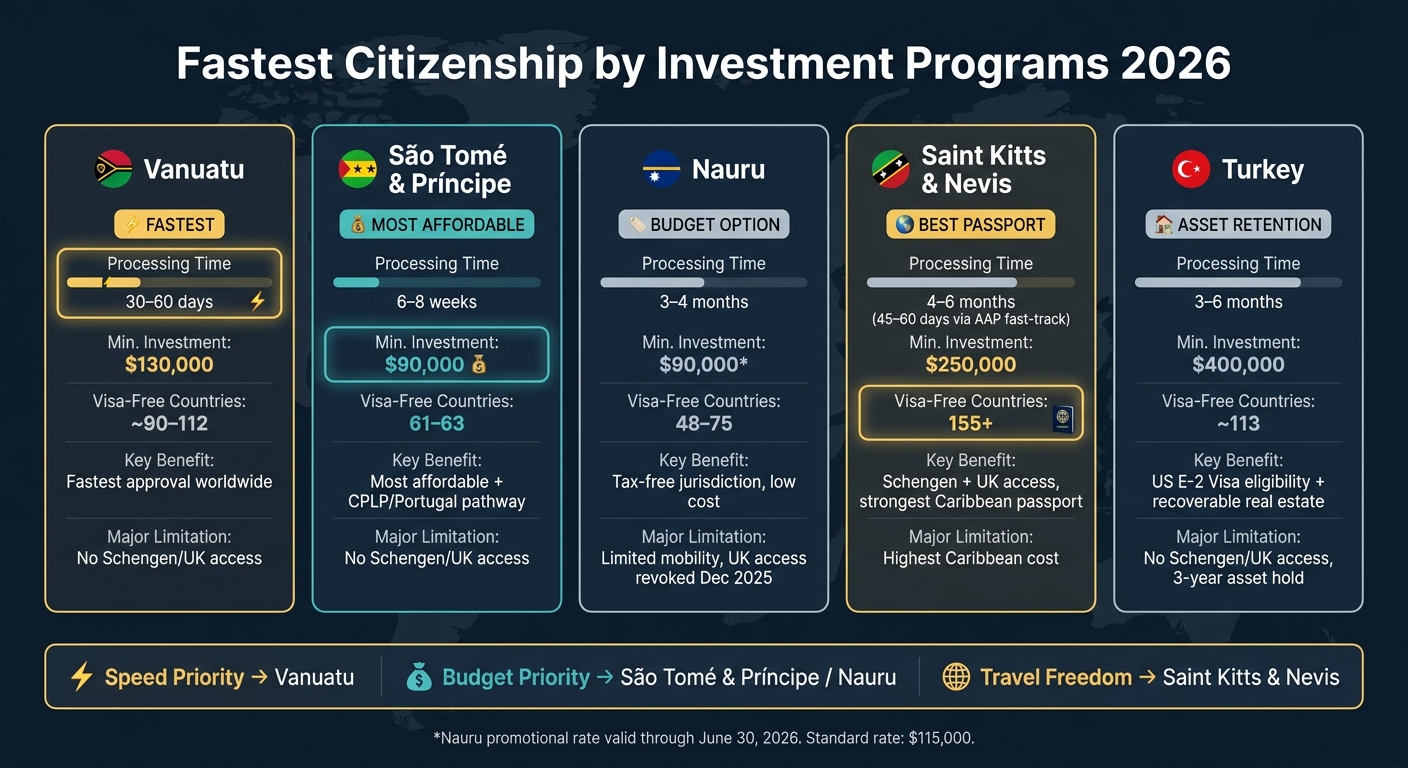
In 2026, Vanuatu remains the fastest citizenship by investment (CBI) program, with approvals typically granted within 30 to 60 days. This makes it the top choice for those prioritizing speed, ranking among the simplest citizenship programs available today. Other options, like São Tomé and Príncipe and Nauru, offer more affordable entry points starting at $90,000, but with slightly longer timelines of 2.5 to 4 months. Meanwhile, Saint Kitts and Nevis provides strong global mobility with its passport granting access to 155+ countries, though it comes at a higher cost of $250,000 and takes 3 to 6 months to process. For those interested in retaining assets, Turkey‘s real estate route starts at $400,000, offering a pathway to the U.S. E-2 Visa, but processing takes 3 to 6 months.
Quick Comparison
| Program | Processing Time | Min. Investment | Visa-Free Countries | Key Advantage | Major Limitation |
|---|---|---|---|---|---|
| Vanuatu | 30–60 days | $130,000 | ~90–112 | Fastest approval | No Schengen/UK access |
| São Tomé & Príncipe | 6–8 weeks | $90,000 | 61–63 | Affordable with CPLP pathway | Limited travel freedom |
| Nauru | 3–4 months | $90,000* | 48–75 | Low cost and tax-free jurisdiction | Limited mobility, no UK access |
| Saint Kitts & Nevis | 3–6 months | $250,000 | 155+ | Strong passport with Schengen/UK | High cost, donation required |
| Turkey | 3–6 months | $400,000 | ~113 | U.S. E-2 Visa eligibility | No Schengen/UK access |
*Promotional rate valid through June 30, 2026.
If speed is critical, Vanuatu is unmatched. For affordability, São Tomé and Príncipe and Nauru are worth considering. Saint Kitts and Nevis is ideal for travel freedom, while Turkey appeals to those seeking asset retention and U.S. access.
1. São Tomé and Príncipe
Launched in August 2025, São Tomé and Príncipe’s citizenship by investment (CBI) program has quickly gained attention for being one of the most affordable options worldwide. By 2026, it stands out not just for its cost but also for its streamlined and efficient processing times.
Processing Time
On average, applications are processed in about 2.5 months, with some approvals happening in as little as 4 weeks. Adam Juchniewicz, CEO of 21 CBI, highlights the importance of proper preparation:
"The 60-day marketing claim is the median of a distribution. The job of the advisory firm is to make sure your file lands on the median or below; not to outrun the regulator."
This efficiency has positioned São Tomé and Príncipe’s program as a strong competitor in the CBI market.
Minimum Investment
The program requires a relatively low financial commitment. Here’s a breakdown of the costs:
- Single applicant: US$90,000 contribution to the National Transformation Fund
- Family of two to four: US$95,000
- Additional dependents (beyond four): US$5,000 each
On top of these contributions, there are mandatory government fees of approximately US$5,750 per applicant. These cover due diligence, passport issuance, registration, and national ID costs.
Investment Options
Unlike some other CBI programs, São Tomé and Príncipe offers only one investment route: a non-refundable contribution to the National Transformation Fund. This fund supports national infrastructure and development projects. While real estate or bond investment options are not available, the program does accept cryptocurrency payments, though the final payment must be made in US dollars. As of April 2026, the entire application process, including biometric verification via video call, can be completed remotely.
Key Benefits
One notable feature of this program is its "approval-first" model, where the main investment is made only after receiving Approval in Principle. This reduces financial risk for applicants. Additionally, São Tomé and Príncipe citizens enjoy a preferential 7-year pathway to Portuguese (EU) citizenship, thanks to the country’s membership in the Community of Portuguese Language Countries. This is a shorter route compared to the standard 10 years. Eligible dependents include spouses, unmarried children up to age 30, and parents or grandparents aged 55 and older.
Potential Drawbacks
While the program has its advantages, there are some limitations to consider:
- The São Tomé and Príncipe passport provides visa-free or visa-on-arrival access to only 60–75 destinations, which is fewer than some Caribbean programs.
- It does not offer visa-free travel to key regions like the Schengen Area, the UK, the USA, or Canada.
- Being a relatively new program, it lacks a long-term track record, and international banks may apply stricter scrutiny to passport holders.
- As of April 2026, individuals holding three or more citizenships are no longer eligible to apply.
Despite these drawbacks, the program’s affordability and streamlined process make it an appealing option for those seeking a quick and cost-effective route to a second citizenship.
sbb-itb-39d39a6
2. Vanuatu
Vanuatu continues to be recognized as the world’s fastest Citizenship by Investment (CBI) program in 2026, thanks to its efficient government processing system.
Processing Time
The government processing time typically ranges between 30 and 60 days from submission to approval, with some cases being approved in less than three weeks. When factoring in document preparation (2–6 weeks) and the in-person biometric enrollment process, the total timeline is approximately 2–4 months. Biometric data must now be submitted in person at designated centers, including Port Vila, Dubai, Hong Kong, Nouméa, and Brussels. Once approved, passports are issued directly. These streamlined processes highlight why Vanuatu remains a competitive option for investors.
Minimum Investment
The program’s starting cost is $130,000 for a single applicant through the Development Support Program (DSP). For families, contributions rise to $180,000 for a family of four. Additional costs include a due diligence fee of $5,000 to $5,500 and a biometric enrollment fee of about $1,000 for the main applicant.
| Investment Route | Single Applicant | Family of 4 | Key Feature |
|---|---|---|---|
| DSP | $130,000 | $180,000 | Non-refundable donation |
| CIIP | $155,000 | $155,000–$180,000 | Includes $50,000 redeemable after 5 years |
| REO | $200,000+ | $200,000+ | Approved real estate investment |
Investment Options
The DSP remains the simplest route, requiring a non-refundable contribution to a government development fund. For those looking for a partially recoverable option, the Capital Investment Immigration Plan (CIIP) includes a $50,000 deposit in an agricultural fund, which is returned after five years – making it appealing to families. The Real Estate Option (REO) requires a minimum investment of $200,000 in approved projects, although it is less popular among applicants.
Key Benefits
Vanuatu offers a tax-friendly environment with no personal income, capital gains, inheritance, or wealth taxes. Aside from the biometric enrollment, the entire application process can be completed online. Applicants must also demonstrate a personal net worth of at least $250,000.
Potential Drawbacks
Since late 2024, the program has lost visa-free access to the EU Schengen Area, and as of August 2023, it no longer includes visa-free travel to the UK. As a result, the Vanuatu passport now allows visa-free or visa-on-arrival access to around 91–95 destinations, including Singapore, Hong Kong, and Russia, but it is no longer a viable option for easy travel to Europe or the UK.
The requirement for in-person biometric enrollment adds extra time and travel costs, which can range from $2,000 to $3,000 per person. Additionally, applicants with prior visa rejections for the UK, Schengen Area, or Singapore may encounter further difficulties. Citizens from Iran, Iraq, Syria, Yemen, and North Korea are generally excluded unless they can prove they have lived outside their home country for at least five years.
"The Vanuatu CBI is now best understood as a fast Plan-B mobility tool and a Pacific-region presence, not as a Europe-travel solution." – Sebastian Sauerborn, Tax and Relocation Expert
3. Nauru
Nauru, the smallest independent republic with a population of about 12,000, offers a lesser-known alternative for those seeking citizenship through investment. Its Economic and Climate Resilience Citizenship Program (ECRCP) is designed for investors looking for a quick and relatively affordable route. Since its launch, the program has remained low in demand, receiving just 20 applications in its first nine months through August 2025.
Processing Time
The citizenship process is straightforward and typically takes 3 to 4 months from start to finish. Here’s a general breakdown:
- Document Preparation: 2–4 weeks
- Due Diligence: 4–8 weeks
- Passport Issuance: By week 16
There are no residency requirements, and even the mandatory interview for the main applicant can be conducted remotely via a secure video platform.
Minimum Investment
Nauru’s program is particularly appealing due to its discounted rates under the Iruwa Initiative. Applications submitted before June 30, 2026, qualify for a 30% reduction, lowering the cost for a single applicant to $90,000 instead of the usual $115,000. Additional fees are applicable:
| Fee | Amount |
|---|---|
| Application Fee | $5,000 |
| Due Diligence Fee | $6,000 |
| Bank/Transaction Fee | $1,200–$2,200 |
| Passport Fee | $500 |
| Dependent Contribution (per person 16+) | $2,000 |
| Sibling Supplement | $15,000 per sibling |
Investment Options
The ECRCP provides a single investment pathway: a non-refundable contribution to the Nauru Treasury Fund. These funds are allocated to the "Higher Ground Initiative", a long-term project aimed at relocating Nauru’s population and infrastructure to safer, elevated areas to address rising sea levels.
Key Benefits
Nauru’s program stands out as the most affordable donation-based citizenship-by-investment (CBI) option, with its promotional pricing offering a 30% lower entry cost than Vanuatu’s program. It also accommodates an extensive range of dependents, including:
- Siblings (regardless of marital status)
- Children of any age
- Parents and grandparents, with no age restrictions
Dual citizenship is permitted, and Nauruan passports come with a 10-year validity.
"This program does bring a new affordability to the CBI field. Despite its relatively recent insertion, we were able to see that the Citizenship Unit is well organized and quite efficient." – Jean-François Harvey, Harvey Law Group
Potential Drawbacks
While the program has its advantages, there are some limitations to consider. Nauru’s passport allows visa-free or visa-on-arrival access to only about 85 to 90 destinations. Further, as of December 9, 2025, the United Kingdom has revoked visa-free access for Nauru nationals.
For applicants from restricted countries like Russia or Belarus, additional hurdles exist. They must prove they have not resided in these jurisdictions for the past five years and must hold residency in a major Western country. Additionally, direct applications are not permitted; submissions must go through an accredited agent licensed by Nauru’s National Processing Office (NPO).
4. Saint Kitts and Nevis
Saint Kitts and Nevis stands out in the Caribbean Citizenship by Investment (CBI) market, offering a combination of rapid processing and a passport with strong global access. It has a long history in the industry, being the pioneer of CBI programs since 1984, and remains a benchmark for others to follow.
Processing Time
The standard processing time for applications is between 4 to 6 months (120–180 days) from the date the Citizenship by Investment Unit (CIU) acknowledges the application. On average, approvals are granted in about 5.1 months, with a range of 3 to 8 months.
For those seeking faster results, Saint Kitts and Nevis offers an Accelerated Application Process (AAP). For an additional fee of $25,000 per applicant, the CIU aims to deliver decisions within 45 to 60 days. This makes it the fastest fast-track option in the Caribbean.
"The 45-day accelerated track is the fastest formally structured fast-lane processing option in the Caribbean CBI market." – Golden Visa Map
This blend of tradition and efficiency makes Saint Kitts and Nevis a top choice for investors who value speed and reliability.
Minimum Investment
The starting point for the program is the Sustainable Island State Contribution (SISC), a non-refundable donation of $250,000, which covers a main applicant and up to three dependents. Including additional fees, the total cost for a single applicant typically falls between $275,000 and $290,000.
| Cost Component | Amount |
|---|---|
| SISC Donation (single or family of 4) | $250,000 |
| Due Diligence Fee (main applicant) | $10,000 |
| Due Diligence Fee (dependent 16+) | $7,500 each |
| Application Processing Fee | $1,000 |
| Passport Issuance | $355 |
| Total Costs | $275,000 to $290,000 |
Investment Options
Beyond the SISC, there are three additional investment routes:
- Public Benefit Option (PBO): A $250,000 contribution to approved national infrastructure projects.
- Developer’s Real Estate Option: A minimum investment of $325,000 in an approved resort.
- Private Real Estate Option: Requires $325,000 for a condominium or $600,000 for a single-family home.
Both real estate options come with a 7-year holding period.
Key Benefits
The Saint Kitts and Nevis passport grants visa-free or visa-on-arrival access to 155–157 countries, making it the strongest passport among Caribbean CBI programs. It also retains access to the United Kingdom through the Electronic Travel Authorisation (ETA) system, a key advantage as other programs, like Dominica, lost UK access in 2023.
The program has no residency requirements and is flexible in including family members. Applicants can add spouses, children under 30, parents and grandparents aged 55 and older, and unmarried siblings under 30.
Potential Drawbacks
Saint Kitts and Nevis has the highest entry cost in the Caribbean and requires a long-term real estate commitment of 7 years. Another limitation is the absence of access to the US E-2 Investor Treaty, which is available only through Grenada among Caribbean programs.
Looking ahead, the CIU has announced plans to phase out donation-only pathways by 2026, replacing them with options that involve physical presence, business establishment, or long-term civic engagement. A mandatory biometric enrollment program will also be introduced, requiring all passports issued before April 14, 2026, to be updated by July 31, 2027, to remain valid for international travel.
5. Turkey
Turkey’s citizenship by investment program offers a distinct advantage: you retain your investment as a physical asset, unlike donation-based alternatives. Each investment option requires a three-year holding period, ensuring your investment remains untouched during that time. With streamlined procedures and versatile investment paths, Turkey aligns well with the fast-track programs discussed earlier.
Processing Time
The typical processing time ranges from 3 to 6 months after submitting a complete file. However, as of February 9, 2026, a new priority service in Istanbul enables same-day residence permit approval and immediate submission of citizenship applications. This expedited process can take less than three months from start to passport issuance. The fast-track service costs TRY 44,000 (around $1,000) for the main applicant and TRY 22,000 (about $500) per family member.
"An investor can fly into Istanbul in the morning, complete biometrics, visit a property we have arranged around lunchtime, and still be home for dinner." – CIP Turkey Representative
Minimum Investment
The real estate route offers the lowest entry point at $400,000, with a mandatory three-year holding period before resale. Other financial investment options start at $500,000. Additionally, there’s a 4% title deed transfer tax (approximately $16,000 on a $400,000 purchase) and extra legal and translation fees.
Investment Options
| Investment Route | Minimum Amount | Holding Period | Key Feature |
|---|---|---|---|
| Real Estate | $400,000 | 3 Years | Generates rental income |
| Bank Deposit | $500,000 | 3 Years | Liquid but subject to currency risk |
| Investment Fund (REIF/VCIF) | $500,000 | 3 Years | Professionally managed options |
| Government Bonds | $500,000 | 3 Years | Backed by sovereign debt security |
| Fixed Capital Investment | $500,000 | 3 Years | Ideal for entrepreneurs |
| Employment Creation | 50 Jobs | 3 Years | Requires hiring 50 Turkish employees |
Real estate remains the most popular choice. Properties in prime Istanbul locations have seen annual appreciation rates of 15% to 20%, with average gross rental yields of 7.32% as of Q1 2026.
"You’re not buying Turkish citizenship for $400,000. You’re buying a $400,000 asset that generates income and appreciates – and getting citizenship as a free lifetime bonus." – TruProperty Turkey
These flexible options, combined with quick processing, make Turkey’s program an appealing choice for investors looking to retain assets while gaining citizenship.
Key Benefits
Turkey offers full citizenship without requiring residency. A major perk is access to the US E-2 Treaty Investor Visa, allowing Turkish citizens to live and work in the United States – an advantage not typically available through Caribbean programs. Additionally, a fiscal reform introduced in 2026 provides new residents with a 20-year exemption from Turkish income tax on foreign-source earnings and capital gains.
"Turkey’s 20-year window [for tax exemption] is longer than any comparable program currently operating in Europe." – Uglobal Staff
Potential Drawbacks
Despite its advantages, Turkey’s program has some limitations. The Turkish passport grants visa-free or visa-on-arrival access to 114 countries, which is fewer than some Caribbean passports. It does not include access to the Schengen Area, the UK, or Canada. The three-year holding period is strict – selling your asset earlier would breach program rules. Family coverage is also limited to spouses and children under 18, excluding adult children and parents. Lastly, with the state-backed KKM currency protection for bank deposits ending in January 2026, the bank deposit route now involves significant currency risk due to Turkey’s history of high inflation.
Pros and Cons of Each Program
Here’s a quick comparison of the key advantages and drawbacks for each program, summarizing the details from the review:
| Program | Processing Time | Min. Investment | Visa-Free Countries | Key Benefit | Major Drawback |
|---|---|---|---|---|---|
| São Tomé & Príncipe | 6–8 weeks | $90,000 | 61–63 | Most affordable option with CPLP pathway to Portugal | No access to Schengen or the UK |
| Vanuatu | 30–60 days | $130,000 | ~90–112 | Quick government processing | Schengen and UK access no longer included |
| Nauru | 3–6 months | $90,000* | 48–75 | Low cost and tax-free jurisdiction | Limited mobility; UK access ends December 2025 |
| Saint Kitts & Nevis | 4–6 months (3–4 via AAP) | $250,000 | 155+ | Strong passport with Schengen and UK access | High donation cost; mandatory virtual interview |
| Turkey | 6–12 months | $400,000 | ~113 | US E-2 Visa eligibility with recoverable real estate | No Schengen or UK access; 3-year asset hold |
*Promotional rate for Nauru is valid through June 30, 2026. The standard rate is $115,000.
Each program has its own set of strengths and trade-offs, so your choice depends on your priorities. If you’re looking for speed and affordability, São Tomé & Príncipe and Vanuatu stand out as the fastest and least expensive options. However, their limited travel freedom may not suit everyone.
For those who value broader travel access, Saint Kitts & Nevis offers the strongest passport in the group, granting entry to over 155 countries, including the Schengen Area and the UK. This comes with a higher cost and longer processing time, but it’s ideal for travelers requiring extensive mobility.
If cost efficiency and tax benefits are your focus, Nauru provides a low-cost option, though its travel access is more restricted. Meanwhile, Turkey is the go-to choice if you’re interested in a recoverable real estate investment and a pathway to the U.S. through the E-2 Treaty Visa, despite its lack of Schengen and UK access.
Ultimately, the best program depends on your goals – whether it’s saving money, gaining quick approval, or maximizing travel freedom.
Conclusion
If speed is what matters most, Vanuatu takes the lead. Its Development Support Program typically secures government approval within 30 to 60 days, meaning the entire process can realistically wrap up in just 6 to 10 weeks. With a competitive $130,000 entry fee, it’s unmatched in terms of speed.
That said, every investor has different priorities. Some may prioritize travel freedom, cost, or market access over speed. For those seeking Schengen and UK access, Saint Kitts and Nevis, through its Accelerated Application Process (AAP), offers a strong combination of global mobility and a 3- to 4-month total timeline. If affordability is your focus, São Tomé and Príncipe and Nauru are the most budget-friendly options, starting at $90,000. Meanwhile, investors targeting U.S. market access should consider Turkey’s real estate route, which uniquely provides eligibility for the E-2 Treaty Visa.
It’s important to note that official processing times only reflect the government review period. The full timeline, including document preparation, apostilles, biometric enrollment, and passport delivery, is often longer. As Nagy Szabolcs of IMI Daily points out:
"The gap between what is advertised and what is delivered is widening."
FAQs
What steps usually slow down the “30–60 day” timeline?
The 30–60 day timeline usually pertains to the government’s processing period, starting from the submission of a complete application to the point of receiving approval. However, the process often takes longer due to delays before submission. For instance, applicants might spend 2–4 months collecting necessary documents, such as police clearances and evidence of their source of funds.
Even after approval, the journey isn’t necessarily over. Steps like oath-taking, biometric collection, or passport issuance can add more time, particularly for programs that involve multiple stages of administrative procedures.
Which program is best if I need Schengen or UK travel?
For those planning travel to Schengen countries or the UK, a Caribbean Citizenship by Investment program can be a smart choice. St. Kitts and Nevis stands out as the quickest option, with processing times of just 3–4 months. This citizenship grants visa-free access to Schengen countries and entry to the UK through an Electronic Travel Authorization (ETA). On the other hand, Antigua and Barbuda offers similar benefits but generally takes longer to process applications. It’s important to note that Vanuatu does not provide access to Schengen countries or the UK.
Can I include parents or adult children in these programs?
Yes, many citizenship by investment programs let you include family members, such as your spouse and dependent children. Some also allow you to add parents or grandparents, though the rules and costs differ depending on the country. For example, certain programs may require extra contributions for parents over 50 or children under 25. It’s essential to check the specific program’s guidelines to ensure your family members meet the requirements.
