
No, Mauritius does not offer direct citizenship by investment in 2026. Instead, the country provides investment-based residency options that can lead to citizenship through naturalization after several years. Here’s what you need to know:
- No Instant Citizenship: Unlike some countries, Mauritius doesn’t allow you to buy a passport directly.
- Golden Visa (2026): A new program requires a $1,000,000 investment for a renewable 2-year visa but doesn’t grant citizenship.
- Naturalization Pathway: Citizenship is possible after 5–7 years of continuous residency and meeting specific requirements.
- Residency Options: Investors can secure residency through occupation permits, permanent residence permits, or real estate investments.
Mauritius focuses on long-term residency rather than instant solutions, making it a destination for those ready to commit to a structured process. Read on for a detailed breakdown of the available pathways and investment requirements.
The Legal Framework: Citizenship and Investment in Mauritius
Citizenship, Residency, and Permanent Residency: Key Differences
When discussing investment opportunities in Mauritius, it’s essential to understand the distinctions between residence permits, permanent residency, and citizenship.
- A residence permit, such as an Occupation Permit, allows you to live and work in Mauritius for a set period. It’s renewable but doesn’t offer long-term security.
- Permanent Residency (PRP) provides more stability, offering a 20-year renewable permit that eliminates frequent renewals.
- Citizenship is the highest status, granting a Mauritian passport, full constitutional rights, and the added benefit of enhanced global mobility.
It’s crucial to note that only citizenship provides access to a Mauritian passport.
Does Mauritius Have a Direct Citizenship by Investment Program?
Given these distinctions, many investors wonder if Mauritius offers a direct citizenship-by-investment (CBI) program. The answer is no.
As of June 2026, Mauritius does not have a formal CBI program where individuals can pay a fee to obtain citizenship and a passport. A 2018 proposal for such a program requiring a $1,000,000 investment was never implemented.
Instead, Mauritius recently introduced the Golden Visa, approved by the Cabinet on April 10, 2026. This visa is not a citizenship product but a multiple-entry visa valid for two years, renewable upon reapplication. To qualify, applicants must commit to a $1,000,000 investment within 12 months of arrival. The program targets approximately 100 investors annually and focuses on five key sectors: fintech, artificial intelligence, biotechnology, renewable energy, and global treasury.
"Holders of golden visas will not automatically be entitled to enter our labour market, as they will be expected to invest in qualifying sectors." – Navinchandra Ramgoolam, Prime Minister of Mauritius
The Golden Visa serves as an entry point rather than a final destination. Visa holders can later apply for permits like the Occupation Permit or Retirement Residence Permit without leaving Mauritius.
How Residency Can Lead to Citizenship in Mauritius
For those aiming to attain citizenship, the journey requires years of commitment. Non-Commonwealth nationals must complete seven years of continuous residency, while Commonwealth citizens need five years. Additionally, applicants must demonstrate 12 uninterrupted months of residency immediately before submitting their application.
The final decision on citizenship lies with the Prime Minister, who has full discretion to approve or deny applications without providing justification. This makes the process less predictable compared to direct citizenship-by-investment models. Application costs include a 2,000 MUR fee (around $43), with an additional 50,000 MUR (approximately $1,092) payable upon approval.
For investors, understanding these pathways is critical when planning for secure, long-term offshore asset protection.
Here’s a quick comparison of the different statuses available:
| Status | Validity | Minimum Investment | Leads to Citizenship? |
|---|---|---|---|
| Occupation Permit | 10 years (renewable) | $50,000 | Yes, after 5–7 years residency |
| Permanent Residency (PRP) | 20 years (renewable) | $375,000 | Yes, after 5–7 years residency |
| Golden Visa | 2 years (renewable) | $1,000,000 | No (stepping stone only) |
| Citizenship | Lifetime | Naturalization only | N/A |
In Mauritius, citizenship is achieved through sustained residency rather than direct investment. This extended process highlights the importance of exploring residency-based investment options for those seeking long-term benefits.
sbb-itb-39d39a6
Investment-Based Residency Options in Mauritius
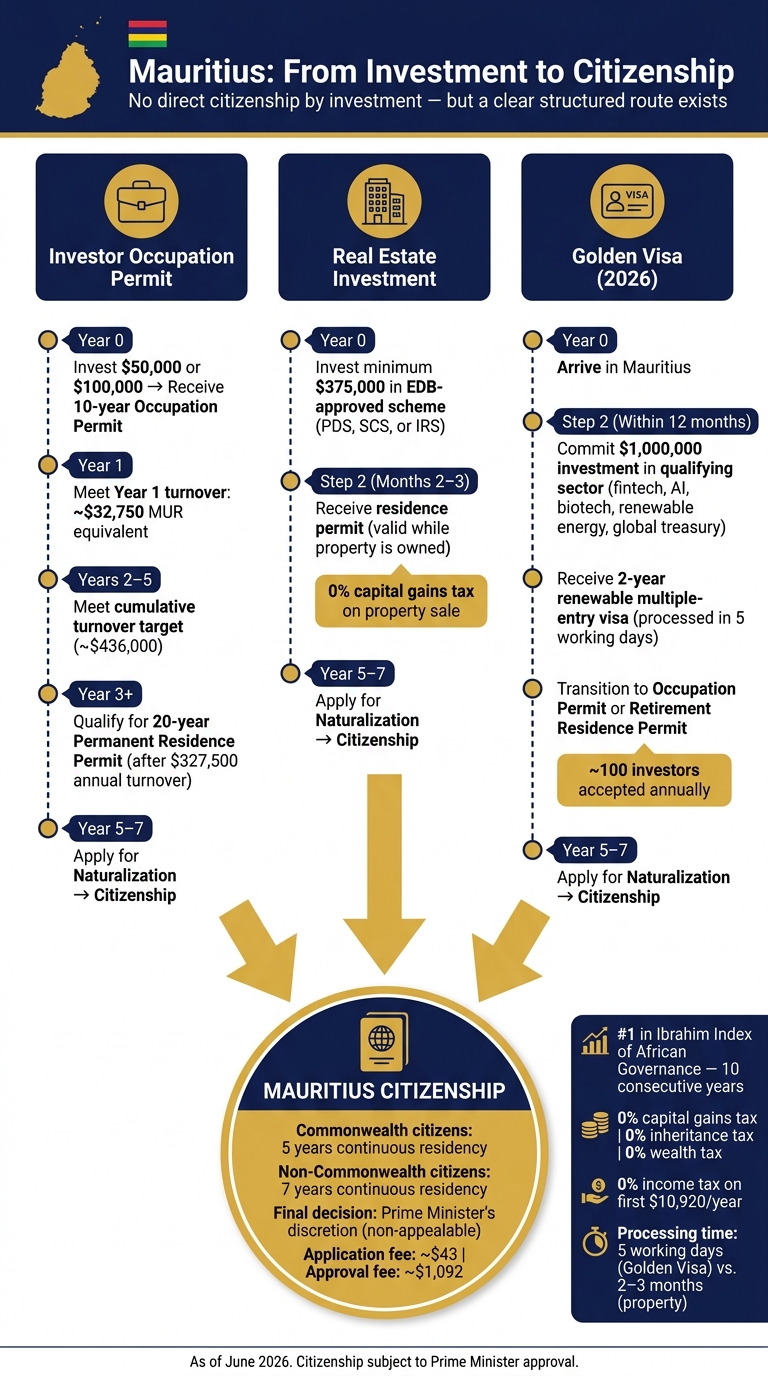
Mauritius doesn’t have a direct citizenship-by-investment program, but residency permits offer a practical route for investors, potentially leading to naturalization. Each type of permit comes with its own investment requirements, timelines, and advantages.
The Investor Occupation Permit
The Investor Occupation Permit (OP) is a combined work and residence permit, valid for 10 years and renewable. Investors can choose between two tiers – $50,000 or $100,000 – each linked to specific turnover requirements.
| Investment Tier | Year 1 Turnover Requirement | Years 2–5 Cumulative Turnover | Year 6+ Annual Turnover |
|---|---|---|---|
| $50,000 | ~1.5 million MUR (~$32,750) | ~20 million MUR (~$436,000) | ~5 million MUR (~$109,200) |
| $100,000 | ~1 million MUR (~$21,800) | ~15 million MUR (~$327,500) | ~5 million MUR (~$109,200) |
Applications are submitted online via the National Electronic Licensing System (NELS). Once approved in principle, you have 60 days to open a local bank account and transfer the required funds. The process also involves a $50 non-refundable application fee and a $1,000 statutory permit fee, payable upon approval.
After three years on the Investor OP, meeting the turnover target (an annual $327,500 or $982,700 total over three years) qualifies you for a 20-year Permanent Residence Permit (PRP). Alternatively, you can achieve immediate 20-year residency by investing $375,000 in eligible sectors like fintech, financial services, or green energy.
Residency Through Real Estate Investment
Property investment in an Economic Development Board (EDB)-approved development provides another direct path to residency. By investing a minimum of $375,000, foreign nationals can secure a residence permit that remains valid as long as they retain ownership of the property. Additionally, this permit allows holders to work and invest in Mauritius.
Approved property schemes include the Property Development Scheme (PDS), Smart City Scheme (SCS), and Integrated Resort Scheme (IRS). These projects range from luxury beachfront villas to mixed-use developments. A regulation introduced in December 2024 requires 85% of the purchase price to be paid in Mauritius rupees (MUR), with the remaining 15% payable in foreign currency. Buyers should also account for an extra 5% to 7% of the purchase price to cover notary fees, registration duties, and VAT.
Property values in these schemes are expected to grow by 5% to 10% in 2026, offering potential returns alongside the residency benefit. Moreover, Mauritius imposes 0% capital gains tax on property sales. This makes property investments a dual opportunity: securing residency and laying the groundwork for eventual citizenship.
Other Residency Pathways: Self-Employed, Retirement, and Professional Permits
Mauritius also offers additional residency options tailored to various profiles.
- Self-Employed Permit: For individuals managing their own businesses, this permit requires an initial transfer of $50,000 to a Mauritian bank account. It is valid for 10 years.
- Professional Permit: Geared toward expatriates working in Mauritius, this permit requires a minimum monthly basic salary of 30,000 MUR.
- Innovator Occupation Permit: Designed for research and development projects, this permit does not require a minimum investment, provided at least 20% of project expenses are allocated to R&D.
With continuous residency under any of these permits, investors can eventually qualify for naturalization in Mauritius.
Challenges and Considerations for Investors
Why Applications Get Denied
There are several common reasons why applications may be rejected. Often, it’s due to incomplete documentation, such as missing a police clearance certificate, or failing to meet the required turnover thresholds for renewing an Occupation Permit.
For real estate buyers, a specific compliance rule introduced in December 2024 adds another layer of complexity: 85% of the property purchase price must be paid in Mauritian rupees. This means you’ll need to transfer foreign currency to a local bank for conversion before proceeding with the payment.
Those pursuing naturalization face a unique requirement. Applicants must publish a notice of their citizenship application in two daily newspapers exactly one week before submitting their documents. Missing this deadline means starting the entire process over.
These hurdles highlight why understanding the process and timelines is so important.
How Long Does the Process Take?
Processing times vary depending on the path you choose, and being aware of these timelines is critical for effective planning. Property-based residency is one of the quickest options, typically taking 2 to 3 months to complete. Meanwhile, the new $1 million Golden Visa program aims for a processing time of just five working days.
| Process | Estimated Timeline |
|---|---|
| Residency by Property Investment | 2–3 months |
| Golden Visa (2026 Program) | 5 working days (processing goal) |
| Occupation Permit (two-step process) | Varies (online + in-person) |
| Permanent Residence Permit | After 3–5 years of holding initial permit |
| Citizenship Application Processing | 12+ months minimum |
| Naturalization Eligibility (Standard) | 7 years total |
| Naturalization Eligibility (Commonwealth citizens) | 5 years total |
For citizenship applications, the Prime Minister’s Office generally takes 3 to 6 months to process submissions. Once approved, the Certificate of Naturalization is usually issued within a month.
Documents and Requirements Checklist
Navigating the process successfully requires thorough and accurate documentation. For starters, any foreign documents, such as birth or marriage certificates, must be apostilled in your home country before submission. Additionally, medical certificates – issued by a Mauritian doctor – are required at certain stages and must be dated within six months of submission.
Citizenship forms also need to be signed in person by a Mauritian judge, District Magistrate, or the Master and Registrar of the Supreme Court, which means you’ll need to handle this step on the island.
Investors should pay close attention to their financial records throughout their residency. Transitioning from a 10-year Occupation Permit to a 20-year Permanent Residence Permit requires proof of cumulative turnover. For instance, investors need to demonstrate a turnover of 45 million MUR over three years. Missing or incomplete financial documentation can delay or even prevent permit renewals.
Another key consideration is the registration duty for property purchases by non-citizens. This rate doubles from 5% to 10% starting July 1, 2026. Closing a property deal before this date could save you a significant amount on transactions of $375,000 or more.
These challenges emphasize the importance of careful preparation and planning for investors aiming to secure long-term residency or citizenship in Mauritius.
Conclusion: Is Mauritius a Realistic Option for Investors?
Key Takeaways: Mauritius as a Long-Term Plan
Mauritius doesn’t offer direct citizenship-by-investment, but it does provide a clear and structured path from residency to citizenship. This pathway is supported by a stable financial system and a reputation for transparency, making it one of Africa’s most attractive destinations for investors.
The country has ranked first in the Ibrahim Index of African Governance for 10 consecutive years. Its tax policies are particularly appealing, with no capital gains tax, inheritance tax, or wealth tax, and a 0% tax rate on the first $10,920 of annual income. For those looking to preserve wealth over the long term, these factors add to the appeal of pursuing residency and eventual citizenship in Mauritius.
The process is straightforward: secure residency through a permit or the $1 million Golden Visa, maintain qualifying residency for five to seven years, and then apply for naturalization. While not an instant solution, it’s a viable option for those ready to commit to a long-term plan.
Next Steps for Investors
Start by applying for the Premium Visa, which costs about Rs 1,500 (US$33), to get a feel for the island before making a major investment. Afterward, select an investment route that aligns with your goals. For real estate investors, ensure the property is part of an approved government scheme like PDS, IRS, or Smart City. Business investors need to focus on meeting turnover targets early, as these are critical for permit renewals and transitioning to a 20-year Permanent Residence Permit.
It’s also crucial to note that the Prime Minister’s decision on citizenship applications is final and non-appealable, so thorough and accurate documentation throughout the residency period is essential.
The evolving opportunities in Mauritius have caught the attention of industry leaders:
"Mauritius is quietly redefining itself – not merely as a destination, but as a platform for global wealth, investment, and mobility." – Ray de Bono, IMGlobal Wealth
FAQs
Can the $1,000,000 Golden Visa ever turn into citizenship?
The $1,000,000 Golden Visa doesn’t offer a direct path to citizenship. According to Mauritian law, individuals can apply for citizenship only after seven years of continuous residence (or five years for those from Commonwealth countries). Although the visa itself is valid for two years and can be renewed, holders would need to switch to other residency permits to meet the continuous residence requirement needed for naturalization.
What counts as “continuous residency” for naturalization in Mauritius?
For non-Commonwealth citizens, continuous residency requires living in Mauritius for 12 straight months before applying, along with at least five years of total residence within the last seven years. Investors who have put in $500,000 or more must complete at least two consecutive years of residency before they can apply. Commonwealth citizens generally need five uninterrupted years, although the Minister may approve a shorter period – no less than 12 months – in exceptional situations.
What are the easiest ways to avoid residency or citizenship application delays?
To keep your Mauritius residency or citizenship application on track, submit everything through the official National Electronic Licensing System (NELS). This platform ensures smoother processing, but it’s crucial to double-check that all your documents are accurate and complete.
If you’re applying for a Professional Occupation Permit, let your employer take charge of the process – they’re usually the ones responsible for handling it. For those pursuing residency under the Golden Visa scheme, make sure to use the Economic Development Board (EDB) portal. This system is designed for faster processing and can save you time.
Lastly, stay compliant with financial rules, such as the 85% local currency payment requirement, to avoid unnecessary complications.
Related Blog Posts
- Investment Immigration for High Net Worth Individuals: 10 Premium Programs Worth the Price Tag
- Second Citizenships Without Donations: 5 Programs Where You Keep Your Investment
- Portugal Golden Visa 2026: What Changed and Is It Still Worth the Investment?
- Back-Pocket Residency Permits in Europe: Your Plan B for an Uncertain World
